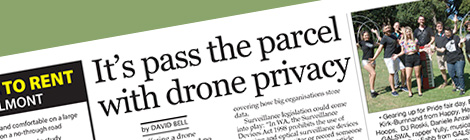
ANYONE suffering a drone buzzing overhead has almost no legal recourse, with rules hazy and enforcement near impossible.
Last week we reported Bayswater councillor Chris Cornish had endured a drone hovering near his backyard swimming pool for three days straight, putting a dampener on swimming plans.
But it’s a game of pass the buck when it comes to figuring out who can help.
Industry body Australian Certified UAV Operators Inc says anyone worried about drones in regards to, “breaches of privacy… or other suspicious activity.. should notify the local police immediately”.
But police media officer Sarah Dyer says, “drones are an issue for the civil aviation safety authority (CASA)”.
CASA didn’t call us back but they generally cover aviation safety (eg, drones too close to airports) rather than privacy. In January 2015 CASA fined an operator $850 for a slew of offences including flying his drone too high, too close to an airport, at night, over populated areas and within 30m of people.
But the only way they discovered the offences was because the pilot uploaded his footage to YouTube and a CASA staffer spotted it online.
While there’s confusion over who’s responsible for errant drones, figuring out which laws might have been broken is also hazy.
West Perth law firm HHG Legal Group published a think-piece in August last year trying to tackle the legal side of things after, “growing concerns in the community about privacy breaches involving remotely piloted aircrafts”.
The article says the Commonwealth Privacy Act, despite the title, has little relevance for nosy drones, mostly just covering how big organisations store data.
Surveillance legislation could come into play: “In WA, the Surveillance Devices Act 1998 prohibits the use of listening and optical surveillance devices by a person to monitor or record someone engaged in private activity,” the article states.
“Although this statute was introduced to, among other things, provide protection from child abuse and voyeurism, it may nonetheless provide some protection against invasive RPA use.”
In WA there are exceptions if the person using the drone is doing it for lawful reasons and they happen to inadvertently spot you in your bikini in the backyard.
“As a result, a person cannot be penalised for the operation of an RPA resulting in the unintentional monitoring or recording of a private activity.”
Even if the Surveillance Devices Act 1998 applies, enforcement is also near-impossible.
Cr Cornish pointed out that someone could be sitting three blocks away and flying their drone remotely, relying on the onboard cameras to navigate and making the pilot near-impossible to locate.
Governments overseas are employing drastic measures to take down rogue drones.
Japanese police equip their own drones with large nets while Dutch police are training eagles to swoop and destroy.
Meanwhile, in the US a research institute is working on a weapon that disrupts radio waves, interrupting pilot control and downing drones from as far as 400m. An ammunition company has a less elegant but equally effective solution: 12-gauge, #2 steel ferromagnetic shotgun shells sold in boxes of 25 to bring down drones “spying on unsuspecting neighbours”. Yeehaw.
by DAVID BELL

 Perth Voice Interactive
Leave a comment