WHEN Mt Lawley’s Laila Shalimar became interested in vintage fashion and culture, there was one hitch; all the role models were white.
“It was really hard being someone who was brown to relate to American and English and Australian actors,” says Ms Shalimar, who grew up in Pakistan near the border of Afghanistan.
“I didn’t look like them, so it was hard to picture myself as a Marilyn Monroe or an Audrey Hepburn.”
When Ms Shalimar arrived in WA as a 16 year old she says she was seen as “that weird foreign kid”.
Trying to fit in, she stumbled into the vintage lifestyle when a teacher who was obsessed with old movies started up a club to screen the classics.
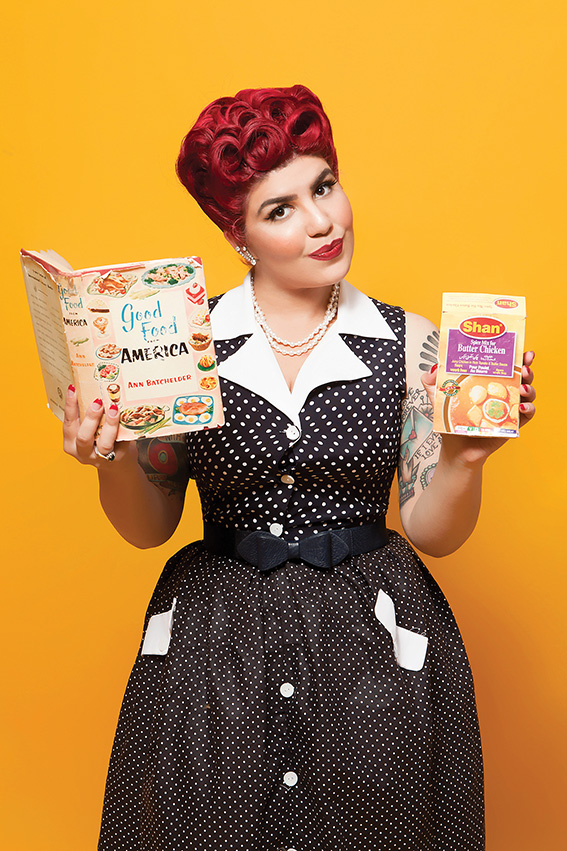
“I thought it’d be a great way to meet people,” she says, but “sadly enough it was just me and her and one other person.”
But the subculture stuck with her.
”It gave me an identity when I moved to Australia,” she says. “It gave me something to relate to people with.”
Modest and fashionable
It was also a good compromise for a young girl caught between two hemispheres: “My parents are quite conservative, so the 50s stuff is a middle ground: It allowed me to be modest and fashionable.”
Now studying criminology and counterterrorism, a bit over a decade later Ms Shalimar has been selected to compete in the Miss Pinup Australia semi finals in Melbourne, a big deal in the vintage glamour world.
Being a Muslim competing in a beauty pageant has drawn a few raised eyebrows (especially as she’s in the “illustrated”, or tattooed section), but she finds it reductive when people try to define her simply by her religion.
She says they also jump to conclusions when they hear her father, a Pashtun originally from Afghanistan, isn’t keen on her participating in the pageant.
“It’s not because he’s a Muslim man, it’s because he raised me a feminist and he thinks a beauty contest is a waste of time,” she laughs.
Ms Shalimar says she thinks her mother’s progressive outlook has rubbed off on her father.
Her mother was a medical student while Pakistan became increasingly Islamicised, and was at the forefront of protests against the restrictions being imposed on women.
With fellow students she burned her chador (the garb that covers everything but the face) that clerics were trying to force on them, arguing it was too restrictive to practice medicine in.
Ms Shalimar says despite her father’s misgivings, Miss Pinup Australia is more than a shallow looks-fest.
“He’s still convinced it’s just a beauty contest, but I’ve seen it do amazing things for people’s lives.

Confidence boost
“I’ve seen great things come out of it. It’s given me that little bit more of a confidence boost, so I can be really pretty and still be terrifying!”
For the talent portion she’s drawing on the four languages she speaks—Urdu, Pashtun, a mild amount of Punjabi, and English—to compose a poem with each stanza in a different tongue.
The contest also looks at charity work and social media conduct in the leadup, and while some in the vintage community are wary of new tech, the internet’s been valuable to connect with other like-minded people.
“There’s beauty standards anyway for women, and when you’re a brown woman it’s so hard to like yourself,” she says, but since regularly chronicling her fashion photos and vintage activities she’s been getting great feedback.
“I’ve had women from all around the world saying ‘I didn’t even know you could be a pin up and brown, I want do do this! I’ve had a great response from people.”
She’s also mining her heritage for her performance at the event, researching the history of the region’s fashion and culture around the 1947 partition that created India and Pakistan.
“I knew I didn’t just want to do a run of the mill story, I want to do something that speaks about me, and how my 40s and 50s would have been like.
“I didn’t know much about my country in the 40s and 50s… I don’t really have any grandparents left, and my aunties and uncles don’t want to talk about what happened during partition.”
She reached out to other people from that part of the world, “but everyone came back with the same story: It’s too painful to talk about, it was a very painful time. For us it was a separation of two peoples. A lot of families were lost and a lot of culture was lost, and a divide was created. So that’s why people don’t like to talk about it.”
What she’s finding blows apart stereotypes of drab, dour dress from that era. “My grandmother used to wear the Mughal style: They’d wear really beautiful, ornate, almost 50s dresses with tight pants. They were really beautiful but quite conservative.”
And with a history of British colonisation, the English women still living there would bring in copies of the Women’s Journal, whose western 50s dress patterns would be sewn together with traditional sari materials.
“I want to clear up any misconceptions about what my country was like in the 40s and 50s, about beauty standards, and what south east Asian women are like.”
She’s off to the Miss Pinup semi finals in Melbourne on June 18. Keep track of her vintage journey she’s Laila Shalimar on Facebook or midcentury_mermaid on instagram.
by DAVID BELL
 Perth Voice Interactive
Leave a comment