
A LENGTHY piece of improvised music about imaginary letters sent back in time to a composer in the 18th century sounds like something off a prog-rock album by Rick Wakeman.
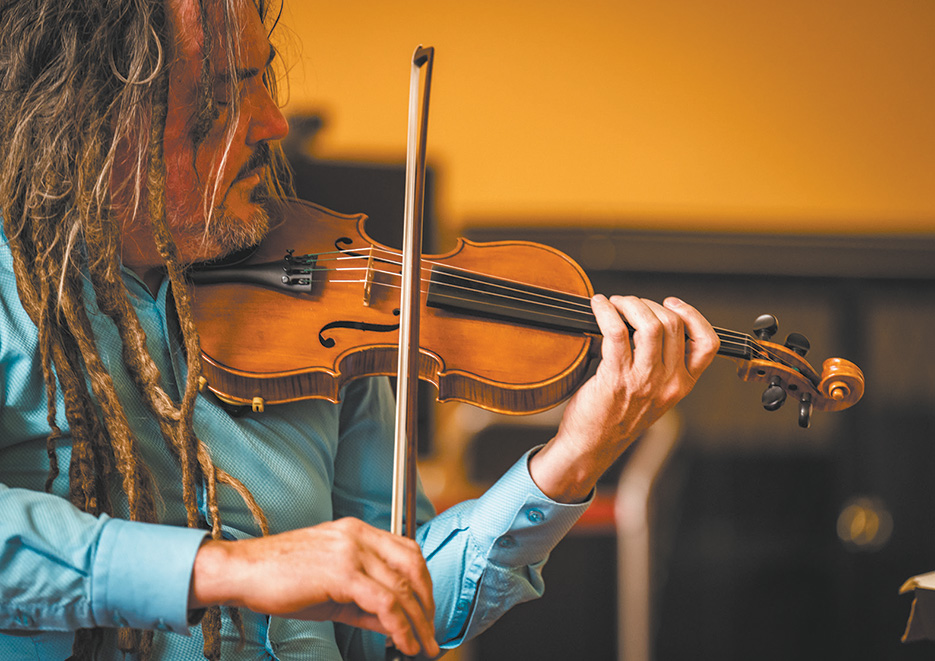
But it’s actually a new classical sonata, New Letters To Esterhazy, improvised by Perth-based composer-violinist Rupert Guenther, who happens to have a cool set of dreadlocks.
He’s part of a new wave of classical musicians who are ditching traditional music scores in favour of improvisation and creative flights of fancy.
Commissioned by ABC Classical FM, New Letters To Esterhazy was based on imaginary letters Guenther wrote to Austrian composer Joseph Haydn in the 18th century Austro-Hungarian court of Esterhazy.
The sonata is a bitter-sweet piece that has moments of great elation and hope as well as profound sadness and despair.
“When ABC Classic FM commissioned and then recorded the works, they could hardly believe what they were hearing – it was classical music, but all improvised out of thin air,” Guenther says. “There were no second takes or over-dubs or corrections, they weren’t needed – the whole story of the sonatas stood complete. The album is a gorgeous record of an artist at their work.”
Guenther is set to premiere the new work at Government House in Perth on the first date of his Australian tour.
“The great intimacy of the music in New Letters To Esterhazy is especially poignant for me, having lived and studied in Austria, and played concerts in the same concert room Haydn gave his performances in at what was once the Austro-Hungarian Court of Esterhazy,” he says.
“It is the special feeling of these historic places, the physical presence of earlier times in the cobbled streets and old buildings, and the way of making music full of nuance which has rubbed off on me in my music during my earlier time living and performing in Europe.”
The concert will finish with three new short contemplative works – Hakone Maple drawing on the ancient tradition of Japanese shakuhachi flute music, So Many Stars an Arabic-influenced composition, and Wandjina a short work about the mythological Wandjina and its relationship with Australia’s ancient culture and desert landscape.
Trained as a virtuoso concert violinist in Vienna, Guenther has 25 albums under his belt and has performed improvised music – inspired by nature and the cosmos – at famous venues around the world including Tate Britain, Docklands Museum and the National Gallery of Victoria.
Formerly a member of the Vienna Chamber Opera, he has been sideman to the stars including late Beatles producer Sir George Martin, Olivia-Newton John, Demis Roussos, John Farnham, Anthony Warlow and Hollywood singer-songwriter Lisbeth Scott.
New Letters To Esterhazy was one of five albums of the artist’s improvisations commissioned and recorded by ABC Classic FM.
“The art of classical improvisation might seem new or unknown in some people’s minds, but back in those times it was very much a normal way of making music which sat easily alongside the composed scores,” Guenther says. “It has become a lost art until now, but in reality what I am doing is no different from a painter who is painting his pictures, giving life to his own thoughts and inspirations onto a blank canvas.”
Guenther will perform New Letters To Esterhazy at Government House on Friday June 30 7pm. Tix on Ticketek (search for “New Letters To Esterhazy”)
by STEPHEN POLLOCK
 Perth Voice Interactive
Leave a comment