
TURTLE tracking volunteers are needed for a project to save the snake-necked turtles in the Maylands and Bayswater wetlands.
The south-western snake-necked turtle lives in patches like the Eric Singleton Bird Sanctuary, Maylands Lakes and Baigup Wetlands, but the population is in decline.
Anthony Santoro from Murdoch university researches the threats facing the turtles.
“There’s a multitude of threats,” Dr Santoro says. “Urbanisation is one of them: Infill, building, habitat degradation. Turtles live in the water, so if you fill a wetland in, you’ve just deleted that population of turtles.”
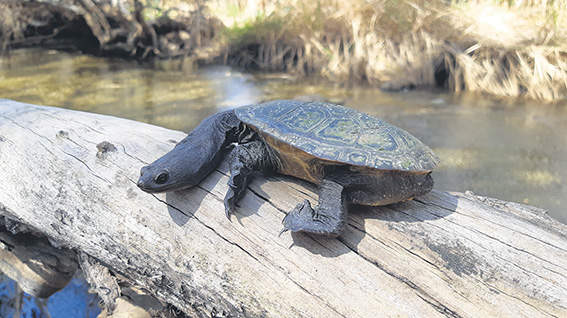
Another threat stems from turtle reproduction habits: “They nest on land. They come out of the water and travel sometimes up to a kilometre from water to lay their eggs.
“So what we’ve done is removed the habitat they need for nesting, and replaced it with housing, lawns, and roads, and it’s making it really hard for them to find suitable places to lay their eggs.”
Those trips also make them more vulnerable to introduced species like foxes, cats, and dogs, and even some native predators like the raven. Ravens adapted well to urbanisation: Their numbers boomed and they now have an easier time spotting a turtle crossing a road, lawn, or a block where the undergrowth has been cleared.

Researchers are working on ways to help turtle populations survive in the city – a recent promising study by Dr Santoro looked at how to make road underpasses more attractive to turtles so they don’t die on roads – but not much is known about their movements.
Murdoch University has now teamed up with the South West Metropolitan Alliance for the “Save our Snake-necked Turtle” project to gather that data with the aid of ‘citizen scientists’ – volunteers keen to help track and tag turtles.
It’s a two-prong approach; first through the TurtleSAT app where people can upload information and photos of turtle sightings. Sightings of live adults, hatchlings, and especially dead turtles can help paint a picture of where interventions are needed.

The second more intensive program is recruiting volunteers to undergo training to patrol these wetlands and ethically monitor the turtles more closely.
“They’ll patrol around the lakes during the nesting season looking for the females, then when they find a female they’ll follow them from a distance so as to not disturb them, help them if a raven tries to attack them, and eventually they’ll nest, and then we’ll protect that nest,” Dr Santoro says.
The lack of juvenile turtles is one of the biggest bottlenecks in the population, and the death of one breeding-age female is devastating to their numbers.
“If you take out one female, you’re taking out decades of nests and reproduction,” Dr Santoro says.
Bayswater council is hosting training nights in August for teams to patrol Eric Singleton Bird Sanctuary, Maylands Lakes, and Baigup Wetlands, email sosnt@murdoch.edu.au if you’re keen.
by DAVID BELL
 Perth Voice Interactive
Leave a comment