AS the FIFA Women’s World Cup kicks off this week, our peek into the past from the City of Vincent Local History Centre features part one of a two-part series delving into the history of women’s soccer.
WHILE football, the Australian Rules kind, remains the most popular spectator sport in Australia, the most played club sport in Australia with more than a million participants is soccer.
The excitement and anticipation of watching women soccer players performing at the highest level on our shores is a far cry from the origins of women soccer in Australia.
The earliest reports of women’s soccer being played in Australia date back to the 1920s.
During this time, Western Australian newspapers carried reports of ‘ladies’ soccer/football’ demonstration matches being played to large crowds in Brisbane and Sydney.
In 1921, The West Australian reported a record crowd of 10,000 people watched a ‘ladies’ soccer football match’ between North Brisbane and South Brisbane.
While we have yet to discover any games of the same scale in Perth, there is a report of women’s soccer being played in Western Australia in the late 1920s in a most unexpected place.
In 1927, local newspapers reported “a ladies’ soccer club was out in full play” in the Eastern Wheatbelt town of Lake Grace (The Wagin and Arthur, Dumbleyung, Lake Grace Express, Thursday, 12 May 1927).
The same paper also reported on a fundraising game to raise money for the local hospital put on by the Lake Grace Girls Soccer Club:
“What will the boys say when the girls give them a gruelling? But that will be nothing to what our grandmothers would have said if they saw the ‘modern girl’ rushing the football fields in striped guernseys and shorts.” (Lake Grace Express, 21 April 1927).
During the 1930s and 1940s, women’s involvement in the development of soccer in Western Australia was less about playing and more about support with Ladies’ Committees helping to organise wind-ups, social events and fundraising for soccer clubs across the state.
Women soccer players didn’t receive a mention in local newspapers again until after World War II.
In August 1946, women played a demonstration game at the Margaret River Soccer Carnival in which the Rosa Brook team defeated ‘the Margaret’.
Reflecting the prevailing attitudes towards women playing what was then seen as a men’s game, the South-Western News reported: “The ladies battled royally in a style all their own for 60 minutes. Many were the cheers and laughs as the girls imitated the tricks of their men friends, and advice from the side-line was varied and not always helpful. It was particularly noticeable that the girls had an aversion to using their heads, and when one was brave enough to try it, her attitude made it appear that the whole sky had hit her.” (The South-Western News, 22 August 1946)
Women’s soccer was still seen as a novelty when women’s soccer came to North Perth.
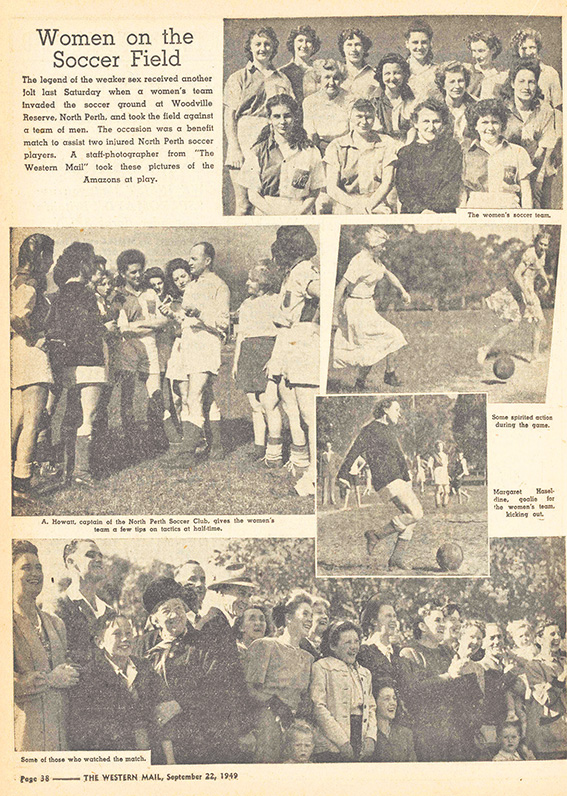
Local team, ‘the Amazons’, played the North Perth men’s soccer team at Woodville Reserve on 17 September 1949.
The game was not a regular fixture, but a fundraising match to help two injured players in the North Perth men’s team.
The Western Mail reported:
“The legend of the weaker sex received another jolt last Saturday when a women’s team invaded the soccer ground at Woodville Reserve, North Perth, and took the field against a team of men.”
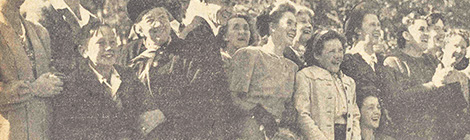
No score was recorded but the newspaper photographers were out in force recording the players and spectators at the popular event.
It is unclear whether the Amazons played any regular or demonstration soccer matches again.
Women’s soccer in WA temporarily disappeared off the radar until the late 1950s when women’s teams took to the pitch at Dorrien Gardens, the focus of next week’s story.
If you have any information about the long-lost team of North Perth Amazons or have any other information about the early days of women’s soccer, get in touch with the City of Vincent Local History Centre.
 Perth Voice Interactive
Leave a comment