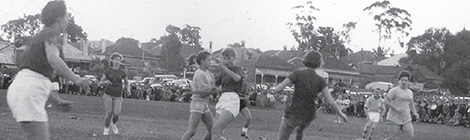
IN part two of a look back at the history of women’s soccer, the City of Vincent Local History Centre brings us the story of the post-war boom in soccer, culminating in the sport being played at the highest level at this month’s Women’s World Cup matches.
IN the 1950s and 1960s, soccer flourished with the post-war influx of migrants and refugees from the United Kingdom as well as Italy, Greece, Macedonia, the Netherlands, Poland and other soccer-loving Southern and Eastern European countries.
Italian teams included the Azzurri (the Blues) based at Dorrien Gardens, which was affiliated with the WA Italian Club, and the Julia team based in Welshpool which was affiliated with the Club Fiumano e Giuliano representing Italian migrants, refugees from North-Eastern Italy and the former Yugoslavia (now Croatia).
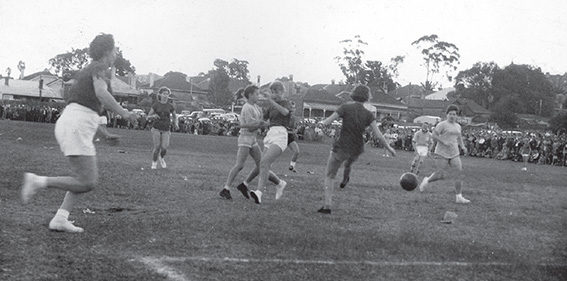
For a short period from 1958 to 1963, Azzurri and Julia both fielded women’s soccer teams who played one another in a regular series of charity matches at Dorrien Gardens to raise funds for what was then called the Spastic Welfare Association of WA (now Ability WA).
Luciana Birighitti (nee Alfieri) was a teenager when she joined the Azzurri ladies’ soccer team which was coached by her father Potito Alfieri, a former Italian soccer player who also coached the men’s Azzurri team in the 1950s.
Birighitti recalled the novelty of the competition for spectators and the excitement of the matches for the players: “We raised money. They went around collecting money while the game was on. The first time we played they had 3000 people. It was absolutely chockers because an Italian singer (Claudio Villa) was supposed to make an appearance. He never showed up, but we still made some money. We also went down to Bunbury once and played an exhibition match. It was mostly for fun more than anything… I loved soccer. I wish I was playing now. But it wasn’t a thing in those days. I can’t wait for this women’s World Cup to start!”
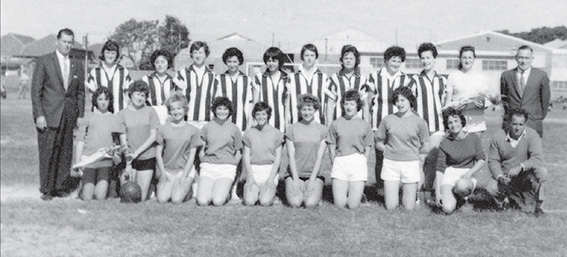
While women’s soccer may have continued in the 1960s, there is no official record of further games until the early 1970s when the Azzurri women’s team played Graylands as the curtain-raiser at Subiaco Oval before the WA state team took on the visiting Moscow Dynamos in a friendly match in February 1971.
Shortly after in May 1971, the first official women’s soccer game between Ascot and Olympic took place at the Lake Monger Velodrome (now Litis Stadium).
The pitch at Litis Stadium was to become a focal point for the development of women’s soccer in Western Australia in the 1970s and 1980s.
Focal point
As former WA state player turned media commentator Penny Tanner Hoath documented in her history of women’s soccer in WA, the Lake Monger Velodrome was home to the fledgling WA Girls Soccer Association which began with six metro clubs in 1972.
The league grew quickly and by 1973, it included 500 players and 14 country teams, mostly from the South West districts.
The association, later renamed the Women’s Soccer Association of WA, had its headquarters under the former grandstand at the Lake Monger Velodrome where it was co-located with the breakaway Soccer Federation of WA offices.
By the late 1970s, WA had hosted the national championships at Lake Monger, the women’s league had expanded to three divisions and the WA women’s state team toured Asia playing matches in Malaysia and Singapore.
During this period, talented local players including Anna Senjuschenko and Sandra Brentnall made the national squad and represented Australia in international tournaments.
The Azzurri women entered the local Perth leagues on a regular basis in the mid-1990s and currently compete in the National Premier League.
Western Australian representative side Perth Glory competes in the A-League Women competition.
Matildas captain Sam Kerr (Fremantle) and goalkeeper Lydia Williams (Katanning) are the two most recognised Western Australian players in their team.
From its early tentative origins, women’s soccer has grown exponentially throughout Western Australia.
Given the early ties to the game in the Vincent area, it is fitting that five women’s world cup matches are being held in Vincent at the Perth Rectangular Stadium (HBF Park) from 22 July to 3 August.
Fans can also watch teams training held at Dorrien Gardens.
If you’d like to learn more about women’s soccer in WA, visit the Women’s Soccer WA Project website coordinated by Penny Tanner Hoath at womensoccer.com.au
More great soccer photos are available through the City of Vincent Local History Collection at https://cityofvincent.imagegallery.me/.

 Perth Voice Interactive
Leave a comment