
IN this week’s Speaker’s Corner we hear from environmental scientist MARY GRAY, who was awarded an OAM in 2022 for her tireless conservation work. Here she writes of a new “CCC” – the Climate Crisis Christmas, marked by hotter summers, fires and floods, and gifts us with some practical local measures to turn the tide.
WITH bushfires now burning in outer Perth suburbs, and the unprecedented rainfall events with flooding in and beyond Cairns in Queensland, we will unfortunately be celebrating a ‘Climate Crisis Christmas’. Some may say yet another ‘CCC’.
Dr Carolyn Orr’s article in last week’s Perth Voice clearly explained the reality of climate change extreme events of oil and gas driven heat waves, bushfires, droughts and flooding, and the need to phase out fossil fuels and replace them with renewable energy.
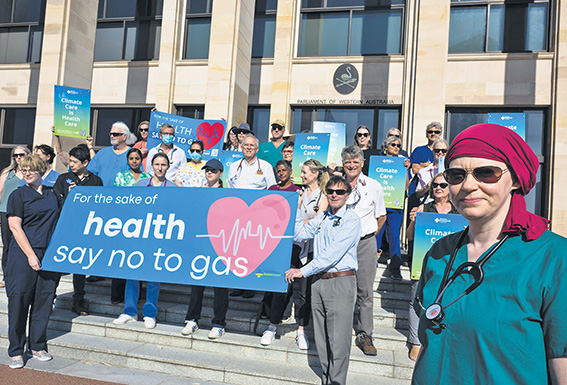
The Doctors for the Environment’s call for the WA government to end all new oil and especially new gas projects in WA is strongly supported. We all need to speak up for this in the public interest.
The existing WA gas industry already causes huge greenhouse gas emissions.
WA is the only State with emissions increasing.
As recently explained by The Australia Institute’s principal advisor Mark Ogge, Woodside’s proposed Burrup Hub expansion alone would add more than 100
million tonnes of greenhouse gas emissions annually, the equivalent of 15 new coal power stations.
And there are other new gas projects under development which will double the existing emissions from exports.
At the local government level, action on climate change is also essential.
With some new councillors and a new mayor in the City of Vincent, there is hope that there could be, and indeed will be, more action to address climate change issues.
In the State of Victoria, new buildings and extensions are now not allowed to have gas connected.
So this is a role model for the City of Vincent which could similarly require no gas in new buildings and in renovations.
Further, there could be local government incentives introduced to support ‘gas free streets’, as many householders have only one gas appliance, usually being a gas cooktop.
These can be replaced with electric cooktops.
Notably gas cooktops and other indoor gas appliances also produce air pollution emissions which have health impacts.
Solar
Gas hot water heaters can easily be replaced by solar hot water heaters with electric boosters. Encouraging more roof top solar panels is also needed.
Once over the initial capital cost of these units, electricity produced on roof tops is free, and the health impacts of emissions from gas appliances are removed.
As individuals, we can all act in this way to remove our gas appliances, and reduce our electricity costs while reducing our emissions.
 Perth Voice Interactive
Leave a comment