A SCIENTIST at the cutting edge of the global fight against the polyphagous shot-hole borer says there’s little hope of halting the invasion with current treatments being trialled.
Francois Roets is a professor in the department of Conservation Ecology and Entomology at Stellanbosch University in South Africa.
The invasive borer was first discovered in South Africa in 2017, where it has been preying on many of the same tree species as those being lost in Perth, including London planes, oaks, and maples.
Originally from south-east Asia, it tunnels into trees and cultivates fungus for food, and the fungus eventually blocks the tree’s flow of nutrients. Many trees die, and dead trees become especially potent launchpads for further spread.
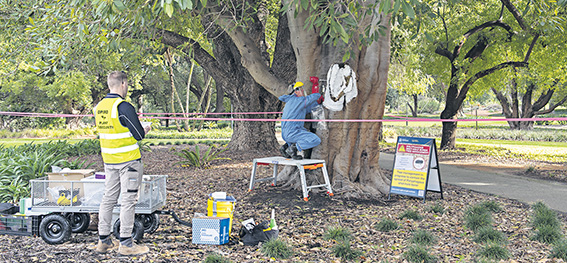
A range of treatments have been tried in California and South Africa, testing a variety of trees and finding low-to-middling results.
Professor Roets recently co-authored a paper in the Journal of Plant Pathology that trialled four of the more promising chemical treatments on liquid amber trees, which is one of the species susceptible to becoming a reproductive host and spreading the infection.
Two types of chemicals were sprayed on trunks, and two types were injected.
“Unfortunately, there is not much one can do it seems,” Prof Roets tells us via email.
The beetles repeatedly attack a target tree, sometimes making many failed attempts before a colony gets established.
“On this tree species, one can reduce infestations a bit, and buy some time, but cannot get rid of the problem,” he says.
One of the injected chemicals they trialled, emamectin benzoate, is the same substance being used in a test in Hyde Park conducted by the WA Department of Primary Industries and Regional Development. Emamectin benzoate has been used to treat food crops in Australia and is considered safe by the Australian Pesticides and Veterinary Medicines Authority, as long as enough time has been passed between treatment and consumption. A two-year emergency use permit was signed in March 2023 to allow DPIRD to use the substance on “high value trees and shrubs” in WA to allow the trials to take place.
Trials
Emamectin has seen some success in sycamore trees in California, but it’s unlikely to be a panacea for all tree species. In the liquid amber experiments in South Africa, emamectin reduced the success rate of colonisation attempts, but across multiple attempts the bugs eventually got a foothold.
The more promising surface spray treatments in their study reduced the number of colonisation attempts, but still could not eradicate the borer altogether. Surface spray treatments also lead to more environmental exposure compared to the direct-injections like emamectin.
Prof Roets cautions that there is another factor limiting the practical use of these treatments: Their trials took place on an estate, not a city, and so they were able to use higher doses.
“It must be mentioned that we used quite high concentrations of chemicals that would likely not be permitted under normal conditions in urban settings,” Prof Roets says.
“Also, some of these chemicals are likely to be banned here in SA in the near future.”
by DAVID BELL
 Perth Voice Interactive
Leave a comment