
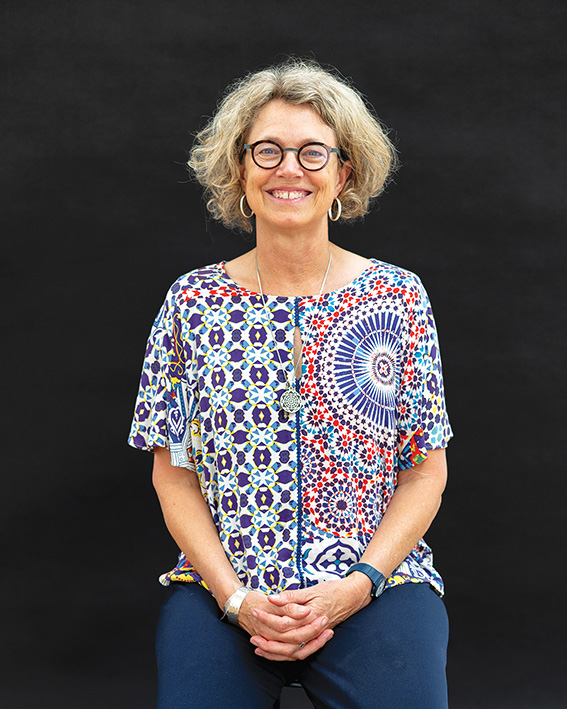
MARCH is Women’s History month, and although the women being profiled are not historical, they are certainly making history. Environmental engineer Carolyn Oldham was one of the 2024 inductees to the Western Australian Women’s Hall of Fame this month.
CAROLYN OLDHAM has been in the environmental engineering field for more than 30 years, witnessing first-hand the changing landscape of gender equality in the scientific and academic world.
When Prof Oldham started at UWA, there was one important detail about her that was at risk of derailing her career.
“I arrived three months pregnant,” she said with a laugh, “and it was like all of their worst nightmares happened.
“They got a woman, and a pregnant woman at that.”
At the time, it was common for pregnant women to stop working, so it was a lonely endeavour for Prof Oldham to begin her career, working up until the weekend before she gave birth to her son.
“They just weren’t used to having pregnant women in the workplace,” she says.
Pollution
Throughout her career, Prof Oldham has focused on the protection of water, and addressing the growing problem of pollution.
“Whether it’s groundwater, rivers, streams, estuaries, or coastal water,” she lists.
She’s worked on research projects which address major environmental concerns such as mine closures and wetland contamination, adopting a “trans-disciplinary” approach which integrates environment and infrastructure, among many other fields.
These include a “pioneering” study into the importance of Western Australian wetlands, and she’s also collaborated in studies on the east coast and Europe.
Prof Oldham was the only woman among the 82 who studied engineering in her year, and only one of a small number promoted to Professor of Engineering in the country.
The experience of being an anomaly in her studies led her to be a champion of women in engineering and STEM subjects.
“It was obvious from the day I started I was what they called an ‘affirmative action appointment’,” she said.
“It was also obvious right from the beginning that the gender questions in engineering needed to be worked on.”
As Chair of a UWA women’s leadership planning group, Prof Oldham acted as a mentor in engineering, stressing the importance of gender equality in the field.
“We need women in all forms of engineering so that they bring different eyes to understanding the world’s problems,” she said. “Therefore designing technology that works and meets the needs of all the population, not just half of the population.
“Engineers make the world we live in, and if everyone who does the design and the thinking around that is a man, we’re not serving half the population.”
All diversity is key, Prof Oldham says, because each perspective offers a “different way of thinking to design the world’s technology” with a “sensitivity” that more than just one gender, ethnicity, or class can offer.
She is all too aware of the lack of gender balance in STEM fields too, which she says applies to anyone in an “extreme minority”.
“When you’re the only woman, it puts a huge burden on you,” she said.
“It puts a burden on you to not just what you think, but everything you say gets labelled as ‘oh, that’s a woman talking or that to black person talking or that’s a Chinese person talking.’
“So somehow you take on the identity of your whole gender, in my case.”
The unnecessary pressure of being in an “acute minority” doesn’t help the experience of women in STEM, which are already often demanding environments.
“You take one step wrong, suddenly, that’s just ‘what happens’ when you have women in the workplace,” she said.
Changing
Slowly but surely, Prof Oldham says, this is changing, especially in STEM fields, where gender equality contributes to organisational function.
“There’s fewer and fewer places where there’s just a single woman,” she said.
“Numbers do matter.”
Prof Oldham is “very much” proud of her induction into the Hall of Fame, which she says came as a surprise as someone who “likes to work behind the scenes”.
“It’s good for young women, particularly, but also young men to see that there’s women doing amazing things in our in our world,” she said.
“The inductees are faces of the women who have achieved amazing things, so to have those faces recognised when for so long they were in the shadows, is really good.”
Times have changed since Prof Oldham first walked into UWA three months’ pregnant.
“No one blinks now when you see pregnant women in the workplace,” she said.
“It’s just so normal.”
Now, it is also normal for women to be in STEM professions: something that Prof Oldham is proud to have helped changed over her career.
“My grandfather said over his dead body would a daughter of his go to university,” she said.
“He was an engineer.
“It’s so ironic that his granddaughter is a Professor of Engineering and in the Hall of Fame, so I wonder whether he’s turning in his grave,” she laughed.
“We’ve come a long way in two generations.”
by KATHERINE KRAAYVANGER
 Perth Voice Interactive
Leave a comment