
DAMAGE embodies the essence of Australia’s troubled and complex treatment of refugees.
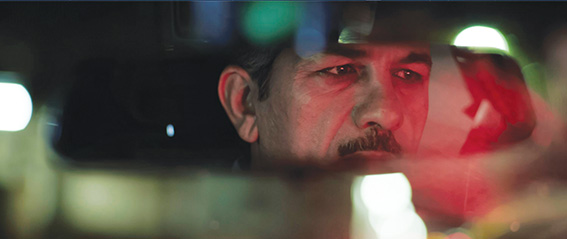
Its synopsis is deceptively straightforward: on a desolate night, Ali, a refugee prohibited from working by his visa but taxi driving nonetheless with another’s license, picks up an elderly woman with a faltering memory.
Thus commences a journey into an increasingly alienated urban environment and the slow revelation of their individual stories.
Surprisingly, there are laughs hidden along the way for the audience’s relief.
With the tagline “She Can’t Remember, He Can’t Forget,” the film’s characters serve as allegorical representations our recent national history.
Ali symbolises all mistreated refugees, while the elderly passenger embodies the Great Australian Forgetting.
As they journey through the progressively more estranged landscape, the audience grasps their needs and traumas through their hesitant dialogue and poignant facial expressions.
Writer/director Madeleine Blackwell describes Damage as “a small film with big ideas.”
It is certainly a quiet film revealing a gaping wound, and employs quietly audacious techniques, such as prolonged focus on the characters’ faces which compels viewers to engage with their genuine humanity.

Remarkably, neither of the lead actors is a professional.
Ali Al Jenabi, an Iraqi refugee, brings his own experiences to the role, as does Imelda Bourke, an 89-year-old first-time actress who also happens to be the director’s mother.
At a recent preview screening at Luna Leederville, Blackwell said that through workshopping the two actors brought their own lives to the script.
She said Ali Al Jenabi in particular changed certain passages of her dialogue into poetry.
His contribution is marvellous. For example, in a scene where he speaks of the inability to forget trauma he utters one of the most lyrical sentences in Australian cinema.
All other voices in the film remain disembodied, whether from mobile phone calls, radio snippets, or the omnipresent state surveillance apparatus.
A pivotal silent sequence involving water serves as a stark commentary on Australia’s history of refugee mistreatment, resonating profoundly with Australian audiences.
All viewers will feel anguish and shame at that moment.
For Blackwell, Damage is a labour of love and a testament to perseverance, having faced numerous rejections from producers before embarking on independent production.
Following successful screenings at international festivals and with Arabic subtitles for immigrant Australian audiences, Blackwell has witnessed the immediate connection many viewers feel with the film’s themes.
The film’s conclusion defies conventional cinematic endings, aiming for a more contemplative response to its multifaceted narrative layers.
With the inclusion of Wikileaks footage and a nod to Julian Assange in the credits, Damage provokes ample thought and discussion long after the credits roll.
Damage is showing at the Luna Leederville until April 3.
by BARRY HEALY
 Perth Voice Interactive
Leave a comment