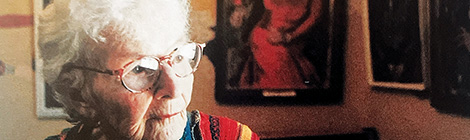
WORK from one of Perth’s most prolific and talented female artists will be on display for the next week at Holmes à Court gallery in West Perth.
Elizabeth Blair Barber, also known socially by her married name, Betty Bunning, painted and sketched hundreds of works depicting Western Australian life.

“Intuitive, bold, and insightful”, Barber was “constantly immersed” in Western Australian life which she transferred onto her easels and sketchbooks.
Ms Barber, who was born in Perth in 1909, had a knack for painting as a girl and became Henri van Raalte’s youngest student when she was just 11 years old.
The Voice spoke to Barber’s son, Bob Bunning, who has early memories of his mother constantly sketching and painting life around her.
“If you weren’t careful, you’d find that she might be sitting having breakfast, or even asleep, and she’d be sketching you,” Mr Bunning said with a laugh.

Balancing her prolific art career with motherhood and the “demands of a society wife”, Ms Barber used her maiden name to represent her artistic identity, and “set herself apart” from her husband, himself a well-established businessman.
“When she got married, she used her married name, Bunning,” Mr Bunning said.
“As time went by, she found that as a professional painter, she didn’t want to get be confused with being the wife of a businessman.”
Working with everything between oil, watercolours, and pencils “in lieu of a camera”, Barber painted all aspects of WA culture, including its people, landscapes and industries.

Her subjects ranged from the Blessing of the Fleet in Fremantle to the forests and timber mills of the South West.
Ms Barber was “very well known” in the WA art industry and among famed contemporaries such as Robert Juniper, Audrey Greenhalgh, Guy Grey-Smith, and Arthur Russell, to name a few.
Celebrities of the day were not safe from Barber’s brush, including Elizabeth Durack and Sir Claude Hotchin – many of whom Barber called her friends.
An artist unknowingly acting as a historian, Ms Barber often went with her husband on business trips around WA documenting the timber mill industry and its people, and towns many of which “no longer exist”.
Often, she’d do it herself.
“She had a little Austin A40 and she’d trundle down to Manjimup, or Donnelly River, or wherever the location was,” Mr Bunning said.
“She loved painting the forests and mills, out on a log road somewhere, totally unconcerned about going into them alone.”
Exhibition curator Connie Petrillo says Barber “deserves to be widely recognised” for the “highly individualist” flair permeated through her art.
“Her legacy is a fascinating one, affording us an insight into the world of both art-making and life in 20th century WA,” Ms Petrillo said.

Spontaneous
“Her approach to painting was about the spontaneous recording of the moments around her.
“Her work is built from expressive brushstrokes that once laid down, remain as a trace of her experience.”
As an experienced professional, Barber would often take young artists “under her wing” and in 1966 opened the Cremorne Gallery on Hay Street to facilitate junior talent – such as Elizabeth Ford, George Haynes, Brian Yates, and Ron Gomboc.
As they reached old age, Barber would take her husband Charles down to North Mole to sketch and watch ships passing in and out of Fremantle Harbour.
“One occasion, there was a lot of industrial action going on in Fremantle, and the pickets were out to stop people going onto the Mole,” Mr Bunning said.
“They were so familiar with Betty and Charlie coming to look at the ships, they waved them through the picket line.”
Barber passed away in 2001, having painted hundreds of pieces cataloguing the world around her.
They will be on display at the Holmes à Court Gallery in West Perth as part of the Elizabeth Blair Barber: A Life Amongst Painters until Saturday, August 10.
by KATHERINE KRAAYVANGER
 Perth Voice Interactive
Leave a comment