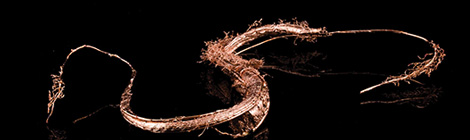
IT looks a bit like something out of Dr Moreau’s laboratory, but Tineke Van der Eecken’s “corrosion casting” is her unique way of honouring marine life and showing they are under-threat.
The gruesome process involves injecting a synthetic resin into the blood vessels of dead animals via the heart.
“It’s followed by the dissolving of cellular tissue and bones with acid,” Van der Eecken says.
“What remains is a sculpture of the animal’s vasculature in resin.”
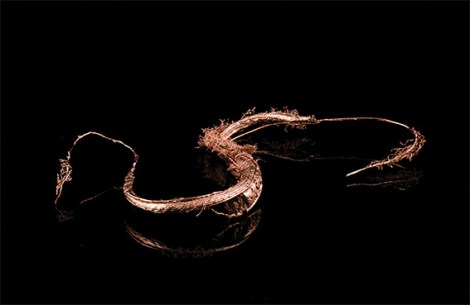

The end result is provocative and thought-provoking – a beautiful creature reduced to its very essence, highlighting the fragility of nature and the very core of existence.
For her latest exhibition Concurrencies, a tribute to the ocean, Van der Eecken went a step further – casting and then copper-coating a sea snake.
“I am used to working with precious materials such as gold, silver, copper and semi-precious and precious stones to signal what is precious, in particular our natural environment – the sea snakes, the ghost sharks, the seals, to name but a few,” she says.
A passionate environmentalist, Van der Eecken undertook an artist residency in Exmouth, where she worked alongside marine scientists and Aboriginal elders, learning about the under-threat Ningaloo Reef and Exmouth Gulf.
While there she helped marine biologists collect sea snakes and tag them, so they can monitor their habits in the wild.
“It was an exhilarating experience… I learnt so much about the diversity of endemic sea snakes over there and all the way to the top end of Australia, and how they are endemic to local reefs,” Van der Eecken says. “I also found out that the sea snakes are an indicator of the health of the ecosystem.
“It is really inspiring that they have been important to indigenous people for thousands of years, and they continue to be important in modern science.”
Sadly many sea snakes die after getting caught in fishermen’s nets and tossed around, breaking their fragile spines.
The copper-coated sea snake is one of 45 artworks in Concurrencies, which includes corrosion casts, jewellery, sculptures, objects and fine metal work.
At times exquisite and delicate, at other times confronting and harsh, the exhibition depicts both the majesty and travesty of the ocean. Van der Eecken’s unique “biological art” has received praise from scientists and academics, who marvel at her ability to blend art and biology.
“At the Animal Morphology Museum in Ghent, I met Dr Christophe Casteleyn a veterinary surgeon who I have been collaborating with for over 10 years,” Van der Eecken says.
“The Baby Grey Seal in the exhibition is our most recent collaborative piece. A must see.”
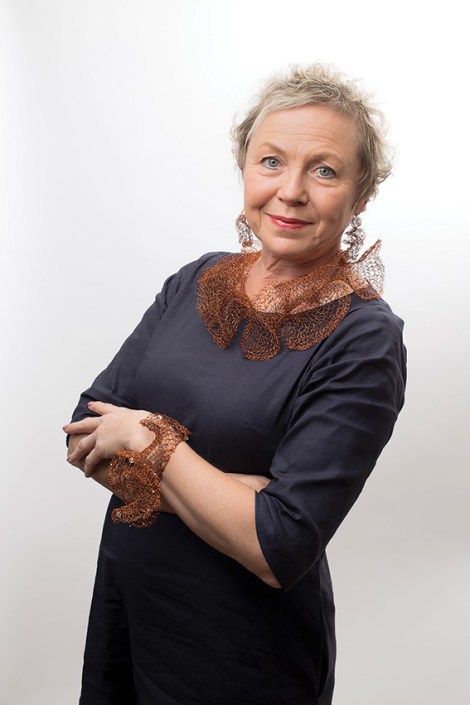
Van der Eecken emigrated from Flanders to Perth in 2001, and while she is inspired by the natural beauty of WA, her art also draws on her early years.
“I remain conditioned by my upbringing in Flanders: my lace-making grandmother, my father who created metal objects in his shed, my politician-mother who is also a poet, my affinity with farm animals during my childhood, and the many layers and diversity of art and culture around Europe,” she says.
“In particular, I have been inspired by biological art and artist such as Berlin De Bruyckere whose conveys a lot of emotion and empathy through her work with animal casts and skins.”
Since moving to WA, Van der Eecken has exhibited in numerous group and solo exhibitions, winning awards and being shortlisted on numerous occasions.
She’s also an award-winning writer and poet, and her manuscript Traverse was shortlisted for the prestigious TAG Hungerford Award.
But right now she’s busy getting ready for the opening night of Concurrencies, an unofficial follow-up to her exhibition Tributaries, which was inspired by the land.
“With our technology, we push complex ecosystems to the brink of extinction, confounding their inhabitants with seismic blasts, dredging and drilling. We fish populations of sea life – living or dead – and dump continents of plastic,” Van der Eecken says.
“Sea snakes are among the endemic endangered ocean creatures and we are facing a disaster in WA and for our planet if Woodside implements its planned massive gas plant near Scott Reef, one of the most pristine reefs in our state.”
Concurrencies is at the Alister Yiap Gallery, 6/191-199 Bulwer Street, Perth from August 9-25 as part of the Indian Ocean Craft Triennal. For more details and other events see indianoceancrafttriennial.com.
by STEPHEN POLLOCK
 Perth Voice Interactive
Leave a comment