
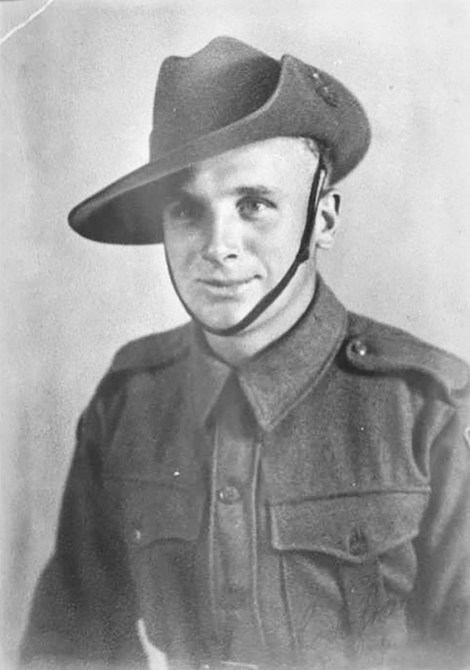
EAST PERTH resident GLEN MORGAN is donating his father’s war medals to the Army Museum of WA, and in honour of the occasion penned the following, “in memory of Ronald Spencer Morgan, 2/11th Battalion, Crete veteran; and all Allied soldiers and Germans who fought valiantly for the fate at Crete during WWII”. The 2/11th was the first WA battalion raised for overseas service during the Second World War, leaving Fremantle on April 20, 1940. In the Middle East they helped capture Libya from the Italians before being redeployed to the unsuccessful defence of Greece and ultimate evacuation to Crete.
MEMBERS of the Friends of Prevelly met earlier this month at St John the Theologian Chapel, Prevelly, for what is now an annual commemorative service of the chapel.
Dignitaries included bishop Elpidios of Perth and reverend Terry Gerovasilis.
The service began with the haunting strains of the Mandurah Pipe Band, before an address by Sean O’Connell, representing the Friends of Prevelly, who spoke of the need to receive government grans and continued fundraising to sustain maintenance to both the chapel and surrounding grassland.
The little chapel, with its white stone walls, stands against the dramatic coastline at Prevelly, built through the inspiration of the first owner of the Prevelly caravan park, Geoff Edwards, an Australian veteran of the Battle of Crete in May 1941.
Geoff’s daughter Marilyn Sadleir gave a moving address as she recounted the events leading up to the invasion by German troops in Crete, and the subsequent 10-day battle that saw losses in the thousands.
She said the Germans placed a critical need to take the island for its geographical location in the Mediterranean, and for resupplying vital oil supplies for the German military machine.
At Crete, Australian troops fought with Greeks, British and New Zealand forces in an attempt to hold onto the island from the Germans.
Hitler’s Crete airborne assault was the first parachute attack in the history of warfare.
It was an unrelenting battle; 274 Australians were killed and over 500 wounded.
Combined allied losses amounted to more than 4000 killed or wounded.
The Germans sent in thousands of paratroopers from low-flying gliders operating from various sites in Greece.
The Germans won the battle due to superior numbers; however, it was a pyrrhic victory, for they captured the island with the loss of 7000 lives.
After such terrible losses, Adolph Hitler claimed he would never again attempt an airborne invasion, and didn’t.
Recalling the battle many years later, my father once explained to me: “First Messerschmitt planes strafed us as Stuka dive bombers came in with their bombs; the shrieking engines of the Stukas frightened us as much as the bombs they dropped.

“Then Junkers, Ju 52s, wave after wave, came clattering in low and fast – suddenly the sky was pock-marked with parachutes.
“Some Germans were killed as they stood in the doorway of the gliders; they plummeted to earth like sacks of lead.
“Others were shot as they floated through the air.
“Then, as paratroopers landed, it became brutal man-to-man fighting.
“It was kill or be killed, simple as that.
“We fought and held on for 10 days, securing vital airstrips, but in the end, their superior numbers won out,” he said.
Following the defeat, some 3000 Australians were captured.
Others, including Geoff Edwards, escaped and were sheltered and cared for by local Cretans.
This was done at enormous peril, for they were told by the conquering Germans that anyone caught harbouring allied troops would be shot, and many were.
So grateful for being sheltered by the Cretans, Mr Edwards was determined to honour them permanently for saving his life.
He did this with the construction of the Prevelly chapel in 1979, dedicating it to the monks of the Preveli Monastery in Crete.
For the thousands of captured Allied soldiers like my father, came an appalling 10-day train journey from Greece, across Germany, to be dispersed in Austria, Yugoslavia (as it was called then) and Poland.
They were POWs for three-and-a-half years until war’s end.
Despite suffering lack of food and basic amenities during his confinement, my father never criticised his German captors, saying that by and large they were treated well, adding that they, too, suffered food shortages.
This is testament to his ‘forgive and forget’ attitude he always displayed to the German troops he once fought.
The commemorative service concluded with the Australian and Greek national anthems, followed by a hearty luncheon; a time to reflect on the deeds of those from all sides, who fought at Crete those many years ago.
 Perth Voice Interactive
Leave a comment