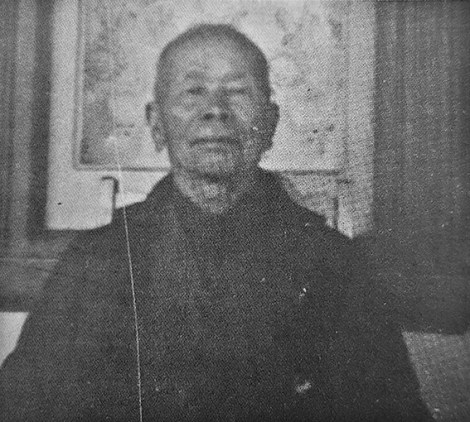
The BHS’s submission to Bayswater council telling Hu Che-Em’s story, from Catherine May’s book Changes They’ve Seen: The City and People of Bayswater, 1827-2013 (2nd ed).
HU CHE-EM was born in 1873 and arrived in Australia in the 1890s.
His daughters, Sylvia Gillespie and Evelyn Wigger, have no doubt that he came to Australia in order to support his family in China, as he continued to send money home for the whole of his working life.
As he was already in his 50s when his daughters were born in Australia, their recollections encompass his later years.
They remember him as a slight, dapper little man whose lack of English did not deter him from managing his own affairs and taking care of the girls after the untimely death from illness of their Australian mother.
As a father, he was a highly organised disciplinarian but kind and caring at the same time.
Hu’s house was simple but practical, furnished with the bare necessities, much of it made by himself.
Cooking was done on a bricked-in fireplace with rungs across it to hold the heavy iron saucepans.
A chopping block consisting of the cross-section of a large tree stood nearby.
Hu did all the cooking and was an excellent cook.
Evelyn Wigger recalls: “Often, father would go to the market in West Perth to select and purchase fish and poultry. Chicken and ducks were brought home alive in a chaff bag, then placed in a pen and fed up until they were ready for the pot.
“Later in life I became aware of our father’s way of preparing and cooking the poultry. The operation was so meticulous that every part of the chicken was cooked, from the coxcomb to the feet, blood and giblets included. It would have been worth filming.”
Water was carried from a spring-fed well in the garden and his daughters now marvel at how such a slightly built man could tip two huge cans of water simultaneously into a large barrel which was the water supply.
Hu began work at dawn and often went on until dark, except for an afternoon nap, lying on the floor in the breezeway, his head on a wooden pillow.
One of Hu’s few indulgences was the occasional bottle of stout which was kept cool in the spring.
Farming operations are remembered:
“Father grew an abundance of vegetables. I can recall market day when, in the early hours of the morning, a large table-top lorry drawn by a draught horse would arrive to be loaded up with prepared and bagged vegetables.
“Thinking back in time, I can see my father with needle and thread sewing up the bags, particularly the potatoes.
“There was another man called Gooey who helped in the garden. Often my father told him in a loud voice that he was ‘too lazy, too muchee sleep and smoke the water pipe’. Gooey just grinned.”
One of the clearest recollections of the farm itself was the aroma of blood and bone for fertiliser, mingling with that of the tannery directly across Beechboro Road (now the industrial part of Beechboro Road).
Hu left the market garden in the late 1940s or early 50s.
The disappearance of Hop Chong from Beechboro Road and of ‘Hoppy’ himself was the end of an era.
Hu’s working life had continued well into his 70s.
He moved to Maylands and from there to James Street where he was able to have a room in company with some elderly countrymen.
The next move was to Leederville where he lived independently with help from his daughters, still preparing poultry the traditional way.
Hu died in Sunset Home [Dalkeith] at the age of 96.
As was the case with many Chinese migrants to Australia, his story is tinged with sadness.
Having left China at a young age, he was never again to see his native land or the family at home he had so dutifully supported.
 Perth Voice Interactive
Leave a comment