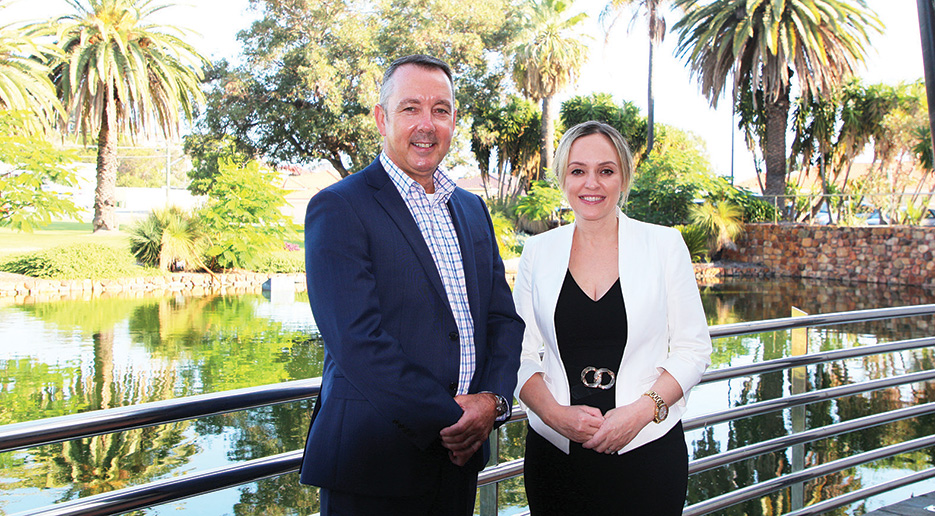
• Incoming Bayswater CEO Jeremy Edwards and mayor Filomena Piffaretti.
BAYSWATER has a new CEO, nabbing City of Swan chief Jeremy Edwards who finishes up there in July.
Bayswater’s last CEO Andrew Brien left in February to take up the top job at Kalgoorlie-Boulder council.
Bayswater mayor Filomena Piffaretti said in an announcement she was glad they’d been able to attract a high calibre CEO in Mr Edwards.
“Jeremy has a proven recordof managing major infrastructure projects and working with developers to better understand the barriers and opportunities to investing in growth council areas,” Cr Piffaretti said.
“His skills are an excellent fitfor the organisation as the Cityis experiencing unprecedented investment in major road and rail projects by the state government.
“Jeremy is experienced at advocating for funding both at the state and federal level. He is alsoa firm believer in engaging the community in the decisions that affect them.”
Funding advocacy will be a welcome skill at cash-strapped Bayswater: In the last few years the council hasn’t had a lot of success getting grants from other levelsof government, with Maylands Waterland and Bayswater Waves in desperate need of external cash for upgrades.
Mr Edwards started out in WA Police and went on to be a patrol officer at Wanneroo council. He worked his way up through local government ranks and from 2010 to 2020 he was director of community services at Bayswater, before going on to be CEO at Gingin, East Pilbara, and Swan councils.
As CEO of Bayswater, Mr Edwards total reward package costs $359,420 a year. The CEO pay band for a big urban council like Baysy is between $250,000 and $381,000.
FANCY a change of scene and a new life south of the river?
Well this unique, modern eco-friendly residential development could be the answer.
Nestled in the quiet suburbof White Gum Valley, “Terrace Green” is a seven-minute drive from Fremantle city centre and surrounded by leafy gumtrees in all directions.
The ocean, harbour and golf course are only a short drive away too.
This town house has three bedrooms, two bathrooms and a double carport.
Through the front gate, along the grey footpath and past the freshly planted garden bed and lawn, the house is bathed in autumn light.
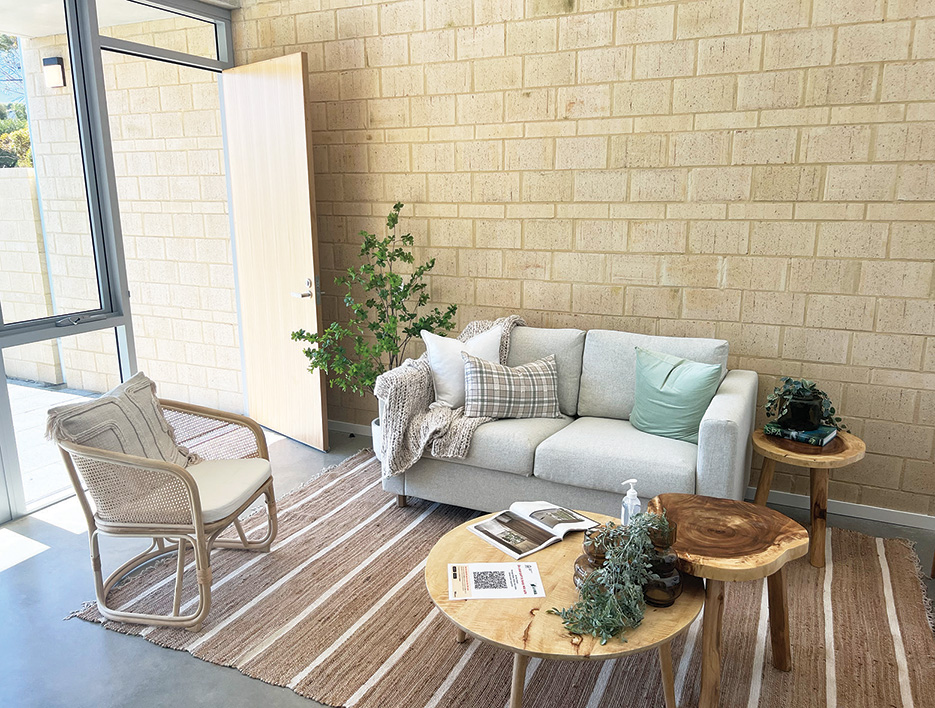
Designed by local architects, the two storey, square-shaped house complements the history of Fremantle with its natural limestone and wood.
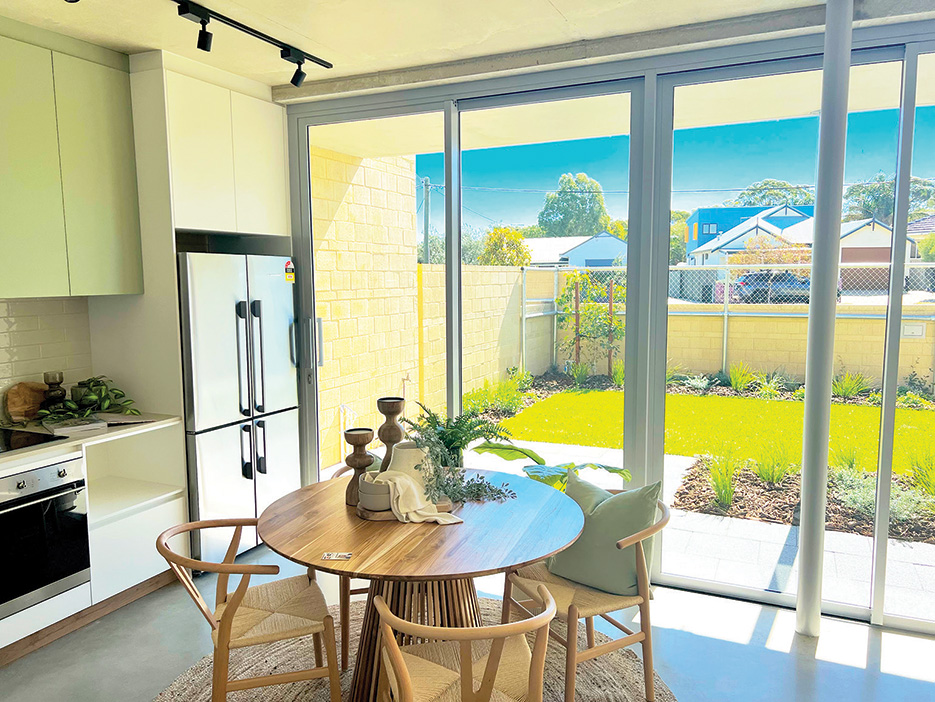
The front door opens to the living room, which has a vaulted ceiling and floor-to-ceiling windows. Connected to this space is the kitchen with sage-coloured cupboards and a marble benchtop.
A hallway leads to the first floor bathroom, bedroom and a back door where the carport, outdoor storage room and laneway is accessed.
A second bathroom and the other bedrooms are located on the second floor. The master suite has access to the balcony, which has a timber ceiling and relaxing views of White Gum Valley.
The limestone wall of the bedroom continues out to the balcony, creating the illusion of a deeper room.
Although built from the same materials, each house at Terrace Green is designed differently and has its own unique personality.
The houses are environmentally sustainable with solar panels, waterwise landscaping, split system air-conditioning and heat pumps.
They have been awarded 7.5 stars by the Nationwide House Energy Rating Scheme.
People will begin to move into stage one of Terrace Green in two to three weeks, and stage two of the development is expected to be completed by December.
The second stage is currently available for purchase with a five per cent deposit.
$810 000 3/119 Hope Street, White Gum Valley dethridgeGROVES 9336 1166 Agent Hayden Groves 0411 615 582
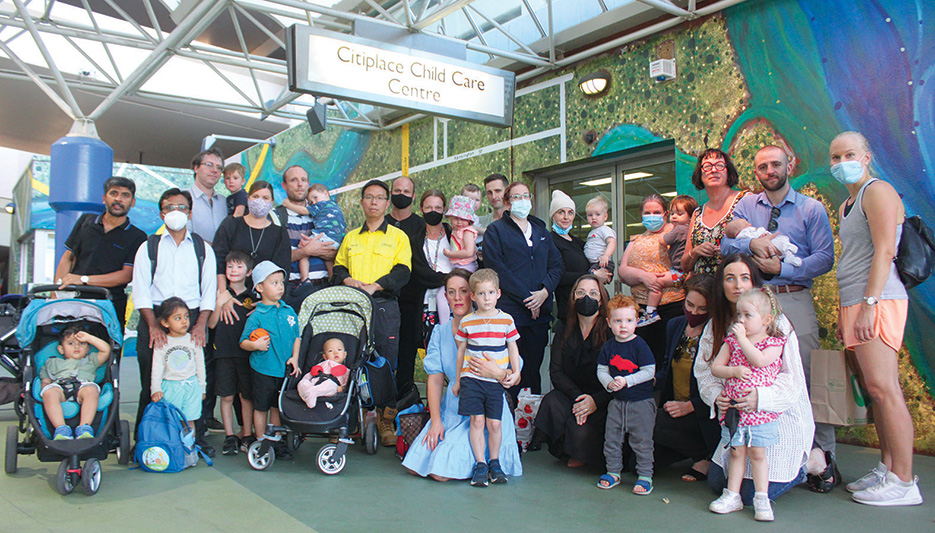
Families invited Perth councillors and the CEO to a group meeting but none showed. Photo by David Bell.
FAMILIES facing the closure of Citiplace Child Care Centre fear months of disruption as they scramble to find new places, and those needing occasional care or with younger kids may not find placements at all.
The 53 families who use the centre were taken by surprise when Perth council went behind closed doors and decided to close the Commonwealth-funded centre by September.
Disposed
Most of the staff report that went to councillorsis still confidential, buta snippet released to the public says the property will be “dispose[d] by lease … as per the income generating parameters outlined within Council Policy 2.7,” a policy the current council line-up brought in last year to make more money off its buildings.
Families have slammed the council for not speaking to them ahead of thevote and said councillors might’ve made a different decision if they’d heard them out first.
We spoke to a dozen parents who all told us they’d gladly pay higher fees to keep the centre afloat, and who say the council doesn’t understand that other centres don’t cater for younger kids or offer short term occasional care.
Eiméar and Michael Mossey are from Ireland, and with their family thousands of kilometres away, Ms Mossey saysthe centre is irreplaceable: “The care we were given was unbelievable. We have no family here, [Citiplace carers] were like a granny to us. They’re his second family.”
“They talk about footfall in the city, and trying to bring people back. The only reason we have to come to the city is daycare.”
Another parent: “The primary reason I spend time and money in the city is the daycare centre,” and others agreed they’d opt to work from home and find childcare in the suburbs if Citiplace closed.
Many believed numbers at the centre would pick up as people returned to the office.
Even those who believe they’ll find placementsat other childcare centres are concerned about the disruption during their kids’ formative years.
Dad Kiran Veluri said for his two year old “it took a while” to get comfortable with going to daycare, and Citiplace’s hour-at-a-time care helped his boy get used to it gradually.
“Now finally he is settled,” and Mr Veluri fears another hard period if they have to find a new centre.
Dad Ming Khor said: “It is my opinion that there are things that a government needs to provide to us: Childcare, education, water, electricity.”
It’s a sentiment that’s reflected in Perth council’s own budget papers, which outlines “education and welfare” as one of its 11 core programs and notes provision of “child care centres” as one of the main activities.
Subsidising
In response to written questions we submittedto the council, an emailed statement attributed to Perth lord mayor Basil Zempilas said that more than 10 child care centres had opened within two kilometres of Citiplace since it opened 33 years ago.
“The City of Perth has been subsiding the cost to run the centre an average $950,000 a year for the past seven years.
“On that basis council voted to close the Citiplace Child Care Centre at the end of September, giving families six months to find an alternative child care provider.”
On the lack of consultation ahead ofthe decision, he said “to speak to staff and families before an official council decision would have been inappropriate. Council was elected to make decisions on behalf of all of our City of Perth ratepayers.”
Centre was a career saver
ARTIST Paula Hart said she wouldn’t be where she was today if not for Citiplace Childcare Centre, as its hard-to-find occasional care let her pick up flexible work to keep her arts career afloat.
It’s been about 20 years since her daughter Ava went to the centre but she felt strongly enough to attend the gathering of supporters on April 7 and advocate for the centre to stay open.
She had to search hard for somewhere that took children on short term stints without committing to expensive long-term enrolments.
“I finally found this one here.
“It is literally the only place that does occasional care.
Original staff
“If you’re coming in for short courses, you’ve got somewhere to put your kids for a couple of weeks.”
“It kept my career afloat,” she says.
She was surprised to return this week and find so many of the original staff still there.
“I walk in, they’re all the same staff that Ava had as a child.”
High staff turnover has been a constant problem for the childcare industry for years.
Multiple parents said they noticed high turnover and staff dissatisfaction at privately run childcare centres, and the longevity of staff at Citiplace made for some much-needed stability for their kids’ early years.
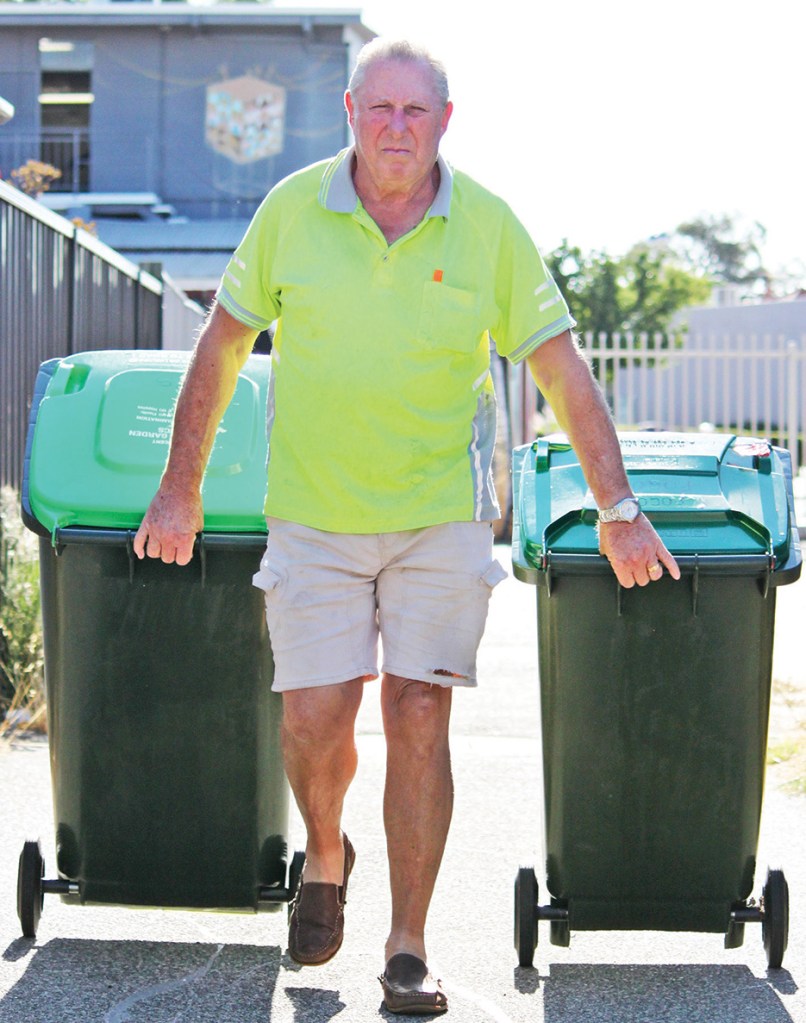
The big bin doesn’t fit at Michael Brazier’s Highgate townhouse, and his attempt to solve the issue’s been deemed “noncompliant”. Photo by David Bell.
Picky garbos won’t take Michael’s bins
STRICT rules around FOGO bins are turning some residents against the system after being punished for other people tossing the wrong rubbish in their bins.
Across Bayswater and Vincent we’ve heard of rubbish going uncollected because a recycling bin has a pizza box in it that’s deemed too oily, or because a passer by tossed an empty bottle in the new “Food Organics/Garden Organics” bin.
Vincent’s at the tail endof a seven-week WA Waste Authority-funded bin monitoring program checking the bins of 2000 households. Those with the wrong stuff are tagged with an unhappy face and a list of sins, and in many cases the noncompliant bins are not emptied.
Highgate resident Michael Brazier says when the new system rolled out he was keen to be a good citizen and sort everything into the right bins.
Strata problems
But he’s fed up with what he calls “bureaucracy gone mental”, with mounting instances of his bins going uncollected after the bin-monitors find something amiss.
Mr Brazier says he’s been scrupulous but he can’t stop others from using his bins improperly when they’re out on the verge awaiting collection. There’s a cafe across the road from his verge and recently his recycling bin wasn’t emptied because customers had tossed some empty coffee cups in there.
Mr Brazier says it’s also tricky at stratas which share common bin space, like at another property he has where there’s seven units on a block in North Perth.
“We’ve had issues there with FOGO. Some of the residents – I don’t know who – haven’t been putting the correct stuff in the correct bins, so [collectors] refuse to empty them.”
He called Vincent council’s waste team but they were firm: “They said unless the correct stuff’s in the bin, then we won’t empty the bin.
“So I said, ‘am I supposed to be the bin police?’ There’s seven residences there.”
Mr Brazier said the system’s ill-suited to many of Vincent’s inner-city houses. He has no space for three bins, and says like many other urban properties he has no need for a big 240L FOGO bin.
“The demographics of Vincent is 2.2 people per living space, and I don’t have a garden so I have no green space,” so no branches, leaves, or grass clipping’s that’d otherwise fill a FOGO.
His attempt to find a solution to a lack of bin storage space worked fine for a few months: He got a spare smaller 140L bin he had, gave it a green lid and marked it ‘FOGO’.
The trucks happily picked it up for several months until the recent bin-tagging trial, when inspectors sealed his bin with pink tape and it wasn’t collected. By the time the next collection date rolled around, maggots had already started climbing out of the bin.
Another round on the phone with the Vincent waste team followed: “They said we won’t empty it because it’s not the regulation bin,” Mr Brazier says.
With so many inner city properties having only a tiny space for bins, enough people had sought a smaller bin that it was included in Vincent’s FOGO FAQ.
Ingenuity
We put some questions to Vincent council and mayor Emma Cole told us via email:
“We appreciate the ingenuity of the Highgate resident, but we are required to use the bins as provided per the Waste Authority’s Better Practice FOGO Kerbside Collection Guidelines.”
That locks them into 140L for general waste, 240L for recycling and 240L for FOGO.
“The collection volume for each service is important to maximise recovery and minimise general waste,” Ms Cole says. “We have a funding agreement with the State Government‚Äôs Better Bins Plus system so we are obligated and required to use the bins provided and consistent with guidelines.”
Asked what people could do about others using their bins, Ms Cole says: “In regards to shared bins in apartment complexes, we suggest residents to contact their strata/property management if this is an ongoing issue as the City of Vincent does offer large signage for bin stores as well as waste sorting material in 12 different languages.”
Good sentiment
Ms Cole says the situation has been improving: “Our Community Waste Educators have had some quality conversations with residents, answering questions about their tricky waste items and other waste and recycling related queries.
“There is good sentiment around our new three-bin FOGO system.
“We have had feedback from our FOGO processor advising that our contamination rate has now dropped below our pre-bin tagging rate of 3 per cent, with them confirming that they attribute this to the bin tagging program.”
STRUGGLING global supply chains have made for delays but with a bit of luck Beatty Park’s water slides will be ready for action during the school holidays.
Vincent council’s spending about $3.4 million upgrading the centre and most was finished in August last year.
But the waterslides aren’t manufactured in Australia and there were lengthy delays getting them shipped from Malaysia; then the experts needed to install them were stuck in Sydney while the state borders were closed.
Vincent mayor Emma Cole says: “We have all been waiting for the arrival of the slides, which are unfortunately not manufactured in Australia and had been delayed due to the Covid-19 pandemic.
“They have finally arrived and we are now working hard to finish the final touches for kids to enjoy with their family and friends during the school holidays.
“My son is one of the kids that has been waiting a long time for these slides and he cannot wait to test them out.”
They’ve now had the final tick from the WA health department and the slides are open.
FEDERAL Perth Labor MP Patrick Gorman has deemed last Tuesday’s federal Budget a “cash-splash” lacking a long-term plan beyond poll day.
Prime minister Scott Morrison announced a May 21 election this week, on the back of a Budget described by treasurer Josh Frydenberg’s as “responsible and targeted” assistance to help Joe Average cope with the rising cost of living.
Measures included halving the fuel excise which has already helped ease petrol off from its $2 a litre high, a one-off $250 payment to 6 million eligible welfare recipients, and a $420 tax-offset for low- and middle-income earner.
“I call this the botox budget; it’s great for three months then the effects wear off and all the wrinkles and frown lines are back”, Mr Gorman said.
But telling voters you’ll stop the gravy train if you win the election is a big call for a party, so Mr Gorman acknowledges Labor isn’t going to try to block the measures.
“We’re not going to stand in the way of the temporary measures.” Mr Gorman said.
“What we’re taking to the election is those long-term economic reforms.”
Greens candidate Caroline Perks also criticised the budget’s short-term focus.
“(This was a) really political budget, this budget was really focused and aimed on winning votes in the short-term, not on long-term outcomes,” Ms Perks said.
But the Morrison government’s continued lack of attention to climate change remains her biggest issue.
“The Morrison government is reducing the climate budget by 35 per cent over the next four years,” she said.
“It’s akin to tossing penniesat genuine emissions reduction initiatives.
Ms Perks said the Greens are champing at the bit to get the balance of power in the Senate through Upper House candidate Darinda Cox, a Yamatji-Noongar woman who would be the first First Nation’s woman to be elected as a WA Senator.
“It’s a chance to make history,” Ms Perks said.
Liberal Party candidate David Dwyer was contacted for an interview but was unavailable.
REFUGEES and supporters gathered in Perth on Palm Sunday to welcome the release of two refugees from Perth Immigration Detention Centre, and called for an end to government’s “harsh” stance keeping people in detention or on fragile temporary visas.
The two refugees released last week had come from Iran and spent six years on Manus Island. They were “medevaced” to Perth in 2019 but remained locked in detention until now.
The releases gave refugees, supporters, and Uniting Church and Anglican Church leaders something to celebrate on Palm Sunday as they gathered at the annual Justice4Refugees rally outside St Georges Cathedral.
The releases came shortly after a federal government announcement of an allocation of more humanitarian visas for people fleeing Afghanistan and Ukraine, and followed several men from the eastern states being freed.
Anglican Archbishop of Perth Kay Goldsworthy said in her Palm Sunday statement “our hope is that the Australian Government’s latest move to release more refugees into the community and to provide more humanitarian visas to people escaping Afghanistan and Ukraine is a sign that it will now move away from its current harsh stance against the 30,000 people who are already in Australia, having fled for safety by sea.”
About 20,000 people are ona cycle of temporary visas, and 11,000 are on bridging visas awaiting the outcome of their asylum claims. About 1500 people are in detention.
“It has become clear to the entire world that when people flee for their lives from situations of conflict and oppression, desperation dictates the means of escape. As we have seen in Afghanistan and now in Ukraine, official processes and systems break down in a crisis and can even be used against the most vulnerable.”
“It is up to the rest of the world to adapt with compassion to such humanitarian crises. Those most impacted by the crisis should not have to jump through endless hoops in their quest for safety, security and freedom.”
A network of 20 refugee support groups have gathered stories from people on fraught temporary visas at www. weallneedourfamilies.com
Nader Hosseini
Increasing despair
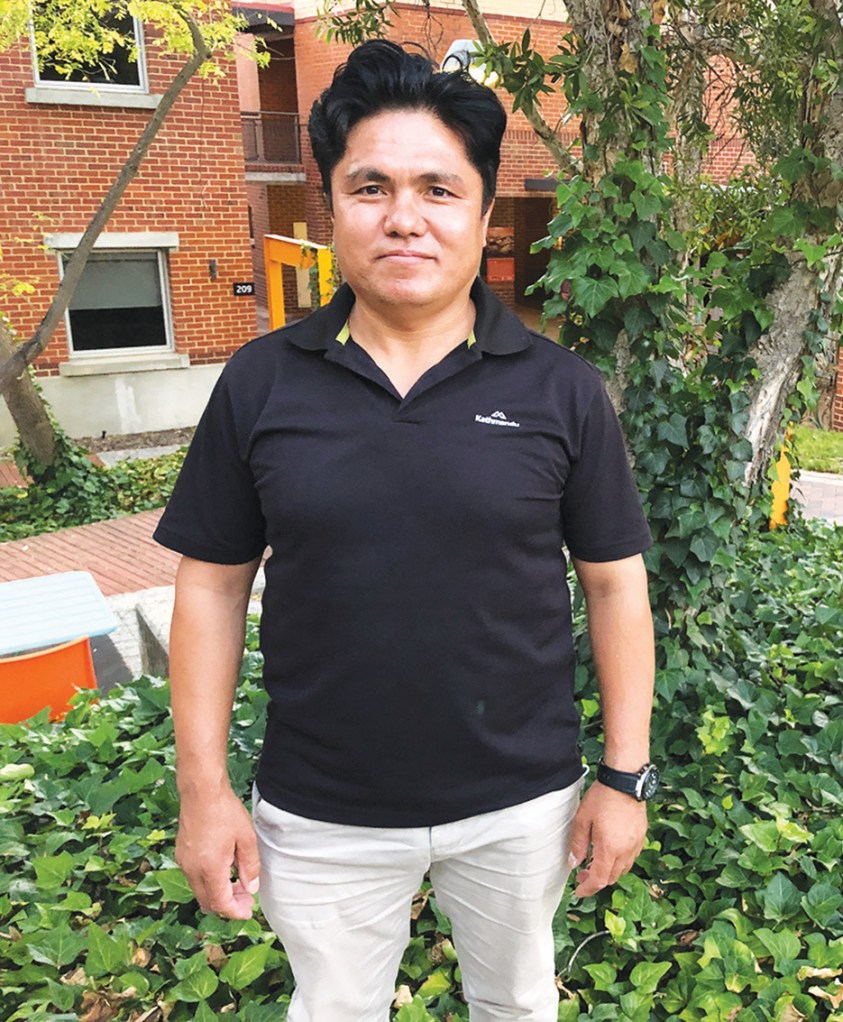
NADER HOSSEINI is a refugee from Afghanistan, and a member of the Hazara community which has long faced discrimination.
He said his people were in increasing despair: “We have fled the Taliban nearly 10 years ago and yet we still cannot be with our families.
“I have my four childrenstill in danger. The Australian government has agreed that I am a refugee, but they won’t allow me to bring my family here.”
He has been here for nine years and works as a tiler, but is still on a temporary Safe Haven Enterprise Visa.
He says “permanency would be everything… I could bring my family here, I could buy a house, and I could open my own business”.
Abdullah Shahabi.
Refugees facing business barriers
ABDULLAH SHAHAB fled Afghanistan in 2012 to seek asylum in Australia. He waited five years for his refugee claim to be processed, and is currently on a temporary visa.
“It is extremely hard for people to remain positive when they can’t see hope for a better future,” he says.
He is on a five-year Safe Haven Enterprise Visa, but because it’s temporary it’s been hard to expand his business.
“I am a painter. I have my own business and I hire other people. I started the business around one year ago.
I cannot get a bank loan to improve my business. If I want to buy equipment or a car for my business, I have to pay cash.
“Being on a temporary visa has also affected my mental health. Not being able to see my family, or bring them here, makes me very sad. And now there is the terrible situation in Afghanistan. It is so hard to concentrate and I find it difficult to talk to people.”
HEADLINES predicting $7 cups of coffee by the end of the year – and the resultant carnage in cafe strips like Leederville or Mt Lawley – might have little more substance than the froth on a skinny cap.
While there have undoubtedly been price rises forced by global supply disruption and the rising cost of milk, cafes and distributors the Voice spoke to hadn’t seen anything suggesting they’d have to resort to that level of marking up.
The story was fuelled by reports of Brazil’s last harvest, the worst in two decades after successive drought and then frost destroyed about 20 per cent of its plants. Brazil accounts for about 40 per cent of the world’s most popular coffee been, Arabica. Columbia, the second-biggest supplier of Arabica, also had a disappointing year.
It forced the price of beans up from $27 a kilo to $31.
Bounced back
But Brazil’s crop has bounced back this season, and with the harvest due to start this month, it’s expected to pull in around 61.4 million bags of coffee – slightly down from its marquee year in 2020-21 when 65.2 million bags were produced but enough to stave off platinum-level brews.
One distributor, who didn’t want to be named, even claimed the $7 price predictions were a bit of a conspiracy – he hasn’t had to raise his prices, but says he’s been under pressure from others to follow their lead.
The distributor reckons when Brazil’s crops were looking grim last season, speculators pre-purchased large amounts at top price, expecting it to continue rising sharply. That failed to materialise, so he reckons they’re now trying to manipulate the market into raising its prices to soften their losses.
But fear of price rises is having an impact on coffee drinkers’ behaviour said another boutique roaster. He told the Voice there’s been a huge increase in people wanting to buy a bag of beans for a home-brew, and they’ve been peppering him with questions on what machines work the best.
Fremantle Traders Association CEO Mia Kriznic says the beans account for just 6 per cent of a cuppa, with most of the cost actually coming from the milk, rent and cost of labour.
“In terms of costs, I don’t think anyone’s actually put prices up,” Mr Kriznic said.
“My understanding now is that everyone’s getting charged a delivery fee which they weren’t before.”
Cafes don’t want to stir first
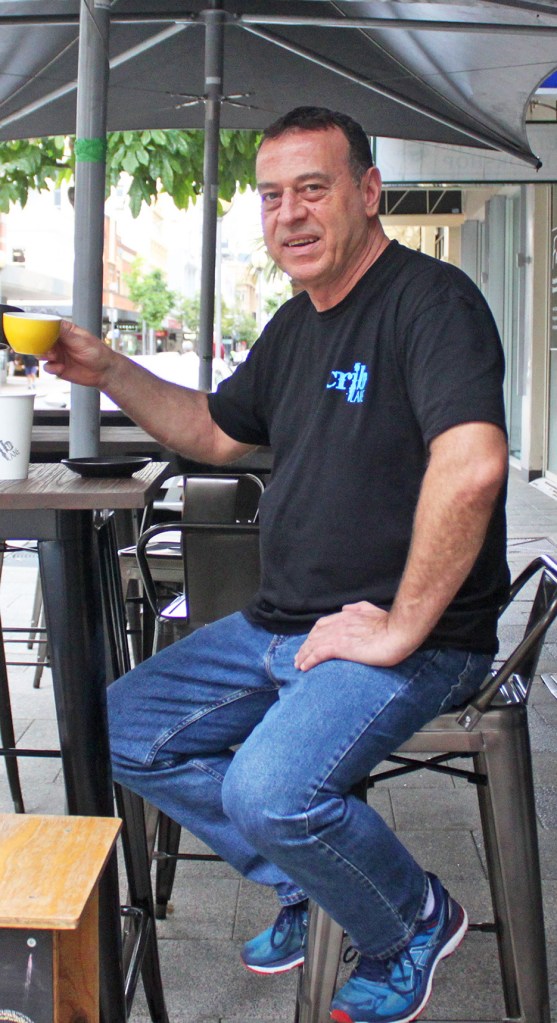
MIKE IVANOFF runs Crib Lane cafe on Hay Street, and has been hit by two recent hikes inthe price he pays for coffee beans.
“Since September last year I have had two coffee increases, first being $1 per kg, which was reasonable, and in March a $4 per kg increase, which is about 20 per cent up prior to September.”
There’s also been rises in the cost of milk, cups, lids, and wage and superannuation increases. Mr Ivanoff’s had to raise his prices but he’s still absorbing most of the cost increases.
“I put all my prices up in March by about 50 cents which realistically wasn’t enough, as we’re still selling our coffee cheaper than the suburbs who have much cheaper rent.”
City cafes have been wary of being thefirst to increase their prices to reflect growing costs: “The problem we have in the CBD is competition and the fear of losing customers to someone who holds on and loses money or breaks even in the meantime.”
Mr Ivanoff says work-from-home is still the big factor impacting CBD businesses.
“McGowan is saying everyone should go back to the office, yet the office of State Treasury – his department – are on a 50 per cent swing shift.”
Mr Ivanoff says having to wear a mask in the workplace all day is still a big deterrent to a lot of workers deciding whether to go back in.
IF karma had an appetite, no doubt it would fill its plate at Mt Lawley’s Sunflower Cafe.
Owner Ram Rajo and his business partner Alvina not only provide people heading to the Beaufort cafe strip with vegetarian meals so healthy they’re life-altering, their gold-plated hearts have touched countless other lives.
“My philosophy in 2021 was that no one should go past my restaurant feeling hungry because they didn’t have the money,” Mr Rajo says of his response to Covid’s impact.
His philosophy’s most obvious manifestation is Sunflower’s pay-what-you-can pricing, which has given a few hungry people their lucky break and those better off a chance to rack up their own bank of karma.
“It’s also been most heartwarming to enjoy the support of all our customers when it’s come to paying-as-they-can afford to; some paying it forward so that other who are currently less fortunate can eat well at Sunflower,” Mr Rajo said.
Behind the scenes he can also be found on the odd weekend blanket run with leftover food, while Sunflower’s also signed up to supply what they can to Foodbank.
Mr Rajo says after setting up the cafe around two years ago, he noticed a high number of homeless Indigenous people in the area whose only affordable option for a meal was Maccas.
Having “never been healthier” since taking up a vegan diet,he wanted to do what he could to help improve their options.
It didn’t hurt that Alvina isa Noongar woman and has introduced a range of Indigenous foods to the menu, including things such as warrigal greens and native eggplants.
“Every day we have a damper,” Mr Rajo says.
He says in the coming months they plan to go even further with their experiments in marrying Indigenous tucker with western cuisine.
But he also has even loftier plans, saying he was horrified by revelations in the Royal Commission into the aged care sector about the woeful food many residents were being served.
Seniors
He believes his style of food could give seniors a much more enjoyable palate to chose from without breaking the bank; and more importantly, can improve their quality of life.
“I ate mainstream for a long time, and moving to a vegan and vegetarian diet I’ve never been healthier,” Mr Rajo says.
“People wash themselves every day, but they don’t seem to want to wash their insides.
“Good food helps to get rid of toxins.”
Mr Rajo arrived in Perth the day before WA’s borders were firmly snapped shut by Covid.
“I didn’t know what to do,” he said.
Despite literally being the only person enjoying a coffee in one of the strip’s cafes that morning, he saw a For Lease sign on the building he now occupies and had signed the lease that afternoon.
But he reckons after 30 years in the industry, starting out in his home country Malaysia and a fair bit of it over east, he reckons he’s now home to stay in WA.
Which is no doubt welcomed by the increasing stream of return customers who’ve discovered his noble philosophy and delicious food and are keen spread the love.
AFTER spending seven years trading licks with blues journeymen Dilip n the Davs, Andrew Pring and Daniel Wiggins knew each other’s chops inside out.
So when their time playing with the Davs drew to an end, the pair found something was missing – like that person you’re so close to they can finish your sentence.
“I’d played with Daniel in that band for seven years, and I said to him one day ‘I miss playing the blues with you’,” Pring says.
Turns out the feeling was mutual and after runninginto singer Kirsty Finn at the Bridgetown Blues festival a year ago, the kernel of a new blues outfit had formed.
A couple of auditions later they’d added Jonathon Redmond on bass and Adrien Grd on drums and had a new name: Whiskey Nips.
Pring says they spent a lot of time working on material in the studio, but in January hit the stage for the first time at Clancy’s in Fremantle.
A couple of months down the track Finn is sitting on the sidelines waiting for Covid mandates to pass so she can return to performing, but they’ve got Peta Lee as a backup and they’re lined up for another gig at Lyric’s Underground at Lyric Lane in Maylands on April 24.
Despite being a harmonica player, Pring sites legendary guitarist Stevie Ray Vaughanas his biggest influence, though Kellerberrian blues/roots icons Blue Shaddy are right up there.
“With a harmonica, I can express myself so much more than any other genre,” Pring said of his love for the 12-bar format.
The Lyric gig will also feature Wiggins’ eponymous group, which last year released its first EP and capped off the year playing at the West Australian Guitar Festival in Margaret River. Also on the bill is soulful rocker and 2021 American Express Australian Music Backers winner Zack Linton.
Blues on the Rocks April 24, from 5pm Lyric’s Underground Lyric Lane, Maylands Tix: oztix.com.au