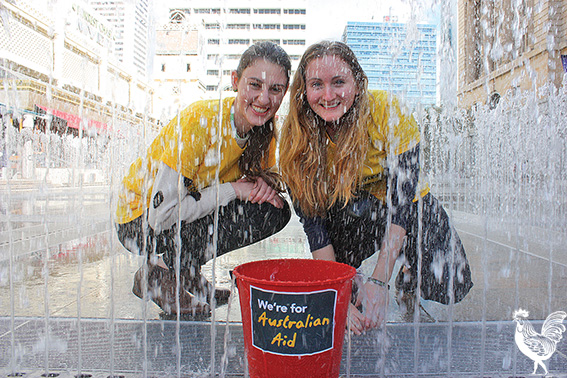
VOLUNTEERS for Oxfam will parade through Perth with buckets on their heads next Friday to highlight the federal government’s reduction in overseas aid.
Participants will fill buckets from the fountain in Forrest Place, before walking to Federal Finance Minister Mathias Cormann’s office where they’ll present an 80,000-strong petition calling for foreign aid to get a bigger slice of the budget.
Oxfam’s Paddy Cullen says Australia’s been giving less than it ever has.
• Hannah Darch and Sarah Laundy are taking place in Oxfam’s bucket walk to try and get Australia’s aid flowing again. Photo by Steve Grant
“Aid has been reduced to a trickle at just 23 cents in every $100 of national income,” he says.
“This is less than a third of the UN recommendation of 70 cents in every $100 of income.
“We’re asking all political parties at this election to pledge to increase aid to 0.7 per cent of GNI by 2030 in line with our global responsibility,” Mr Cullen told the Voice.
The event will be taking place at 3pm on Friday June 24, starting in Forrest Place.
Wrong wavelength
THE Federal government has cut $1.4 million per year from community radio.
This is critical funding for our future in digital radio.
Digital radio will replace existing AM and FM bands in the near future.
If we can’t pay for our transmission costs – which this federal funding pays for – our community stations will be under threat.
Community radio stations such as RTRFM 92.1 in Perth are a vital part of the media landscape.
We provide opportunities to hundreds of Western Australians every year to engage with communities of interest here and around the world.
Our programs are heard live and in re-streams by hundreds of thousands of people every week.
We operate on a shoestring – our turnover is less than $1 million per year.
We rely on volunteers to present diverse and alternative programs not heard elsewhere on Western Australian radio.
Those same volunteers dedicate hundreds of hours per year to assist with fundraising events that are essential to meet our day-to-day operating costs.
We need your support to convince the government to reverse this decision.
Please sign our petition at http://www.keepcommunityradio.org.au. Yes, Prime Minister, audience habits are changing and we need to change with them.
But please don’t lecture those of us who have to find new ways to obtain revenue every year on the need for innovation.
Here’s an innovative idea: rather than giving commercial TV and radio a 25 per cent cut on their licence fees, keep the money and keep community radio. Rewi Lyall Bulwer Street, Perth
Not a way to treat homeless
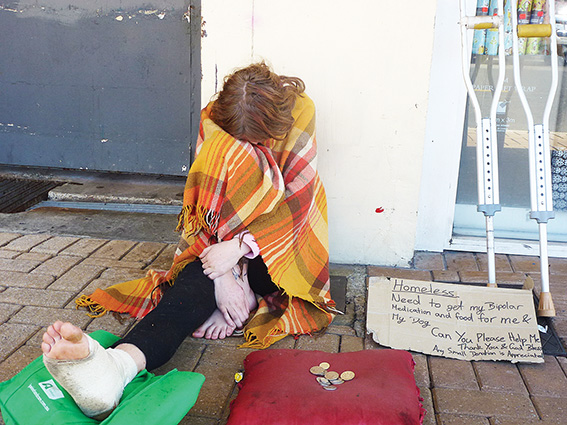
WITH regards to your lead story in the June 4 issue about the PCC Ranger and other staff’s treatment of the homeless young woman, I am disgusted.
Firstly, I have a friend who just returned from travels to San Francisco, and yes the very large number of homeless there included many with extremely aggressive behaviour, so this is a public disturbance and deserves to be handled as such.
But this woman was offending no one, and as far as debates about the legality of begging go, it would appear that there is no debate to be had. Bottom line is that it’s not acceptable behaviour by officers of a local authority on the job.
It brings to mind that movie of a few years ago “Trading Places”……. Keehan Flinders Street, Mt Hawthorn
IAN CARTER has been the CEO of Anglicare WA since 1995. He has held the positions of deputy president of the ACOSS, president of WACOSS and president of Family Services Australia; and was also chairman of both the state taskforce on poverty and the social housing taskforce. He was a member of the prime minister’s council on homelessness for over four years.
WHEN we first met Colin* at Anglicare WA, he had been living under a bridge for some months. His only possessions were the clothes he wore and a small pillow to sleep on. Most tragically, he had been ostracised from his family and had not seen his young son for years.
There was not a single issue behind Colin’s homelessness. He was unemployed, in financial crisis and because he was disconnected from his family, he had nowhere to go. He also suffered a debilitating alcohol addiction.
These situations are all too common for us at Anglicare WA. Homelessness is a complex and often multi-faceted issue. When we work with people who are homeless, it is critical that we address the full spectrum of issues they are experiencing and provide a truly sustainable solution.
In Colin’s case, on the first day our team worked with him for 10 straight hours. We used emergency relief funds to buy him some basic clothes and a blanket and helped him to purchase medication to ease his alcohol withdrawal. Our financial services also worked with him to develop a sustainable weekly budget.
Colin’s ultimate aim was to reunite with his son. For that to happen, it was obvious that we would need to help him to get off the streets and into stable accommodation.
Housing services are under enormous stress in Western Australia. Because of their high demand, many services require referrals, doctor’s certificates, and mountains of paperwork before they will accept an applicant. It took three days of intensive work with Colin, but our team managed to secure him a place with a crisis housing service. From here, he was able to move into a sobering up shelter and eventually book into a rehabilitation clinic.
We’ve kept in touch with Colin and things are looking up for him. Today, he has been sober for three months and has put on weight with a healthy, regular diet. He participates in work therapy and has re-connected with his parents. Best of all, his 12-year-old son has visited him – their first contact in six years!
Colin’s story is an excellent example of the kind of flexibility and variety that is needed to tackle homelessness in Western Australia. The days of single solutions to simple problems are fast fading. We need to forge networks of services that can help people like Colin with all of their challenges, rather than just work on one issue and send them away.
Affordable housing remains critically scarce for lower income families. Anglicare WA’s recent Rental Affordability Snapshot found that less than 1% of rentals in Perth are affordable to people who are on pensions or benefit payments.
We as a community need to make a commitment to preventing homelessness. This means investing in housing services, affordable housing options, employment and training, financial services and even relationship support services.
The support of the public is critical in this endeavour.
Anglicare WA has just launched its Winter Appeal to drive greater funding for our service network. Anyone who would like to support us can do so by calling 9263 2091.
THERE really was rice in my green tea (toasted), along with wild-flowers and lemon verbena leaves.
And there was I thinking the blurb on the menu was a bit like the description on a bottle of wine; pretentious flavours you try vainly to detect.
Secondeli in Mt Lawley is one of the first to serve Whistleblower Tea, produced by a WA start-up.
My meaningful green ($5) was superb, the slight bitterness of the green tea overlaid with a myriad of sweet flavours. And, full of antioxidants, it’s good for you too.
It arrived in a tall mug, the blend still infusing and the leaves and flowers looking like they’d just been picked.
Six teas
A choice of six teas range from delicate green tea to a robust Sri Lankan one.
But I’m getting ahead of myself, the tea being the finale of a very pleasant lunch at Secondeli. It started with a cheery “hi” from no less than three staff as I perused the joint and its many offerings.
The sun was warming a seat on the pavement so I grabbed a table outdoors despite the funky semi-industrial chic interior, where mellow jazz added to the ambience.
If it had been breakfast the coconut pancakes, with salted caramel sauce, bananas and hazelnut cream ($14) wouldn’t have escaped.
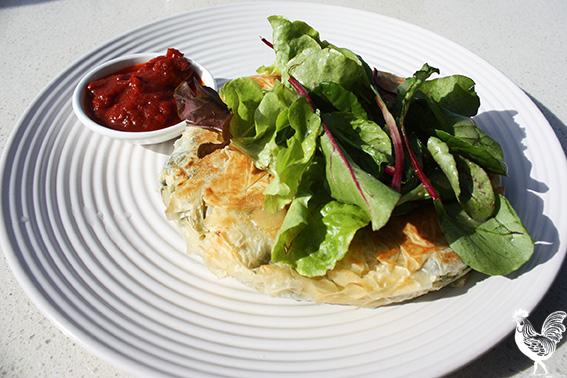
But this was lunch and a spanakopta $15) caught my eye.
Crisp, delicate filo pastry encased a tasty mix of spinach and ricotta, with plenty of flavour and none of the bitterness some spinach pies have. And the rich tomatoey chutney was a deliciously sharp accompaniment.
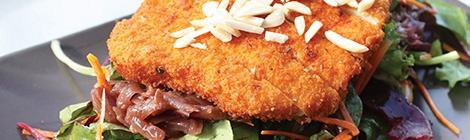
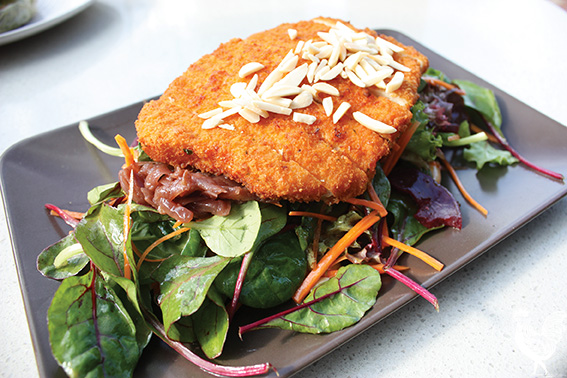
My companion took a nanosecond to choose the crumbed chicken breast with caramelised onion.
It’s coating was such a rich, golden hue he mused it deserved its own place at the London Metals Exchange, perhaps at $16/oz.
“Thick, even and delicious, it took aeons to make my way through to the chicken, where crunch gave way to a tender piece of breast. The caramelised onions were subtle and complemented the fresh salad, and left a pleasing zing in my mouth as a reminder of a lovely meal,” he enthused
The dessert cabinet was groaning under a great selection, but we finally settled on a Persian love cake (“I need love,” my mate said) and a sticky date pudding cake ($6).
Magnificent
Warm and moist, the sticky date was magnificent with the tea and quickly gobbled down.
The love cake was so moist it was threatening its own “not Persian – Iranian” decree and rebadging itself mousse.
“It was slightly more sugary and less piquant than other versions where they’ve hammered the nutmeg and cardamom to get that exotic east feel, but was delicious and well worth it nonetheless.”
by JENNY D’ANGER
Secondeli 751 Beaufort Street, Mt Lawley open 7 days 7am–4pm
“What’s love but a second-hand emotion,” Tina Turner belted out on her way to the top of the charts in 1984.
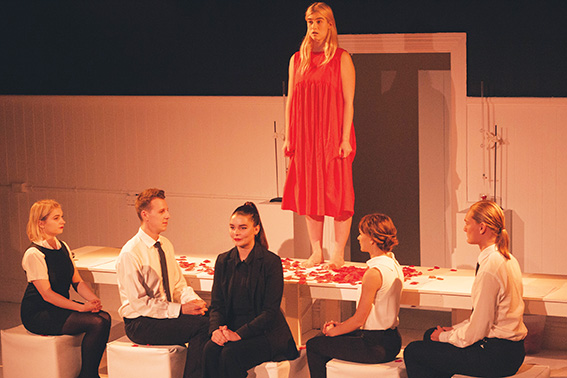
It’s a question a troupe of former WAAPA students explore in their collaborative play What’s Love Got To Do With It, currently playing at the Blue Room in Northbridge.
There’s a dark vein in the satirical look at love and loss, director Rachael Woodward says: “Does it benefit us? But then you look at what a world without love would be like.
“It’s a terrifying double-sided coin.”
The cast of six (Zoe Hollyoak, Tristan Balz, Phoebe Sullivan, Mariah O’Dea, Tristan McInnes and Jacinta Larcombe) take the audience inside a pharmaceutical company boardroom where the imminent release of a cure for love is being discussed.
In reality there’s plenty of scientists working on anti-love drugs, and it was an article in respected New Scientist magazine that sparked the idea for the play, Woodward says.
“We thought how is that a thing – to want to kill love?”
The article Cure for love: Should we take anti-love drugs, likens the emotion to an addiction.
“Breaking up is hard to do. If drugs could ease the pain, when should we use them?” neuro-ethicist Brain Earp pondered.
But Woodward wondered about what the world would lose if the pain and joy of love were simply anaesthetised; would artists still paint masterpieces, would writers be able to pen classics, would life be worth living?.
“We ask [the audience] to think about their lives,” she says.
Woodward describes What’s Love Got To Do With It is a fast-paced ride, with a cameo appearance by Hollywood romance icon Meg Ryan — or at least someone who looks like her.
“You end up laughing and then wondering what you’re laughing about.”
The 20-year-old has yet to have her heart broken, which piqued her curiosity: “That’s one of the reasons [for the play].”
During research she found plenty of “horror” stories about falling in love amongst the joy: ”Love is such a complex thing.”
What’s Love Got To Do With It is on at the Blue Room Theatre, James Street, Northbridge until June 25. Tix $18 at blueroom.org.au
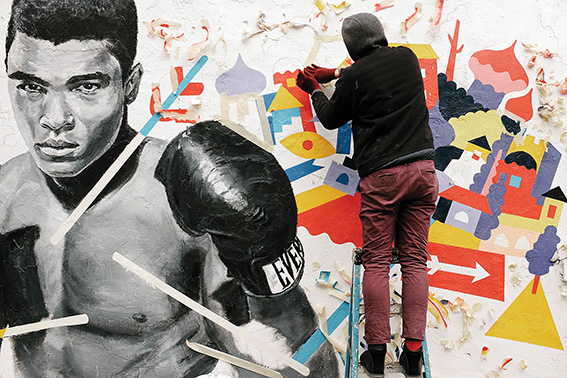
FORMER WA street artist Brolga has found himself in the limelight after one of his murals was co-opted by fans of Muhammad Ali to mourn the boxing champion’s death.
The graphic designer who now lives in Brooklyn, painted a large mural of the boxing legend on a wall next to famed pizza joint Joe’s Pizza last year.
New Yorker’s have been streaming past and laying flowers at the colourful image to pay their respects to the three-time heavyweight champion and social activist.
“It’s been visited by uncountable well-wishers and fans,” Brolga says.
• Brolga at work on his Muhammad Ali portrait.
Several international news organisations have also used the image in eulogies to the iconic fighter.
Brolga started off in Brooklyn wheat-pasting huge illustrations on walls around the city.
“I find it really interesting to see characters that have come straight from my sketchbook get thrown into the New York City landscape,” he says.
“Once they’re out there, the characters wear with the city and just become a part of the daily life.”
Brolga enjoys New York life, but says it can be tough for artists because of high rents and a huge talent pool to compete against.
He’s got a solo exhibition in Tokyo later this year, but is more excited to be returning home in July.
ARIES (Mar 21 – Apr 20) There’s a whole lot of love coming your way. Are you able to fully comprehend that this is so? Are you able to receive it? Or are you so busy going somewhere where you are blind to the screamingly obvious? There’s a feast to be had. Take time out from your pet adventures and let it in.
TAURUS (Apr 21 – May 20) Where others might baulk at being loved and pampered, you are completely at ease with it. The Cancer Sun means existence is behaving like a mother. Your legendary appetite for the good things in life comes in handy here. The more that you know you are loved, the more you achieve.
GEMINI (May 21 – June 21) Mercury remains in Gemini, keeping you sparky even though you are passing through a more inwardly focussed time than usual. Keep your curiosity alive, even when all the external entertainment goes away. You may find that the absence of entertainment is a good thing.
CANCER (June 22 – Jul 22) The Sun and Venus are in Cancer. The beauty of the sign of Cancer is that it hints at the wonders of love expressed. There are of course many things that go under the name of love. Not all are particularly nourishing. Know what love really is. Put it out there. Love embraces freedom.
LEO (July 23 – Aug 22) The Moon starts the week in Aquarius. Aquarius is cool and societally focussed. You are hot and individually focussed. The hint here is to slow down and get the overview. You might be barking up the wrong tree. Step back, see where you really are, and then reappraise your situation.
VIRGO (Aug 23 – Sept 22) Difficult things are proving easy and easy things are proving to be difficult. You are able to assess and make major changes to a large project, whilst being completely floored by the misbehaviour of your home printer. This is a good week for retaining perspective and remaining loving.
LIBRA (Sept 23 – Oct 23) As the Sun and Venus make their way through the watery world of Cancer, so you are confronted by your feelings. It’s all too easy to get entranced by the world of ideas, especially great or beautiful ideas. It’s the state of our feelings that shows where truth really lies. Be vulnerable to love.
SCORPIO (Oct 24 – Nov 21) Mars is providing you with bucket loads of creativity and bucket loads of impetus. Let yourself be driven. It’s not going to last forever and it’s not worth sacrificing for other people’s dubious opinions. Open yourself up for adventure and change. Show off your brilliance and your wit.
SAGITTARIUS (Nov 22 – Dec 21) There are roadblocks all the way. Everything you want to do seems to require the patience of Job. It’s time to put your toolbox down and change tack. The Sun is in Cancer. It’s time to figure out how life is loving, mothering and supporting you, in all sorts of strange and interesting ways.
CAPRICORN (Dec 22 – Jan 19) Trust the crazy, left-brain insights you are having. They will help you to find ways through your present dilemmas that tried and true formulas can’t. Use your intelligence rather than wilfulness and blind force. This will give you the wisdom and the energy to go around all obstacles.
AQUARIUS (Jan 20 – Feb 18) The Moon begins her week in Aquarius. She doesn’t stay for long, but long enough to make you feel refreshed. If you can put aside any habits of complaint that may be dogging you, and look around, you will discover that there is a whole lot of love coming your way. See the obvious.
PISCES (Feb 19 – Mar 20) By Monday the Moon will be in Pisces. She will charge you up with a feeling of possibility. Deliberately sift through habitual currents of emotion, to find the currents of feeling that will serve you best. The Cancer Sun is here to give you the sense that existence loves and supports you.
RAW brick, industrial roof lines, huge steel doors and massive girders, the Maltings in North Perth took out numerous awards for its mix of heritage and development.
“A first-rate example of urban renewal because of its blend of heritage and history with modern living,” Development Institute of Australia judge Peter Lanigan said in 2006.
New buildings rub shoulders with old ones (including the brewery’s stables) in this mix of apartments and townhouses.
Quirky
The industrial grunge of the warehouse conversion mixes with gorgeous, and at times quirky, landscaping.
There’s a private museum, a vast space of huge timber beams and equipment, and the commodious community lounge and kitchen still has a giant hopper and a couple of roasting ovens.
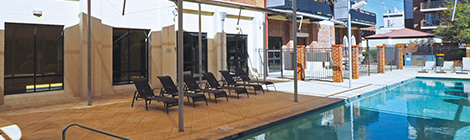
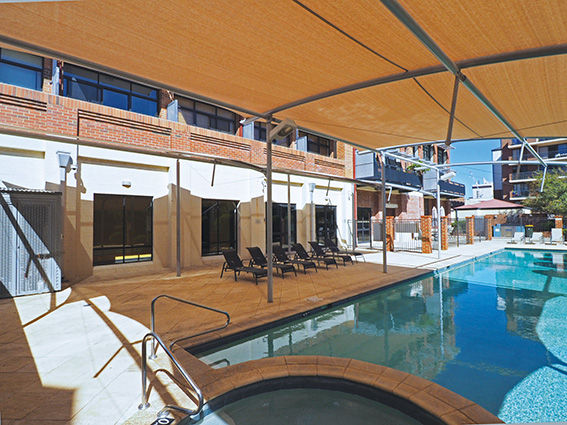
Bring your mates around for a barbie by the pool and show off some of North Perth’s unique history between dips.
The huge communal area also boasts a sauna and gym, and a conference room for those working from home.
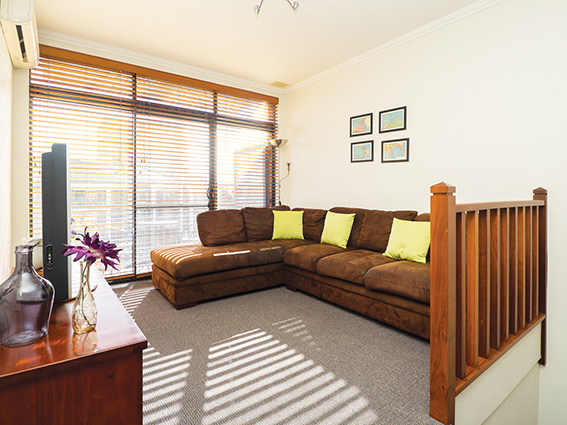
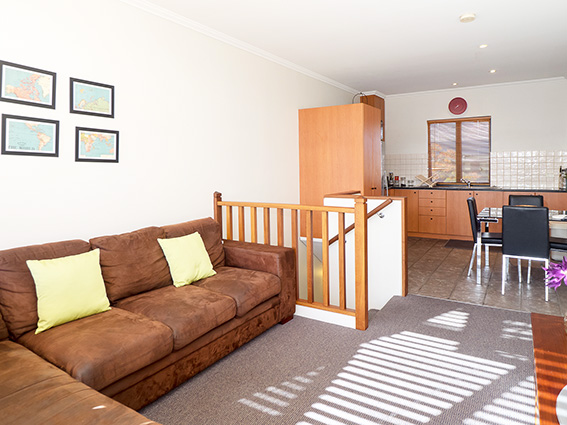
Apartment 8 is the perfect inner-city starter for those on the first rung of the executive ladder, or perhaps retirees looking for a lock and leave.
Life doesn’t get much simpler with a lower level bedroom and bathroom/laundry and upper level living, each with a balcony.
Sculptured gardens
The pleasant open-plan is found on the second level, where a wall of glass onto the balcony overlooks the pool and spa and beautifully sculptured gardens, which with a central fountain and manicured hedging is reminiscent of a pocket-sized Versailles.
The apartment’s kitchen is compact rather than squeezed, with lovely biscuit-coloured timber-look cupboards, a floor-to-ceiling double pantry, and stone-tile floors.
New owners will be forgiven for daydreaming at the sink, with views of another lovely garden, currently a blaze of autumn reds and golds.
And for romantic dinners for two, there’s the small balcony overlooking Versailles.
The apartment has undercover parking for one car in the well-secured grounds.
by JENNY D’ANGER
38/65 Palmerston Street, Perth high $300,000s Claude Iaconi 0412 427 877 Abel McGrath 9208 1999
Each year our aid has sent more than a million children to school, vaccinated over 2 million children and supplied almost three million people with clean drinking water.
Australian Aid has helped win the fight of eradicating global poverty which halved over the last 25 years.
But this year Australian aid was been cut to a mere trickle, to its lowest level ever, and we need to get it flowing again.
That’s why we are walking with buckets on our head – to show our solidarity with the world’s most vulnerable people, including the 900 children who will die today because of unclean water, and the millions of women and girls currently labouring right now with water containers on their heads, taking them out of school, paid employment and community life.
Our aid cuts mean millions are missing out. So this election we’re asking all political parties to pledge to increase aid in line with our global responsibility. This means increasing aid from 23 cents to 70 cents in every $100 of gross national income by 2030.
This campaign for Australian Aid represents over 65 aid and development organisations, businesses, community groups and faith communities and over 80,000 Australians who have signed our pledge. We need your help too.
Walk with us and make a difference.
Date: Friday 24 June 2016 Time: 3:00pm – 4:00pm Place: The walk starts at Forrest Place RSVP: bit.ly/bucketwalk http://www.australianaid.org
WHEN Mt Lawley’s Laila Shalimar became interested in vintage fashion and culture, there was one hitch; all the role models were white.
“It was really hard being someone who was brown to relate to American and English and Australian actors,” says Ms Shalimar, who grew up in Pakistan near the border of Afghanistan.
“I didn’t look like them, so it was hard to picture myself as a Marilyn Monroe or an Audrey Hepburn.”
When Ms Shalimar arrived in WA as a 16 year old she says she was seen as “that weird foreign kid”.
Trying to fit in, she stumbled into the vintage lifestyle when a teacher who was obsessed with old movies started up a club to screen the classics.
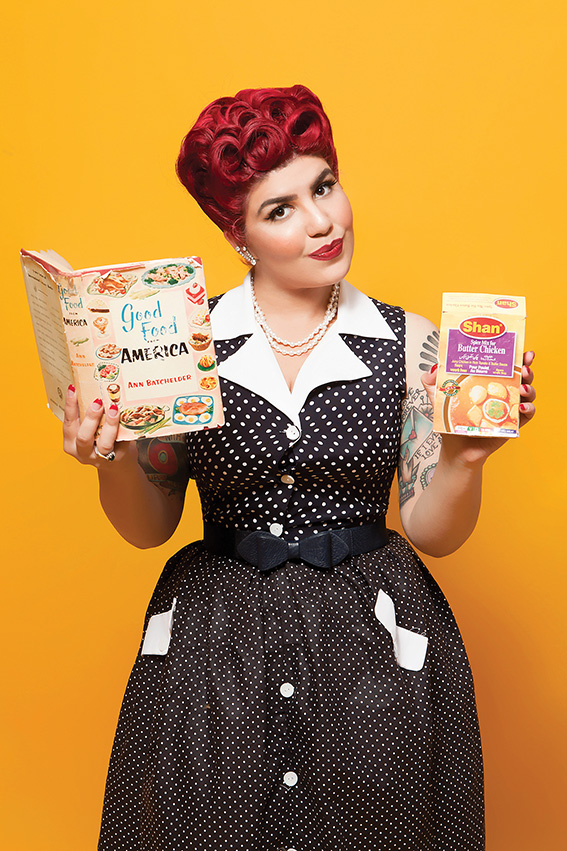
• Laila Shalimar’s hopes of fitting in by going retro didn’t quite pan out as she expected, but look at her now. Photo by David Woolley of Vintage Glamour Photography
“I thought it’d be a great way to meet people,” she says, but “sadly enough it was just me and her and one other person.”
But the subculture stuck with her.
”It gave me an identity when I moved to Australia,” she says. “It gave me something to relate to people with.”
Modest and fashionable
It was also a good compromise for a young girl caught between two hemispheres: “My parents are quite conservative, so the 50s stuff is a middle ground: It allowed me to be modest and fashionable.”
Now studying criminology and counterterrorism, a bit over a decade later Ms Shalimar has been selected to compete in the Miss Pinup Australia semi finals in Melbourne, a big deal in the vintage glamour world.
Being a Muslim competing in a beauty pageant has drawn a few raised eyebrows (especially as she’s in the “illustrated”, or tattooed section), but she finds it reductive when people try to define her simply by her religion.
She says they also jump to conclusions when they hear her father, a Pashtun originally from Afghanistan, isn’t keen on her participating in the pageant.
“It’s not because he’s a Muslim man, it’s because he raised me a feminist and he thinks a beauty contest is a waste of time,” she laughs.
Ms Shalimar says she thinks her mother’s progressive outlook has rubbed off on her father.
Her mother was a medical student while Pakistan became increasingly Islamicised, and was at the forefront of protests against the restrictions being imposed on women.
With fellow students she burned her chador (the garb that covers everything but the face) that clerics were trying to force on them, arguing it was too restrictive to practice medicine in.
Ms Shalimar says despite her father’s misgivings, Miss Pinup Australia is more than a shallow looks-fest.
“He’s still convinced it’s just a beauty contest, but I’ve seen it do amazing things for people’s lives.
• Laila Shalimar’s off to compete in Miss Pinup Australia. Photo by Jennifer Villalobos Photographer
Confidence boost
“I’ve seen great things come out of it. It’s given me that little bit more of a confidence boost, so I can be really pretty and still be terrifying!”
For the talent portion she’s drawing on the four languages she speaks—Urdu, Pashtun, a mild amount of Punjabi, and English—to compose a poem with each stanza in a different tongue.
The contest also looks at charity work and social media conduct in the leadup, and while some in the vintage community are wary of new tech, the internet’s been valuable to connect with other like-minded people.
“There’s beauty standards anyway for women, and when you’re a brown woman it’s so hard to like yourself,” she says, but since regularly chronicling her fashion photos and vintage activities she’s been getting great feedback.
“I’ve had women from all around the world saying ‘I didn’t even know you could be a pin up and brown, I want do do this! I’ve had a great response from people.”
She’s also mining her heritage for her performance at the event, researching the history of the region’s fashion and culture around the 1947 partition that created India and Pakistan.
“I knew I didn’t just want to do a run of the mill story, I want to do something that speaks about me, and how my 40s and 50s would have been like.
“I didn’t know much about my country in the 40s and 50s… I don’t really have any grandparents left, and my aunties and uncles don’t want to talk about what happened during partition.”
She reached out to other people from that part of the world, “but everyone came back with the same story: It’s too painful to talk about, it was a very painful time. For us it was a separation of two peoples. A lot of families were lost and a lot of culture was lost, and a divide was created. So that’s why people don’t like to talk about it.”
What she’s finding blows apart stereotypes of drab, dour dress from that era. “My grandmother used to wear the Mughal style: They’d wear really beautiful, ornate, almost 50s dresses with tight pants. They were really beautiful but quite conservative.”
And with a history of British colonisation, the English women still living there would bring in copies of the Women’s Journal, whose western 50s dress patterns would be sewn together with traditional sari materials.
“I want to clear up any misconceptions about what my country was like in the 40s and 50s, about beauty standards, and what south east Asian women are like.”
She’s off to the Miss Pinup semi finals in Melbourne on June 18. Keep track of her vintage journey she’s Laila Shalimar on Facebook or midcentury_mermaid on instagram.



















 Perth Voice Interactive