A FACEBOOK page purporting to represent white UWA students has popped up, likely as part of a worldwide troll movement to establish pages with little connection to real students.
The UWA White Student Union, with a modest 52 likes at the time of writing, states “finally an organisation on the UWA campus exists in order to cater for white students”.
“There are many issues that are unique to white people, and that have been largely unaddressed on campus. UWA WSU will serve partly as an advocacy platform, and partly as a social club.”
The admin goes on to say “despite the many achievements of Western Civilisation, UWA WSU does not endorse white supremacism, and racism is not welcome on this page”.
The Voice contacted the page administrator but did not hear back. Despite a slogan of “100% white, 100% proud,” none of the organisers was proud enough to put their identity on the page.
UWA requires anyone seeking to use its name or logo to get approval. Media man David Stacey says the uni’s reported the page to Facebook HQ.
Whoever set up the UWA page was either familiar enough with the school (or did their homework) to be able to name several other student guilds and understand the affiliation process to become an official club.
MORE than a dozen mature trees will be axed in one swoop in Noranda because Bayswater council has failed to maintain them over the years, green thumbs claim.
The council this week decided to chop down 13 trees—half the stock at the small reserve on Noranda Place—because of two potentially fatal incidents involving falling trees in the past month and neighbourhood complaints, mainly over leaf and branch “litter”.
A report, tabled at the special meeting, states the $13,000 axings will “reduce canopy” and safety risks. The entire project will cost $47,000: $5000 to inspect remaining trees, $15,000 on grass, and $14,000 on 28 new trees across the road at a larger park.
Urban tree network member Jacquie Kelly says it’s odd so many “need” chopping down, saying there wouldn’t be a problem if they’d been properly managed.
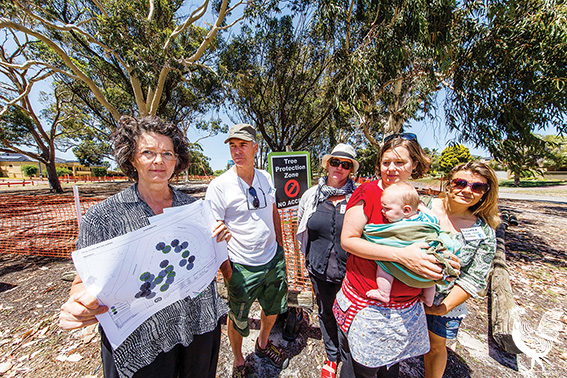
• Members of the Bayswater Urban Tree Network Jacquie Kelly, Lucy Gibson with baby Paddy Walker and Branka and Lazar Radanovich. They’re up in arms over the planned felling of 13 mature trees at Noranda Avenue Reserve. Photo by Matthew Dwyer
Fellow green thumb Branka Radanovich is taking the issue higher up, raising it with politicians, including federal Labor Perth MP Alannah MacTiernan.
“I’ve questioned the City of Bayswater’s so-called ‘tree management’,” Ms Radanovich says, accusing the council of “covering up” its mismanagement.
“It’s like going to a dentist and them saying you need to get 13 teeth taken out.
“Isn’t the problem then that I haven’t properly looked them? Something is wrong here.”
Mayor Barry McKenna “totally rejects” claims the council has mismanaged its trees: “Those trees fell over because of a fungal infection at the roots and base, and historically we know this has happened in the past because of root disturbance from road works,” he says.
Repeated Voice questions over whether the trees were pruned over the years and maintained to a certain standard were met with the response, “there were several reports on those trees over numerous years”.
In November, a marri red gum fell on a moving car, and “thankfully” no-one was injured. In the same month a lemon-scented gum fell, narrowly missing a motorist.
Three councillors voted against the decision: Crs Dan Bull, Chris Cornish and Sally Palmer.
The council expects to spend $1.6 million on tree maintenance this financial year.
A VETERAN scrutineer says the WA electoral commission did not run the vote well in the City of Canning, echoing concerns laid against the organisation by former Bayswater councillor Michael Sabatino (see page 1).
The Voice spoke with Dean Blanchard, a scrutineer for Joe Delle Donne, the mayor who was booted off council by more than 1000 votes.
Mr Blanchard has his own concerns over how the WA electoral commission handled votes, saying election night was “unorganised”.
“I’ll say what I saw and it was not run well at all,” says Mr Blanchard, who has counted state election votes.
“It was very hard for a scrutineer to do their job.”
He says the mayoral ballot was counted at two tables at one stage, and “too many” people—up to 11—were sorting out already-opened envelopes.
He says some people were even counting votes on cardboard boxes, away from the tables.
“My overall feeling is that this is going on all over the state,” he says.
“The most worrying thing for me was that envelopes had already been opened and sorted and rubber-banded into lots of 100. That surprised me.
“There was a little bit of secrecy and it was a bit of a rush. But I wouldn’t say there was anything dodgy happening with the count. It’s just the system is all over the place.”
THERE’S a certain frankness about Wiwince Pigome when she talks of her tortured father, his subsequent premature death, and her murdered grandfather and uncle.
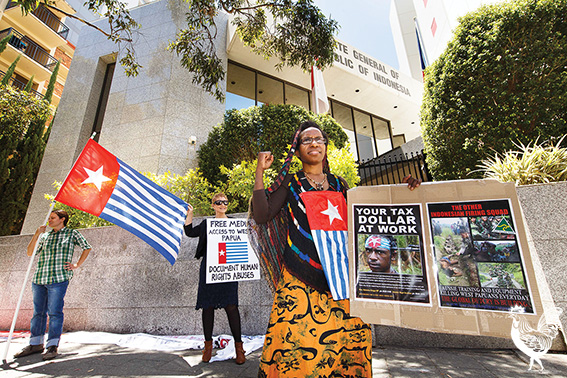
There was no quiver in her voice when she spoke about the trauma at a silent vigil in Perth CBD this week to protest Indonesia’s occupation of her former homeland, West Papua, virtually within shouting distance from Australia’s northern tip.
“When my father was tortured, my mother was heavily pregnant with my older sister,” Ms Pigme told the Voice, standing outside the Indonesian consulate, in front of posters of bloodied people lying in ditches with armed, uniformed men standing over them.
“My mum is still living with the trauma. She was telling us all these stories, while we were at home, when no-one could hear her, because we are not allowed to study our history in Indonesia or talk about it.”
• Wiwince Pigome and supporters staged a silent vigil at the Indonesian Consulate in Perth CBD on Tuesday this week. Photo by Matthew Dwyer
For resisting the Indonesian government, which has controlled West Papua and its resources since 1962, the 34-year-old says her people are condemned, tortured, raped, imprisoned and murdered.
Human rights activists say more than 500,000 have died at the hands of Indonedia’s armed forces.
“People still have no say at all, even after 54 years,” Ms Pigome says.
“You are not allowed to protest or have an idea, or make a difference for your own people.
“You are basically a robot. The government is actually telling you what to do.”
A group of three Australian federal police agents attended this week’s vigil to “protect the dignity of the consulate”.
Ms Pigome has been protesting with like-minded friends outside the consulate for four years. Last year, three federal police cars attended.
This time, agents and an Indonesian official stepped in to tell Ms Pigome to remove posters from a consulate wall.
“It is my property,” the official says.
“There is control no matter where we are,” Ms Pigome retorts. “This is typical.”
She is part of an international campaign for West Papuan independence, freedom of expression and justice which has been slowly gathering speed since the 1990s.
Ms Pigome migrated to Australia in 2003, and while she fears death upon any return, she says her generation will “never shut up”.
She urges Australians to join her fight. The December 1 vigil marked the 54th anniversary of the declaration of the new nation in 1961 — following the departure of Dutch overlords — which lasted just a year before the Indonesians invaded.
VINCENT mayor John Carey wants to abolish alfresco licensing fees, saying it makes no sense to put businesses through the rigamarole and expense of applying for permits given they’re helping liven up the place.
It costs $73 to apply for a yearly permit and $88 per sqm used, but Mr Carey says “what we find is it’s really the inconvenience factor” that stops businesses from bothering.
“What we want to see is … if you’re going to do something within the standard parameters of alfresco then you wouldn’t need to come and get approval for us.
“We want to see a system for cafes, retail, any business, so they don’t have to come to council to put out chairs, planter boxers or alfresco tables.
“Activating streets is good, it adds to vibrancy, it’s good for business… it encourages people to linger longer and that’s what we want.
“It’s not just about cafes, that’s what I love about many overseas countries: retail shops, laundromats will put a couple of benches out front. They’re not trying to sell food, they’re looking to create an experience outside their shop.
“The role of local government should be as a facilitator to activate our streets and make them vibrant, not this hardline regulator that tries to trip businesses up.”
The same idea had been floated across the border by Perth city councillor Reece Harley in his unsuccessful lord mayoral campaign.
MORE than 200 residents attended a public meeting organised by WA Labor to discuss rail options in the Bayswater/Maylands area as part of its MetroNet transport plan.
Maylands MP Lisa Baker says feedback confirms the Caledonian Avenue crossing at the railway is a bone of contention for many motorists. She promises a Labor government will build a crossover.
However, the party will take its time considering all other tabled ideas, such an underground station at Bayswater, with no big promises likely before budget time next year.
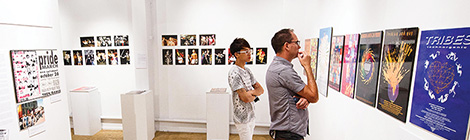
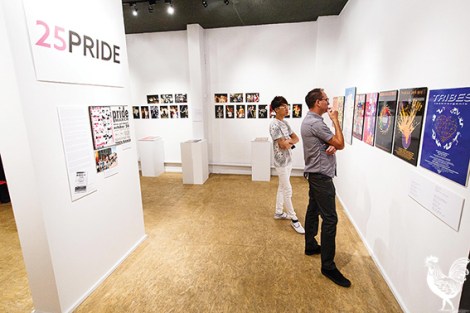
TWENTY FIVE years of Pride festival history has been put on display at the Museum of Perth.
The folks from the independent not-for-profit museum have dug through the Gay and Lesbian Archives of WA to unearth posters, photos videos and artifacts from a quarter-decade of Pride.
The movement started back in the early days of the Stonewall Union of Students WA as a grassroots political movement, with the early 1990 photo of the first Pride march showing a bolshy protest with a political bent, morphing over the years to become a celebration of community.
Museum chair Reece Harley says they picked this topic in part because the museum’s “keen to shine a light on stories which don’t get enough attention in mainstream media”. GALAWA, which started up in the mid-1990s, had carefully collected rare material from the community but for years it’s been sitting in the basement of Murdoch uni library.
• The first Pride march, in 1990.
With a new committee getting together earlier this year they were keen to get the material out there, with photos of the first protest full of feathered hair and ‘90s fashion (who knew mum jeans would come back?) through to rolling footage of last year’s more festive celebratory parade.
It’s on until Dec-ember 13 at the Museum of Perth in Grand Lane, just off the Murray Street Mall, entry by gold coin donation.
SUICIDE claims a person a day in WA: it is the leading cause of death for Australians aged between 15 and 44.
Over the festive period Lifeline estimates it will receive a call every 37 seconds, with one in four callers at imminent risk of taking their own life.
“Christmas is usually a time of family, sharing and giving, but for some people it can be a time of despair, loneliness and isolation,” says WA Lifeline CEO Fiona Kalaf.
“We have launched the Lights for Lifeline campaign to raise funds to train more accredited volunteers who do such important life-saving work.
“It costs $3000 to train each volunteer for the telephone crisis support service, with many months training and one year probation.”
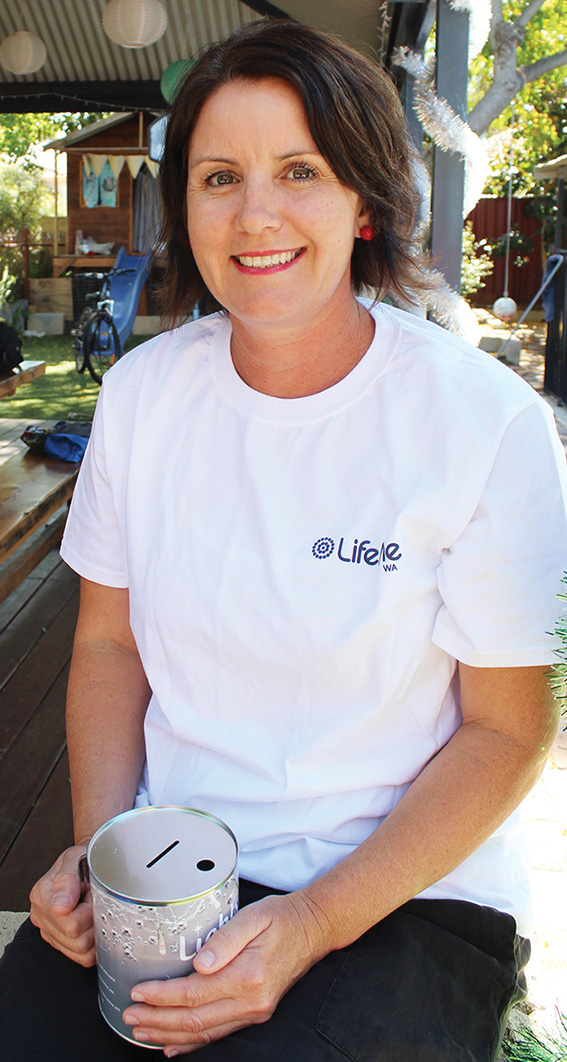
• Lifeline’s Jo Lockhurt. Photo supplied
Lifeline manages to answer 90 per cent of calls Australia-wide, but the work is so emotionally intense that volunteers usually work four hours per week.
Over the past 12 months, 57,265 Western Australians called the service, and it received 14,196 online crisis chat requests.
Jo Lockhurt, a “Telephone Crisis Supporter”, says the role requires a unique skill set.
“Being on the phones we cannot see or touch the person in crisis, so essentially you lose two of your senses, you must learn to really listen and be 100 per cent present in every caller’s personal situation,” she says.
“The role requires learning a very unique set of skills, different to face-to-face on-going counselling, hence why the training is so involved.
“You must provide a caller with a safe and non-judgemental space to talk and be heard.”
Lifeline WA patron Kerry Sanderson says volunteers are the “lifeblood” of the organisation and work tirelessly.
“I strongly encourage all Western Australians to support Lifeline’s work to help those in need,” the WA governor says.
For every $50 donated, people have the chance to go into a draw to win a Mazda2 Neo Sedan.
IT’S been 15 years since the belltower opened on Perth’s foreshore, its planning, expense and construction plagued with grumbles.
A chief criticism these days—that the belltower is too short and unimpressive—must grate with former Liberal premier Richard Court, who’d wanted a much bigger tower.
An editorial in the West Australian newspaper on October 20, 1998, however picked up on narky public sentiment and an unrelenting campaign by the Labor opposition.
The paper urged the then-premier to “think again about the size of the proposed belltower—a structure as high as the Statue of Liberty seems grandiose for the Perth riverfront and would be out of scale with the city”.
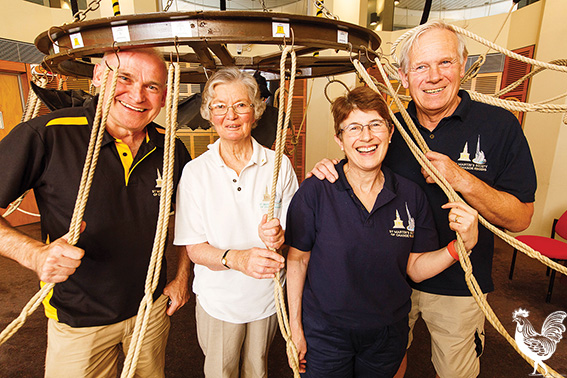
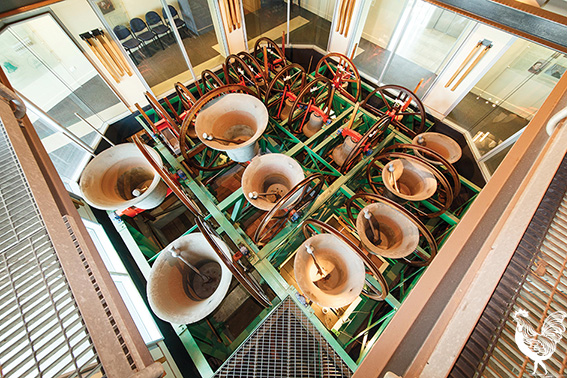
• Robert and Sally Nicols from Cumbria, UK, pictured with local bellringers Richard Offen and Laura Ivey of Menora, went back home to learn the art to ring their own town bells in Cockermouth. Photo by Matthew Dwyer
The cost also drew fire: ”Will they ring the bells each time a long-suffering patient died waiting for admission to our crowded hospitals?” Freda Hatton of Yanchep wrote in a letter to the editor, one of many that flooded Perth’s papers of the day.
Eventually, a scaled down 82-metre version was erected, opening December 10, 2000. There were grumbles for and agin it, but about as much as any new project garners.
As for the bells inside the tower, their history reaches back far longer. Called the St Martin-in-the-Fields bells, they date back to at least the 13th century. They’ve been recast a couple of times over the centuries (melted down and some new metal added), but have rung out to signal the end of the Battle of Trafalgar, and again at Lord Nelson’s funeral. Their Australian link was being rung to announce the return of Captain Cook to England after charting Terra Australis.
Bellringer and Heritage Perth chief Richard Offen has his own history with the bells: back when he used to live in the UK he rang them at their original home at St Martin-in-the-Fields.
Having been a bellringer since the age of eight, he recalls “I used to ring them virtually every Sunday in the 1970s”. Before they were restored, he recalls them as “dismal, they were bloody hard work and they sounded dreadful”.
They were destined for recasting but local bell enthusiast Laith Reynolds caught wind of it and negotiated instead for their repair, and that they should be gifted to WA for Australia’s bicentennial. In return, an equivalent weight of WA copper and tin was gifted to St Martin-in-the-Fields.
When Mr Offen came to visit Australia, he toured Perth to see where his old bells wound up, and ended up living here himself.
He says these days the tower’s reputation has recovered, despite early days when it “really did suffer from distorted public opinion, which was fueled by one or two sections of the press who mounted a very aggressive campaign about it”.
Now, “it’s one of the few iconic millennial projects in the world that came in on time, on budget and is still in place,” Mr Offen says. He compares it favourably to London’s Millennial Dome which cost $700 million and “was a total damp squib”.
“It is genuinely unique in the world,” he says. “People pooh-pooh it here. Say what you like about it. You walk into a tourist information bureau or a travel agent in England or America and ask for a brochure on WA, nine out of 10 times what’s on the cover? It’s that building.”
It’s also had an effect that the average punter might not realise, in the boost it’s given the art of bellringing in Perth.
Before the tower was built, Mr Offen says Perth, “was really a campanological backwater”. Now, “as a result of that tower where there is unlimited practice time in near perfect condition… one of the bellringing groups in the UK nominated us as one of the top 10 bellringers in the world.”
The Belltower officially turns 15 on December 10 and there’s half-price entry on the day.
MAYLANDS crafty sort Angela Loucaides is urging more people to take up the old time arts and crafts before they die out.
Ms Loucaides learned needlepoint back in the ‘70s but has watched with sadness the number of Royal Show entries in her category, and many others, dwindle over the decades.
“In 1997 [when she first entered]… there was four or five different classes,” she says. “When I first started I thought I’d be lucky to be hung, there were so many entries in those days. Now we’re just down to one class and not very many entries.”
Back in the 1970s (and freshly here as a “ten pound pom”) Ms Loucaides worked as a mixologist at the Parmelia Hotel bar in the city, practising a very different craft — of mixing cocktails.
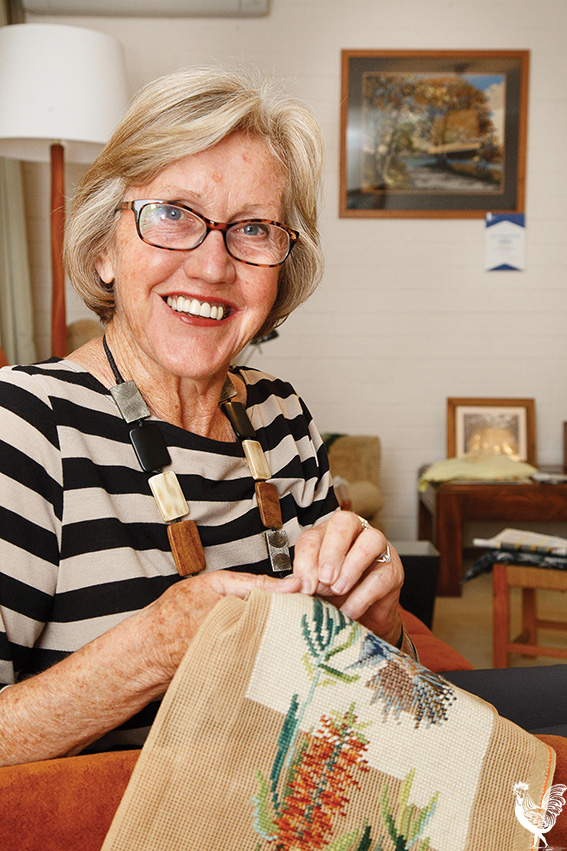
• Angela Loucaides doesn’t want the old crafts to be forgotten. Photo by Matthew Dwyer
At the time the bartending world was still strongly old fashioned and women weren’t fully welcomed: “I went into the inaugural cocktail mixing competition in 1971 and I wasn’t allowed to win because I was a woman, and I couldn’t go to the Australian championships because it was men only.
“I couldn’t join the United Kingdom’s Bartender Guild because it was men only.”
Ms Loucaides picked up needlepoint because she had an impending operation at Mount Hospital and was going to be confined for a few days. A fellow bar worker suggested she do a little tapestry while bed-bound and she was quickly hooked.
She came away with first place this year but with her craft and many others becoming more rare she’s worried the skills will die out.
She’s urging people to pick up a knitting set or a hammer and chisel or anything else crafty to keep traditions alive.
“If we don’t, all these lovely old crafts will disappear.”















 Perth Voice Interactive