AS Australia Day nears some councils are embracing it, some are avoiding it and some are just not saying the name.
From 2017 to 2022 councils had been required by federal dictum that if they held a citizenship ceremony in January, then it had to be on Australia Day.
That’s made for an awkward celebration for some councils caught amid increasing opposition from many Aboriginal people and their supporters to celebrating what they describe as “Invasion Day”.
• Perth Lord Mayor Basil Zempilas and (below) photos from Bayswater’s 2023 “Community BBQ Breakfast”, neatly omitting “Australia Day” from the event title.
Last year was the first time councils had been allowed to veer off the January 26 date for their citizenship ceremonies, following changes by the Albanese government.
According to the Liberal shadow minister for citizenship Dan Tehan, 81 councils around the country are now refusing to conduct citizenship ceremonies on Australia Day.
Here we take a look at how our locals are handling the situation:
PERTH continues to hold citizenship ceremonies on January 26 (as well as other dates throughout the year) and is celebrating Australia Day with a fireworks and drone show sponsored by Hancock Prospecting. Lord mayor Basil Zempilas said this month that the prime minister should just change the date if that’s what he wants.
“By allowing Councils to make their own choice over the date for their events – knowing full well many of them will choose not to conduct them on Jan 26, he encourages other organisations to actively diminish Jan 26 also,” Mr Zempilas said on social media on January 11.
“If you want the date to change PM, lead that change. Otherwise tell everyone to get in behind Jan 26.”
VINCENT was one of the first to switch their January ceremony to another date in 2023, after lobbying the federal government for several years to allow councils that freedom. As in previous years, they’re not holding any Australia Day celebrations. If you’re missing your council-provided sausage sizzle, then Vincent staff and councillors are hosting a bbq outside the Vincent Street HQ on February 1 at 5.30pm. But it’s not Oz Day-related, it’s just to entice people to come along to the AGM afterwards.
STIRLING continues to celebrate the date, holding an Australia Day breakfast at Des Penman Reserve in Nollamara from 8am to noon. It’s run by the Lion’s Club and there’s kid-friendly activities, with entry via a gold coin donation.
Bayswater has sidestepped the issue for now, running a “Community BBQ Breakfast and Citizenship Celebration” on January 26 but with no mention of “Australia Day” in the event title.
The day is only mentioned in the finer text, thanking one of the sponsors, the National Australia Day council.
In 2023 the council went out to public consultation on the thorny issue, with the council to consider feedback in early 2024.
A MAYLANDS resident who has gone through a year of administrative hell is facing another three month delay before a laneway can be named to help ambulances find her home.
Back in October 2022 resident Peta Illich beseeched Bayswater council to name the right of way her house sits on, which is between Crawford Road, Stuart Street, York Street and Alma Street. She wrote that “I have had to call an ambulance on several occasions; issues have arisen when our right-of-way was difficult to find and resulted in me having to wait at the entrance on York Street and direct them up the hill to the house, or at night I have to flash a torch down the laneway to attract attention.
“My son is unwell and I am a pensioner and at times our home needs to be found.”
The council picked two potential names in January 2023, Kuser and Ginger, both named after World War 1 soldiers. But after advertising the options with the public they found too many people didn’t like the idea of naming yet more streets after males, given the gents are already pretty widely recognised in local street and park names (‘Street names too blokey’, Voice, June 3, 2023).
So to prevent such lengthy waits Bayswater council set out to put together a list of acceptable names to have on hand to quickly dole out whenever a street or park needs a moniker.
• Freiderich Wilhelm Gustave Liebe: An acceptable person to name a street after. Photo via the Liebe Group
Years passsed
The public submitted a total of 51 names, and Bayswater council staff have deemed 44 of those fit with the requirements of the Geographic Names Committee that advises Landgate.
The GNC requires that when a person’s name is used, they must be dead and must have a “demonstrated record of achievement” and a long-term association with the area. Noongar words are also allowed as long as it’s connected to the area and approved by local elders.
Councillors will vote on whether to endorse the list at the January 30 meeting, though they’ll still have to go to the GNC for final approval whenever the time comes to actually name a place.
The GNC stopped approving ready-made lists in September 2023, on the grounds that sometimes many years passed between the lists and the naming and community sentiments changed (that grounds proved correct in the case of Kuser and Ginger, at least).
The council will also vote on whether to finally give the Maylands lanes a name, picking one of the three on the new list of approved names.
That’s pegged to take another few months, including 30 days of public advertising, and is due back to council at the April 24 meeting.
A staff report to councillors says “since the deferral of the matter at the May 2023 ordinary council meeting, the resident contacted the City a number of times requesting progress updates on the naming of the laneway”.
by DAVID BELL
——————————————
Here’s some of the notable new names that’ve been deemed acceptable to name streets and places after, subject to council approval and a final sign-off by GNC:
Liebe: After Freiderich Wilhelm Gustave Liebe (1862-1950), the Prussia-born farmer and builder. The Peninsula Hotel (built 1906) is considered his finest work.
Chong: To commemorate Hu Che-Em, born in 1873 and arrived in Australia in the 1890s. Hu Che-Em was a market gardener trading as Hop ‘Hoppy’ Chong.
Cumper: To commemorate Fay Cumper who worked at the Blind Institute in Maylands until retiring in 1991.
Moon: For Albert Moon, who attended the Royal Institute for the Blind and went on to work in the institute’s looming factory.
Djidi Djidi: The Noongar name of the Willie Wagtails common throughout Bayswater, derived from the sound of the quarrelsome bird’s song.
Rejected
Karrak: The Noongar name for the red-tailed black cockatoo sometimes seen in the trees along Bayswater’s wetlands.
Yellardonga: The name of a Whadjuk Noongar leader on the north side of the river.
Some of the names that have been rejected:
Bean: Suggested “to commemorate a loving and selfless dog who is wildly regarded by the Bayswater area as a ray of sunshine and someone who brings joy and happiness to all that meet her”. However Landgate rules don’t support naming streets after pets.
Fairbeard: After private Charles Henry Fairbeard, an Indian-born Anzac who came to Australia in 1912 and was among the first to join the Australian Imperial Force at the outbreak of WW1, and died at Gallipoli. While WW1 veterans were once frequently selected to have streets named after them, Fairbeard is on the “no” list due to not having enough of an association with the area. Baysie: The diminutive term for Bayswater won’t be allowed because it is “not in standard English”.
LITIS stadium will finally get its federally-funded upgrades, more than five years since the truly strange circumstances surrounding $3million of grant money offered by the federal government in 2018.
Vincent council owns the property and the main lease is held by football club Floreat Athena.
Back in August 2018, then-senator for One Nation Peter Georgiou announced $3million of federal funding was on offer to upgrade Floreat Athena’s home ground.
That was a huge surprise to Vincent council: Despite owning the property, no one had told the council of the announcement, and they were unwittingly caught up in federal politicking.
• Designs for the Litis Stadium upgrades, with work commencing in late January.
Floreat Athena’s management of the day hoped that bringing $3million in upgrades would convince Vincent to give them a long-term exclusive use lease over the grounds.
But that was at a time when Vincent was bringing an end to the era of one club having exclusive-use of its grounds, and steering towards shared use by multiple groups. The council refused to green-light Athena’s plans.
New blood
New blood at Athena and a shift in club culture eventually saw relations with the council grow warmer, and Athena accepted new buddies with the Vincent City Ducks gridiron team now sharing the grounds.
Now, with Vincent having had time to draw up a proper long-term plan for the stadium and its surrounding Britannia Reserve, construction is finally starting this month. Works include roof repairs, kitchen upgrades, new flooring, new electrics and constructing publicly accessible gender-neutral change rooms.
A long-recognised barrier to getting more women playing team sports is that they have often have to share old dingy men’s changerooms, so it’s hoped gender-neutral change rooms will help foster more women’s involvement.
Vincent mayor Alison Xamon announced the construction’s start in a media statement this week, saying: “Female sport has been on the rise in Australia and across the world thanks to the recent FIFA Women’s World Cup and ICC Women’s Cricket World Cup.
“Our new changeroom facility will build on that momentum and global interest while boosting female participation in sports at a local level.
“It will also benefit the clubs that use the stadium and Britannia Reserve and attract new members from the local community.”
Construction’s scheduled to complete in October 2025.
IN reply to our article last week on the new design for the Perth Convention & Exhibition Centre, reader David Beetson reminds us there was another design for the PCEC that was kept “hidden” from the public.
As recounted in our story “Farewell Comrade” (Voice, January 20, 2024) the current PCEC built in 2004 is pretty widely considered an unattractive building.
But Mr Beetson reminds us it didn’t have to be that way.
“You’re forgetting the Norman Foster option hidden from the public for 20 years,” Mr Beetson told us via perthvoiceinteractive.com.
Back in 2000 when the Court government was seeking a builder for the centre, a few designs were being seriously considered.
One allegedly dazzling riverfront design was put forward by the firm headed by Sir Norman.
• Images of Norman Foster’s Perth convention centre design may be lost to us, but it may have resembled some of his other designs like The Reichstag Dome (above) photo by Fernando Pascullo under Creative Commons 4.0 and The Sage Gateshead on Tyne in the UK (below) photo by Chabe01 under Creative Commons 4.0
The British architect had previously designed many other international drawcards, including the restoration of Germany’s Reichstag and the Hearst Tower in New York.
At the time the Labor opposition was dead keen on bringing in Foster, figuring his star power would bring more tourists to Perth.
But in a closed-door session, a Court government task group opted for a more modest proposal and awarded Multiplex the tender to build a design by local architectural firm Cox.
Years later in parliament, now-retired Liberal MP Kim Hames revealed the logic behind the decision.
“The problem was an enormous difference in cost,” Mr Hames told parliament in 2017. “We were in the middle of the South-East Asian crisis at the time, so finances for the state were very poor.
“It was decided that we badly needed a convention centre for tourism. The cheaper design was chosen at the time.”
Images of Foster’s model are vanishingly rare, and may be classed as “lost media” that no longer exists.
We have heard whispers that photos taken of the model are occasionally passed around between elders in the local architectural appreciation circles, but we’ve not been able to confirm their existence.
• New concept plan for the Perth Convention and Exhibition Centre by Wyllie and Brookfield.
Descriptions are as glowing and ephemeral as the supposed eyewitness accounts of El Dorado, describing a silver-walled, possibly domed but certainly round, shining landmark that connected to the river.
If anyone has an image of the Foster model, or a clue to track one down, please get in touch via news@perthvoice.com.
CHANGE is slow, the thanks are few, and the enemies are vicious, but looking back on her time in parliament former Labor state MP for Perth Diana Warnock says there were far more ups than downs.
In parliament from 1993 to 2001, Ms Warnock had gotten into politics because she’d experienced the sexism of the 60s and “found my people” at university among other activists.
“We wanted to change the world for the better.”
Being a Labor opposition member during the Liberal Court government’s era made for a particularly steep hill to push any policy up.
Her farewell speech from parliament in November 2000 cited some issues of unfinished business, and many remain current talking points in her electorate today.
We caught up with Ms Warnock to chat about five of the biggest issues in Perth and politics at the time, and to get her take on where we’re at today.
• Diana Warnock in January 2024. Photo by David Bell
Homelessness:
Ms Warnock said in her valedictory speech in 2000: “We still have a big problem with housing the homeless, and there is not nearly enough affordable housing for lower income people in the inner city.”
It remains an ever-present issue.
Ms Warnock tells us she’s occasionally nudged current homelessness minister John Carey about the situation, but she acknowledges he’s got an extremely difficult job trying to get new projects delivered given the ongoing construction materials and labour supply shortage rippling out of the pandemic.
“It’s a portfolio I wouldn’t want in a thousand years,” she says. “You just can’t build houses out of thin air.”
Ms Warnock says it’s a problem built up over decades.
“Governments of both colours have, over the years, sold off social housing, which I think has been a mistake,” she tells us.
“Nobody should have got rid of all that state housing.”
• Feminist Simone de Beauvoir (above), and Nelson Mandela (below) are two of Diana Warnock’s heroes.
Gay rights:
Despite efforts from state Labor party members to remove lingering pieces of anti-gay legislation in 1996, many of those laws allowing discrimination remained on the books when Ms Warnock retired from parliament.
“People should not be able to discriminate against others because of their sexuality any more than they should be able to discriminate because of a person’s race, sex, age or disability,” she said in her 2000 valedictory speech.
“These changes will have to wait for a more sympathetic government, and I hope that will be soon.”
The laws would be unpicked in stages over the next few terms of government, with major anti-discrimination bills passed in 2002 through to the 2018 expungement of criminal records for historical same-sex relations.
Ms Warnock had many supporters in the gay community, and she backed her successor John Hyde to take the seat of Perth and become WA’s first openly gay MP.
And while the changes hadn’t been effected during her time in parliament, she recalls one rare moment of thanks in particular when a long-time gay supporter Les came up to thank her for her efforts from the cross bench.
“The work sometimes is so exhausting and annoying and you can get very grumpy about it when things don’t change,” Ms Warnock tells us.
But “the tiny rewards, like Les saying thank you just out of the blue, it’s worth it.”
Women’s rights:
Ms Warnock had long been interested in women’s rights, and allowing women to access safe and legal abortion had been one of her earliest causes.
She had a rare opportunity as an opposition MP to take the lead steering WA’s abortion reforms through parliament via a conscience vote.
“I was asked by the leader of the house, Colin Barnett – who I like, by the way – he asked me: This is a free vote, none of ours want to take it on. Do you want it?
“I said ‘Do I want to do it? For thirty years I’ve wanted it!’”
The pro-choice bill was passed in 1998, with great controversy in the leadup and afterwards.
“This is where I got quite a lot of those enemies,” Ms Warnock says. “They used to wait outside parliament at night, and yell out ‘murderer’, ‘exterminator’ et cetera.”
Still, she says, having the opportunity to steer those reforms through parliament, from opposition, “was one of the best things that ever happened to me”.
Ms Warnock says she occasionally looks at womens’ rights taking a backwards step in places like the United States.
She says Australia’s compulsory voting system likely makes us more resistant to those kind of backwards steps, which can be pushed by a smaller number of passionate voters in a place with voluntary voting like America.
“I thank my lucky stars every day of the week, and I thank my Irish great grandmother, for her part in coming out to Australia rather than America.”
Relationships with the public:
As a figurehead of the abortion reform movement, Ms Warnock had some pretty fiery and sometimes threatening encounters with members of the public wanting to keep abortion illegal.
Her husband Bill Warnock, who died in 2001 shortly after she left parliament, was “my bodyguard” in those encounters, as well as being a driver, adviser, co-campaigner and companion.
When she left parliament Ms Warnock lamented the difficult relationship politicians had with some members of the public, which she felt came from a misunderstanding of a politician’s duties: “I believe that it is because most people do not understand very much about the nature of the work we do that perhaps people have so little respect for members of Parliament – a fact that I regret a great deal and that I would like very much to see changed.”
While the in-person aggression was trying, Ms Warnock tells us she doesn’t envy modern public figures who are subject to endless vitriol on social media.
“I have felt that the arrival of social media has made the job extraordinarily more difficult, because of the way that people will talk about other people – vilely, frankly. The social media behaviour now is so bad that I feel sorry for most politicians, even the ones on the other side.”
On lessons from history:
As a “nerd” in school who found her people among other swots in university, a firm knowledge of history underlies much of Ms Warnock’s ethos, and her path as an activist and then politician had been inspired by figures who’d brought about progress.
She tells us during her time in parliament her “heroes for the century” were “Nelson Mandela and Simone de Beauvoir,” the French philosopher and feminist, “and my man of the millennium was William Shakespeare,” whose work greatly influenced language and culture.
A medallion on her keychain carries a cameo of a complicated runner up: Napoleon Bonaparte, a figure remembered for his social justice reforms punctuating his tyrannical power-grabs.
“He was a terrific public servant,” Ms Warnock says, with his Le Code Napoleon reforming the monarchic legal system and still underpinning the justice systems in many countries today.
She recalls when a young journalist once asked her who Simone de Beauvoir was, and Ms Warnock told her of de Beauvoir’s groundbreaking feminist texts written during the 40s, 50s and 60s.
The journalist said “well, I wasn’t around.”
Ms Warnock’s reply: “I said ‘my dear, I wasn’t around in 1066, you know, but I know what happened’.
“I felt dreadful later. Well, for five minutes.”
While history highlights stories of the rapid reformers who came along at the right time to overthrow a monarchy or to unsettle a dazed post-war patriarchy, the more common lesson from the past reflects Ms Warnock’s own modern experience.
More often, she says, “change is gradual” and sometimes you’re not around anymore when it happens.
I HAD a real good friend, Johnny Engler who lived in Westbury Crescent, Bicton.
One day in 1950 it was announced at assembly at Fremantle Boys School that Johnny was to be given two weeks off school to go with his father on a plane trip to the eastern states.
We all sat on the jarrah floor of the school hall and listened to Mr Stewart the headmaster.
“This is a great opportunity for Johnny to see a big city and ride home on a new bus across the Nullarbor desert,” Mr Stewart said. Johnny’s father Douglas was the manager of the Pioneer Bus Company.
The company had ordered a brand new bus to be picked up in Melbourne and driven back to WA by a company mechanic.
• The Douglas DC4 Skymaster, nicknamed the Amana, was an all Australian National Airlines plane.
Johnny and his dad would be passengers.
The plane to take Johnny and his dad to Melbourne was a Douglas DC4 Skymaster named the Amana – all Australian National Airlines (ANA) planes were given a name ending in ana.
The Amana took off from South Guildford Airport at 9.55pm on June 26, 1950 under Captain RJC Chappell on route to Adelaide.
Just 20 minutes later it was a burning, tangled wreck in thick bush about 20km from York just east of Perth.
One man, Edgar Forwood from Adelaide, briefly survived the crash.
He died six days later taking the death tally to 29.
We heard that condensation in the fuel tanks of the plane was believed to be the cause of the crash.
Johnny’s house with its round leadlight window in the front with a camel and sand hills design is still there in Westbury Crescent. A light in the lounge room illuminates the design at night.
WIDELY regarded as one of the worst designed buildings in the CBD with “all the charm of a Soviet-era mausoleum”, the Perth Convention and Exhibition Centre is in line for an extensive makeover.
This week the Cook government announced negotiations had started with PCEC leaseholders Wyllie and Brookfield, who have unveiled a concept plan to extensively transform the PCEC.
Originally conceptualised under the Court government in 2000 and delivered during the Gallop government in 2004, the original $225million building was a target of the aesthetic authorities from the get-go.
By 2006 journalist Tim Treadgold declared it was “a white elephant” and a failing business, “showing “all the charm of a Soviet-era mausoleum, and having limited windows to showcase Perth’s crowning glory, the Swan River.”
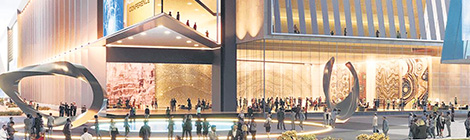
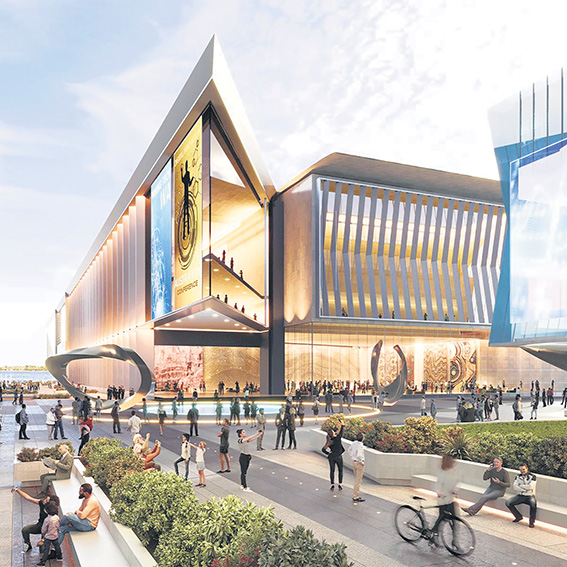
• New concept plan for the Perth Convention and Exhibition Centre by Wyllie and Brookfield.
The redesign aims to improve connectivity to Elizabeth Quay and showcase the riverfront and Kings Park. It’ll include a new outdoor theatre on the river, new public waterfront facilities, and new food and beverage venues.
Premier Roger Cook said this week in his announcement “there is huge potential on our riverfront, and this proposal would deliver an iconic new precinct that opens up major tourism and hospitality opportunities for WA, helping to diversify our economy and create local jobs.
“The PCEC is the oldest and smallest major convention centre in Australia. My government wants to see the precinct redeveloped to attract lucrative business events, while creating a place of pride on the river for all Western Australians.”
A business case will now be finalised for the state government to evaluate, touted for mid-2024.
PAUL COLLINS is fighting to overturn his two-month suspension from the WA Cricket Association board.
The ban was dished out on January 4 during a pivotal time for the governing body.
Mr Collins is one of five board directors voted in by WACA members, along with five appointed directors, and there’s been a range of disagreements among board members and WACA management in recent years, including a high-profile spat over mens urinals (‘Slash on the off side,’ Voice, August 26, 2023).
In a social media post this week, Mr Collins said that “On 4 January 2024, I received a letter from the Deputy Chair of the Western Australian Cricket Association Limited (“WACA”) which purported to provide a notice of suspension of both my membership of the WACA and my position as a director of the Board of the WACA.”
He says the investigation that led to this outcome was started just 10 days after the story broke.
• WACA board director Paul Collins.
Mr Collins wrote: “I have engaged legal representation to protect my interests and remedy the situation.
“Accordingly, I have nothing further to say publicly other than to encourage all Members of the WACA to continue to ask questions about the design, costs and funding of the WACA ground redevelopment.”
Mr Collins has been critical of some of the directions taken in the massive WACA East Perth ground upgrades, and in August last year he spoke out against the decision not to include urinals in the new mens’ bathrooms.
He said the decision had been made on the grounds of addressing “inclusivity”, but he argued that the gender-neutral bathrooms would cause chaos on game days as the mainly-male audiences would have to queue for cubicles in lieu of using more efficient urinals.
Within a day of the Voice breaking the news, the story blew up in national media, and we’ve heard some of the WACA higher ups were furious that Mr Collins had gone public. The former Stirling councillor gave us a brief update this week, telling the Voice: “The advice I’ve received is that my legal remedies to have this purported suspension set aside in a court of law are very strong.”
This all takes place during a key period for the WACA: Along with the ongoing redevelopment of the East Perth grounds, the board is currently searching for a new CEO as Christina Matthews announced her resignation in December 2023.
We contacted the WACA to ask what mechanism Mr Collins had been investigated and suspended under, asked who decided on the suspension, and queried the timing given the search for a new CEO, but a spokesperson says they weren’t able to provide any more information about the matter this week.
THE dreaded polyphagous shot-hole borer has been found in Kings Park, dangerously close to rare and endangered flora in the WA Botanic Garden collection.
The beetles ravage the insides of trees by boring a network of tunnels that they use to grow fungi for food. This can eventually kill the tree as the fungus blocks the flow of water and nutrients.
They attack a wide range of trees but are especially prone to go after many of the introduced ornamental species planted around Perth like the London Plane, Moreton Bay fig and Port Jackson fig.
• A trap in Kings Park in 2022 to monitor for the spread of borers. Photo via the Department of Primary Industries and Regional Development
The common box elder maple has also been identified as a “highly susceptible reproductive host”, dying within two years of infestation and leading to the borer’s population exploding into surrounding areas.
They were spotted in Dalgety Street in East Fremantle in 2021 by an inquisitive gardener, wondering why her mature trees were dying (‘Deadly borer found in East Fremantle’, Fremantle Herald).
The infected Kings Park trees are located in Mounts Bay Gardens beneath the Mount Eliza Escarpment.
The Botanic Gardens and Parks Authority announced a score of Moreton Bay figs, Port Jackon Figs and Coral Trees have “significant signs of PSHB infestation” since confirmed with molecular testing.
• The polyphagous shot-hole borer.
They have to be removed to prevent them becoming a new launching pad for the beetles to spread.
It’s a particularly crucial culling given “the Mounts Bay Road location of the trees is in close proximity to the Western Australian Botanic Garden and the many rare and endangered flora protected in its collection,” according to the BGPA.
The Mounts Bay Garden area is known to Noongars as Goonininup, and it’s a significant site of a freshwater spring and considered a home to the Rainbow Serpent, the Waugal.
The BGPA announced it’ll consult with Noongar elders on healing the area, with a focus on planting local flora species both to reflect the cultural history and because “local flora species are much more resilient to threats as well as vital habitat and food for our native animals and birds”.
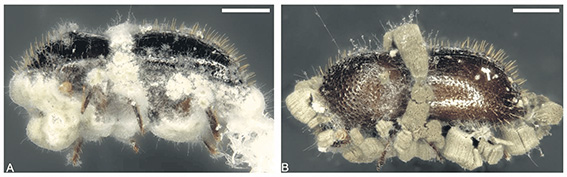
• A The Last of Us-style solution tried to infest the bugs with a killer strain of fungus, but it was ineffective in the field. Image via Nel et al., (2023) in the journal ‘Insects’
There are no effective chemical treatments for stopping the borer, and the race to find a cure has been marked by disappointment so far.
South Africa, which also has many Plane and fig trees, has been dealing with an invasion of the borers for six years and has tried many remedies.
They recently hoped that a borer-killing fungus might help control the beetles: A study showed they could be infected by a fungal strain that would overtake their bodies and kill them within a week of infection.
But it didn’t work out in the field: They just bore too deep to be effectively targeted, and the predator strain of fungus is too fragile to survive for long outside a lab.
VINCENT council has become the first in the country to dangle a carrot of swifter assessment for new house plans if they’re more environmentally-considerate.
It’s part of an effort to get more sustainable homes built and cut down on emissions, water waste and electricity use.
Lengthy waits to get development applications processed are a common complaint from builders dealing with local governments: The development assessment processing time at Vincent currently ranges from 14 days to 159 days, with simpler house plans averaging 20 working days.
• Houses that have their lifetime environmental impact assessed will be prioritised for assessment to cut waiting times.
Vincent’s new fast “green-track” incentive aims to further reduce processing time for single or grouped dwellings to within 10 working days if the applicant can show how their design stacks up against the council’s environmentally-friendly housing objectives.
That will be done via a “Life Cycle Assessment” – a measurement of the lifetime savings of emissions and fresh water the development could achieve through green-friendly measures. This will be included with the house plans.
Vincent mayor Alison Xamon announced the new fast-track system this week, and said in a statement: “We are thrilled to be the first local government in Australia to introduce a GreenTrack service.
“This will have a huge impact on our sustainability footprint in residential areas and help tackle climate change at a local level.
“We want to help lead the transformation in how we live and use our resources in the future and reward our community for choosing to invest in environmentally friendly design.
“Getting this right at the beginning will save time and money during construction as fewer expensive add-ons will be required to achieve performance targets. This is in addition to a lifetime worth of financial savings for residents who live in a comfortable energy and water efficient home.”
While applications that include an LCA will get prioritised for assessment and be processed faster, they still have to meet the usual building rules to get approved.












 Perth Voice Interactive