• Plea over law knock-backs

    VINCENT mayor Alison Xamon wants the state government to give councils more advice to try and stem the number of local laws being knocked back by one of its oversight committees.

    Over the past few years several councils have tried to pass laws to keep cats confined at home, only to have them rejected by the Joint Standing Committee on Delegated Legislation, which rules on whether they are consistent with state law.

    Vincent in particular has butted heads with the gatekeeper over policies around parking restrictions, controlling election signage, or rules preventing filming people in change rooms. 

    A knock-back can force councils into bringing in lawyers for a rewrite, which comes with a hefty bill.

    Ms Xamon sat on the JSCDL while an Upper House MP: “Del-leg is what we call it,” she said at Vincent’s last meeting for the year.

    Ms Xamon said councils seemed to be asking the committee for advice early on, but weren’t always getting feedback. 

    Feedback

    That meant there was a fair bit of finger crossing when first drafts were submitted.

    “That puts local councils in a very difficult position because local councils need to be able to pay lawyers to be able to construct legislation and it’s obviously a lot of staff time to try to put together legislation,” Ms Xamon said.

    “And if you don’t get that early feedback then it means that ratepayers can end up spending a lot of money only to find at the end that there’s a particular interpretation that’s being applied by the del-leg committee that could have been avoided if only there had been that early feedback.

    “I don’t believe this is the orderly way that we should go about construction of legislation and I’m disappointed about that because I do believe the committee’s system within the legislative assembly and council is a really important oversight and I want to make sure that it’s functioning as well as possible.”

    Former councillor Dudley Maier, who served from 2005 to 2013, believes the laws Vincent is putting forward are not as well drafted as those of yesteryear (“Cat laws unleashed,” Voice, August 12, 2023).

    Rejected

    Mr Maier has raised the issue at several council meetings during public question time, and wrote a submission for December’s meeting noting there’d been five occasions in the last five years where the JSCDL had either outright rejected a Vincent law or sent it back. 

    Mr Maier wants to know what Vincent’s success rate is in getting laws passed by the JSCDL, and he’s posed the question: “Do you agree that there have been a significant decline in the technical quality of the proposed local laws in the last five years?”

    The answer is due in the agenda for the next meeting, scheduled for February 13, 2024. 

    For now Ms Xamon will write to the speaker of the lower house, the president of the upper house, and to the WA Local Government Association, to “see if there is a better way that there can be earlier input from the del-leg,” she said.

    by DAVID BELL

  • Weathering the storm

    THE STS Leeuwin is back out sailing, while the foundation that runs the training vessel is emerging from voluntary administration and trying to calm the waters for volunteers left seething by the treatment of its former CEO.

    Carol Shannon’s sudden sacking by Leeuwin’s board of directors back in April sparked a volunteer mutiny and staff resignations which in turn forced the ship’s captain to cut a voyage short and return to Fremantle. 

    Principal sponsor the McCusker Charitable Foundation withdrew funding over Ms Shannon’s treatment and after a review of the books administrators were called in.

    It was in this whirlpool that new CEO Amanda Harwood took the helm of the Leeuwin Ocean Adventure Foundation with little idea about what had happened.

    Within three weeks the organisation had ground to a sudden halt as Korda Mentha took over and the board of directors had been stood down, but Ms Harwood said the administrators were very supportive and in September issued a call for help which was picked up by Andrew and Nicola Forrest’s charitable arm Minderoo.

    “They were the ones that came through as wanting to recapitalise and support Leeuwin, so they went into a deed of company arrangement and there’s certain criteria you have to meet, which we’re coming out of now,” she said.

    Ms Harwood says Minderoo is hoping to make an exit from the deed after about two years.

    • After a dreadful year that included a volunteer mutiny, abandoned voyage and administrators, the STS Leeuwin is back on the water doing what it does best – training up a new generation of leaders.

    Independent

    “What they want to see for the Leeuwin is that Leeuwin will become an independent non-profit.”

    Ms Harwood said the billionaire couple wrote to each of the Leeuwin’s volunteers and staff thanking them for their work on the ship.

    “I think that was really appreciated,” she said.

    “I think the volunteers are passionate about the ship, and they’re passionate about the work and, yeah, I think it was tricky – we didn’t even know if we were going to continue.”

    Ms Harwood said communication problems fed into the drama and had volunteers worrying the Leeuwin might fundamentally change or even be sold off.

    “We have to be able to look after ourselves continuously, so that may be looking at different programs or different partnerships, but the ship will still be the ship – it won’t change.”

    With more than a decade’s experience working with young families at the Kwinana Early Years Service, Ms Harwood said it was important to get the ship back out on the water changing young people’s lives because the impact of the Covid pandemic was still showing.

    “The data will show you that social isolation and disconnection from young people is huge; they went to their bedroom and they closed their doors and there wasn’t that ability to travel and to get out and be in a community.

    “So I think that it’s it’s kind of almost Paramount now that we can go back out.

    “We want to look to get into rural and remote regions because I’m conscious that there’s a lot of lack in opportunity for those kids, or they see a lack of opportunity.”

    Ms Harwood said teachers were reporting that kids were disengaging at a younger age, which poses challenges for Leeuwin because sending 10-year-olds on a six-day voyage just isn’t feasibly.

    “How do you still support those young people to build confidence and capacity?”

    • Prepping the Leeuwin for her next voyage.

    Confidence

    She says the key might be in forging more partnerships with organisation already dealing with that demographic, while the Leeuwin has run “alongside” programs for primary school children where they get to explore the ship while it’s docked.

    Ms Harwood says they’re also keen to explore ties with the maritime industry, saying the Leeuwin was a perfect training ground for an industry projected to be facing a critical shortage of staff by 2026.

    “We have had kids that came here when they were 12, 14 years old 20 years ago, and they are master unlimited [a qualification] operating huge vessels up north and helping the offshore industry in Australia.”

    Ms Harwood says the Leeuwin can be seen as an early intervention that can give young people skills that can help set them up for life, so she’s keen to see whether she can convince the state and federal governments to step up, and particularly would love to see more state schools sending their students on voyages.

    “They need to do more in this space,” she said.

    Ms Harwood also wanted to scotch concerns the Leeuwin was unsafe to sail, saying it was recalled from Dampier during the staff and volunteer mutiny over communication concerns, not because of any fault on the ship.

    The vessel’s next youth voyage will be to Busselton from January 4, timed to arrive in time for the town’s big festival where they’ll take part in Pirate Day and also an open day to try and recruit some young salts.

    There’s still berths available, while they’ve also just released tickets for an Ultimate Challenge adventure in the first week of February.

    “That voyage is particularly special because we are going to try to encourage young people with disabilities to come on board,” Ms Harwood said.

    “The beautiful part about it is that we’re going to have allied health professionals and medical students who can come and support the individuals with disabilities.

    “We are going to allocate a ‘big strong muscles’ as we call it, which will be one of our vounteers who will be able to help them out with the most physically challenging activities.”

    by STEVE GRANT

  • Jumping at the chance

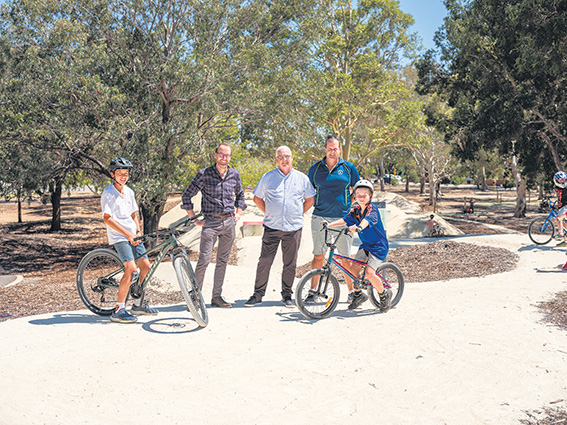
    THE third and final stage of the Dianella BMX and mountain bike track is ready to go, finished just in time for the school holidays.

    It’s been a long race to the finish line for the the project, with Dianella’s Regional Open Space being having been pegged as the ideal spot for a dirt BMX hub back in 2013.

    Earlier stages including the pump track and skills trail were constructed in 2021, and the final stage adds new jump lines so the track can cater to beginner, intermediate, and advanced level riders.

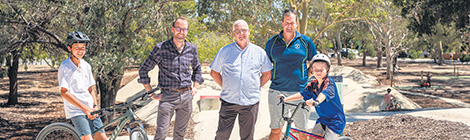
    • Test riders trying out the new track, with Inglewood ward councillors Damien Giuduci and David Lagan, and Stirling’s recreation and leisure manager Cheyne Cameron.

    Mayor Mark Irwin said: “We know that more than 50,000 young people live in the city and more than 60 per cent are involved in some sort of BMX or skate activity”, and demand for urban mountain biking continued to grow alongside the ever-popular BMX discipline.

    “Completing the new jump lines for a range of rider skill levels now provides a more diverse experience for local riders, which I am sure they will continue to enjoy over the summer.  We look forward to seeing the facilities at Dianella being used to their fullest by future Olympians and recreational users alike.”

  • Ruah steps in for safe space

    PERTH’S Safe Night Space for women may live on at a new location in Ruah’s existing James Street facility in Northbridge.

    In the meantime the Cook Government has announced $210,000 for interim emergency accommodation for women who’d otherwise have slept in the East Perth SNS before it was closed down.

    The funding was described as a “Christmas miracle” by homeless advocaes Shelter WA.

    Perth council – and lord mayor Basil Zempilas in particular – copped tremendous flak for bringing the East Perth trial to an end. There were online petitions and a snap rally, while the public gallery at recent council meetings has been packed and question time peppered with queries about the closure. 

    But the council only funded the space in 2021 as a temporary two-year trial, a stop-gap solution run by homeless service provider Ruah until state government shelters could be brought online. 

    In February the council voted to extend it for another six months, but that came due in November. By that point the council had spent around $4 million running it, and had fielded scores of complaints about behaviour of SNS attendees and their male partners. 

    A $3.1m state government offer to keep the centre open only came after the council had advertised for expressions of interest from new users (“Safe space offer comes too late,” Voice, November 18, 2023).

    This week’s $210,000 funding will be used to put women up at Ruah’s James Street facility, while the Cook government has offered to redirect the $3.1m to make the measure more permanent. 

    “All this would require is for the City of Perth to support an extension of hours at Ruah’s James Street facility,” homelessness minister John Carey said in a December 16 statement. 

    “We are continuing to assess Uniting WA’s proposal for a Safe Night Space at their Tranby facility”,  a homeless engagement hub on Aberdeen Street.

    The Tranby hub is Mr Zempilas’ preferred location for the SNS. 

    Perth council had opposed the James Street day centre opening up in the first place following a monumental level of opposition from nearby locals in 2022. 

    The state government stepped in to approve it anyway, with then-planning minister Rita Saffioti declaring its opening to be in the public interest.

  • Wandering child earns fine

    A CHILD wandering away from Camp Australia’s out-of-school-hours care at Coolbinia Primary has seen the operator hit with a $14,000 penalty.

    It was one of three levelled against Camp Australia this week for similar scenarios across an incident-filled summer of 2022-23.

    The four-year-old child was attending a school holiday care program at Camp Australia’s Bradford Street, Coolbinia service on January 12, 2023, and was one of four ‘kinder’ aged children among the 32 total kids. 

    Six staff were overseeing them, but just after lunch the children were arranged into three groups to head off to activities.

    The child was in a line heading to the library with a staff member up front, but “in the short distance transitioning to the library the child separated from the group”, according to a State Administrative Tribunal summary of facts.

    Some time between six and 36 minutes later, two members of the public spotted the child, who said he was looking for the library. They returned him to care, apparently while the staff member who had taken the group to the library was in the middle of conducting a headcount.

    The Department of Communities took Camp Australia to the SAT, and after the facts were agreed on by both parties the SAT ordered Camp Australia to pay a $14,000 penalty to the DoC for “failing to ensure that all children receiving education and care at its service were adequately supervised at all times the children were in the care of the service”.

    The incident followed another temporary loss of children on December 21 at Camp Australia’s care service for Grandis Primary School in Banksia Grove. Two five-year-olds were at the playground under the supervision of an educator, when one child said “oh mummy’s here” and both wandered off at about 3.30pm. 

    Their exit wasn’t noticed due to an over-reliance on technology: The iPad that tracked who’d been signed in or out had a flat battery.

    Missing

    The kids were spotted walking along Grandis Boulevard by an educator from another care provider where they’d previously been enrolled, who recognised them and contacted their parents. Camp Australia only realised the kids were missing when one of the parents contacted them around 4pm. That incident saw Camp Australia hit with another $14,000 penalty.

    The escapes continued: At Camp Australia’s service at Makybe Rise Public School in Baldivis, a three-year-old child who’d just started kindy went missing shortly after arriving for his first day in care on February 3, 2023. 

    He arrived around 3pm, and a headcount at 4pm showed a mismatch between present kids and those checked in on their software. The service manager assumed the child had been picked up by his parents. Instead he was wandering through alleyways between shops and walking on the road on a 36-degree day. 

    Camp Australia was hit with an $18,500 penalty for inadequate supervision, and a $15,000 penalty for not taking every reasonable precaution to protect kids from harm or injurious hazards. The service manager was sacked.

    The company has since sent staff to three workshops to ensure they comply with supervision procedures. Following the Coolbinia incident, they also purchased high visibility jackets to keep track of kids in their care.

    by DAVID BELL

  • Scribblers with a View

    LOCAL authors from the Vincent Writers Group have compiled a new tome titled Scribblers with a View. 

    The work follows on from their second anthology Reflections and Introspections from 2019, a well-received collection of poems and short stories.

    The new book was launched at Mt Hawthorn’s Bodhi Tree Bookstore Cafe on November 29, and is on sale there now. 

  • Summer Reading: With Khuh

    WE got fabulous entries of all shapes and sizes for our Summer Reading competition, so thanks to all the creative souls who got cracking.

    We’ll be running them over the next month, then we’ll announce the winners.

    First cab off the rank, is Nick Hingston’s reflections on a time he spent working in WA’s beautiful, but challenging, Pilbara. It’s titled With Khuh.

     “I spy with my little eye, something beginning with… I’m not very good at spelling, but I think khuh”. She’s maybe 6, her size thrown into ironic relief against the chair designed for children twice her age. You watch her eyes, looking for clues as to what starts with a khuh. Only contentment shines back at you, the joy of a fleeting moment.

    This girl is one of six. You wonder as you move between these six kids, ‘is every child as blithe as these?’, though you enjoy asking the question more than you consider you would searching for an answer. They are all predisposed in their own ways, some with a focus it seems more tenacious than productive, others with the capricious calls of the young mind effortlessly steering. As you watch it makes you feel… what exactly?

    Guilt for leaving children exactly like these behind at home? Resentful of the institutions who have forgotten these children? Begrudging of the ease of their youth? ‘Maybe you’re putting too much on these kids’ you think, ‘will they ever ask of themselves these same questions?’.

    These four walls, the ones which contain something beginning with khuh, will provide all the formal education these children will have. You’ve walked their length countless times in only two hours, their beguiling quaintness having long since passed. In these four walls, you watch your colleagues provide for these kids in a way few others can. It’s charming really, watching how they blend the rigidities of a far-away curriculum with the intricacies of a gentle life.

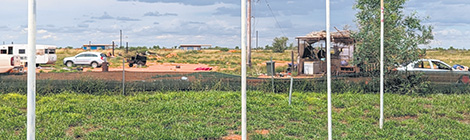
    You wonder how many of these particulars will remain with these kids, how much will be communicated to those who provide for them. Beyond these kids, these four walls – you stop for a moment to consider if the kids consider them ‘their walls’ – you see the few things there are to see. Each one caressed by spinifex with the carefree permanence only the unowned can have. Two buildings – you’re unsure if they’re occupied – a handful of cars in various states of forget, a fence placed as if by accident and most stark, football goals arching for the sky as if to grace the unknown face of the warm clear blue.

    It’s these football goals that leave you to think more about this community, this collection of kids with their hope, invisible optimism and permanently temporary contentment – and that something beginning with khuh. More questions come to mind than you would ever care to ask, ‘who built these?’, ‘do the kids use them?’, ‘do the kids even care about football?’, ‘why are they so short?’, ‘where’s the other set?’, ‘what would be here if we weren’t in Australia?’. It’s that last question you stop to consider.

    Where exactly are you? The presence of communities just like this one not far from your distant home in a distant region are evidence enough that this community is as much this country as anything else. But is this country as much this community? Behind you, inside of the four walls, remain those six kids. Six irresolutely unchanged lives made brighter, more self-assured and wonderous by the resolve and undemanding endearment of your colleagues, your friends.

    Inside, you ask of the teacher how many people live in town. A shrug would have been a simpler answer than the one received. You know that Aboriginal peoples have long been transient communities, temporary in their stays but not their connection to Country.

    The teacher continues in their answer and then with the disparaging tone only a passing motion can bring, says without words that those of the community not currently here have gone to town in search of the common scapegoat.
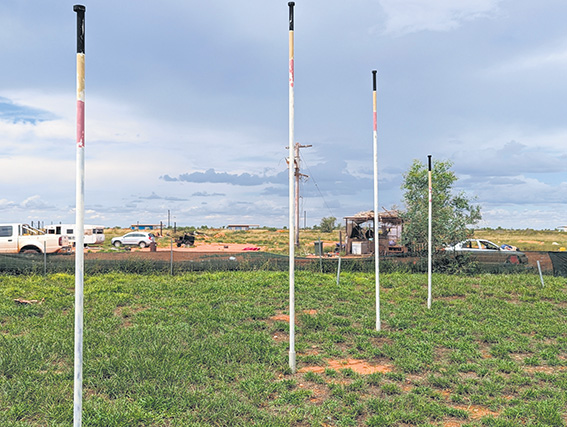
    It confuses you how someone like this teacher, someone who needs to drive hundreds of kilometres for something as luxurious as to browse the shelves of a fluorescent grocer, can surmise that the ills of their student’s families lie at the bottom of a brown paper bag. It is with this motion this conversation ends, not with a defined truth but with the discomfort of assumption and a broad patsy. You ask another question – yet more are imposed upon you by the unbearing landscape. ‘Is the curriculum these kids work on consistent with the city or is it tailored to focus on relevant learning outcomes?’. You’re a little ashamed at the buzzwords – not that the teacher notices. A shorter answer than expected, they detail it’s the same curriculum but perhaps hoping to seem a more bespoke educator to someone sharing their classroom only for the day, they beam when they include that it does feature trips on Country.

    With this information sitting on the warm air, made louder, more alien, by its contrast to the ground you stand upon, you’re sure of two things. These four walls contain something beginning with khuh and there exists an unseen disparity of an institution made great by its reach and that of knowledge and custom made great by their persistence in time.

    How then you wonder, do we produce and equitably provide the fruits of the sum of these systems and how has our combined and shared consciousness, a consciousness spread across thousands of sprawling lands under the same sun you see outside, not determined the way to do so? Will these institutions together have the capability to determine that elusive something beginning with khuh?

    You think more about this, the contrast between a nascent European approach to education and community and the knowledge of 45 thousand years of culture and wisdom as you watch your friends with these children. It is without strain, without preamble or thought that they share with these kids not the joys of their curriculum, but instead the untroubled and effortlessly buoyant knowledge that aspirations are as welcome here as are their families, the presence of their connection to Country remains without question and that there is no doubt to the continuation of the knowledge and custom that is so much theirs that it just is.

    Maybe, just like that something beginning with khuh, you think that the others who share this same sun on land beyond reach or perception for these kids, are looking for something subtle without definition, unlabelled except the surrogate names of those burdened by it and yet undoubtedly vacant from their minds, their considerations. You consider that – but no. It’s not that the custodians of the European institution cannot see what they cannot name, it’s that they cannot consider custom and knowledge inconsistent with theirs. Knowledge as old as this land. Knowledge you see waving as the spinifex breathes. Knowledge beyond the football posts. Knowledge you hear singing to you as you murmur across the ground outside. Knowledge shining bright in the eyes of a 6 year old girl unknowingly holding tight to the joys of a fleeting moment.

     “I spy with my little eye, something beginning with… I’m not very good at spelling, but I think khuh”.

    You wonder if you will find it.

     She already has.

    by NICK HINGSTON

  • Modern tribute

    TAKE a well-deserved break from the Christmas sales to enjoy the stunning 3D tribute to the Moodjar Tree in Yagan Square.

    Part of Perth’s Xmas Lights Trail, each night the story of the “Australian Christmas Tree” is told through a vivid and beautiful multimedia installation with artworks by Biara Martin and a spoken word performance by Rose Walley.

    Renowned Noongar singer-songwriter Phil Walley-Stack composed the soundtrack and narrates the journey with 15 stunning scenes about the Moodjar Tree and its iconic orange blooms.

    Presented in a way that has never been seen before, the cutting-edge 3D anamorphic visuals were created by Perth’s Lux Events.

    For the Noongar people, December and January is a season called Birak. It is during this time the Moodjar tree flowers bright orange. In local Yued dreaming, stories passed down from ancestors shows why the Moojar is of such cultural and spiritual significance to Noongar people in the past, and still today.

    It serves as a marker for significant ceremony and burial sites. During lore time, when the tree is in flower, it shows in significant places around the country.

    • There’s a stunning, 3D version of the Moodjar Tree in Yagan Square (above).

    Yued ancestors have always enforced that people show respect for the Moojar and to protect the tree where possible.

    A Yued legend associated with the Moojar is that when a Noongar person dies their spirit enters the tree where they wait for Birak. 

    When the tree flowers, their spirit goes west to Kooranup (over the ocean) to be with their ancestors.

    During Birak, celebrations are held on the seashores to honour the spirits of the ancestors and celebrate the continuation of cultural lore and traditions.

    The vivid orange flowers of the moodjar are traditionally used to make a lightly alcoholic brew called mungitch. The sweet drink is brewed over several days by soaking the flowers in fresh water and the drink is used to celebrate the abundance of food traditionally on offer during Birak.

    Birak is also lore time on Yued Boodja. It is that time of year when Noongar people host ceremony and celebration with other cultural groups along the coastline.

    The Moodjar Tree in Yagan Square is on 6pm nightly until January 2 at Yagan Square.

    by STEPHEN POLLOCK

  • Rates revolt over midges

    “PRISONERS in our home” – a midge plague around the Maylands peninsula lakes has residents unable to step outside without being swarmed by countless insects.

    Some are refusing to pay their rates in full until Bayswater council deals with the pests. 

    Several residents grew emotional at the December 5 council briefing as they described the millions of midges impacting life around the Brearley, Bungana and Brickworks Lakes. 

    The three artificial ponds have been hotspots for algae, bacteria, and insects since they were created out of old brickworks claypits in the late 1990s as part of the Satterley Peninsula Estate Development.

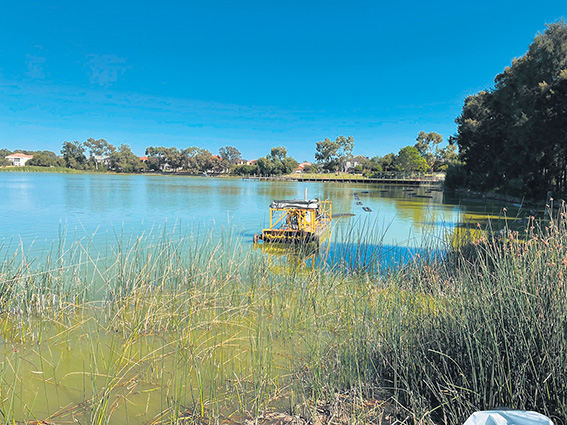
    • The City has tried dredging the lake and installing an oxygen mixer, but the lakes are still green and breeding midges.

    Resident Nick Lange said his wife walks the dogs and comes back “covered in midges… through her hair, on her face, on her clothes; she’s breathing in midges”.

    Unusable swimming pools are covered in a thick “blanket” of insects, while Mr Lange’s says his garage is so infested that the usually inaudible bugs can be heard swarming.

    “We’re still expected to be paying our rates. We keep receiving overdue rates bills; there’s a few of us who have refused to pay 50 per cent of our rates… I think it’s extremely unfair that we should be paying our rates when we cannot use our amenities throughout the year.”

    Resident Steven Cloughley said he’d sent “hundreds” of emails to Bayswater council over the 12 years he’s lived near the lakes. 

    “We’ve spent at least $13,000 just replacing pool filters” clogged by midges, he said, “replacing blinds, replacing outdoor furniture. Having friends over, we have to lock ourselves in the house because we just can’t go outside and enjoy it.”

    Mr Cloughley acknowledged Bayswater council had tried various strategies, but nothing had worked and he proposed they needed to bring in upper levels of government to assist.

    “When you can’t sell your family home and realise its value, and your kids can’t use their backyard, there is a serious problem,” Mr Cloughley said.

    On top of the joy-ruining impact of the midges, residents are growing increasingly concerned about the health impacts of the toxic cyanobacteria infesting the lakes. 

    Bacteria

    Resident Craig Ashton said “most of the community are unaware of the significant hazard as cyanobacteria levels in the lake are between 140 and 240 times greater than the Department of Health’s guidelines”. 

    Those guidelines are for “active” uses of water like swimming, and Bayswater staff point out the lakes are passive use only. But residents argue that in high winds people close to the lake are exposed to foam spray just the same, and the fountains have to be turned off during the worst outbreaks to avoid spreading it across the surrounding area. 

    So far Bayswater’s spent nine years and some $2 million trying to fix the lakes, from planting more sedges, throwing in blocks of clay to soak up excess phosphorous, to partially dredging Lake Bungana’s bottom to scrape up some of the nutrients that feed algae.

    Mayor Filomena Piffaretti said at the December 12 meeting: “This is an issue that keeps me up at night. I really, really want to find a solution for the residents and improve your way of life.”

    Ms Piffaretti said she’d had emails, phone calls, and even residents stopping her in the street about the lakes. “This is a very high priority for me… this is one of the top priorities that we need to work on as a council team.”

    With no solution so far, the council has now endorsed putting together a scientific advisory panel to come up with a masterplan, the first concerted effort to fix the problem rather than the piecemeal attempts of the past.

    Councillors Elli Petersen-Pik and Nat Latter, who represent the south ward area covering the lakes, prepared a joint amendment for the December 12 meeting calling for the masterplan to be a matter of urgency and to be back in front of council by April 2024. 

    by DAVID BELL

  • Fears media policy goes a step too far

    STERN new speech restrictions being considered in Bayswater would require councillors to “clearly state” they weren’t representing the views of the City of Baywater when making any public comment, even when posting family photos on Facebook. 

    Some councillors were flabbergasted at the December 12 meeting, believing the proposed Communications and Social Media Policy goes a step too far.

    Cr Dan Bull queried: “Does this mean that … every social media post that I make, or comment that I make or respond to on someone else’s post, requires me to put a statement that says it is my personal view only and it doesn’t necessarily represent the views of the City?” 

    “I have the same question,” mayor Filomena Piffaretti echoed.

    Corporate services director Kym Leahy confirmed: “Yes, that was the intent in how it was drafted.”

    Cr Bull then posed: “Does it also mean that on my personal page, my personal profile, if I do a photo of me and the kids and Nys [his wife] on a family holiday, that would also require me to say the same statement?

    “If I attend a public meeting … if I were to make a comment at that forum, would I also need to state that it is my personal view and does not represent the views of the city?”

    Strict

    Again, the director confirmed that under this strict wording: “Yes,” in both cases.

    The restrictive wording came from a draft version of the policy that had been unanimously flagged as too onerous by councillors at a behind-closed-doors discussion earlier this year.

    Staff had recommended removing it, instead just inserting a rule saying councillors must not “imply that the comment or content necessarily represents the views of the City”, with standard practice dictating that only the mayor can speak on behalf of the city.

    But when it came to the vote on December 12 councillor Josh Eveson moved to restore the earlier stricter version, and councillor Steven Ostaszewskyj seconded the motion.

    Cr Eveson said the strict version was “very clear and unambiguous”. 

    Deputy mayor Elli Petersen-Pik spoke against Cr Eveson’s motion to use the more severe wording, saying, “I’m not aware of any local government that has such a requirement on elected members to make such a comment under each comment on social media. It’s too onerous. Every elected member should be aware that if they forget that, it would be a breach of the policy, and a complaint could be served against them.”

    Crs Bull and Petersen-Pik wanted to deal with it immediately and scrap the harsh version, but the majority voted to defer the decision till next year to give more time to work out the wording.

    by DAVID BELL