FED up protesters gathered outside Wesley Uniting Church in the city last Thursday to recognise International Day of Peace, and to oppose the trilateral security pact AUKUS.
Around 30 peace activists from Stop AUKUS WA and the Independent and Peaceful Australia Network created and handed out paper “peace cranes” to passers-by whilst calling for “an independent foreign policy and our region’s comprehensive security and peace”.
Under the AUKUS deal, Australia will acquire eight nuclear-powered Virginia class submarines, some built locally but the majority most likely to be built in the United States.
They won’t be armed with nuclear weapons, but that hasn’t dimmed the protestors’ distrust.
The connection between paper cranes and peace has long been linked to Sadako Sasaki, a young girl who died as a result of radiation from the atomic bombing in Hiroshima, Japan in World War II.
Origami cranes were said to bring luck in Japanese culture and Sadako kept folding them in the hopes of beating her leukaemia, making about 1450 before finally succumbing to her disease.
In 2013, the peace crane project was founded in order to promote world peace and every year around 6 million cranes are said to be laid at her monument.
Stop AUKUS WA said they were calling out “both the racism and arms race in our region fuelled by AUKUS”.
• About 30 peace activists gathered to recognise International Day of Peace, some claiming AUKUS has a racist undertone.
Anger has grown since the AUKUS agreement was formed on September 15, 2021, with groups across the country rallying to abolish the $368 billion deal.
Stop AUKUS WA spokesperson Leonie Lundy said the AUKUS deal sets a risky precedent surrounding the usage of nuclear energy.
“It is being perceived on one level, as a backdoor nuclearisation of Australia,” Ms Lundy said.
“We’re talking about nuclear subs here on the coast of WA.
“HMAS Stirling is only a kilometre off the mainland,” she said.
“If hostilities did ever break out, then we’re a sitting target. It’s frightening.”
Signs from the protest read “nobody wins a nuclear war” and “US subs make us a nuclear target”.
A joint leaders statement on AUKUS released on March 14, 2023 maintained that “Australia is fully committed to responsible stewardship of naval nuclear propulsion technology.”
BAYSWATER’S two-month long Flourish Community Arts Festival kicks off this weekend with a medley of workshops, performances, and exhibitions set to ignite the community’s art scene.
The inaugural festival features more than 65 different events running from October 1 to November 30 throughout the city, including the much-loved community art awards and exhibition which boasts over $14,000 of prize money to be won.
The RISE community centre in Maylands is set to host the awards and exhibition from November 5-18, with emerging local artist Frida Aditi taking up residency in the building for the event’s eight-week period.
Ms Aditi said she is excited to contribute to community building within the city through her basketry, meditation, and silk string making workshops.
“I enjoy the synergy of community and am keen to create some community engagement with my work and art in general,” Ms Aditi said.
• Artist Frida Aditi with one of her textile creations; she’ll be having an eight-week residency at RISE during the city’s annual community arts awards. Photo courtesy Instagram
Everyone
“Art is for everyone.”
The building will also host the brand-new RISE-Up art market in its amphitheatre on Saturday November 18, where visitors can expect a range of handcrafted goods for sale from Perth’s “finest makers and creators”.
The festival will kick off with an opening party on October 1 at King Somm Bar on William Street where live music and mural painting will take place along with food and drink specials and giveaways.
This will be followed by a series of free live music concerts at the venue every second Sunday throughout the festival’s duration.
• The Western Australian Symphonic Wind Ensemble will be performing at Flourish.
Further musical events are in abundance with an ABBA tribute show, Halloween celebrations, Ukelele lessons and a concert from the West Australian Symphonic Wind Ensemble lined up.
City of Bayswater CEO Jeremy Edwards said he hopes festival participants get the opportunity to explore and enjoy the city.
“There is something for everyone,” Mr Edwards said.
“I encourage you to take the opportunity and get along to view the outstanding works on display.”
For more information and the full program, check Bayswater council’s website at bayswater.wa.gov.au/flourish
OF all the amazing bands to emerge from Greater Manchester in the 1980s, The Smiths were the most influential, The Stone Roses the most critically acclaimed, but the Happy Mondays were the one the British public took to their hearts.
They were unpretentious, wore their heart on their sleeve and liked to party – especially frontman Shaun Ryder, who seemed to hoover up all the drugs in Western Europe, and dancer/maraca shaker Bez – a sort of ecstasy-loving court jester who became a cult figure in the UK.
In 1990 the band released their breakthrough album Pills ‘n’ Thrills and Bellyaches, a genre-bending mix of house, indie guitar and psychedelia that included hit singles Step On, Kinky Afro and Loose Fit.
International success and lots of drugs followed, before the band recorded their chaotic follow-up Yes Please! and imploded in a supernova of crack cocaine.
Ryder and Bez went on to enjoy success with Black Grape, before sporadically reforming the Happy Mondays over the years.
• (above) Shaun Ryder and (below, centre) Bez from the Happy Mondays.
Now the band are coming Down Under – playing shows across Australia and New Zealand in October as part of their Greatest Hits tour. Once famous for their Herculean drug intake, what is touring like these days? And does Bez, 59, need fish oil capsules before going on-stage?
“He’s on the same f*ckin’ capsules he was on back in the 80s,” Ryder laughs.
“After a gig I’m back in the hotel room at 11 watching the news, but Bez is out partying like he’s 21.
“He’s the party representative for the band now.”
Despite a case of the lurgy, which Ryder puts down to his kids going back to school after the UK summer holidays – “I feel like something has crawled up mee arse and died” – the Salford larrikin was in good spirits when the Voice rang for a chinwag.
In recent years, Bez and Ryder have carved out an unlikely career as a dysfunctional, comedy double act – Madchester’s Laurel and Hardy – appearing on family-friendly TV shows like Celebrity Gogglebox.
Ryder says it’s introduced the Happy Mondays to a new generation of fans, something he witnessed when playing the UK festival circuit this summer.
“Festivals are great because there are no age restrictions,” he says. “The Mondays’ audience now goes from about 7 to 77 – it’s all over the shot because of all the TV work me and Bez do.
“We are playing better than ever and to bigger audiences than we’ve ever done. The Mondays have become iconic, because we’ve been at it for so long.”
Ryder concedes there was a time when he was “pissed off” playing the band’s biggest hit Step On, but he’s now “enjoying it more than ever” and is at peace with the band’s iconic status and legacy. He says he keeps things fresh by doing other projects.
“In 2024 I’ll put the Mondays to one side and do an album with Mantra of the Cosmos [a supergroup featuring former members of Oasis, Ride and the Happy Mondays] and I’ve got the new Black Grape album as well,” he says. “Then I’ll come back to the Mondays revitalised.”
Recently one of Ryder’s peers – ex-Stone Roses frontman Ian Brown – went on tour with no band and sang along to a backing track, polarising critics and fans.
Brown and Ryder are old mates, but even he is a bit baffled by the glorified karaoke.
“It’s either very brave of Ian or he just doesn’t want to pay the band,” Ryder quips.
“I’ve not spoken to him to see what his game plan is – not to pay the musicians or if he’s trying to become Bob Dylan.”
The Happy Mondays have always been a bit of a family affair with Ryder’s brother Paul the founding bassist and their late dad Derek a sound tech for the band during their heyday.
Tragedy struck in July 2022 when Paul suddenly died aged 58, just hours before the Mondays were due to play at Kubix Festival in Sunderland. Ryder says he hasn’t fully processed his brother’s death.
“When my father died it took me three years to come to terms what that and then it suddenly hit me,” he says.
“I’ve got a weird emotional response to things and it can take time for things to really sink in.”
“It’s been a year since our kid [Paul Ryder] went and some days it will just come over me.”
Ryder, 61, has had his fair share of health problems in recent years – thyroid trouble, ADHD, alopecia, covid and a new hip. Ironically, most of them started in his early 50s, years after he kicked hard drugs, but the frontman says he is looking forward to the Mondays’ shows in Australia – their first in the country since 2019.
“We always have a great time out there and the band are firing on all cylinders after playing dates in the UK,” Ryder says. “We must have done alright last time in Australia, because they asked us back!”
The Happy Mondays will play The Metropolis in Fremantle on October Wednesday 25 as part of their Twenty Four Hour Party People – Greatest Hits Tour. Tix at premier.ticketek.com.au.
SANDGROPERS have a rare chance to experience a spectacular labyrinth of light, air and sound with the luminarium arriving in Perth.
Created by the renowned Architects of Air, the luminarium is a giant 45m by 35m inflatable structure with 1000sqm of glowing tunnels and caverns for all ages to explore.
Since 1992, more than three million people in over 40 countries have immersed themselves in Architects of Air’s atmospheric worlds.
In Perth for the first time, the ‘Aborialis’ luminarium is dedicated to trees, and once inside it feels like you are lost in a magical forest with radiant canopies and vibrant foliage.
Enhancing the atmosphere is a soundtrack by Irish composer Dr Michael Morris, inspired by spirituality and the sounds of nature.
• The spectacular Aborialis luminarium is in Perth for the first time. photos by Jane Barlow
The luminarium is the brainchild of Architects of Air founder Alan Parkinson. Growing up, the Englishman was fascinated by light and went on to study photography at university.
“I design luminaria because I want to share my sense of wonder at the phenomenon of light,” Parkinson said. “A luminarium provides the frame for an encounter with a light whose surprising and simple intensity cuts through conditioned perception.”
“I’ve long had an interest in light. At 11 years of age I was a keen photographer with my own darkroom.”
But it took a chance encounter with some criminals and an airbed in 1982, before the luminarium seed was planted in Parkinson’s mind.
“I had taken a part-time job as a minibus driver for a community project to supplement my work as a photography teacher,” Parkinson said. “The project provided work in the community for criminal offenders and they, in turn, supervised the play activity of groups identified as ‘in need’ (inner city kids’ groups, centres for adults and children with handicaps).
“The offenders had built a large bouncy airbed and my job was just a half-day a week, ferrying the inflatable and the offenders and supervising the play session.”
The airbed has some structural weakness, so Parkinson came up with a better design, and from that point onwards he built up his skills with inflatables, eventually founding Architects of Air in 1992.
Hand built by about six people in a workshop in Nottingham, a luminarium takes about four to six months to build.
It’s then exhibited around the world for 300 days, spread over four years, before being cut into pieces and recycled.
A multi-sensory maze of light, air and sound, one visitor has described it as “somewhere between a womb and a cathedral”.
Despite the enormous success of his luminaria, Parkinson still gets nervous before a new creation is unveiled.
“Usually things do work out and I am continually amazed by how well the luminaria engage people’s attention and enthusiasm,” he said
“Perhaps there is a modern need that is met by this kind of secular hybrid cathedral/mosque structure in which light is the nourishment that feeds a hunger for meaning.
“Whatever its significance may be I feel very fortunate to have stumbled across this way of making my living.”
The Aborialis Luminarium is at Fremantle Arts Centre until October 8. Tix at oztix.com.au
THERE’S walk-in ready and then there’s this house in Embleton.
Every room in this four bedroom two bathroom home is immaculately presented and nothing needs done.
Split over two storeys, it has a lovely facade with the wooden garage door contrasting nicely with the light render on the exterior walls.
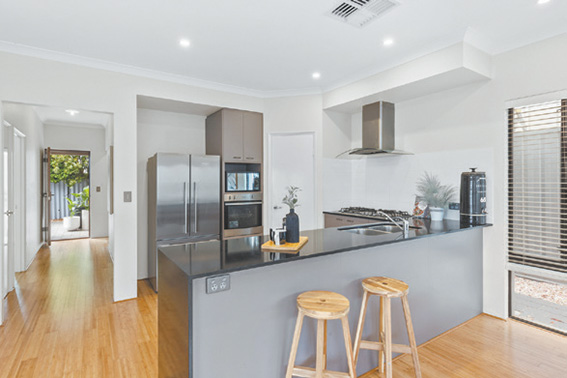
The layout of the ground floor is superb with a huge open plan dining/living/kitchen area with gorgeous polished bamboo floors.
There’s plenty of light courtesy of the many windows and the glass sliding doors, which connect to decking in the back yard.
The kitchen is well equipped with a double sink, walk-in pantry and double gas cooktop. It’s a nice place to whip up meals for family and visitors.
The back yard has a sheltered north-facing alfresco, decking and a Colorbond fence punctuated with plants and shrubs.
The home is a newish build (five years old) so you’re not getting a massive back garden, but there’s enough space to entertain and it’s super low maintenance.
There’s a theatre room and a study/fourth bedroom on the ground floor, which could be used as a home office or a music room if you’re into playing the guitar. There’s also a large laundry, powder room and linen cupboard on this level.
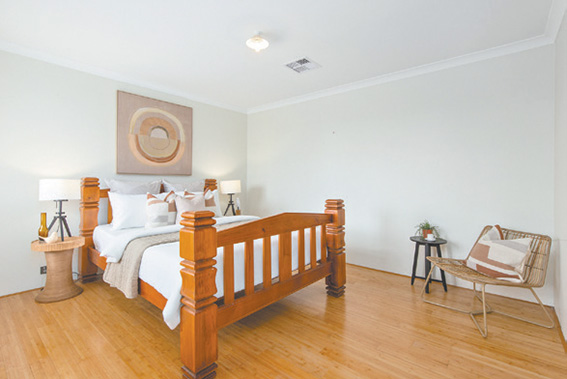
The remaining bedrooms are on the first floor with the main featuring a massive walk-in robe and stylish ensuite, while the other spacious bedrooms have built-in robes and share a family bathroom.
There’s also a large activity area with a balcony, giving kids a place to hang out with their mates (invaluable as they get older). So you have a massive amount of living areas to chose from.
The home includes high ceilings, stone benchtops in laundry, ducted and zoned reverse cycle air con, storage under stairs and laundry, and a two-car garage.
Situated on Holmwood Way, the home is 800m from the new Morley Train Station, 400m from Bayswater Waves, and it’s a short walk to the Galleria Shopping Centre and Embleton and Hillcrest Primary Schools.
This classy abode has an understated style and coolness. It doesn’t have to shout “I’m great!” because it knows it is.
Offers in the $800,000s 22A Holmwood Way, Embleton Beaucott Property 9272 2488 Agents Aaron Storey 0417 931 604 Paul Owen 0411 601 420
CONVINCING the Cook government to transform the “sandpit” at the eastern gateway of his city into open space tops a 10-point plan released as part of lord mayor Basil Zempilas’ re-election campaign this weekend.
Mr Zempilas said while the list wasn’t necessarily in order of importance, pulling down the barriers around the stalled Waterbank development on the East Perth foreshore was a “huge priority”.
“It’s important because it is a gateway to our city, and anyone coming across the Causeway or coming from Crown or Optus Stadium, they’re greeted by what is basically a sandpit surrounded by ugly barriers,” Mr Zempilas told the Voice.
• Lord mayor Basil Zempilas and family recently snapped together at Elizabeth Quay. Photo supplied
Developer Lendlease won a tender from the Barnett government back in 2011 to build a $1 billion hotel, apartment and office complex on the site, but pulled out of the deal in 2022.
“We have all seen the reasons why the development has not been able to go ahead, but we can claim that empty space and make it green with some trees and plants, put in some grass and landscaping and then it can be used by the community,” Mr Zempilas said.
He believes there’s room for a decent sports oval and a more passive Victoria Gardens-style space on the site.
“The kids at Trinity College could use it, the new primary school at East Perth could use it, and the community could use it.
“If it takes 10, 15 or 50 years to develop, let’s getting it looking as good as we can.”
• Waterbank was supposed to be a vibrant entry to Perth with hotels and apartments, but it’s languished for years behind temporary barriers and fencing.
Mr Zempilas said he’d already flagged the idea with DevelopmentWA and the state government, and given the City was prepared to look after the maintenance, he says they’ve “welcomed” the idea.
He says it’s important for WA as well as for the locals who complain about the eyesore in their neighbourhood: “It also gets raised by interstate and oversea visitors who say ‘gee, we love your city, but what’s that happening on the foreshore’,” Mr Zempilas said.
India
His 10-point plan also suggests developing stronger ties with India via a sister city arrangement.
“The state government have realised the significant economic benefits that could be unlocked with a stronger relationship with India, and as a capital city we are also awake to those significant benefits.”
Mr Zempilas said Perth’s migrant population has overtaken those born on Australian soil, and those from an Indian background were likely to overtake those from China as soon as the next Census. Despite that the council has two Chinese sister cities and none from India.
“I want Perth front and centre in exploring the modern incarnation of the sister city,” Mr Zempilas said.
That could include student, cultural and business-to-business exchanges which he says have to bring tangible benefits to both sides.
“It would be good to identify a city in India that has similarities to Perth, like a mining city or an Indian energy city.”
Mr Zempilas said the council had renamed Nelson Street after Indian Gurkha and Anzac Private Nain Singh Sailani at the request of Indian prime minister Narendra Modi who’d also mentioned Perth while meeting with his Australian counterpart Anthony Albanese.
“What an excellent time to foster that relationship with a sister city.”
Another plan would be to green up Forrest Place.
• Waterbank as it was envisioned. There still sand, but it’s on a beach.
“We are very lucky to have a great civic place like Forrest Place, and other cities around the world would kill to have something like Forrest Place… but there is no disputing that it is unforgiving and inhospitable when the weather starts to get warm,” Mr Zempilas said.
He’d like to see some grass where people can sit, and says that might make the space more useable more often. It also fitted in with the city’s currently sustainability push.
Other items on his list include:
• Business relocation incentives to poach companies from other suburbs;
• Safety with better lighting and improved community services;
• A lift in food and beverage offerings in the Hay Street Mall;
• A community space for East Perth, West Perth and Nedlands/Crawley;
• Expanded free parking;
• A permanent stage at Supreme Court Gardens; and,
• Give Perth’s creatives an opportunity to reimagine Citiplace from the train station to Barrack Street, saying it’s currently “tired and rundown”.
A FIERY crowd was expected for WA Cricket’s annual general meeting this week as tensions rise over the board’s decision to go ahead with a stripped-down WACA redevelopment which doesn’t have any men’s urinals.
The multi-million-dollar plan, which has been in contention since last month, omits the internal fit out which once included the urinal-free, stall-only bathrooms and gender neutral hand washing areas.
The members-only bar, viewing area, and bathroom have now all been shunted to later stages of the redevelopment. The first stage is due to start this month.
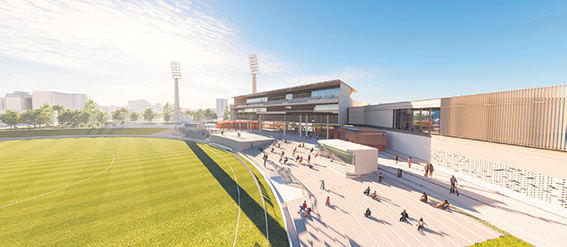
• Plans for the WACA include upgraded community facilities including a swimming pool, but the delay of facilities for members has ruffled a few feathers.
Contention
WA Cricket board member Paul Collins initially aired concerns about the urinal-free design with the Voice, which subsequently made national headlines, and says the mothballing of members’ facilities had become another bone of contention he’d raised.
He said the “matter was not resolved at the board level” and he expects members to be raising the issue at the AGM, which was due to be held as the Voice went to the printers.
“Addressing the issue is still a work in progress,” Mr Collins said.
“The members are now getting a shell because they can’t afford to do it all at once.”
If this year’s meeting proves contentious, it would follow a pattern set by last year’s general meeting and “special general meeting” held in November, which highlighted key issues the organisation was facing.
The CEO was peppered with questions regarding “gender matters”, director resignations, concerns regarding an apparent “lack of budget”, as well as offensive comments directed at members.
There was a perception that members were seen as an “inconvenience”, with more non-members attending the meeting than members.
A report by WA Cricket CEO Christina Mathews presented at last year’s AGM detailed cost increases the redevelopment had experienced, with $30m needed to progress. That funding was later secured, but one year on the development costs have increased again, rising from $154m to $163m.
WA Cricket, which committed $11m to the project, currently lacks more than $7m that it hopes to fundraise.
One Facebook user David Brown said the “disaster” is getting worse by the day.
“How are we to fund what has been left out so the building can be used; even by members.”
Ms Mathews has said that separating the members’ facilities from the overall redevelopment contract will allow WA Cricket to save money.
THE notoriously draughty Redemptorist Monastery in North Perth is finally getting 21st century heating and cooling, but it’s come at the expense of two old sheds.
The three-storey Federation gothic-style church on Vincent Street is a “category A” protected building and Vincent council has previously approved adding air conditioning and heating.
But the chance to upgrade the system to a geothermal heat exchange means the two sheds on the north-west side of the church now won’t be big enough and will have to be demolished.
A report from the council’s planners says the changes “would have no impact on the cultural heritage significance” of the site as the buildings were a later addition and too run down to renovate.
• The heritage Redemptorist Monastery is getting a state-of-the-art and sustainable air conditioning system, but had to get permission to bowl over a couple of old sheds (below).
Slavin Architects director Stuart Neal told a recent council briefing the development would “incorporate additional sustainability initiatives” as the plant room seeks to utilise a geothermal heat exchange system.
“The initiatives are quite significant […] the system will provide somewhere between 80-20 per cent energy reduction,” he said.
“Approximately 12 tonnes of reductions of CO2 emissions.”
Previous stages of development helped to ensure preservation of the site through reconstruction of the veranda and the building’s re-roofing.
The item was passed in one of outgoing mayor Emma Cole’s quickest-ever meetings; it was all over in under 15 minutes because the city is in caretaker mode pending October’s elections.
A LIGHTBULB moment and some “unwavering” support from a council has paid dividends for a WA start-up which has secured its first major contract to supply “smart” doggie bag dispensers to the City of Swan and has a trial running in Vincent council.
Little Rippers founder Peter Konstek says he was chatting to a mate who’s a ranger in Mosman Park about the difficulties they were having getting dog bags during Covid. It got so dire they had to raid the dispensers in quiet parks to fill up the busy ones.
But the lightbulb came when his mate revealed that the only way the council could keep track of what was needed was for the rangers to drive around once a week checking them out.
“I was thinking ‘this is a bit of crappy job’,” Mr Konstek says.
“So I thought I’d just go knock on the door at Freo and see if I could get some answers out of them.”
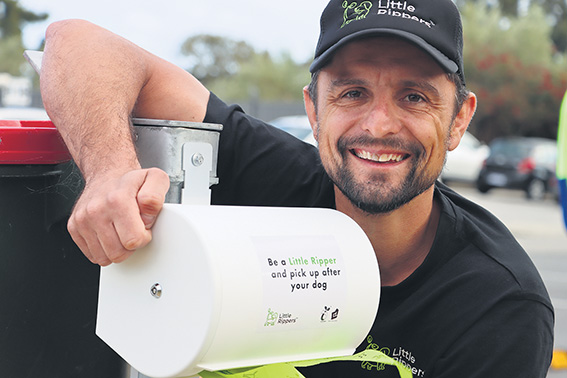
• Peter Konstek’s doggie bag dispensers save time and prevent excess plastic waste. Photo by Steve Grant
Turns out Fremantle council’s rangers were also driving out each week to check their 100 poo bag dispensers and he started to do the math; all that time behind the wheel wasn’t very efficient (or good for the environment), while dispensers which had a few bags left would be emptied anyway, leaving a bit of a plastic waste problem.
“I said to him ‘look, I think I’ve got an idea’.”
It was to put a sensor in the dispenser letting the rangers know when the bags had run out.
He took the idea to a mate who’s an electronics engineer and they completely rethought the dispenser so it could be manufactured cheaply.
“We started playing around with different types of sensors and devices and use our 3-D printers to create the prototype dispensers… and about six months later we managed to get something to work.”
Freo’s rangers agreed to trial the new bags, and although there were a few hiccups the council hung in there as Mr Konstek refined his designs until the system proved to work.
He says now the rangers only have to check their emails over a morning coffee, print out a list of the empty dispensers and travel directly to where they’re needed.
“That way you aren’t having any wastage and customers aren’t complaining.
“We did trials for about six months, and once we got to the point where the prototype was working quite reliably, we then opened up trials with Melville, Stirling and Vincent.”
By July, Little Rippers knew they had the demand and commissioned a local company to produce the plastic molding dies they’d need to go into mass production.
They’ve now secured the three-year contract with Swan, but are also running field trials in Bunbury, Karratha, Murray, Denmark and Shark Bay councils.
Locals apparently like the new design; as the Chook lined Mr Konstek up for a photo with a dispenser in Booyeembara Park in White Gum Valley, one of the regular dog walkers announced it was “very cute”. We’re pretty sure she meant the dispenser.
RESIDENTS with a strong connection to Bayswater have been invited to share their memories for a publication exploring the city over the years.
Resident Reflections: Local Tales of Change will feature stories from older adults aged 50 years or over about the significant events and experiences they’ve lived through and the changes they’ve seen.
The City is undertaking the project in partnership with the McCusker Centre for Citizenship to launch the stories for Seniors Week from November 12 – 19.
It’s part of the City’s Age Friendly Strategy.
If you have a story to share, fill in the form on the City’s website or contact the City’s age friendly coordinator on 9270 4107 or community.centres@bayswater.wa.gov.au.



















 Perth Voice Interactive