MAYLANDS man Darren Peterson is inviting blokes along to a free barbeque to have a chat and make connections.
Mr Peterson previously hosted similar barbecues for men’s health charity Mr Perfect in Kalamunda for a few years. After recently moving to Maylands he’s hosting the first one in his new neck of the woods.
“We can talk about football, we can talk about cars, we can talk about music. We can talk about mental health as well, but it’s not clinical. It’s about creating a space to come down and have a feed, have a little bit of music playing, and you can come and say as much or as little as you want.”
• Darren Peterson at Maylands Foreshore Reserve.
In his day job Mr Peterson is a mindfulness and meditation instructor, a big change in direction from his earlier career.
“I’m from Wales, and I came to Australia when I was 30 and I worked FIFO and construction mainly,” Mr Peterson says. “And I had a few struggles myself when I was working FIFO.”
He says it’s common for men to have a hard time making new friends, but the barbeques have been a good setting for some long-term friendships to develop over snaggers, hashbrowns and soft-drinks.
“I’ve seen the magic happen,” he says.
“It’s not a support group in the sense of an AA meeting. We’re not standing around saying ‘this is my first time I’ve experienced depression’. It’s just creating a non-clinical environment… a place for every male to know they’re not alone, and somewhere they might make a lifelong friendship.”
Mr Petersen first attended one of the barbeques in East Perth, and after seeing friendships being made he decided to become a host.
The “Mr Perfect” name is an ironic moniker for the charity’s founder Terry Cornick, a Sydney man who says his friends thought he had the perfect life on the surface, but he was hiding a struggle with depression, anxiety, and PTSD.
The first free barbeque is on September 17 from 10am to noon at Maylands Foreshore Reserve, and no sign-up is needed; there are plans to make it a monthly event.
THERE is no doubt a lot of folk are doing it tough.
The cost of living is so high, a growing number of people are turning to food banks because they can’t even afford a meal.
With this in mind, the Voice looked for a budget feed that was reasonably healthy, tickled the tastebuds and was easy on the wallet.
There are cheaper options, but Noodler’s Noodle Bar in Como – trying saying that after a six pack – has been consistently good and I’ve been getting takeaway there for more than 10 years.
You get a huge serve of chicken satay with noodles for $13.90 which is probably about half the price you would pay at a Thai restaurant, and that’s before you add rice and delivery. Situated opposite The Karalee on Preston, Noodler’s shopfront is basic and small and won’t be featuring on Grand Designs anytime soon.
The austere interior has a few bench seats and a large counter displaying all the stir fry ingredients and freshly prepared sushi.
The old-school menu – a light box above the counter – had a large range of noodle and rice dishes including seafood mee goreng, beef and black bean, char kway teow, pad Thai and Singapore noodles.
There was a good variety of spicy and milder dishes, and even a Noodler’s box for kids with sweet and sour sauce.
The concept is simple – the chef takes the ingredients from the display counter and cooks your food in an open kitchen behind the till in a matter of minutes.
There is no hiding place in Noodler’s – the cooktop is literally a few feet behind the counter and you can hear the reassuring sizzle as the meat and veg hit the bottom of the searing-hot wok.
I went with my all-time favourite – Noodler’s Special Combo ($15.90).
I’ve been getting it for years and can’t go past the tasty and filling medley of chicken, beef, roasted pork, prawns, shrimps and fresh vegetables.
The produce is all good quality and there is no fatty, chewy lumps of beef or rubber prawns.
It’s all finished with a light oyster sauce that isn’t overpowering or too salty.
Another highlight is the thick egg noodles, which have a lovely flavour and texture, and actually add to the dish rather than just bulking it out. It was a big serve and I struggled to finish it.
Across the table, steam was coming out of my young kids’ ears as they shared a chicken satay ($13.90).
I forgot the sauce had a bit of zing, but they managed to devour all the pieces of tender chook and there was plenty of veggies too.
My wife “Special K” brought up the rear with her Mongolian Beef Box ($13.90).
This is another one of my favourites – slices of tender beef coated in a sticky sauce that has a nice salty-savoury kick.
It’s very moreish and the meat was good quality with no stringy bits.
“Those thick egg noodles are lovely and perfect for soaking up the sauce,” noted Special K.
We also got some cooked tuna sushi to share (eight large pieces for $8.50).
They were decent enough and pretty tasty, but nothing outstanding, so I would go with the noodle boxes first.
Noodler’s Noodle Bar did what it said on the tin again – well-priced, tasty, big serves and pretty healthy.
It’s far superior to other noodle-style chains and the one in Como has never done me wrong.
Noodler’s Noodle Bar 3/24 Preston St, Como 9367 8882
ANYONE up for a head-banging Nosferatu or Frankenstein?
Perth muso Ben Penfold-Marwick has been writing and recording black metal scores for silent horror films made in the 1920s, giving them an eerie and frenetic new lease of life.
A horror buff and black metal guitarist, Penfold-Marwick especially loves old horror movies and has played in extreme metal bands over the years.
In 2022 he combined his two passions for the 100th anniversary of Nosferatu.
• (above) A scene from the silent horror movie The Cabinet of Dr Caligari, which has been given a ‘black metal’ facelift by Perth muso Ben Penfold-Marwick (below).
“I thought it would be fun to try and write and record a black metal score for the film,” he says.
“It was a really different way to write music for me, trying to make pieces of music fit the length and feel of different scenes.
“I also matched some sound effects to certain parts of the film, to further tie the audio to the visuals. The difficulty was matching sounds that didn’t seem too comedic or silly and kept the gloomy tone of the film.
“When I was younger, I used to watch silent horror films with the sound turned down and listen to black metal CDs while watching. I preferred the heavy guitars and drums to the generic organs and orchestral scores the films came with.”
The multi-instrumentalist had so much fun, he did another black metal score for The Cabinet of Dr Caligari, a classic silent German horror film from 1920.
“This time around, I created a few themes and motifs for different settings and characters, and some sections of the score use these themes with different arrangements and tempos, to match the character or setting on screen,” Penfold-Marwick says.
“It’s a time consuming project, but I enjoy it and plan on recording one silent horror film a score year, all released under the 100 title through my Demon Sin project name. I play guitar, bass, drums and keys for Demon Sin.”
Aside from his horror soundtrack work, Penfold-Marwick runs his own extreme metal label Rassilon Records, writes and plays everything on Celestial Shadows – a black metal project inspired by science fiction – and hosts Nightbreed Metal Radio, a weekly audio and video podcast where he interviews metal bands.
But horror is his main muse, especially Italian movies directed by the late Lucio Fulci.
“The Italian horror of the late 70s and early 80s just has its own feel and style like nothing else,” he says.
“Films like Profondo Rosso, The Beyond, and Demons feel otherworldly and extreme in a way American cinema never quite nailed in the same way. I’m not only into old horror though. Just this year, Sissy and Talk to Me, two new Aussie horrors, really blew me away.”
Perth cinemagoers will get a chance to see The Cabinet of Dr Caligari on the big screen with Penfold-Marwick’s black metal score on the opening night of the Perth Horror Film Festival on Friday August 18.
After a highly successful debut last year, the three-day horror festival returns to Backlot Perth cinema with an even bigger programme that now includes a session devoted to international shorts as well as tons of homegrown movies.
“We have some phenomenal WA films this year and they are all fantastic in their own right, but I’d have to say that the two films which really stand out to me personally are The Guard Station, directed by Matt Zappala, which has a sold-out screening on opening night and The Quiet, directed by Radheya Jegatheva, which is a visual masterpiece set in space, screening during our sci-fi night,” says festival director Vanessa Gudgeon.
Tix for the Perth Horror Film Festival (August 18-20) at perthhorrorfans.wixsite.com/perthhorrorfans and to hear Penfold-Marwick’s ‘Demon Sin’ music check out rassilonrecords.bandcamp.com.
THIS townhouse is a great way to climb the property ladder in Mt Lawley without busting the bank.
Priced at mid-$600,000s with three bedrooms and two bathrooms, you’re getting a lot of bang for your buck, including a top location in the heart of the suburb.
With a classic red brick facade, dark green trims and a wrought iron gate, this property looks impressive from the get-go.
The interior isn’t too shabby either with clean lines and a neutral colour scheme making the place feel uncluttered and spacious.
This feeling is enhanced by the high ceilings and natural light flooding through the windows.
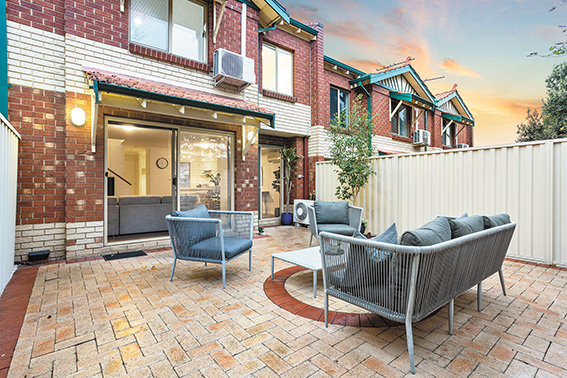
The open plan lounge/dining/kitchen area is a pleasant spot to relax with the glass doors conjuring up nice views of the rear courtyard, where leafy trees loom over the cream fence.
The kitchen is the one area that could do with a slight cosmetic makeover. It’s nothing major, but the benchtops and cupboard doors look a bit dated and could be upgraded to make the place shine.
But it’s perfectly functional and all the appliances and white goods are super modern.
Also on the ground floor is the powder room/laundry and a big storage area.
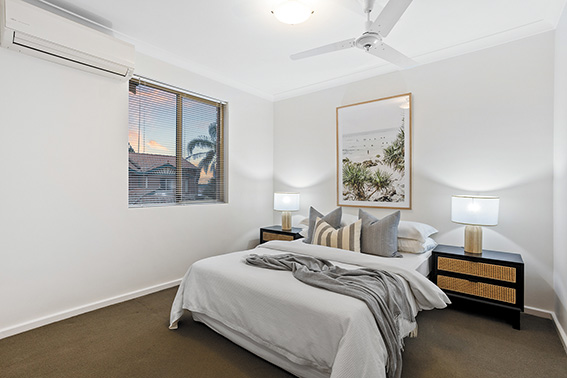
All three bedrooms are on the first floor with the main featuring built-in robes and an ensuite.
One of the other bedrooms has built-in robes and they both share a family bathroom, so no annoying trips to the downstairs toilet in the middle of the night.
There’s some lovely views of the treetops up here and you’re removed from any street noise as well.
Out the back is a paved east-facing courtyard with enough space for a dining set, BBQ and pizza oven.
It’s super low maintenance and only requires a few potted plants to soften the fence line.
A great place to relax with a glass of vino and some al fresco nibbles.
The home includes AC throughout, ceiling fans in all bedrooms, double glazed window to main bedroom, three WCs, and a car bay outside the front door and visitor bay beside it.
Situated on a 163sqm strata lot on First Avenue in a secure complex with only 18 homes, you are in the catchment area for Mount Lawley primary and high schools, and all the cafes, bars and shops in the Second Avenue precinct are just around the corner.
Home open today (SaturdayAugust 12) 1pm-1:30pm From mid $600,000s 12/64 First Avenue, Mt Lawley Beaucott Property 9272 2488 Agent Carlos Lehn 0478 927 017
Have you been hiding your teeth when you smile or have you noticed your teeth aren’t as white or as bright as they used to be? Over time our teeth can discolour due to smoking, dental trauma, poor oral hygiene and certain foods, drinks and medications.
Yes, those daily coffees can be disc- olouring your teeth! Thankfully, tooth discolouration in the majority of situa- tions can be improved with professional teeth whitening solutions.
At Insight Dental Studio we are proud to offer Australian made Pola in-chair and take home teeth whitening solutions. And the best bit is, our takehome whitening kit with custom trays (made specifically to fit your teeth) are currently on sale for only $110 when you book and attend a check-up and clean appointment, usually valued at $415.
Simply wear the custom trays with Pola Day whitening gel for only 30 min- utes a day for 5 to 14 days to gradually and safely whiten your teeth.
So if you’re looking to smile brighter or freely, jump onto Insight’s website to find out more or to book your appoint- ment.
DISPLACED Pickle District creatives could have a new spot over the border in Perth under a proposed arts plan announced by lord mayoral candidate Sandy Anghie.
The Pickle District is in Vincent’s old industrial slice of West Perth, and in the past few years galleries and artists have moved in to repurpose the old warehouses and factories and hold event nights.
Some of the prominent creative businesses that made the Pickle District what it is are currently tenants of a large block that’s soon to be demolished to make way for a Bunnings.
Cr Anghie, who’s running against incumbent Perth lord mayor Basil Zempilas in October, has announced her “Arts Means Business” plan to invest in Perth’s creative and cultural sectors.
One prong of Cr Anghie’s five-part plan is to set up creative hubs in vacant spaces owned by Perth council.
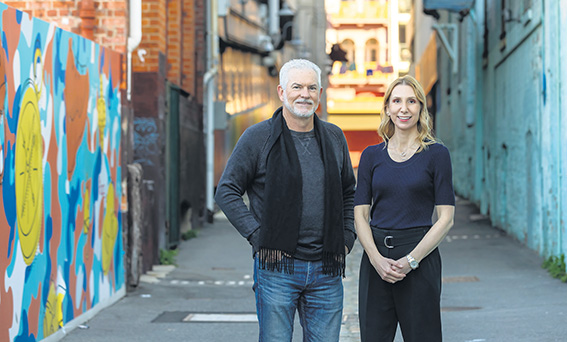
• Sandy Anghie in the Pickle District with Linton Parlington, owner and director of Linton & Kay Galleries.
“Based on recent media reports, local arts hub The Pickle District looks set to lose their space in the Town of Vincent,” Cr Anghie wrote in her arts plan announcement
“The City of Perth should lead by example and welcome creatives like the Pickle District into vacant City-owned space.
“There are some great examples in the private sector already, such as the Humich Group activating the Liberty Theatre and shopfronts on Hay and Barrack Streets; and the Fragrance Group on Pier Street providing cost effective space to Huzzard Photographic Studios and others. Let’s back this up.”
Cr Anghie said moving in creatives would help revitalise quiet areas.
“It is well known that creativity enables urban development: artists move to inner-city areas in search of accommodation and studio space. They make a place fun and interesting, which draws others in.”
Artist Jon Denaro runs VoxLabs, a studio on Old Aberdeen place that’s having to move to make way for the Bunnings. He’s keen on Cr Anghie’s idea.
“The potential for the Pickle District is very real,” Mr Denaro tells us.
“Getting closer to the centre is vital – we would look forward to making Perth a more interesting place.
“It is a no brainer for people in the know: Perth needs the Pickles.”
Vincent mayor Emma Cole had opposed the hardware giant’s application, but the decision rested with the state’s Development Assessment Panel which voted to approve the $25.5 million plans in November 2022.
Revised plans, which re-design two community spaces to instead accommodate a fresh food market or gym, are currently out for consultation until August 7.
CRIMEFIGHTING robots used to patrol Singapore’s streets could be brought to Stirling under a plan by councillor Joe Ferrante.
In 2021 Singapore ran a short trial of four-wheeled robots named “Xavier” patrolling streets. They were armed with a 360-degree camera and a two-way communicator so human operators could remotely talk to nearby people.
Their video feeds were analysed by artificial intelligence to alert a human if they detected suspicious behaviour, and they were intended to focus on low-level malfeasance like smoking in prohibited areas, impro
per bicycle parking, scooters on footpaths, or flouting Covid-19 rules (which at the time included more than five people congregating in public).
Augment
In April 2023 Xavier bots were deployed at Changi airport to “augment” police on patrol, and in June the Singapore government announced they would progressively deploy more patrol bots across the city.
Stirling council pays for its own security patrols, but the program is expensive, and some locals still don’t feel safe.
At the August 1 council meeting, Nollamara resident Daniela Ion told councillors that locals were observing a rise in break-ins and calling for more lighting to deter crooks.
“People from Nollamara, Balga, Yokine, Mount Lawley, and other suburbs are worried about the increase in the number of house and car [breaks-ins],” Ms Ion said.
Later that meeting Cr Ferrante gave notice he’d move a motion that “robocops ‘Xavier patrol autonomous mobile robot units’ be assessed for a trial deployment in hotspots”.
• HTX’s Xavier patrolling Toa Payoh Central. Photo from htx.gov.sg
Councillors will vote on whether to investigate bringing the bots over at the next council meeting.
Singapore’s trial prompted a small number of concerns from privacy activists.
“It all contributes to the sense people – need to watch what they say and what they do in Singapore to a far greater extent than they would in other countries,” said digital rights advocate Lee Ti Ying, quoted by Agence France-presse in 2021.
In San Francisco in 2017, private company Knightscope started hiring out its wheeled robot as a private security guard. A local organisation briefly rented the robo guard to patrol the footpaths outside their building.
But many locals disliked the idea, believing the robot was brought in to stop homeless people from being on the footpath, and the robot was relentlessly bullied.
After the robot was squirted with barbecue sauce, blinded by a tarpaulin, smeared with faeces, and shoved around, the trial was cut short.
PLAN to restrict the unfettered spread of new vape or smoke shops was unanimously endorsed by Bayswater councillors this week, with the rule now off to the state government for a final decision.
The rule change would mean cigar stores, shisha bars, or shops that sell “smoking related implements” would be classed as a “restricted premises” giving council the power to keep them from opening in most areas.
It came about from a motion lodged by councillor Catherine Ehrhardt in late 2022, after she’d seen a proliferation of vape stores open up including in sight of schools and near parks.
During the consultation period 26 people lodged supporting submissions and 16 were opposed.
Comments in favour included echoed concerns about vape shops near schools: “Vaping is the next epidemic amongst young people and products [are] clearly targeted towards teenagers,” one commenter said.
A few of the objections were opposed to lumping in shisha bars with other types of smoking, arguing that shisha bars had a “sociocultural” element and “for some groups of people, can be a safe social space without alcohol”.
However a council report states the rule would only restrict new venues from opening, and existing authorised shisha bars can keep operating.
Cr Ehrhardt said after reading the arguments for and against, she was “very happy” to move ahead with the plan.
Cr Sally Palmer said schools would be “very relieved to hear this type of motion is happening”.
Vaping’s become a major behavioural problem in schools, according to an article in the Medical Journal of Australia, with teachers reporting agitated and disruptive behaviour from vaping students.
The new rule requires amending Bayswater’s Town Planning Scheme so it now requires approval from planning minister John Carey and the WA Planning Commission.
Due to a planning quirk new vape stores can still open in Morley’s town centre, which has a unique zoning that allows other kinds of restricted premises like adult shops.
A PRICEY tree planting program for Yokine’s Flinders Street strip will cost an estimated $6,500 per tree and comes with a traffic engineer’s warning it could be dangerous.
Flinders Street is pretty bare and back in mid-2022 ward councillors Suzanne Migdale and Joe Ferrante requested more trees along the strip.
Nearly $200,000 was set aside to plant 31 trees along the median strip, but after a lengthy investigation some of the tree locations have proved unworkable due to nearby underground services. Now somewhere between 26 and 29 trees will be planted.
Councillors this week unanimously voted to approve the latest concept plan, despite warnings from a traffic safety engineer at Donald Veal Consultants they’d hired to review the proposal.
Hazard
The engineering company report states, “DVC considers that the introduction of the stated species of tree within the median of Flinders Street would introduce a significant hazard, potentially affecting all road users. The strong recommendation would be that they should not be [planted]”.
But Stirling staff reckon she’ll be right, reporting to councillors: “While the City acknowledges the outcome of the engineering report it is also noted that the potential increase in risk is mitigated by the effect landscaping within streetscapes has on slowing the speed of vehicles.
“Planting trees within the median reduces the perceived width of the road reserve, this in turn reduces average speeds which in turn mitigates the risk of planting trees within the median.”
Ahead of councillors voting, Scarborough resident Simon Wheeler queried the immense cost per tree during public question time.
Mr Wheeler, who’s previously run for Coastal Ward, said, “We have to plant more trees, Mayor [Mark] Irwin, and not doing so will cost us much more in the long run. And I think council should support this item.
• The cost of planting a tree in Yokine has raised eyebrows, but Stirling’s mayor says areas shouldn’t miss out just because they’re trickier to green up.
“But when the planting of it turns out to be less than 30 trees, it takes nearly 12 months of administrative wrangling, an external risk assessment – the outcome of which council has been advised to ignore in tonight’s report – and close to $200,000 for less than 30 trees, there’s something wrong, Mayor Irwin, there has to be a better way.”
Stirling is aiming to plant a million trees and shrubs by 2032, and Mr Wheeler noted the plan could get very expensive at this rate, somewhere between $1.5b – $5b- depending on the tree-to-shrub ratio.
“I’d like to know what measures the City will undertake to ensure that further much-needed tree planting and climate mitigation strategies can proceed in a financially sustainable manner.”
Mr Irwin acknowledged, “It’s a very expensive tree planting… when you look at them in isolation, it is an exorbitant amount.”
Mr Irwin said it was a particularly expensive area to plant in, and about $45,000 is budgeted for traffic management to close the streets during planting. Additional money was spent on sending out 550 flyers for community consultation, resulting in four responses (one in favour, three raising safety concerns).
Mr Irwin said, “It’s important that we also look at areas that have a low amenity and quite difficult plantings, and make sure that they don’t miss out just because it costs more money.”
A NEW name in sports writing has caused huge upset in British and North American media markets in recent years, and Australia could be in their sights.
The Athletic was founded in 2016 as a subscription-only sports news site, and within two years had gutted American legacy media newsrooms through a robust recruitment campaign targeting their best sports writers.
The company was the brainchild of Americans Alex Mather and Adam Hansmann, who quit their jobs at fitness company Strava to establish The Athletic.
• The Athletic opened a branch in England in 2019, poaching Fleet Street’s top sports writers with huge salaries their legacy media owners couldn’t match; but it didn’t help the sports disruptor turn a profit.
Mather described the initial objective of The Athletic as “to be the local sports page for every city in the country”.
In a matter of months, The Athletic had outgrown its Chicago birthplace, and opened a branch in Toronto, Canada.
By 2019, the company had expanded to 47 North American cities, and opened a branch in the UK.
It became clear that The Athletic had found a niche in the market and had far outgrown its founders’ initial vision.
Multiple large venture-capital firms threw their lot in with the start-up, and by March 2018 The Athletic had raised approximately A$40 million in investments.
But for all the confidence investors placed in The Athletic, the company is still yet to turn a profit. It lost A$10 million in the quarter to February this year, though pundits say that’s a significant improvement over previous years.
The ultra-cheap subscriptions offered by The Athletic to attract first-time subscribers was a costly strategy, and its strictly advertisement-free model ruled out a major source of income utilised by most modern news outlets.
• The New York Times bought The Athletic and recently added advertising – it wasn’t a hit with fans.
The global sporting drought caused by the first year of the Covid-19 Pandemic would also prove to be a major stumbling-block for The Athletic, and by 2021 a low subscription growth rate effectively forced Mather and Hansmann to sell the company.
After months of negotiations, The New York Times bought The Athletic for $790 million, far lower than the $860 million to $1.2 billion price the founders were aiming for.
However, this is still considered a remarkable sum for a company that had only existed for five years.
The deal was closed in the first quarter of 2022, and The Athletic was made a subsidiary of The New York Times, with Mather and Hansmann retaining directive control of their company.
Though The Athletic’s sale to The New York Times may have technically made it part of the ‘legacy media’, the drastic changes made to the media establishment had already been made.
But the nature of these changes has been a matter of intense debate in recent years.
Understandably, hackles have been raised among traditional sports news outlets, not only from the loss of their staff, but a comment made by Mather in 2017: “We will wait every local paper out and let them continuously bleed until we are the last ones standing. We will suck them dry of their best talent at every moment. We will make business extremely difficult for them.”
These comments were quickly retracted by Mather, who apologised for his brashness.
But the damage was done, and to many existing media companies, The Athletic had tarred itself as something of a villain, which was out not to change but to conquer sports media.
However, in addition to over one million paying subscribers, there are those in sports journalism who see the founding of The Athletic as a good thing, and a huge boon for the industry.
So far, the story of the news media in the 21st century has been one of profit decline, readership decline, and overall, a massive disruption to the way news is collected and disseminated.
This is often pinned down to an abject failure of legacy media to adapt to the Digital Age, and to this day, traditional publications are fighting an uphill battle against colossal social media platforms to win back readership.
The side-effect of this failure has been continued layoffs in the media industry, amplified recently by the Covid-19 Pandemic.
According to the Pew Research Centre, since 2008 newspapers have shed over 40,000 jobs in the US alone; a 26 per cent drop which shows no sign of abating.
The story is much the same the world over – between 2006 and 2021, the Australian media industry shrunk by 60,000 jobs, with approximately half those being lost during the Covid-19 Pandemic.
It is hoped by some that a fresh face in the global media industry can help break this downward spiral.
Devotion
And, that The Athletic’s devotion to digital news will ‘future-proof’ it, as opposed to some older publications, who awkwardly straddle both print and digital news and are tentative to complete the transition.
A deputy sports editor at a UK newspaper, who didn’t want to be named, has spoken highly of The Athletic, praising its role in replacing the nigh-extinct community newspapers as the career springboards for young journalists.
“They’ve hired lots of young journalists out of university or starting out their careers, and given opportunities to young people that just simply didn’t exist three or four years ago.”
• The Athletic has focussed on long-form stories – any notion Millennials have no attention span has been blown away.
The source didn’t see The Athletic as a threat to sports media, but a creator of a “fluid state” which has forced legacy media organisations to evolve to keep up with new players like The Athletic.
A unique aspect of The Athletic’s market penetration strategy was the aggressive headhunting of journalists.
The lucrative salaries enticed not just big-name national sports writers, but also local journalists who had a staunch following within their communities for their dedicated coverage of specific clubs or players.
“They also went into all the local media,” the sports editor told the Herald.
“And so they hired the person in Manchester, who was best renowned for covering Manchester United, and the person who was best renowned for cricket, or best renowned for covering Manchester City.
Bidding war
”The people who are best renowned at a local level rather than national level. But they also hired a few from national newspapers as well.”
But in the employee bidding war that raged between The Athletic and its competitors, wafer-thin profit margins and seemingly uncertain futures proved no match for innovation and a mountain of venture capital funding.
Legacy media outlets haemorrhaged staff severely, and as a result, months of labour shortages ensued.
Alongside hiring practices, the nature of sports writing itself has also been altered in markets where The Athletic has a presence.
The source talks of how long-form articles have become more popular, with readers wanting “the story behind the story”, especially drawn-out sagas or major incidents in the sporting world.
I think there’s been a greater emphasis towards what we would describe as long reads – where people are writing in depth 4000-5000 word pieces on particular subjects in sport more frequently than they used to.”
However, the source maintained that the number of articles published by outlets had stayed the same.
Research has shown readers are beginning to prefer broad, in-depth articles supplemented by shorter, more specific pieces, as opposed to a flurry of five-to-six paragraph articles – each focussing on a single subject.
And perhaps this is no fluke or happy accident, but a sign that consumer attitudes are changing in favour of The Athletic’s model of writing.
Podcasts
A 2021 study by Edison Research found that approximately 37 per cent of Australians listen to podcasts each month, with an average of six 40-minute episodes consumed per week.
Of these Australians, 93 per cent claimed they paid attention to “all, or the majority” of each episode.
Whilst the topic of these podcasts may vary between things like news, gossip or comedy, there is clearly a niche reopening for longer forms of media – regardless of whether The Athletic is driving it or not.
Australia remains the largest English-speaking nation without any branch of The Athletic covering our sporting market.
But in January 2021, the name ‘The Athletic’ was registered with the Australian Securities and Investments Commission – perhaps a sign that the world’s most sport-mad country has not been forgotten by The Athletic.
Sunshine Coast University sports journalism expert Peter English, is sceptical of the prospect of The Athletic expanding to Australia.
He concedes the company could eke out a foothold similar to ESPN Australia – an American sports network that maintains a cable television service and news bureau in Australia.
“Some similar sports sites have been established already with varying success over the past 15 years or so, such as ESPN Australia, Cricinfo, The Roar, etc,” Dr English said.
“You might even include CODE Sports, which seems to be doing a similar job as The Athletic, even though it’s owned by News Corporation.
“It could have a similar impact to the US and the UK, if they take big name reporters,” said Dr English, though he thinks The Athletic could be scaled down and have its content syndicated through The New York Times sport section if it fails to turn a profit.
Dr English’s doubts are rooted in the painstakingly slow profit growth produced by The Athletic’s subscriber-based system, although earlier this year the company surprised (and outraged some) subscribers who logged on one morning to their first ad.
But our UK source says The Athletic’s future is bright, and it’s legacy media that will change, in order to provide a level of journalism not seen in free news services.
“If you’ve got news that’s free, you’ve got to create something that people will pay for. And for us, it’s good analysis. It’s intelligent thinking, it’s exclusive news stories, brilliant interviews.”
They say that even within their own organisation, the future of media looks to be heading to where some may argue The Athletic already is.
Curator
“I see my role as being a curator of content for a website or an app, rather than what I do a lot of the time at the moment, which is designing pages and print pages and kind of working out.”
Whilst both The Athletic website and critically acclaimed app are available in Australia, The New York Times, as the now-owner of The Athletic, declined to comment when asked about plans for an Australian expansion.
But should major international sports like cricket and rugby union – so far relatively untapped by The Athletic – ever entice the company to expand beyond Atlantic coastlines, Australian media could see huge upheaval.
























 Perth Voice Interactive