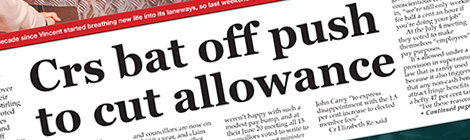
AFTER expressing “disappointment” over the small size of their payrise this year, Stirling councillors have voted to grant themselves superannuation and to bat away a staff recommendation to trim their IT expenses.
The WA Salaries and Allowances Tribunal is in charge of setting pay rates, and increased councillor pay by 1.5 per cent this year.
At a big council like Stirling that bumps the mayor’s allowance up to $93,380 plus meeting attendance fees of $48,704, and councillors are now on $32,960 a year, and claim around $10,000 in other benefits.
But Stirling councillors weren’t happy with such a modest pay bump, and at their June 20 meeting all 15 councillors voted to write to local government minister John Carey “to express disappointment with the 1.5 per cent increase to elected member fees”.
Cr Elizabeth Re said given the number of hours a conscientious councillor put in, “we’re still only working for half a cent an hour if you’re doing your job”.
At the July 4 meeting they voted to make themselves “employees” for pay purposes.
It’s allowed under a provision in superannuation law that is rarely used because it also triggers a rule that any non-cash benefits attract fringe benefits tax at a hefty 47 per cent tax rate.
“For these reasons, local governments in Australia typically do not pursue this course of action,” states a 2021 report from the WA Local Government Association.
Mayor Mark Irwin said Stirling was the first council to do this in WA, and would push for changes in state law to make super payments standard for councils.
Cr David Lagan he’d heard at a recent WALGA conference: “For many young mothers they would never stand for council if they were not also getting the same remuneration support that all workers get in our Australian work environment.”
Stirling has not yet calculated how much this would cost, with a staff report saying that’ll be considered in the next budget.
At their June meeting councillors also voted to maintain their annual Information and Communication Technology allowance at the $3500 maximum set by the Salaries and Allowances Tribunal, despite a staff recommendation to trim it back to $2350.
Staff had estimated councillors’ phone contracts cost them $89 a month, internet costs were $85 and electricity $248 per year.
But Stirling told the Voice that councillors had recently advised their annual electricity expenses to do their job were around quadruple at $868, while phone and internet services were each roughly $200 more each year.
Maximum
Their iPhone, iPad, laptop, and printer are provided by the council.
This year the salaries tribunal made clear councillors weren’t supposed to get both the maximum allowance on top of being provided free devices.
The SAT’s 2023 determination states: “The Tribunal’s intention is for the maximum annual allowance to cover the cost of providing ICT hardware and equipment. It is not the intention for the allowance to be paid in addition to providing equipment and hardware.”
SAT acting executive officer Luke Cullen clarified that “councils can provide equipment within the set allowance, but the costs should be covered by the allowance”.
However he said if equipment such as phones and iPads were still retained as council assets rather than given to councillors, their costs wouldn’t be picked up by the allowance.
Stirling councillors get a pretty good deal if they want to buy ‘old’ equipment: They’re given a new iPhone and iPad every two years, and a new laptop and printer every four years, and can buy any piece of gear for $1 apiece at the end of each two or four year period.
Last financial year Stirling councillors were paid about $160,000 in benefits between the allowances for phones, furniture, travel and conferences, plus about $560,000 in regular pay.
by DAVID BELL


Leave a comment