
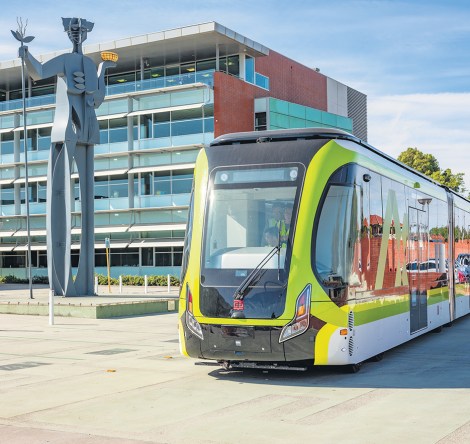
STIRLING’S trackless tram trial has picked up a national award for innovation.
The tram project won the Productivity through Infrastructure category at the 2024 National Awards for Local Government, with Stirling CEO Stevan Rodic accepting the award from prime minister Anthony Albanese while on the annual pilgrimage to Canberra to lobby for project funding.
To win the category the project had to demonstrate technological innovations, sustainability, liveability and productivity in investment strategies and planning and addresses long-term infrastructure priorities.
The trackless tram trial delivered a fully operational tram in Stirling last November, while the council also ran a Net Zero Symposium and Community Open Day.
Mayor Mark Irwin said accolade was prestigious and reflected the hard work of all the City’s partners.
“The City of Stirling embarked on a business case, which has been funded by the Australian government, to investigate the feasibility of implementing a trackless tram system from Glendalough Station to Scarborough Beach,” he said.
“It was important to bring our community along on this journey so that they could really see what we were trying to do.
“We held a trackless tram open day at our administration centre where we gave residents an opportunity to ride on the tram and share their feedback.
“More than 1200 people came to the event and the response was overwhelmingly positive.
“Of those who completed a survey, 94 per cent said the ride quality was good to excellent,” he said.
The council is currently finalising its business case and expects to deliver it to the federal government in the next few months.

 Perth Voice Interactive
Leave a reply to Ben McMillen Cancel reply