

• Flexi home


    THE Voice has always had a soft spot for Mount Hawthorn.

    You’re still in the inner-city, but it’s slightly removed from all the hustle and bustle with pleny of nice parks and a short walk over the bridge to Lake Monger, where you can really get away from it all.

    This Mt Hawthorn home not only looks great but is extremely practical and could be nicknamed “Mr Flexible”.

    It has five bedrooms, but you could lose some and have more living areas, depending on your situation (for instance, older kids leaving the nest).

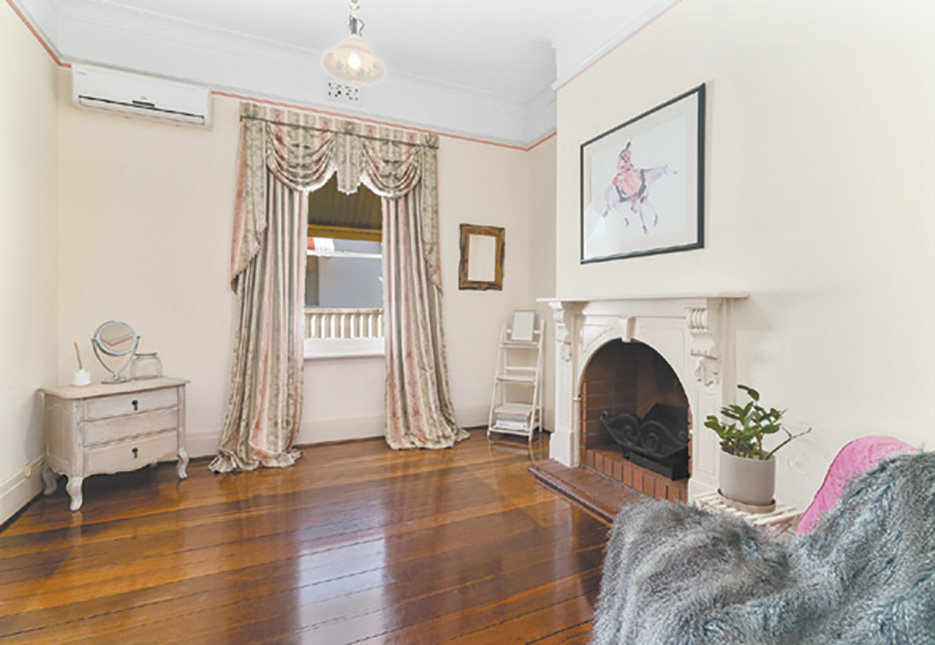
    Built in the 1920s, there’s lots of character to the place with gorgeous wide timber floors, a clawfoot bath in the vintage-look bathroom, decorative plasterwork and period fireplaces.

    The facade is especially impressive with the wrought-iron fence framing a gorgeous leafy front garden and verandah.

    Recent renovations bring the home into line with the 21st century, ensuring you have all the mod cons like air conditioning, remodelled kitchen and a good-sized laundry.

    The living airy is nice and bright, courtesy of the large glass doors that lead to the rear landscaped garden. This lovely, relaxing area includes a large patio with plenty of room for a dining table, bbq, pizza oven and lounge setting.
    Off to the side is a small garden with a nice patch of grass, raised garden beds and plenty of shade from leafy trees.

    There’s enough space for a pub-style wooden bench and chairs (always good if you have older kids who want to socialise).

    And let’s not forget about the fish pond; a quaint touch that will always be a favourite with curious kids and guests.

    The kitchen is done in a sort of country style with natural wood doors.

    It’s nice and practical, but I’d probably go for a more modern lighter look, updating the benchtops and cupboard doors down the line.

    Home offices used to be somewhat of a rarity, conjuring up images of CEOs managing their global empire from afar, but post-covid has changed the working landscape and they are now far more common.

    Thankfully this home has a decent-sized one with plenty of space to manage your affairs and do Zoom calls without work colleagues glimpsing your undies drying in the background or clothes hanging off the edge of the spare bed.

    Both bathrooms are a decent size with the main having a lovely vintage-look.

    The home includes split-system AC, potbelly stove, landscaped gardens and a garage with space for two cars.

    Situated on a 501sqm block on Anzac Road, you are close to tons of local cafes, shops and restaurants, and it’s just a short walk to Britannia Road Reserve.

    48 Anzac Road, Mt Hawthorn Offers from $1.43m
    Home open today (Saturday May 21) 12pm-12:30pm and tomorrow same time.
    Bellcourt Property Group 6141 7848

    Agent Donna Buckovska 0419 928 467

  • Business aid set to be binned

    VINCENT businesses are unlikely to get any more rates freezes from their council to compensate for the privatisation of commercial waste collection.

    The City of Vincent pulled out of commercial waste collection in June last year, but softened the blow by offering landowners a $520 rates rebate, with promises of a review of the “financial and services impact” of the privatisation before this year’s budget round.

    The review was completed by an external consultant, but not a single question put to 100 business asked them how much extra they were paying for waste collection compared to the old scheme.

    But in the broad “do you have any other feedback” section of the survey, many let fly.

    Irrelevent

    “They have given us a rebate of $500pa but the charges are now $1700pa so it is costing us three times as much as before, so the rate freeze is basically irrelevant,” one owner responded.

    Another complained of the “massive shift of a very large sum of money” during Covid “just when we needed it most”.

    “The landlord has done a little clap,” reported another, who said the move had “just added an additional cost to my operational expenses and another thing I have organised”.

    Others pointed to other problems they’d encountered, such as limited recycling options.

    “Everybody is now using our bins; they are locked so they dump stuff on top so we have to pick it up and put it in the bin we’re paying for …all in all we’re not too happy,” another respondent noted.

    Another who now has only one bin to deal with said it was cheaper, but they were still unhappy about the inability to recycle.

    Adjusted

    Despite this feedback, a report to this week’s council briefing forum claimed “most businesses have adjusted well to the changes and are happy with their current arrangements.”

    The report noted that 19 per cent of businesses had reduced the amount of waste they were generating, while 28 per cent had found services that allowed them to increase how much they recycled.

    It also found that the “reported higher costs are more reflective of the fact that the business had previously had multiple bis or collection frequencies under the old council system; a system with [sic] was subsidised by ratepayers.

    “… not all businesses have taken advantage of the tailored waste options available to them – particularly those where waste is managed by the landlord or strata company.

    “It is not recommended that any further transitional support for commercial ratepayers is required.”

    The recommendation will be debated and go to a vote at this Tuesday’s full council meeting.

    by STEVE GRANT

  • Recycling rhapsody
    Patricia Alessi (below) has turned flimsy violins into bug hotels, guitars into painters’ canvas, and now massive stocks of old sheet music into pinwheels.

    CHEAP unusable musical instruments are being thrown out by the truckload, but a touring project coming to Maylands is striving to reuse or recycle every plinky instrument and accessory to keep them out of landfill.

    Curate is a not-for-profit arts and music outfit, and founder Patricia Alessi started the “Recycle Instrument Project” in 2019.

    Ms Alessi says places like Aldi are selling cheapo instruments en masse, and sometimes a violin can go for as little as $39.95.

    It’s a bargain, “except it doesn’t work!” Ms Alessi says, and they’re better described as “instrument-shaped objects”.  

    “It doesn’t even make it through the first lesson because it’s so terrible. 

    “It actually costs more to try to fix  it than if you had just gone to buy a decent second hand violin or guitar. 

    “So it ends up costing money, because it can’t be used and it’s not worth fixing.” 

    It can also turn kids off learning music: “It’s not a pleasant experience for anyone.” 

    A lot of cheapies are made out of such flimsy materials they can’t be recycled, so Curate’s been collecting them for other useful ends. 

    “We’ve taken in over 1000 instruments already, from 2019 to 2022. That’s just Perth, and a bit of Mandurah,” Ms Alessi says. “If that’s what’s going on in Perth alone, you can imagine what’s going on on a national or global scale.” 

    The best option for the flimsiest pieces is “turn it into something else”. 

    Instrument bodies have been used as canvases for painting, glockenspiels at the end of their lifespan have become planters and windchimes, and unusably flimsy violins have been upcycled into bug hotels to attract beneficial insects. 

    Now the recycling project’s focusing on tackling a huge surfeit of donated sheet music. 

    The high end glossy paper is pretty pricy and many people tend to hold onto it for sentimental reasons, eventually leading to closets full of reams of aging tunes that find their way to the Recycle Instrument Project. 

    Sometimes people can pass it on but there’s been a lot that has no demand for reuse. 

    “Intro to Recorder Music Level One is not flying off the shelves … I have so much recorder sheet music,” Ms Alessi says, with intros to Disney music and old theme songs being a mainstay of the growing stacks. “And people don’t want to throw it away.” 

    At the upcoming date in Maylands, she’s hosting an intergenerational art workshop to turn the donated stock into nostalgic low-fi papercrafts, reviving the old-timey tradition of the pinwheel. 

    School science 

    They were the fidget spinner of their day and once a popular mainstay in school science lessons. Ms Alessi recalls growing up they were even used competitively to see who could craft a pinwheel that would spin the fastest when held out a car window. 

    “I remember taking my pinwheel on a summer vacation and tried to see if I could beat my sister. It was very competitive … best out of 10.” 

    The workshops run across the day at Maylands Town Hall on Sunday May 22, and Bayswater council’s sponsoring it so the spots are free, RSVP via eventbrite (search ‘nostalgic pinwheels’). 

    Djinda Boodja Arts Centre director Vicki Warn will be along to help decorate the pinwheels. 

    by DAVID BELL

  • ‘Vote of confidence’
    Carillon City as it is now (top) and how it could have been under the ‘upgrade’ (bottom).

    • THE CBD bounceback looks to be underway with Perth having its biggest footfall count for a Friday night in months. Lord mayor Basil Zempilas reported at the May 3 AGM that “the Friday night just gone… figures showed an increase of 14.6 per cent in activity on the previous week,” the biggest number of people in the city in 11 weeks. “And that was day one of the masks coming down… we’ve seen just on day one, the first available numbers, the immediate impact.”

    • THAT Friday also brought the announcement that Andrew and Nicola Forrest had bought Carillon City arcade for a reported $80 million, which Mr Zempilas called “a huge vote of confidence for our city and in particular the retail core”. The arcade contains a huge chunk of the city’s retail spaces but it’s been dogged by years of disruptive upgrades that’ve left shops vacant in preparation for a redevelopment that’s never arrived. Those dormant plans will now be scrapped.

    • WATCHING municipal meetings online has made for compelling viewing during the pandemic, but anyone missing those city hall meeting vibes will be glad to hear regular council meetings are recommencing. Local government minister John Carey announced last week: “I will shortly be writing toall local governments to ask that meetings now return to normal, including allowing for any interested member of the public to attend in-person to engage in the regular business of council meetings.” He said online meetings had allowed for greater participation for people who couldn’t make it in person, and he’d like to keep the online streaming an option; “I also think there is now no reason for typical council meetings to be held in an online-only format. “My strong view is that it is critically important that ratepayers and interested members of the public have an opportunity to attend meetings in person, to engage personally in the democratic process.”

    • THE upgraded Bayswater Waves has won the inaugural platinum award for a “Waterwise Aquatic Centre” from the Water Corp. So many centres were meeting the old gold standard that the new “platinum” ranking was added to recognise low-flow standouts like Bayswater Waves for going above and beyond to minimise splashing and install the latest watersaving tech. Water minister Dave Kelly said: “Water efficiency is a shared responsibility across the community ‚Äì in our homes, workplaces, and across all levels of government. In the face of climate change and declining rainfall, never has this responsibility been more important.” He said the awards are “supporting high water users to be as water-efficient as possible across their operations. This is an essential part of meeting our future water needs because reducing the amount of water we collectively use defers the need for expensive new sources.”

  • Free parking to boost business

    THE City of Perth will trial extended free parking in West Perth in an effort to support local businesses and promote neighbourhood vibrancy. 

    “I hear continually that the cost of parking, and the time limits on street parking, is a barrier to people visiting our city,” councillor Sandy Anghie said when putting forward the motion. 

    The high cost of parking has led to car bays along parts of Hay Street standing empty over weekends, which was hardly good news for West Perth businesses already struggling from the effects of the pandemic.

    “Times are tough out there at the moment; these little things can make a huge difference to small business owners,” Cr Anghie said.

    The trial will result in lost revenue for the city, but Cr Angie says it’s a viable option: “The cost of free parking in West Perth should be insignificant in comparison to the potential benefits for the local businesses.”

    The only West Perth cafes open on Saturdays are clustered around the free parking area, with Cr Anghie hoping more cash in customers’ pockets will encourage more to extend their trading hours.

    The one hour free parking area will include Harvest Terrace and Thomas Street on Hay Street, Monday to Saturday. On Saturdays, one hour free parking will be available on Outram street and Colin Street. 

    There will also be a reduced fees across the suburb on Saturday mornings. 

    The trial will start immediately and run until June 2023, or until Covid-19 conditions are no longer an issue for local businesses. 

    Councillors also requested a review of all on street parking in Perth, with findings to be announced in six months time. 

    by ISABELLA SMITH

  • A long way behind
    Heike Motzek was a fit and healthy triathlete before long Covid got a grip on her lungs.

    A WOMAN who believes she’s suffering from long Covid says the WA government has dropped the ball and isn’t ready for the inevitable emergence of the condition.

    Heike Motzek (55) contracted Covid four weeks ago and is still struggling with severe breathlessness, which makes even talking a challenge.

    Ms Motzek says she’s drawn a blank from the health department, which didn’t have a mechanism to record her condition, while the only clinic set up to examine Covid-related respiratory problems will only see people for two weeks after they’ve contracted the disease.

    Ms Motzek was fully vaccinated and had no underlying health conditions; as an active triathlete she was in excellent physical condition before the virus hit.

    She’s tried to stay active, and says the struggle to take a breath is pretty much the same whether she’s exercising or talking to someone.

    “So this is like I’m exercising all day long, every day, and that’s very exhausting.

    Doctors can’t predict who’ll be left with long Covid, but it’s defined as a continuation of mild to severe symptoms which persist after four weeks; how long it will last is also something of an unknown.

    Common symptoms include fatigue, breathlessness and in some isn’t normal”.

    Apart from hoping the government steps up its reporting requirements, she also wants it to follow the lead of other countries and establish specialist long Covid clinics.

    She also points out that many countries are now provideing financial assistance for people with long Covid.

    Ms Motzek says her employer has been supportive in providing Covid-related sick leave, but with her family living back in her homeland of Germany, she’s worried what will happen if she’s unable to return to work soon.

    Ms Motzek says her experience should be a lesson to other Sandgropers who shouldn’t be ignoring preventative measures on the presumption Omicron was little more than a sniffle.

    “People should have done better by each other”.  

    Too early

    A spokesperson from the health department said Covid-19 affected people in different ways and there was no standard recovery period. 

    “Those concerned are encouraged to visit their GP to discuss their symptoms and management,” the said.

    “Given case numbers for Covid-19 are only just peaking in Western Australia, it is too early to determine the number of people affected by long Covid.

    “Recent studies suggest vaccinated people who have received at least two doses of vaccine are significantly less likely to have symptoms associated with long Covid after being infected with SARS-CoV-2.”

    by SKYE WILLOW-WITHERS

  • Meeting of mines

    THE National Aboriginal Press Club held its fifth event at Optus stadium last Thursday, May 5, bringing together leaders from industry and government with native title holders to discuss the future of WA’s mining and energy sector.

    BHP’s head of Indigenous engagement Allan James told the crowd of about 150 people the relationship was “very much a work in progress”.

    A Wongi/Yamatji man born and raised in the northern Goldfields, Mr James shared his lived experience of dispossession after mining forced his family off their land 20 years ago.

    Mr James said he’d seen and felt the devastation and loss of culture when mining companies “get it wrong,” but said there can be positive outcomes for communities if mining companies do better.

    “[There is] enormous opportunity for prosperity in generations to come, but [it] needs to be done right,” he said.

    He wants to see more Aboriginal people in leadership roles within the mining sector, and a transparent process of decision making. 

    Mr James said mining companies need to be focusing on retention and creating pathways for Aboriginal people, as well as creating work environments that are “culturally respectful.” 

    “We can’t succeed if we have to stop being Aboriginal on the job,” he said.

    by KELLY WARDEN

  • ACOSH warns on vaping kids

    THEY’RE sweet and tasty, kids love them, and they come in all different flavours and colours. 

    They’re not lollipops, scoops of ice-cream or soft drinks, but e-cigarette, which the Australian Council on Smoking and Health have warned are harmful, addictive and increasingly targeted at our youngsters.

    ACOSH says it has serious concerns about the rise of vaping among young Australians. 

    Vapes were initially developed to help heavy smokers overcome their addiction, however have now become a trendy and cool device taken up by an increasingly young crowd.

    Influencers

    ACOSH chief executive Maurice Swanson said E-cigarettes are “advertised entirely on social media platforms” like the popular and largely ungoverned TikTok.

    Influencers are being paid to “post glamorous photographs of them vaping” which has resulted in an enormous uptake from followers.

    ACOSH’s concern is that naïve young people who have never smoked before will be encouraged to try a vape and become addicted to nicotine. 

    A recent University of Queensland study found that 808 vaping videos had been viewed a combined 1.5 billion times, with 63 per cent presenting it positively and just 13 per cent presenting it as a concern. 

    The university recommended age restrictions be imposed to restrict kids from seeing pro-vape content, a position Mr Swanson wholeheartedly agrees with.

    “Once you get addicted to nicotine you’re three to four times more likely to go onto smoking the traditional way.” 

    Big Tobacco use the gateway approach knowing it will help to create the consumers of tomorrow, Mr Swanson believes.

    Vaping has been blamed for cases of poisoning, burns, lung disease, addiction, and seizures, while there are fears other long-term effects may still be ahead.

    Mr Swanson says the “16,000 flavours used in e-cigarettes worldwide and not a single one of them has been approved to be able to inhale into your lungs” shows the scale of the problem. 

    He believes the government needs to “get better at stopping them coming in”by banning social media promotion and beefing up enforcement. 

    “WA is the only state that has a legal precedent from the Supreme Court decision that it’s illegal to sell e-cigarettes here because they resemble tobacco products,” Mr Swanson said.

    Vaping outbreak

    “I fear that with a vaping outbreak we’ll undo all of that good work over the last 30 years.”

    He said that would be galling given Australia’s leadership in imposing strict tobacco controls.

    E-cigarettes have also become a major issue for schools as their design allows them to be easily carried and used. 

    WA Secondary School Executives Association president Armando Giglia said vaping in WA schools wasn’t as big a problem as over east but “it is definitely growing and becoming a concern”.  

    “Schools can only operate the way they would with any other [illegal] product,” Mr Giglia said, adding vaping was being managed “under the same guidelines as drugs and alcohol policies”. 

    But Mr Swanson believes schools could do more to prevent e-cigarettes from coming onto their grounds in the first place.

    by SASKIA CUMMING

  • Vape store clients mature
    Raymond Kelman says Wet Wicks doesn’t see a lot of youngsters, and always checks IDs.

    WET WICKS vaping store sales employee Raymond Kelman says they don’t see a lot of youngsters trying to get into vaping, saying it’s mostly being picked up by an older generation. 

    Wet Wicks was established in 2018, selling reusable vaping products and accessories such as ‘rebuildables’, tanks, coils, and pods. 

    Mr Kelman told the Voice they stock “350 different juice flavours” including Fiji apple, gummy bears, custard strawberry and dragon blood. The “fruiter juices” are the most popular. 

    “The average age of people that come in range from 25-40 years old,” Mr Kelman said, adding he was sometimes surprised by the number of over-60s who walk in. 

    Australian laws states people must be over 18 years old to use or buy vaping products. Mr Kelman says he always checks IDs as “fines and other harsh punishments” are in place for those caught peddling vapes to kids. 

    Since October 1, 2021 it has also been illegal  to purchase vaping products that contain nicotine without a prescription. Wet Wicks sells “nothing with nicotine,” Mr Kelman says. 

    He doesn’t see a problem with vapes, having known people “who have vaped for over 10 years” with no ill-effects. However, he says he “doesn’t like the disposable vapes” as he believes they are “bad for the environment” and contain too much nicotine.

  • Unit to empower Aborigines

    Mines and energy minister Bill Johnston announced a $14.6 million commitment to establish an Aboriginal Empowerment Unit within his department.

    Mr Johnston said the unit would ensure mining and resources projects and policies were developed in a culturally respectful way and improve information access for Aboriginal people related to activities on their lands.

    “It is important that Western Australian mining and petroleum activities also deliver improved outcomes for Aboriginal and Torres Strait Islander peoples,” Mr Johnston said.

    He said the McGowan government’s proposed Heritage Protection Bill would put traditional owners “at the heart of the decision-making process,” however National Native Title Council CEO, Jamie Lowe wasn’t convinced.

    Mr Lowe said it was unclear whether the Heritage Act in its current form would have a genuine impact on the mining industry and the protection of Aboriginal people’s rights and interests.

    He brought up the Juukan Gorge disaster when miner Rio Tinto destroyed significant cultural sites in the Pilbara in May 2020, saying it resulted from “inequality entrenched into the systems and laws”.

    Prosecution of mining companies for destroying sacred sites is already a rare occurrence, and Mr Lowe said “it remains to be seen… how often anyone will be prosecuted” under the newly proposed act.