• Green cuisine

    THERE are some interesting cafes at the quieter end of Oxford Street in Leederville.

    Three Sisters Vietnamese and Pixel Cafe spring to mind, and this week I stumbled upon Dear Green Cafe, which serves Asian-style brunch dishes.

    The cafe is diagonally opposite the old Midway taxi rank, which is now caked in graffiti and overgrown with weeds.

    Some might find that off-putting, but I enjoyed watching skateboarders zoom about the abandoned site, occasionally sailing through the air or stopping for a cigarette.

    Let’s call it urban recycling and the cultural detritus was far better than some homogenous chain or shiny, anti-septic shopping mall.

    Dear Green Cafe is a tiny gaff with a few tables and chairs and a pavement alfresco.

    There were some bright cushions with oriental patterns, but aside from that it was fairly minimalist.

    The menu was minimalist too with a smattering of dishes including bacon, scrambled egg and cheese roll; meat and veggie wontons; and smashed avocado on toast with feta and balsamic glaze.

    The most substantial dish was the chicken potato curry noodle soup, which looked very inviting but a bit too heavy for lunch.

    The one-page menu was slightly confusing with photos of the dishes at the top, but nothing to marry them up with the descriptions at the bottom. 

    After some hemming and hawing, I went for the chicken and mushroom wontons with a fresh juice combo ($21).

    There was a bit of a wait for my food – only one lady working in the cafe – and my drink was nowhere to be seen either.

    As the youth across the road mistimed a 720 and clattered into a railing, the lady called out my wontons were ready.

    I had wanted a sit-in meal not takeaway, but these things happen and I took my recyclable bowl and wooden fork and sat down at the table beside the window.

    The house-made chicken and mushroom wontons looked nice and fresh with glistening yellow cases.

    They were semi-submerged in a reddish sauce which was a little bit spicy with a slightly sweet satay refrain. 

    It was very moreish and went well with the steamed dumplings, which had a lovely filling with nice slivers of mushroom and good quality pork with no gristle or fat.

    There were plenty of the dainty wontons, which were garnished with a liberal dose of scallions to add some bite.

    It was a very enjoyable, tasty dish and you could tell it was house-made, but it needed some rice or super thin noodles to bulk it out. 

    My beetroot, ginger and apple juice was very refreshing and wasn’t too spicy with a nice balance of flavours. Very enjoyable.

    The cafe also do a lovely-looking range of cakes and some bagels. 

    During my meal, lots of people were popping in and out, enjoying conversations with the very friendly and smiley lady behind the till; so the place was clearly popular with locals.

    After my meal I ordered a takeaway latte ($4.50) and had a lovely chat with the lady, who hails from Macau.

    You could tell she was a people person and it wasn’t faux enthusiasm put on for customers.

    Dear Green Cafe is a quirky number and is worth a try if you are up that end of Oxford Street.

    You might even want to bring your skateboard…

    By STEPHEN POLLOCK

    Dear Green Cafe
    376a Oxford Street,
    Mount Hawthorn

  • Don’t hang about

    DON’T let the pandemic put you off calling triple zero if you think you are having a stroke, says the Stroke Foundation’s Erin Godecke. 

    After a stroke, 1.9 million brain cells die each minute, but people with symptoms aren’t calling 000 because they are worried about catching covid at hospital or putting unnecessary pressure on the under-strain health service. 

    “Stroke is always a time-critical medical emergency,” Prof Godecke says.

    “After a stroke 1.9 million brain cells die each minute, but medical treatment can stop this damage. 

    “A delay in hospital presentation can lead to lengthier hospital stays, more serious disability or even death. 

    If you, or someone with you, displays any of the FAST signs of stroke (Face, Arms, Speech, Time), call triple zero at the first sign. You could save a life.”

    The FAST acronym helps people recognise the most common signs of a stroke: 

    • Face – Check their face. Has their mouth drooped? 

    • Arms – Can they lift both arms? 

    • Speech – Is their speech slurred? Do they understand you? 

    • Time – Time is critical. If you see any of these signs, call triple zero straight away.

    “Every stroke is different depending on where it strikes in the brain and how severe it is,” Prof Godecke says.

    “Stroke can impact people physically and also cause issues with fatigue, memory, communication or sensory loss and depression.

    “Recovery from stroke can be challenging and ongoing.”

    The good news is that 80 per cent of strokes can be prevented by managing blood pressure and cholesterol and leading a healthy, active lifestyle.

    Mr Godecke says stroke survivors should be extremely wary of covid.

    “They are more vulnerable to the serious consequences of covid-19 infection, meaning vaccinating against it is very important,” she says. 

    “I urge survivors to talk to their doctor about the vaccine to ensure they find out what the best course of action is in their individual circumstances.”

    For more information and help go to the website http://www.strokefoundation.org.au

    Top 10 stroke facts

     • There were 27,428 Australians who experienced stroke for the first time in their lives this year, which equates to one stroke every 19 minutes.

    • One in four people globally will have a stroke in their lifetime.

    • More than 445,087 Australians are living with the effects of stroke.

    • Stroke is one of Australia’s biggest killers. It kills more women than breast cancer and more men than prostate cancer.

    • In 2020, the estimated cost of stroke in Australia was $6.2 billion in direct financial impact, and a further $26 billion in mortality and lost wellbeing.

    • More than 80 percent of strokes can be prevented.

    • In 2020, 6535 (24 per cent of total) first-ever strokes occurred in people aged 54 years and under.

    • Regional Australians are 17 percent more likely to suffer a stroke than those in metropolitan areas.

    • When a stroke strikes, it attacks up to 1.9 million brain cells per minute.

    • Without action by 2050 it is predicted that the number of first-ever strokes experienced by Australians annually will increase to 50,600, or one stroke every 10 minutes, and there will be 819,900 survivors of stroke living in the community.

  • City slicker

    THIS Northbridge apartment is perfect for someone who wants to be in the thick of the action.

    Situated on James Street, you are in the heart of the city with all the cafes, pubs and clubs literally on your doorstep.

    But don’t worry, this two bedroom one bathroom apartment is on the fourth floor, so you can have peace and quiet when you want it.

    Part of The James precinct, the building has a pretty cream and white facade, with the odd nod to the art deco movement. 

    With city views and plenty of natural light, this apartment feels bright and airy.

    There are some nice views of the city from the balcony, which is a great spot to enjoy some drinks and nibbles before heading out for the night.

    The bedrooms are a decent size for an inner city apartment with the bathroom having enough space for a washing machine and a tumble dryer.

    You’ll be comfortable all year around with reverse cycle air con, and sliding glass doors on the balcony letting the breeze in.

    The home includes a secure car bay, but I doubt you will be using the car much with the free CAT bus and McIver Train Station very closeby.

    All the highlights of the city are on your doorstep or a short walk away including Yagan Square, RAC Arena and the Perth Cultural Centre.

    The flat is currently tenanted at $300 a week, so you have the option to become a landlord or move in and make it your own.

    Priced at offers over $375,000, this would make a great first home for a young couple or single professional, who could make it an investment property when they eventually move to the burbs later in life.

    41/191 James Street, Northbridge
    Offers Over $375,000
    Realestate888 
    Agent Brendon Habak 0423 200 400 

  • More than a snap in Coolbinia bush
    Sophie Xiang

    THE Friends of Coolbinia Bushland are gearing up for another Djilba of restoring remnant bush, and are inviting folk along to get to know their rare urban woodland on Bradford Street.

    The group’s now marked a year tackling the exotic weeds that had been crowding out the native vegetation, having revived a dormant Friends group that fell away many years ago.

    On September 4’s open day they’re marking the Noongar transitional season of Djilba with a smoking ceremony by Phil and Neville Collard, guided walks through the area to learn Noongar knowledge, and some millennial ventures like workshops on how to take a decent wildflower pic with a mobile phone.

    FoCB coordinator Karen Lee says it’s calming and restorative to spend time in urban bushland, a bit like a bush holiday but with less travel time.

    “Local bushland is an undiscovered gift right here in our neighbourhood. You have a chance to step out of your everyday experience to see the wonders of more than 90 local plant species, many of them in flower right now. Once your senses are attuned, you can return whenever you like.”

    The group holds regular busy bees and they’re hoping more people get onboard with helping preserve the patch.

    “Urban bushland needs people to know it and care for it to keep it safe as habitat, for our enjoyment right now, and for future generations. If we don’t look after this place, it will be lost,” Ms Lee says.

    Phone photographer Sophie Xiang is heading along to teach people how to get the most out of their phone flower pics.

    “I love the bright colours and rugged beauty of Western Australian wildflowers,” she says.

    “It’s amazing that you can see them in the city too in places like Coolbinia Bushland.”

    And she sees a lot of character in our flora: “I like taking portrait-style photographs of flowers to convey their unique personalities.”

    It’s on Saturday September 4 from 1pm and everything’s free, but some events have limited numbers so plug “Coolbinia” into trybooking.com to nab a spot.

    by DAVID BELL

  • Big pool bill lands with city

    A HUGE request for a $25 million ‘contribution’ to the WACA pool project has landed on Perth council’s door.

    It comes as the state government tries to get the current council to make good on its predecessors’ tentative agreement.

    Back in September 2020, just weeks before the current line-up was elected, the council was being run by caretaker commissioners appointed by the state government. The commissioners agreed to contribute the $25m to the WACA pool and $10m for Roe Street upgrades as part of the Perth City Deal between all three tiers of government.

    But the pool funding was “subject to council’s future consideration and endorsement of a business case”.

    The new council didn’t like the cost, estimated at $151m over its 40-year lifespan (a figure disputed by the state government) and reckoned it was better off looking for another site and doing its own thing.

    But the state still wants a “one off” contribution to honour the commissioners’ commitment, sending a request for the $25m earlier this month.

    Hard cap

    Perth council CEO Michelle Reynolds has advised the council it might be a good idea to pay up as long as they get it in writing that it’s a hard cap that doesn’t include any maintenance.

    Her recommendation to councillors notes they’ve been keen on eventually getting some kind of pool in the city, and paying $25m as a one-off was probably the quickest and cheapest way to go about it.

    Councillors vote on whether to pay up at the August 31 meeting. 

    Tacked onto the request for $25m was also another optimistic invoice from the s tate for a $10m contribution for “unspecified CBD transport initiatives”.

    It’s separate from the $10m the council committed for Roe Street upgrades (which has now ballooned in price and will cost them $12.5m), but they still don’t know what’s in the transport mystery box.

    Ms Reynolds reckons councillors should say no, given “the lack of clarity”, and also noting the city pays millions to the state in parking levies every year for an increasingly bloated fund that’s meant to cover that stuff.

    by DAVID BELL

  • Policy renos
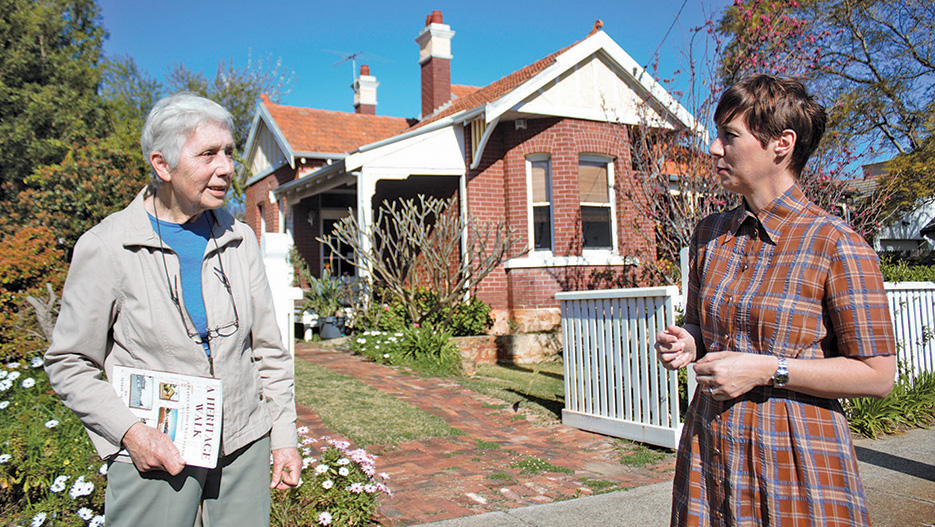
    Relieved at finally getting character retention for part of Cleaver Street, West Perth local Marie Slyth chats with Vincent mayor Emma Cole. Photo by David Bell  

    AFTER years of disputes, frustrations and delays around Vincent council’s heritage and character area retention scheme, there’s finally some renovations coming to speed things up.

    The policy was intended to let people nominate their neighbourhood as a heritage area or character retention area, to ensure future development fitted the existing character.

    Owners of at least 40 per cent of properties in a proposed area had to agree to nominate it, then neighbours would gather for council-facilitated workshops to nut out the exact details they liked and discuss what to encode into a policy framework. The council would have the final vote over whether to declare a retention area. 

    But in the six years the policy’s been around progress has been achingly slow and has led to heated arguments among neighbours, and only a few small areas have been declared.  

    The process “took significant time, did not result in a clear understanding by the community of the proposal and led to disagreement within the community and frustration in the delay of an outcome”, a Vincent council report says. 

    Under the new policy locals will still nominate an area and gather the 40 per cent of signatures, but instead of public workshops bogged down with planning policy framework, council officers will do the work of translating what locals like about the street into planning-speak and drafting up rules.

    Once guidelines are ready the workshops will be held, with a council vote still the ultimate decider. 

    West Perth local Marie Slyth is hopeful a quicker process will mean fewer old houses are demolished while waiting for the nominations to be processed.

    “It’s so important we protect this slice of history and hold onto these beautiful homes,” she says.

    She’d nominated several streets over the years but said it was always a race against time: In some cases like that of Florence Street, it took so long for the nomination to be finalised that a lot of the old homes had already been demolished or sold to new owners who didn’t like the retention area idea. 

    Mayor Emma Cole says “we were losing momentum if we can’t act quickly on a nomination request”. 

    She says guidelines stemming from the new system will still be based on the residents’ nomination but be quicker for council staff to draw up and then put out for feedback. 

    Rather than tackling whole chunks of a suburb, smaller sections are encouraged to nominate. Then if nearby segments like the idea they can jump onboard too, rather than trying to get a widespread area to reach consensus. 

    The policy changes still have to be advertised then it’s hoped five nominated areas in the backlog can be handled. 

    by DAVID BELL

  • Fierce debate

    THE streamlined rules follow a fierce neighbourhood dispute around a patch of Mount Hawthorn being declared a character retention area.

    March’s council meeting was peppered with comments from those for and against. Those in favour wanted to keep the area’s interwar houses, those against said they shouldn’t be prevented from developing their properties by a minority of history fans. 

    “How dare the council even consider this ridiculous change,” Mount Hawthorn resident Robert Gemelli said in March. “It surely cannot be legal to have different rules for different streets. My home is my home and when I want to develop it, I should be allowed to build my dream home within normal rules as is now.”

    A resident in favour of character retention said: “I live next door to an ugly modern house that was built in 2012-2013, despite the objections of many residents who were relying on the council to ensure that street character was retained. I therefore hope that this new policy will prevent this from happening again.”

    From an initial plan to cover a wide area of Kalgoorlie Street, Buxton Street, The Boulevarde and Matlock Street, councillors eventually settled on adding just a segment of the latter two. 

  • Closed crossing concerns for cyclists

    Cars will be given some easy routes to compensate for a closed crossing, but walkers or riders face long detours. 

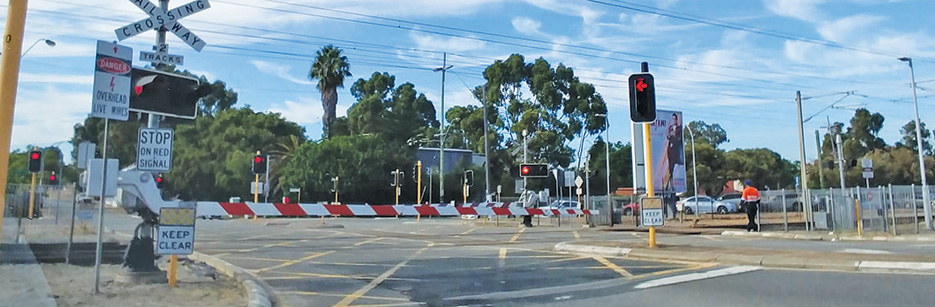
    MAYLANDS’ heavily congested railway crossing at Caledonian Avenue will be closed by the state government, but locals fear pedestrians and cyclists will face such lengthy detours they’ll drive instead.

    In 2017 Labor promised to close the crossing and upgrade surrounding crossings to ease traffic flow, as drivers were routinely waiting more than 10 minutes to cross. The boom gates are lowered 150 times a day for a total of nearly four hours, causing traffic to bank up along Whatley Crescent and Railway Parade.

    Removing it wasn’t precisely costed but the government estimated it’d come in at between $50m-$70m.

    On August 25 transport minister Rita Saffioti announced a more frugal $15m plan to close the crossing in the first half of 2022 (said to be necessary for the Forrestfield-Airport Link), upgrade the intersections at 7th and 8th Avenue, and make the whole of Whatley Crescent two lanes to give people an easier drive through alternative routes.

    But it’s a long hike round for pedestrians or cyclists. 

    Bayswater councillor Elli Petersen-Pik says in the past four years he has several times advised Metronet and the state government they needed to provide a safe crossing for pedestrians and cyclists, such as an underpass.

    “It’s a main crossing for many people from one side of Maylands to the other,” he said.

    There’s a lot of housing on the north side and schools and shops on the south.

    Now pedestrians will have to hike at least another 350m to venture down under Maylands train station’s crossing, and cyclists are in for a detour of at least 500m each way.

    Cr Petersen-Pik says the crossing closure is required but is concerned that in the mitigating measures “all the focus is about cars”. He fears that such lengthy and inconvenient detours will just end up with more people choosing to drive, especially people who used to ride with their kids to school. Since raising the issue many locals have echoed his concerns.

    “It goes against what we’re trying to do on council, the Safe Roads to School plan,” Cr Petersen-Pik says.

    He says there should’ve been more consultation ahead of this week’s surprise announcement.

    The state government media release says a road bridge at Ferguson Street, close to Caledonian Avenue, had been considered, but 14 homes would have to be demolished and more traffic would’ve ended up on local streets. There’s no mention as to whether a lower-impact underpass or pedestrian bridge was considered.

    It does give pedestrians a small boon, saying pedestrian access at Eighth Avenue and Guildford Road (the crossing south from the Maylands Station) will get upgraded. 

    Cr Petersen-Pik’s planning to raise the issue again with the state in a briefing to councillors scheduled for this week.

    by DAVID BELL

  • Election risks linger

    AS local government elections draw near Perth council is scrambling to patch a number of “high risk” weaknesses in its vetting processes that could lead to election fraud.

    Many of the risks identified by a recent audit relate to the troubled roll of property owners and occupiers; people who claim a vote because they own a non-residential property or rent a property in the city. 

    It was identified as being a source of bogus voters by the City of Perth Inquiry, which found it “common practice” for people to invent sham leases to run for council or cast a vote.

    Trying to keep out bogus voters was a headache in 2020.

    A last minute surge of voter applications in 2020 led to undertrained council staff interpreting complex legislation throughout the weekend to get information on several thousand applications to the WA Electoral Commission in time.

    The audit states there’s a “likely” risk (between 66 and 95 per cent) that “applications are inconsistently and/or incorrectly assessed resulting in errors and potentially non-compliance with the act”.

    With applications closing August 28, the council’s governance staff are on a three-week leave ban to process the influx of applications, and an election coordinator has been employed for a three-month stint.

    The council’s software for storing applicant information and the roll was also found to be hot garbage, or as the audit delicately puts it, a “problematic technology solution intended to be decommissioned”.

    The audit says the software’s so complex anyone without a background in infotech can’t even fully use it, and the only person from the last election who was fully trained has switched to another department. 

    And while it’s complex to use fully, it also hasn’t been secured, making it pretty simple for a staffer to blunder their way in and pilfer a copy or edit data even if they don’t understand the full workings.  The audit says the lack of security “increases the risk of error or possibly election fraud occurring which may not be detected”. 

    There’s no time to replace the software before this election so the council will try to train up a new person to be fully across the byzantine program, and clamp down on who can make edits.

    Councillors will have to decide whether to upgrade the software at the next budget. 

  • Audit: WAEC unhelpful in election

    ONGOING problems with vetting voters has been worsened by a lack of help from the WA Electoral Commission, a Perth council-commissioned audit declares.

    The 2021 audit was carried out by KPMG Legal and found “communication between the WAEC and the City of Perth has been largely ineffective”.

    At 2020’s election Perth council staff identified concerning cases of people applying to vote, but when asked to provide proof of a lease they presented forms that showed their first date of occupation was after they’d applied to vote. 

    A 2020 audit reckoned “on this basis the occupier nominee claim should have been rejected rather than accepted,” but the council’s rejections “were later overturned on appeal by the claimants to the WAEC”.

    The new 2021 audit says the council has never received an explanation from the WAEC, setting the stage for a possible repeat.

    Risk

    Another risk stems from the WAEC not wanting to train external temporary staff brought in to handle the extra election workload. 

    They’re dealing with voter applications but don’t get training about “the release of sensitive information and the potential implication this has for the city if this type of information was to be leaked”, and the audit flags 

    a medium risk that “sensitive information may be released inappropriately to councillors, city staff, or the general public”.

    The council tried to train the temps via informal slideshows but reckons the full resources of the WAEC are needed to get them up to speed. The audit says “the city has contacted the WAEC to determine the possibility for the agency to provide training, this request was declined”.

    Instead the council will try to train up all governance staff who’ll then try to train the temps in time. Temps will also be asked to sign a confidentiality agreement this election.