• Tigers Optused out of final bid

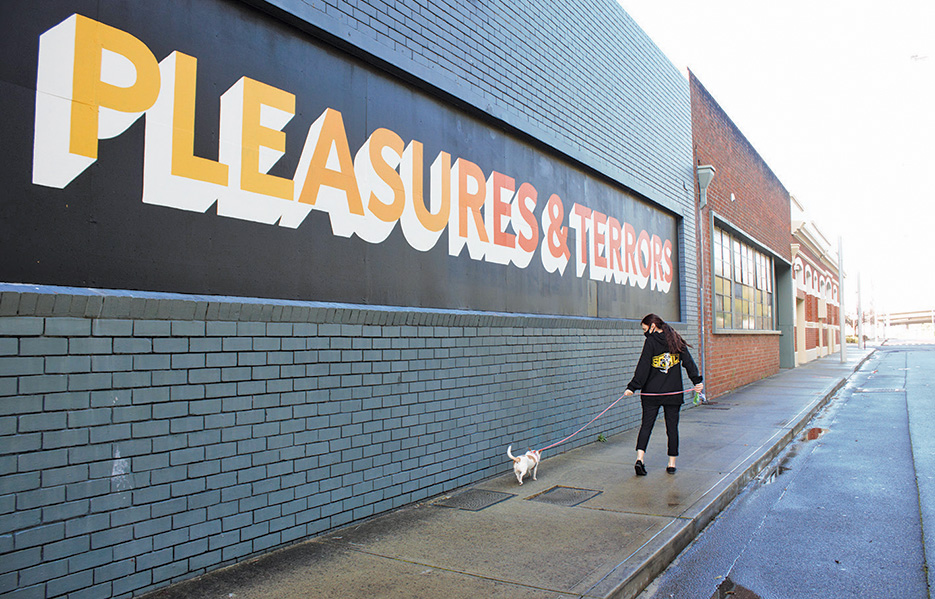
    SUBIACO Football Club’s CEO has revealed his club didn’t pursue a chance to host this year’s WAFL grand final at Leederville Oval after getting the inside running that Optus Stadium was in the box seat.

    Vincent council, Subiaco and East Perth Football Club were working on a joint submission to host the final – a lucrative opportunity for local businesses – with the city sending the clubs a draft expression of interest in April this year.

    But Tigers CEO Peter Capes told the Voice he decided it wasn’t worth pouring too much energy into the bid when it became apparent Perth’s big new arena was the “logical” choice.

    “The WAFC commissioners had discussions with me about where the grand final could be played, and I said ‘every player wants to play at Optus, but if because of the Covid thing there was an opportunity to play at a local level, somewhere like Leederville, that would be ok’,” Mr Capes said.

    “The commissioners indicated they wanted to continue playing at Optus as long as they could.”

    East Perth CEO Dean Turner didn’t appear to have been updated on Subiaco’s views when the Voice spoke to him.

    Embarrassment

    “It was an embarrassment, because people like ourselves and the business community would love to have been able to host the grand final,” Mr Turner said.

    Last year’s grand final was played in Fremantle after local traders committed to $50,000 to help cover some of the WAFL’s costs, and Vincent’s bid had considered upping the ante to $70,000.

    Mr Turner said the Royals had been ready to approach potential big sponsors, while the Voice heard some notable Leedy businesspeople were willing to contribute.

    But the CEO said there wasn’t a follow-up email from the council letting the clubs know where the bid was up to. He says that when he noted a discrepancy between the council’s initial correspondence and the WAFC’s submission deadline, he rang the council and got the response: “Oh shit … damn” but says that wasn’t the staffer preparing the EOI.

    The issue came up at Vincent’s June council meeting where former councillor Dudley Maier quizzed the current lineup about why the paperwork didn’t go in.  

    He also asked “can you confirm that both the Leederville business community and the football club stood to significantly benefit financially if the grand final was held at Leederville?” and questioned who took responsibility.

    by STEVE GRANT and DAVID BELL

  • Ideas worth pickling
    Industry and art is packed side by side in the Pickle District.

    IDEAS are being sought for the Pickle District as the old industrial wedge of West Perth undergoes a rebirth as an artsy hub.

    Just south of Newcastle Street, it sits on a drained lake that was later home to market gardens, warehouses, manufacturers and pickling plants, which inspired the recent Pickle District rebranding.

    The revival’s been spurred by arty businesses moving in among the warehouse, such as the Holmes √† Court Gallery @ No. 10, Stala Contemporary art gallery, Linton & Kay Galleries, and film hub The Backlot. 

    Vincent council’s currently finalising a “place plan” that’ll outline big initiatives, including a potential underpass to better connect it to the Leederville town centre (it’s currently cut off by a busy four-lane street).

    Feedback on the draft plan’s open until July 23 via imagine. vincent.wa.gov.au or at the council library at 99 Loftus Street. 

  • More on the scrap heap

    In May the council approved disposal of three other dilapidated artworks in East Perth.

    The 1998 “Greenway Fountain” artwork installed at the corner of Royal and Fielder Street will be disposed of as it’s in very poor condition. Some controversy surrounds this artwork, as it was created by artist Nola Farman in 1998, and at a later date sandstone plaques with poetic text by Marcelle George were added.

    Farman has now told the council she didn’t approve the text plaques, and they weren’t able to contact George for an opinion, so they’ll be removed. 

    The last three of the strange dogs in Russell Sheridan’s “Diver and Dogs” artwork on old Belvidere Promenade will also be disposed off, being “significantly degraded”. There was a fourth dog but someone drove a car into it in 2019. Nearby residents asked for the dogs to be replaced with a similar work but councillors voted against spending $50,000 commissioning a replacement. 

    And lastly three of the 20 sculptural timber shoreline marker posts Rob Finlayson crafted for the East Perth shoreline have rotted and will be removed. The others will probably degrade within three to five years. 

  • Shelter to open next month

    A BACKPACKERS at 300 Murray Street will reopen soon as a 100-bed homeless shelter, five months after the McGowan government’s troubled election commitment.

    Boorloo Bidee Mia will take in troubled rough sleepers and provide support services on site.

    The shelter was announced in February in the shadow of the state election, with Labor’s presser stating $14.3m was ready to “immediately” house up to 100 rough sleepers at the YHA backpackers.

    But the government didn’t have a secure lease and 300 Murray Street was on the market, leaving the Department of Communities scrambling to find an alternative location.

    Now full circle, 300 Murray Street will be the location after all, and is scheduled to open next month.

    Drug and alcohol support service Wungening Aboriginal Corporation has been contracted to manage the facility, along with Aboriginal housing group Noongar Mia Mia.

    Boorloo Bidee Mia is Noongar for “Perth Pathway to Housing” and the facility will focus on being culturally-appropriate for Aboriginal people given their high rate of homelessness.

    Wadjelas are welcome too. Labor’s state Perth MP John Carey says: “I’m really pleased this is commencing.

    “This is an appropriate location. I know people often say ‘why are homeless services in the city?’

    “Because it’s where people do congregate. That’s where there is activity, food, meeting places, it’s near transport, hospitals, so you do find that people who are sleeping rough tend to go to cities.

    “Yes there was a delay… but I’m glad the leasing arrangements have been [resolved], because I do think this is a good location for this facility.

    “In terms of potential conflicts with neighbours, it’s not near residential properties, so hopefully we don’t see conflicts.”

    The shelter is an interim option intended to tide over some of the city’s rough sleepers, who number roughly 190 in the CBD according to Perth council’s most recent count in March. 

    The end game is still a ways off with the state government’s first Common Ground long-term support housing at the corner of Hill and Wellington Streets due to start construction this financial year. 

    Given the long wait and increasing homeless counts, Perth council’s now opened two interim safe night spaces, one for women at the Rod Evans Centre and the newly opened men’s space at Citiplace near the Perth train station.

    They are hangout spaces with couches and laundries but don’t have beds, as that requires extensive and expensive changes to meet building code standards. 

    by DAVID BELL

  • Greens: Buy up

    THE Greens’ sole MP in state parliament, Brad Pettitt, says a longer term solution may lie in the state government buying up vacant buildings to convert them into housing.

    Dr Pettitt welcomed the interim shelter in a statement but added “crisis accommodation is not a home. A longer-term solution to ensure these people are permanently housed and not forced back into homelessness is also needed”.

    About 1000 people sleep outside in the greater Perth area, and the public housing waitlist grows ever longer.

    “The bottom line is that Western Australians are facing an unprecedented housing crisis and, without an equally large and innovative response from the McGowan Government, it will only worsen,” Dr Pettitt says.

    “Perth has the highest rate of commercial vacancies in Australia. The Urban Development Institute of Australia has also identified nearly 1,700 vacant properties in Perth that cannot be sold.

     “If the McGowan Government is serious about addressing the housing crisis, they need to be investing in a range of solutions including spotincluding spot-purchasing those thousands of vacant homes, quickly adapting government land and buildings for housing, and converting empty commercial buildings while WA grows its social and general residential housing stock.”

    As of April there were about 28,680 people on the public housing waitlist, or 16,660 applications. 

    There’ll likely be a spike once numbers catch up with the increase in evictions since the covid rent moratorium ended in April.

    “If the McGowan Government is serious about addressing the housing crisis, they need to be investing in a range of solutions

  • Un-treaty approved

    A FORMAL agreement outlining how Perth council will work with Indigenous people has been endorsed after a year-long delay caused by the McGowan government prohibiting the use of the word “treaty”.

    The not-treaty was intended to patch up the council’s relationship with the Indigenous community, coming a couple of years after its heavy-handed approach to removing homeless people living at Heirisson Island/Matagarup.

    The one-page document previously dubbed the “Danjoo-Treaty” was drawn up with the bridyas, the Noongar leaders on the council’s elders advisory group. It called for the council to acknowledge past injustices, commit to partnership, listen to Aboriginal voices, and make Perth a more welcoming and culturally safe environment for Aboriginal people. 

    It was supposed to be approved at the July 2020 meeting, the last one attended by retiring CEO Murray Jorgensen who’d done a lot of work with the bridyas. 

    But the state government argued treaties were reserved for agreements involving land ownership. 

    After “several additional engagement sessions”, according to a council report, the bridyas endorsed the new Noongar name Yacker Danjoo Nglada Bidi (“working together our way”).

    The YDNB was approved by councillors at this week’s council meeting, more than two years later than the original April 2019 timeframe nominated in the Reconciliation Action Plan.

    In a statement issued via the city, elders advisory group member uncle Farley Garlett said: “The City of Perth has come a long way and for me this has been a big change. The Reconciliation Action Plan has given us good ground work for moving forward.

    “We’ve been lucky that the City of Perth has been receptive to the conversations we’ve had over the last few years. It has been nothing but positive.

    by DAVID BELL

  • LETTERS 10.7.21

    This rubbish is now a farce

    THE farce that is Vincent’s jettisoning of commercial waste collection is coming to a head with council refusing to step in, and the staff channelling Yes Minister.

    Despite staff saying they would look at extending the residential FOGO system to eligible businesses they neglected to tell the businesses.

    It was only in late May that they put something on their website, but it had no details and no costs.

    They also told the council that every business had been visited and had a face-to-face meeting.

    When I checked with businesses the responses I got were along the lines of “he was like a disinterested uni student who couldn’t answer my questions”.

    Which brings us to the cost of the micro-business service which the staff had previously said would be based on a full cost recovery basis. They decided to charge $699 plus an $80 administration fee even though they worked out that in 2019 that the current waste collection system costs $336.99, and councils like Bayswater are charging about $360 for their three-bin system. 

    When challenged they simply said they had benchmarked the charge against other local governments. 

    Rather than looking for the best and trying to better it, they seem to be looking for the worst, and accepting it.

    Exccessive charging

    To their credit the council did drop this to $520 but this is still demonstrably more than it actually costs the city.

    The main outcome for charging this excessive amount will be to discourage businesses from taking up this service. 

    I am sure the fact this will mean less work for the staff is an unintended consequence.

    This raises the question: Why the cost discrepancy between Vincent and somewhere like Bayswater when the service is pretty straight forward – you pick up the waste and dispose of it?

    My guess is that it may be something to do with efficiency and overheads (i.e. too many desk jockeys writing reports rather than doing something useful).

    But this wasn’t just about costs. There were supposed to be environmental benefits from having better separation of waste that supposedly only commercial collectors can provide.

    In a word – rubbish. I know of one business who has moved to a commercial collector and who now puts everything (landfill, recycling, and a significant amount of organics) into a single skip.  Goodbye recycling, goodbye compost, hello landfill.

    All we’ve got from the council are platitudes (we feel your pain), a demonstration of how out of touch they are with the plight of small business, and how unwilling they are to engage with them in a meaningful way. 

    Probably what is worse is the immoral intention to continue to charge businesses for a service that will no longer be provided. 

    And we’ve got an administration that look, to many, like they are more interested in reducing their workloads and improving their statistics, than in providing a service to their customers.

    “We simply said we would offer a service, Minister. We never said it would be affordable or what the businesses needed. Isn’t that right Bernard?”.

    Dudley Maier
    Highgate

    Tide’s in

    MY name is Tide and I’m 10 years old. 

    After reading your story “A Rough Winter” about homelessness and hunger that people in my community are facing this winter, I wanted to help. 

    I looked online and found some great websites that have volunteering opportunities, including chorus.org. au who provide many community services.

    Unfortunately you need to be at least 12 years old to register. 

    They suggested that I look up volunteeringwa.org.au. It also had lots of great ways to volunteer, but not many choices for a 10 year old. 

    My mum could see my disappointment and suggested I take part in World Vision’s 40 Hour Famine. 

    Mum said it was something that she did when she was at school. We looked up the website worldvision. com.au and although they didn’t recommend kids my age fasting, mum suggested that If I replace my meals for a bowl of rice, I could enter. Yay!

    I set myself a target to raise $100. I asked my parents, grandparents, cousins, and even my brother to sponsor me. 

    I managed to double my target, woohoo! I’m now onto my final bowl of rice for breakfast, and with the thought of something yummy for lunch, I will make it to the finish line. 

    This challenge has made me realise how grateful I am to have a warm bed and a full tummy each night. I feel sorry for those people that don’t have these necessities. 

    I know the money I’ve raised will make a difference for someone, somewhere in the world. I hope everyone can spare some time, donate some clothing, or sacrifice some food for someone who needs it. 

    Tide Robinson
    Bicton

  • Power to the people

    LINDSAY LOVERING was Healthway’s inaugural arts program manager and more recently Musica Viva’s WA manager. In 2009 he was the recipient of the National Arts and Health Leadership Award and in 2010 was a finalist in the WA Citizenship of the Year Awards for his contribution to Arts and Entertainment. 

    IT appears the state government has given interested parties a couple of weeks to submit tenders for the development of the South Fremantle Power Station … really, after 36 years lying dormant there’s suddenly a rush for development submissions?

    In 2011, exactly 10 years ago, I wrote about the future use of the South Fremantle Power Station. It fell on deaf ears at the time but, given current developments, I feel that I should repeat the points that I made in my letter, as I believe they are still relevant today.  

    At the time, I proposed that the Tate Modern in London should be the basis of a model for the development of the South Fremantle Power Station and I quoted the following from its website: “The redundant Bankside Power Station proved an amazing discovery; a building of enormous size; great architectural distinction; superbly sited and in a fascinating and historic, if neglected, area.

    “An international architectural competition was held, which over seventy architects entered, including some of the world’s most distinguished, to develop the building that is now one of the cultural icons of the world. 

    “The Tate Gallery London now rates third in the list of the world’s most visited art museums and the most visited in Britain”. 

    There are two examples of redundant power stations being converted into museums in Australia – the Powerhouse in Sydney and the Powerhouse in Brisbane and both provided electricity to the tram network in their respective cities. 

    If converted, the powerhouse in South Fremantle could:

    • Be serviced by light rail from Fremantle to Cockburn; 

    • Be the long-term home of the film studio currently planned for Fremantle Harbour (the site of which, in the opinion of some in the film industry, will not suitable to grow and house all the required resources); 

    • Display private and public art works, currently in storage and include flexible performing art spaces and art forms such as decorative arts, science, technology, communication and media arts; 

    • Be the home of an Aboriginal culture centre;

    • Include galleries, cinemas, theatres, studios and workspaces for the practise and promotion of the contemporary arts and house facilities for the development of youth arts;

    • Be a centre for residencies and fellowships in all art forms including writing, music composition, theatre, dance and cultural research.

    In addition, the land in the surrounding precinct could be used to promote environmentally sensitive and tech-savvy start-ups, instead of high rates…sorry high-density apartments.  

    I am proposing a ‘Tate Modern’ on the site of the South Fremantle Power Station. We cannot underestimate the incredible potential and benefits of the arts in today’s world. 

    It is a well-known fact that millions of tourists come to Australia to visit the Sydney Opera House (10.9 million annually to be precise). It’s regarded as one of the world’s most iconic buildings of the 20th century and one of the few buildings that is instantly recognisable in just about every country in the world.  

    The Sydney Opera House was also the subject of an international architectural competition that attracted 233 designs submissions from 32 countries around the world. And, by the way, the Opera House was constructed with funds raised by a lottery! 

    Could we not do the same with the South Fremantle Power Station?

    Another inspiring and more recent example in Australia is the Museum of Old and New Art (MONA) in Hobart, financed by David Walsh, a private individual who is passionate about the role of the arts in today’s world. MONA has increased tourism in Tasmania by almost 20 per cent and has had a significant effect on the Tasmanian economy. It has even led to the introduction of the term “the MONA effect” in that it has transformed the way Hobart sees itself and the way the world sees Hobart. 

    The people of Fremantle and Cockburn and indeed of WA should demand that the South Fremantle Power Station remains a public asset and is not be given to an entity cosy with the current government that provides a convenient but short-sighted solution.    

    The bureaucrats and politicians who are involved in any decision on the future of the South Fremantle Power House will be held accountable by future generations. 

  • Well seasoned

    THE Seasonal Brewing Company is one of the more recent additions to the Maylands hospitality scene.

    Situated on Guildford Road, the microbrewery fits the tried-and-tested formula established by Little Creatures in Fremantle all those years ago – shiny steel vats loom over an informal dining area, there’s a rustic beer-friendly menu,  and indie rock is playing in the background.

    In fact microbreweries are the new smashed avocado, springing up bloody everywhere.

    Not that I’m complaining, but I’ve always been a bit underwhelmed by their food, which never matches the excellent beer.

    Would The Seasonal Brewing Company be any different?

    The compact menu had a range of share plates, burgers, pies, mains and a few specials like Sunday roast and steak.

    It was pretty rustic but there were a few refined dishes like Tiger Prawns with miso butter and persimmon, as well as some variety to keep you coming back for more.

    My Stirling Range beef rump cap ($36) was nicely presented with thick, pink slices of beef resting against a thatch of broccolini and a wedge of potato gratin.

    I ordered the steak medium and the chef did a good job – often steak is overcooked outwith fine restaurants – and there was plenty of pink juicy flesh on show.

    The little tub of gravy was gorgeous – super rich and thick – and went perfectly with the beef.

    One of the highlights of the dish was the inclusion of potato gratin; I don’t know if it has gone out of fashion but I haven’t seen it on a menu in a while.

    Anyway, this was a delicious version with thin layers of potato and cheese creating a mouth-watering stack of flavour. 

    Adding some texture was the crunchy broccolini, providing a salutary burst of greens.

    A top dish. My only quibble was that one thick slice of meat was slightly undercooked. 

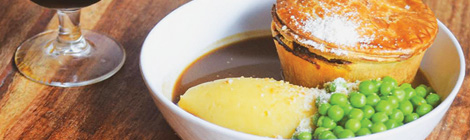
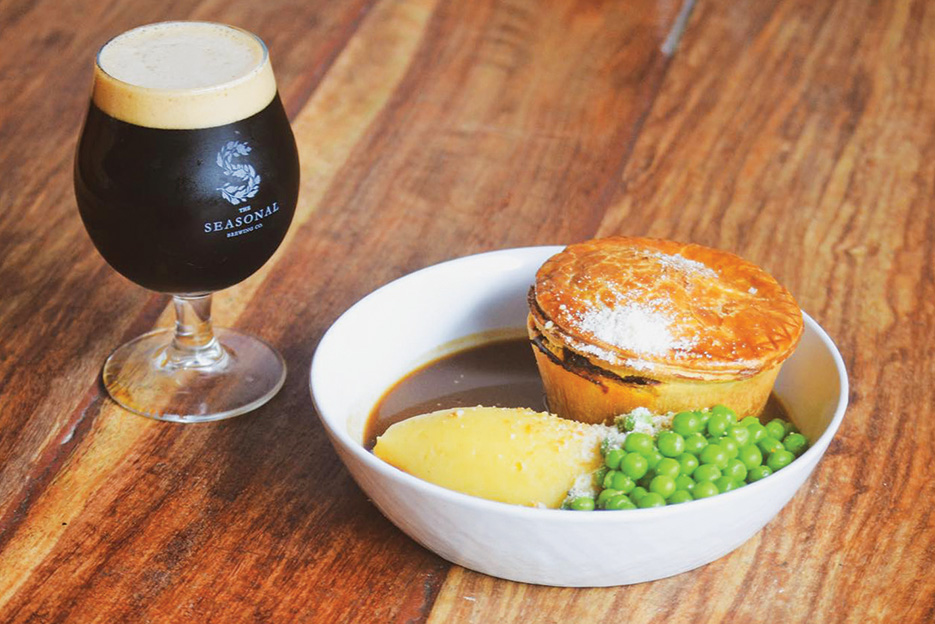
    Across the table my wife was raving about her prodigious chicken, leek and spinach pie ($20) which was braised in Seasonal’s ale.

    “It’s absolutely gorgeous and has got that lovely homemade flavour with a light pastry,” she said.

    “The creamy mash and peas complement the filling, and it’s the quintessential dish for a cold, wet night.”

    There was only spagball or grilled cheese sandwich on the kids menu, which I found a bit disappointing, so we got them an adult cheeseburger ($22) to share.

    They wolfed it down with no complaints and I tried some of the chips, which were delightfully rustic and not over seasoned.

    My wife finished off her meal with a sticky date pudding ($13) from the special’s menu, which she described as “heavenly with a great balance of flavours.”

    The beer is not too shabby either and I enjoyed a lovely glass of chocolate porter ($9 for 300ml)

    My only gripe was the staff not clearing our table (we still had three plates on there while we ate dessert) but that aisde the service was good and the staff were friendly and polite.

    The food surprised me at The Seasonal Brewing Company and it’s definitely a cut above the usual pizzas and burgers you get in other fungible microbreweries in Perth.

    A welcome addition to the Maylands dining scene.

    The Seasonal Brewing Company
    175 Guildford Rd, Maylands

    by STEPHEN POLLOCK

  • Sports fanatics

    ON the eve of the 2020 Olympics in Japan, a prestigious exhibition at the WA Museum sheds light on the importance of sport in ancient Greek culture.

    Featuring one of the largest collection of Greek artefacts ever loaned by the British Museum, Ancient Greeks: Athletes, Warriors and Heroes is a fascinating look at the competitive spirit that helped shape one of the world’s most influential nations.

    Dr Peter Higgs, exhibition curator from the British Museum, says the ancient Greeks were fanatical about sport and even in times of war, battle would stop to allow sporting competitions to be held.

    “Sport and athletics and training the body were considered as important as training the mind in the education of Greek male citizens,” he says.

    “The perfect citizen was virtuous in mind and in body; training was a civic duty, rather than a lifestyle choice. Philosophers write widely on the subject.”

    Yet for some reason, Greek competitors never fancied the water much.

    “One particularly peculiar omission from any of the Greek games are swimming events – or sailing events – this is even more surprising when you consider that they were sea-faring peoples, from regions with a large coastline, island cultures and tradition of exploring by sea,” Dr Higgs says.

    The inaugral Games held at Olympia in 776 BC in honour of Zeus were the blueprint for the modern Olympics, attracting Greek athletes and patrons from all over the Mediterranean basin and settlements in the region.

    However, Dr Higgs says most of the evidence of ancient Greek sport originates from Athens.

    “The games in Athens, the Panathenaic were for Athenian citizens from the city and suburbs and were not international ‘all Greek’ Games,” he says.

    “Yet much of our visual evidence for ancient Greek sport comes from the painted scenes on Athenian manufactured pottery.

    “There is more literary and visual evidence for the city of Athens than any other from the Greek world – not just for sport but for other competitions also, such as performing arts etc. 

    “Our view of the ancient Greek world is very biased towards Athens because of the relatively large amount of material and literary evidence, but also because many of the ancient writers were pro-Athenian.” 

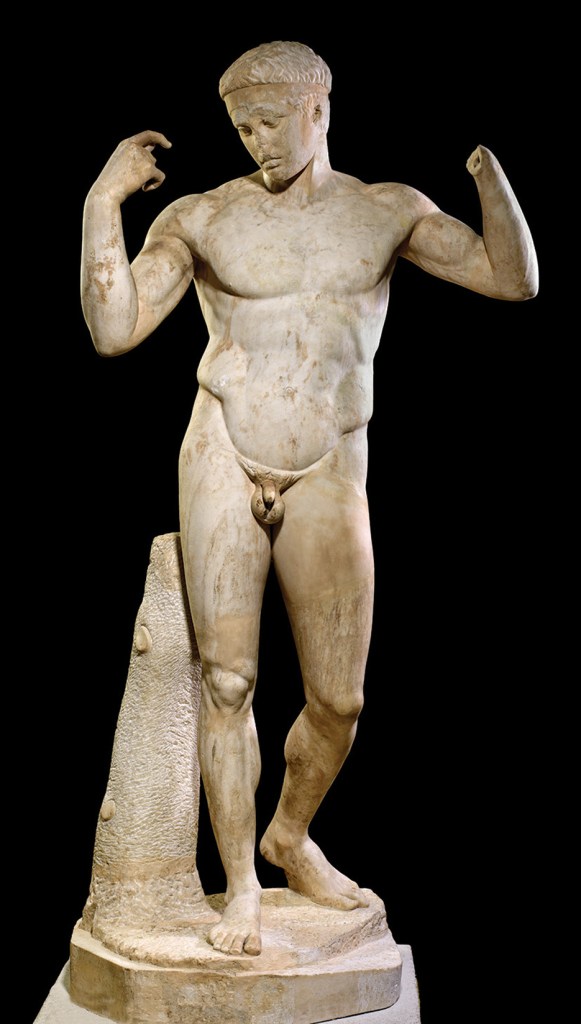
    The exhibition contains 178 fascinating artefacts from the sixth to first centuries BCE, including a statue of the Diadoumenos, the winner of an athletic event at a Games, still nude after the contest and lifting his arms to fix a diadem around his head.

    The statue was discovered in the ruins of a Roman theatre in Vaison, France, but the head was nowhere to be found.

    “According to hearsay, a local farmer took the statue’s finder to a nearby farm and showed him what appeared like a weathered boulder serving as a guard stone to stop horse and carts hitting the gate posts,” Dr Higgs says.

    “When examined it was discovered to be the head of the Diadoumenos statue, squared off to prevent it from rolling.” 

    The first international exhibition to be held at the WA Museum, Ancient Greeks: Athletes, Warriors and Heroes is on until November 7.

    By STEPHEN POLLOCK