• Slow points hit first speedhump

    SLOW points may be on the way for North Perth under a new Vincent council traffic-calming plan.

    However long-term traffic petitioners have already panned the initiative as making little sense. 

    Cars snaking through every little residential street has been a long-time concern in the inner-city suburb. 

    Back in 2017 residents called on Vincent council to run a proper consultation session to hash out ideas on how to keep heavy traffic on the main roads and out of small streets, coming at it holistically instead of the old approach of sticking a speed bump in one street and waiting to see where that diverts the rat runners.

    Resident Geraldine Box put in a formal petition in 2018 requesting council “engages with residents to develop acceptable measures to make these streets safe and more liveable”. 

    Ms Box says “the residents asked for some proper sit-down consultation with both council admin officers and some councillors there to talk through what the full options could be for some kind of low-traffic neighbourhood. We didn’t want one street receiving treatment and some others left.”

    She says that’s yet to happen: Instead the council seems to come up with a plan first and ask questions later, and it’s happened again with these slow-points.

    “What they’ve put in this proposal doesn’t make any sense for traffic calming,” Ms Box says, especially in relation to long roads like Claverton and Alma which just have one slow-point in the middle. She predicts that may do little to lower speeds and neighbours have expressed concern it’ll just increasing noise as hoons slam on the breaks on approach and then rev their engines to jet away. Hitting the kerb is optional, but a popular option, based on the thick rubber marks on existing slow-points around town.

    Ms Box doesn’t claim to have all the answers and says that’s why a proper workshop is ideal, but she suggested some ‘street-filtering’ such as restricted turns on minor streets to encourage only local traffic to use them.

    Instead of calming the homely streets they got the controversial 12-month trial banning right hand turns from Fitzgerald onto View Street. Since it started early this year the Voice gets a call or complaint about it every fortnight on average. 

    That kind of street-filtering is meant to be used on the small streets, and putting it at View Street has diverted traffic into the little surrounding roads that residents wanted to be calmed in the first place.

    “We’ve certainly noticed an increase in the amount of traffic” in those smaller streets since the closure, Ms Box says.

    The slow-point plan is out for consultation via imagine.vincent.wa.gov.au until May 27. 

    The council says slow-points, which can either reduce traffic to one lane or just give them a “blister” style island to navigate around, “are effective at slowing traffic”, but usually cost four parking bays of space.

    They’re also keen to hear what people think of the View Street trial so far.

    Ms Box says she hopes the slow-point plan gets put aside until the proper consultation can be run, and not the current approach of “a tick-box that says ‘this is what we’re planning to do ‘what do you think?’ 

    “Bring people in earlier on.”

    by DAVID BELL

  • Tree efforts ringbarked
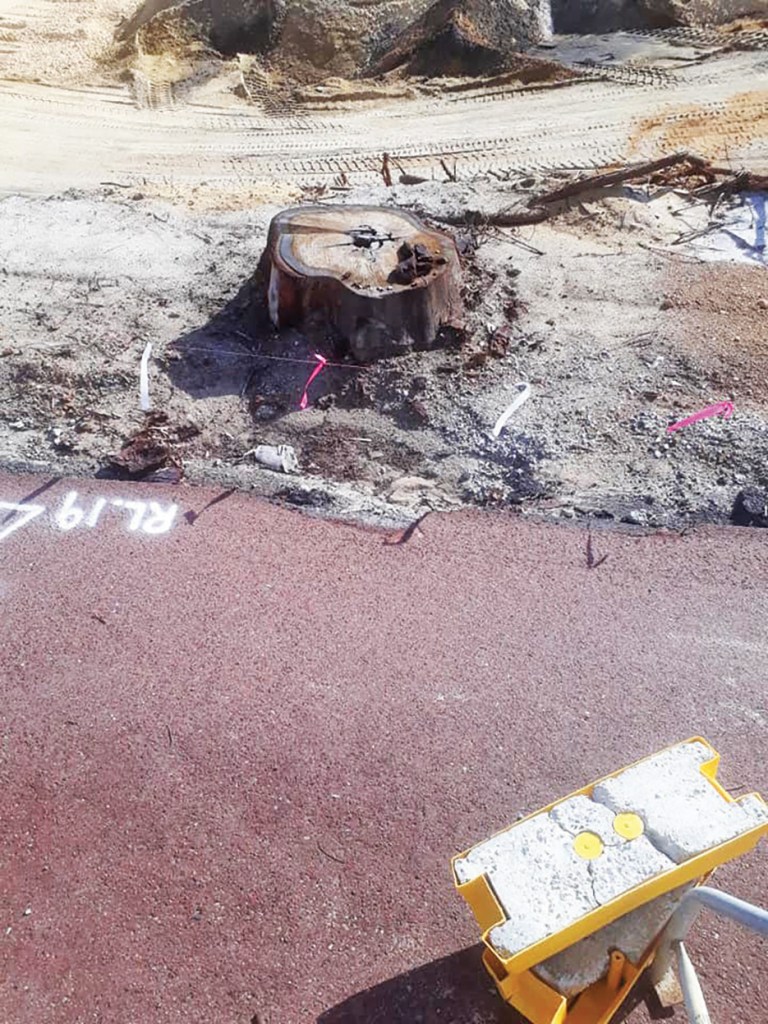
    One tree makes a determined effort to stay with us; many others were too far gone. Photo by Greg Smith

    AS fast as Bayswater council can plant new trees, state government projects and private development just keeps tearing down older growth.

    Last planting season the council put in 50,000 tubestock native plants and 1,500 new street trees, in an effort to the goal of 20 per cent tree canopy coverage by 2025. 

    The canopy plan’s starting point in 2014 was 13.2 per cent coverage. The last big review in November 2020 showed they had gone backwards and now had just 10.2 per cent cover and had the greatest spread of “grey growth” in the country, with 60 per cent of the area now pavement, roads and carparks.

    A report to councillors this week said the City’s own tree-planting efforts just weren’t replacing greenery as fast as it was being felled, “due to continued loss of canopy on private property and large canopy loss due to key infrastructure projects”.

    It didn’t name them, but the big recent ones have been the state-government approved clearing of riverfront blocks for housing, the Tonkin Highway works, and the Bayswater train station upgrades (the trees there are being replaced with more numbers-wise, but they’re small and the canopy will take many years to fill in).

    The council was quizzed from all sides about the tree loss at the AGM in March, from Future Bayswater members, business owners, and traditional tree-lovers alike.

    Future Bayswater’s Andrew Watt noted it had been two years since an AGM motion called on the council to look at more incentives for property owners to keep trees, including rate differentials for maintaining trees or development bonuses that allow taller, skinnier buildings that leave trees on the block.

    The council agreed to investigate which incentives might be effective but the project’s been delayed.

    Mr Watt said “sadly, since the time of that motion in 2019, the City of Bayswater was named in the renowned national report by RMIT, the ‘Greener Spaces, Better Places’ as being the worst in the nation of its type and urban local government for lack of tree canopy and also the worst in Australia for the highest increase in grey hard space that creates the urban heat island effect. 

    “Not exactly the outcome I’m sure that the city would have desired.”

    Urban planner and ecophile Greg Smith said “unless you’ve closed your eyes lately you’ll see that the Tonkin Highway and that Gap proposal have cut down so many trees, and of course the town centre upgrade to do with the train has cut down so many trees, that they will have an impact on Bayswater’s canopy percentage. But even I wouldn’t blame the City of Bayswater totally for that, because I don’t think it has much say in it.”

    But he did think the council should be stricter in enforcing its rules requiring one tree per four bays in commercial developments, and he’s been campaigning for them to do more to protect trees on private blocks.

    The council’s currently working on a draft “significant tree register” to preserve notable trees, coming to a future council meeting. Mr Smith reckons blanket protection for trees above an established height is a better way to go than the dob-in-a-big-tree approach. 

    Bayswater’s also started working with the Urban Design Research Council on rejigging its approach to hit that 20 per cent canopy target.

    by DAVID BELL

  • Exploring MD’s life a real treat
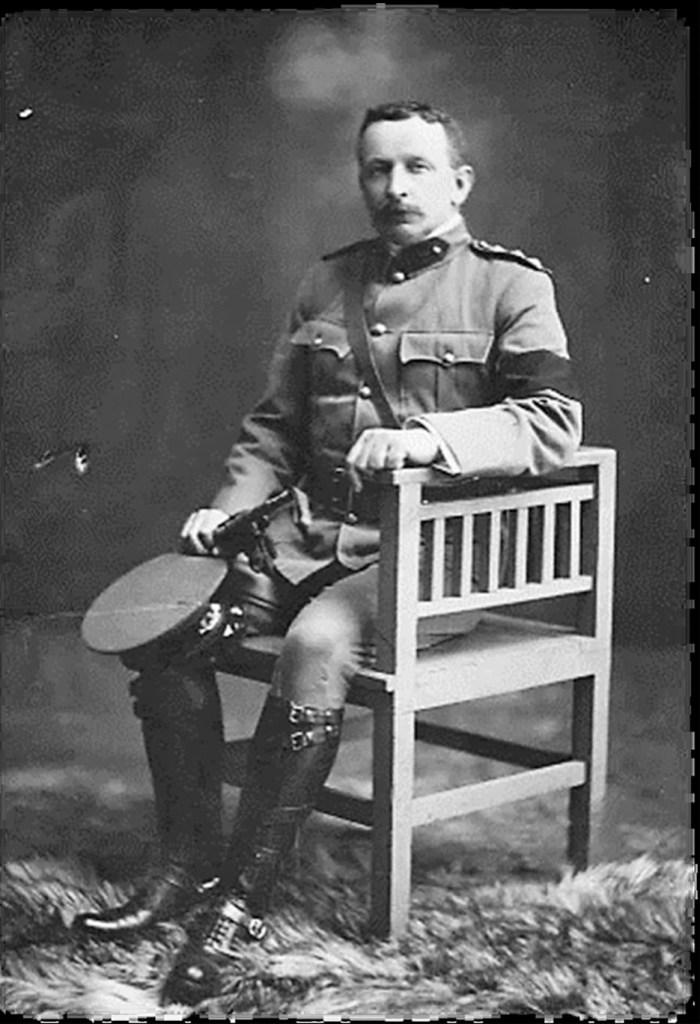
    George Barber.

    SIMON DOYLE recently published, along with co-author Jenny Mills, a biography of his great-grandfather George Barber, a doctor who served with the Fremantle Garrison before sailing off to run a venereal disease hospital for unfortunate Anzacs who’d camped right next to an Egyptian brothel district. During his research, he also uncovered a hand-written poem by famed bard Banjo Paterson in his great-grandmother’s journal, which has now been published for the first time.

    SOLDIER Sailor Surgeon: The Life of George Barber, which I wrote with Jenny Mills, is a timely addition to those books that acknowledge the contributions of our Anzacs. This one differs in that it specifically covers some of medical history of World War I.

    George Barber was my great-grandfather; I first learnt about him when I came across a ribbon-bound bundle of letters and postcards that my grandmother Kathleen Sandover had kept.

    These letters, which were the main incentive for writing the book, were from George to his wife Jess, and were sent from Egypt, Gallipoli and various battle zones in France/Belgium during the war.

    Curiosity

    My curiosity was piqued and I conducted extensive research at places such as the Australian War Memorial and the JS Battye Library, and I uncovered a trove of information about his fascinating role as a pioneering doctor in Kalgoorlie and as deputy director medical services in charge of medical arrangements for the Australian Corps on the Western Front.

    George first met Jess Loughborough in 1894 on his last trip as a P&O ship doctor. 

    She was returning to her home in the Blue Mountains after studying French and German in Switzerland.

    On the journey George proposed and then left for England to sort out his business affairs prior to the two of them moving to the nascent WA goldfields.

    Jess’ parents were happy for the union but were likely to be aware of the fact that George’s family, through his mother, Isabella Loughborough, were directly related to a notorious but hapless early 18th century Barbadian pirate, Stede Bonnet.

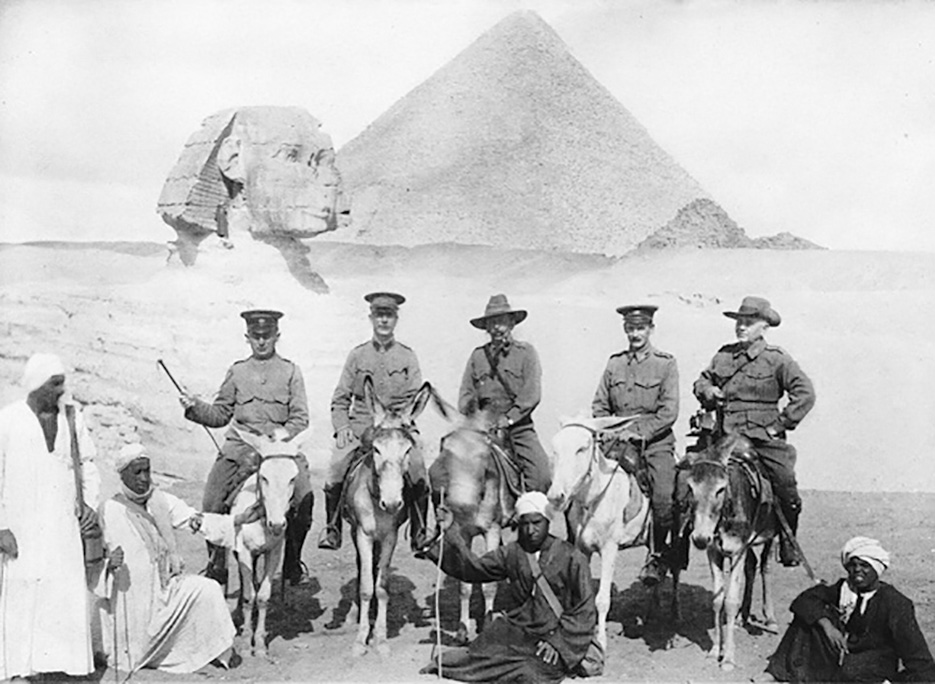
    George Barber with the Sphinx and pyramids while on duty in Egypt.

    The book includes an interesting anecdote about Jess and Banjo Paterson.

    Before George had returned from England, Jess was chaperoned to a bush dance by Banjo Paterson who was so grateful for her not mentioning horses that he wrote a poem (the wail of the horse poet) for her in her journal. This is the first time this Banjo poem has been published.

    George and Jess spent 17 rambunctious years in Kalgoorlie where George ran the Kalgoorlie Hospital, a period in which they underwent numerous trials and tribulations (including typhoid outbreaks, and political and professional intrigues). 

    In 1912 they moved to Perth where George opened a practice in Milligan Street and became heavily engaged in the Civilian Military Force in the Fremantle Garrison, right up to his enlistment at the outbreak of the first word war.

    Venereal disease

    George arrived in Egypt in January 1917 and was immediately asked to run a venereal disease hospital on the outskirts of Cairo. 

    In retrospect the Australian camp based adjacent to the pyramids of Giza was a poor site, with its close proximity to the Cairo brothel district (the Wasa) resulting in an immediate outbreak of venereal disease. 

    The soldiers did not acquit themselves very well and were reputed to have the highest incidence of VD of all the forces (and also instigated two riots in the Wasa district. This aspect was glossed over in the official records as a ‘rag’.

    He subsequently served on a number of gruesome hospital ships stationed off Gallipoli. 

    In January 1916 he was made assistant director of medical services for the 4th Australian Division which left for France in June. 

    In April 1918 he was made deputy director medical services for the Australian Corps. 

    His skill as an organiser and administrator was most fully appreciated in mid-1918 when trench warfare gave way to mobile warfare and his standing orders became the basis of those for the whole Australian Corps.

    Dr Barber with his wife and daughter.

    Just one week after this appointment he was asked to conduct an autopsy on Manfred von Richthofen (the Red Baron) – it was his autopsy and subsequent report which demonstrated that he was shot by an Australian machine gunner on the ground.

    Our book covers medical issues such as shellshock, gassing, trench foot, trench fever, sanitation, influenza, blood resuscitation and venereal disease that confronted soldiers in the war; and shows how the conditions enabled and necessitated many medical advances.

    The book also recounts a number of narrow escapes, both on land and sea which, in keeping with his Edwardian demeanour, he showed seeming indifference. 

    For example in August 1916, after moving to Albert, close to the front line, George breezily recounted in a letter to Jess: “They put about 200 HG shells into us that night and if any of them had been a direct hit we should have gone to Glory but please don’t worry too much.” 

    However, his reassurances to Jess were premature as shortly thereafter: “My office…was unfortunately blown into the street by a shell which wrecked the house… luckily no one was hurt all of us being absent at mess.” 

    In May 1925 he was appointed, director general of medical services at Australian Army headquarters, Melbourne. He was in charge of medical services for the Australian Army, as well as the Royal Australian Air Force and the Department of Civil Aviation. 

    He held these offices until his retirement from the army on August 20, 1934. The last 17 years of his life were spent in a quiet semi-rural practice at Kalamunda.

    Copies of the book can be obtained from simondoyle123@yahoo.com

  • Focus of Jewish life

    THIS week’s story from the Vincent Local History Centre looks at the now-demolished Brisbane Street Synagogue that was once the centre of Jewish life in WA. The LHC is also hoping to find photographs and any information about another demolished synagogue on Palmerston Street run by the Perth Jewish Association. 

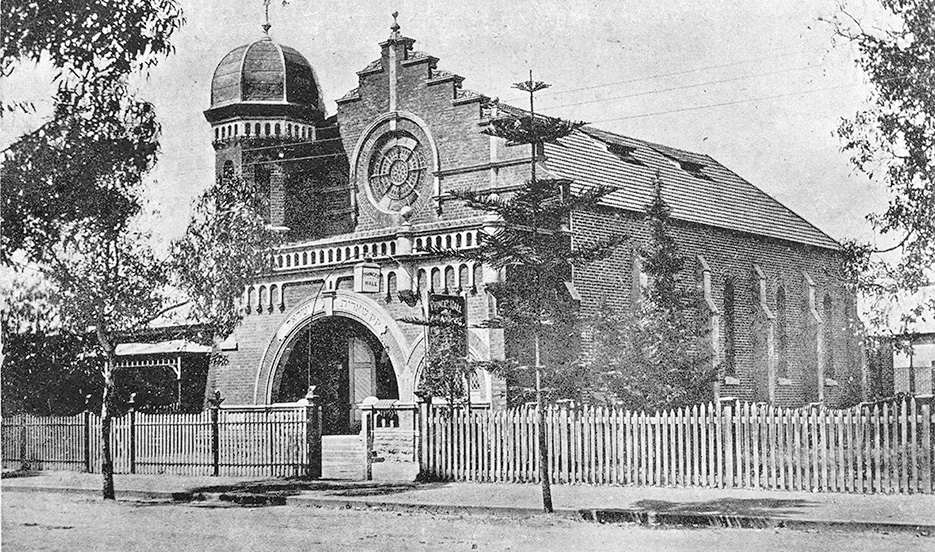
    THE Brisbane Street Synagogue stood on Brisbane Street in Perth from 1897 until it was demolished in the 1980s. It was home to the Perth Hebrew Congregation for almost 80 years, before they moved north to their present home in Menora in the 1970s.

    The Perth Hebrew Congregation formed in 1892 at a time when gold discoveries were attracting more immigrants to Western Australia. 

    While there had been small Jewish communities in Fremantle and the Goldfields from earlier colonial times, at the turn of the 20th century Perth became the focus of Jewish life in Western Australia with the Brisbane Street Synagogue at its core.  

    The synagogue was built on land granted by the Lands Department on an acre block just east of the corner of William and Brisbane Streets, near the Perth Mosque. 

    Buildings on the site, which ran between Brisbane Street and Robinson Avenue, consisted of a brick and stone synagogue that could accommodate 300 worshippers, the manse, a community hall (Prince’s Hall) and five semi-detached cottages at the southern end of the block.

    With its circular tower and large rose window, the synagogue was a distinct landmark building in the area.  

    Rabbi David Isaac Freedman, Western Australia’s first ordained Hebrew minister, led the congregation from 1897 to 1939. 

    He served as Jewish chaplain to the Australian forces during WWI, and after the war he continued to serve the community developing ancillary agencies and the religious school that was attached to the congregation.

    The Perth Hebrew School was originally located in the Prince’s Hall at the rear of the synagogue.

    Dances

    The Prince’s Hall, which had a stage, kitchen and adjoining rooms, also served as a communal centre for public meetings and social functions.  

    Mount Lawley resident Ivan Bercove, whose parents were active members of the congregation of the Brisbane Street Synagogue, recalls dances and community events held in the Prince’s Hall: 

    “My father used to organise things. He knew people that ran circuses. He used to get a few artists to come to the Prince’s Hall and he would run a night there with a tight rope walker or a dancer for the people to come and watch.

    “He also ran a dance there to make the kids dance so they could get to know one another and hopefully marry one another.

    “He did quite a lot of things for the Jewish community … he was very good at looking after new immigrants that came [to Perth]. 

    “His parents had done the same thing and it was instilled in him to try and help people.” (Interview with Ivan Bercove, COV Local History Collection, OH292) 

    In 1974, the Perth Hebrew Congregation moved to a new and larger synagogue in Menora which was closer to residential areas that were home to more Jewish families.

    But the former Brisbane Street Synagogue lives on in the memories of community members, some of which have been shared with the Vincent Local History Centre which holds several photographs of the interior and exterior of the Brisbane Street Synagogue prior to its demolition in the mid-1970s. 

    To view the images visit: https://cityofvincent.imagegallery.me/

    If anyone has photographs of the Brisbane Street Synagogue, or the Prince’s Hall which served as a community centre behind the former synagogue, please contact the Vincent Local History Centre. 

  • Robotics breakthrough offers pandemic hope

    MURDOCH UNIVERSITY’S Antimicrobial and Infectious Diseases Laboratory has made a breakthrough in monitoring bacteria using robotics that promises to slash medical costs and hospitals stays.

    Sam Abraham from the AMRID-Abraham laboratory at the uni said using robotics could speed up testing for bacterial infections by 700 per cent. 

    “Looking for emerging resistance, currently humans are doing all the work… there’s a high cost associated with this, testing is expensive and slow… humans can only work for so long.” Dr Abraham said.

    “A person can do 100 tests a week a robot 1000 per day or more… we are making better tools.

    “Bacteria that causes infection can build a resistance to the drugs; if an infection can’t be cured at the basic level they have to go to hospital.” 

    Dr Abraham said the cumulative global cost of bacterial resistance is estimated to rise to US$100 trillion by 2050. He said this was due to “lengthy hospital stays”.

    Robotics could also be used to reduce the cost monitoring bacteria in livestock.

    Dr Abraham gave the example of the pork industry in Scandinavian Denmark where out of 28 million pigs in only 200 are tested for infections per year”. He says that’s nowhere near adequate to tackle bacterial infections adequately.

    Dr Abraham says the ability to conduct real time monitoring through robotics could also have great benefits during a pandemic. “COVID testing; hard to do thousands, we can do it cost effectively and fast so it can be used globally.”

    The Department of Agriculture, Water and the Environment is funding this research as well others in the field of AMR a part of its $157 million “Rural R&D for Profit Programme”. The department was contacted for comment.

    RICHARD VAN UFFELEN

  • Voice Mail: Bin Vincent’s anti-business madness

    THE farce that is the City of Vincent’s abandonment of commercial waste collection is getting more ridiculous with time, and sounding more like an episode of ABC’s Utopia.

    When one business owner asked if businesses had been consulted before the decision had been made, they were told that the City’s Waste Strategy 2018-2023 was advertised in 2018, and because the impact to business of removing the service was seen to be minimal, further consultation was not deemed necessary. 

    The strategy was advertised in 2018, but nowhere did that strategy mention removing the service. 

    It simply said the city would review alternative options. Most people would have taken this to mean a better, more tailored service, possibly using bigger bins.

    Of course, the business owner was bluffed into thinking they missed their opportunity to comment.

    When the city was asked what percentage of rates was spent on waste collection the staff said they were unable to provide this breakdown.

    This is surprising because it took me less than five minutes to work out that 10.4 per cent of commercial rates goes on waste collection.

    So logically you would expect that commercial rates to drop by 10.4 per cent once the city stopped collecting the waste. But no, the staff recommended keeping the money because it would result in an $8.3 million profit over 10 years.

    As a response to a motion at this year’s AGM the staff have said they will investigate, not implement, simply investigate, a ‘micro-business three bin system’ when they implement the FOGO system. 

    The only problem is they will stop collecting bins in July, and the FOGO system starts in late October.

    What are businesses supposed to do, stockpile their waste for four months?

    Then there’s the claim that the move will be better for the environment.

    I’ve already seen a business who used to have a mixture of bins – recycling bins and other waste. They now have a single skip and everything goes into that. Goodbye recycling.

    Then there’s the business owner whose landlord will get the one-off transition payment, but the business owner will have to organise and pay for new bins. Once again business costs go up.

    Vincent businesses are angry. It’s time that somebody on council stepped in and ended this anti-business madness.

    Dudley Maier,
    Highgate

  • Yummy house

    FINDING a good dim sum bar outside of Northbridge and East Vic Park has always been a challenge.

    There’s the odd place that’s got them on the menu, but not many specialise.

    Thankfully I was walking through Leederville on Tuesday and spotted My House Dumpling, a fairly large eatery which sounded like it had been named by Yoda.

    Situated on the Oxford Street strip, I was worried it was a chain or some impersonal franchise, but my fears were allayed when an old maître d’ welcomed me inside with a warm smile.

    He then placed down a tablet on my table and explained how to order using the touch screen.

    It seems physical menus and waiting staff could soon be a novelty as more and more restaurants adopt a system where you order via a device from your table.

    It’s a scary scenario for hospitality staff and social interaction in general, but I’ll leave that for another time.

    The menu had a nice range of steamed, boiled and fried dumplings, classic Asian mains, noodle soups and desserts.

    I liked how there were different quantities of dumplings available (3 pieces upwards) catering for Billy-no-mates to large groups.

    My House Dumpling was also licensed and had a nice range of oriental teas and soft drinks.

    After pressing a few buttons on the tablet and hitting “Send order to kitchen” it wasn’t long before the waiter was back with my dumpling feast.

    Plumes of steam rose upwards as the waiter theatrically lifted the lids on the bamboo baskets; a clear indication these bad boys were freshly made.

    The standout was the steamed Xiao Long Bao ($13.80) which were filled with beautifully sweet crab meat and finely ground, juicy pork.

    It was a delicious combo in a dainty, pretty-looking casing.

    These were on the “Judy’s Favourite” section of the menu and after a few mouthfuls I could understand why – moreish and utterly delicious.

    If the Xiao Long Bao were refined and petite, the steamed prawn and chive dumplings (3 for $9.80) were the super heavyweights of the menu.

    These were seriously big and crammed with large chunks of fleshy prawn and a generous helping of chives.

    I normally don’t get the dumplings with gelatinous casings, but these were perfectly cooked and didn’t stick to the wrapper in the bamboo steamer when you picked them up or fall apart because they had been steamed for too long.

    It was great execution and there was a lovely fishy kick from the prawns, which were good quality.

    The Taiwanese eatery was pretty busy on Tuesday lunchtime, and from my window seat I had a nice view of Oxford Street, where an entertaining kaleidoscope of people passed-by, including a man wearing purple bell bottoms.

    I was soon devouring my favourite steamed dumplings – siu mai (4 for $9.80).

    These didn’t disappointment with high quality minced pork (no gristle) encased in that trademark soft wonton wrapper.

    Again these specimens were pretty big and I struggled to finish off my lunchtime feast, so beware if you’re eating on your lonesome.

    The service was excellent throughout, with the staff smiling as they promptly brought out the food.

    I was pleasantly surprised by My House Dumpling, as given the restaurant’s size and location I had anticipated a mediocre meal, but it was excellent and great value.

    The restaurant sits in the Twilight Zone between fine dining and a chain, providing a great option for you dumpling fix in Leederville.

    My House Dumpling
    140 Oxford St, Leederville
    myhousedumpling.com.au

    by STEPHEN POLLOCK

  • Explosive art

    AN Aboriginal art graduate has blasted his painting apart with a shotgun in a swipe at the colonial mentality in the contemporary art world.

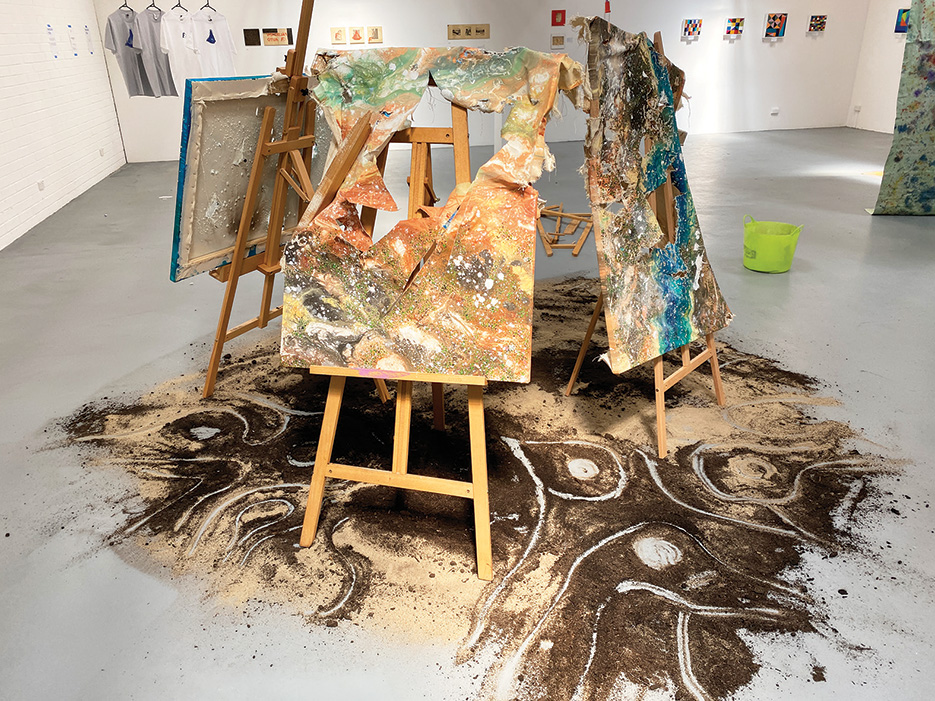
    Bradley Kickett stabbed and chopped his canvas with a knife before shooting it with multiple calibre rifles and shotgun shells, as part of his installation Boundary Road.

    “I used the tools that were used to enforce colonisation to destroy my cultural art practice,” he says.

    Kickett graduated with a degree in Fine Art from Curtin University and is one of the many promising WA graduates displaying at the PICA exhibition Hatched, but he says the exhibition circuit is a closed shop and art education is “ethnocentric”.

    “I don’t think anything is changing in Perth,” he says.

    “The contemporary art world will only show artists with degrees. 

    “There is an under representation of First Nation artists in the contemporary arts. 

    “The education system tries to change you into a Western European artist. And teaches nothing about aboriginal art at all. 

    “To do an art degree you need to go through an ethnocentric system. 

    “A system built on colonialism which is designed to destroy Aboriginal culture and identity. 

    “The system needs to change to recognise and teach the fundamentals of Australia’s First Nations cultural arts. Instead of ignoring that it even exists.”

    Bradley Kickett (above) applies the finishing touches to Boundary Road (top right) Photo by Bo Wong

    A Nyoongar artist descended from the Kickett clan in York, Bradley is a painter, but also does installations and animation.

    Boundary Road includes replicas of the text posters that were put up around around Perth before 1967, when the movement of local Aboriginal people into the city was limited and controlled. 

    A Certificate of Exemption was required to be able to live in the city on a road specifically set aside for Aboriginal people, often called Boundary Road.

    Another highlight of Hatched is UWA graduate Harrison Riekie’s Hidden Vista, which includes photos of his giant 50×50 metre QR code, created in a block in urban WA.

    Armed with just a household rake and a 2m measuring rope, Riekie created a mega QR code he generated from an image of a landscape in the northwest of WA.

    “Initially, I didn’t have permission to use the space, but I explained that it was an impermanent form of mark-making when confronted,” Riekie says.

    “I received the all-clear as long as I ended up handing over some of the aerial documentation.”

    Riekie works mostly within the landscape, subtly manipulating the soil to question the value of current communication systems and the methods of distributed information.

    “I think digital forms of communication are destabilising the relationship between ourselves, space and time,” he says. “It is undoubtedly a great way to create global connections, and intrinsically, speed means progress. 

    “However, with this newfound instantaneity, there is a constant emphasis on real-time and live feeds, where everything exists within a 24-hour window. 

    “Therefore I think, as a society, we are drawing upon an inexhaustible stock of information in the present, which is then being disseminated and consumed within an ar-rhythmic new cycle.”

    Hatched: National Graduate Show, now in its 30th year, is at PICA in Northbridge until July 11.

    By STEPHEN POLLOCK

  • Baysy beauty

    YOU can tell this Bayswater home is going to be special by the lovely character facade.

    Leadlight windows, a cute verandah and painted weatherboard create a charming and very inviting entry statement.

    The front garden is cute too, with brick paving and nice shrubs and plants.

    In fact the garden plays a huge role in this house; it’s mostly edible with raised planter beds in the backyard, shady mature trees, a chook pen and water tank.

    The inside of this three bedroom two bathroom home is equally impressive with vintage fireplaces, gorgeous timber floors and high ceilings.

    Everything has been done with care and love, and you can tell the owners really liked their home and enjoyed living here.

    I like the geometric-style feature wall in the open plan lounge/dining/kitchen area, which is spacious and bright with a neutral colour scheme.

    The kitchen itself is sleek and modern with white cupboards and drawers contrasting nicely with darker stone benchtops and stainless steel appliances.

    It includes a large pantry, and the chunky light dangling above the island bench is a bold and stylish touch. Both bathrooms are contemporary with gleaming white tiles and dark cupboards, with one featuring a lovely clawfoot bath and large shower.

    All three bedrooms are very relaxing and have a subtle design touch here and there to make them stand-out.

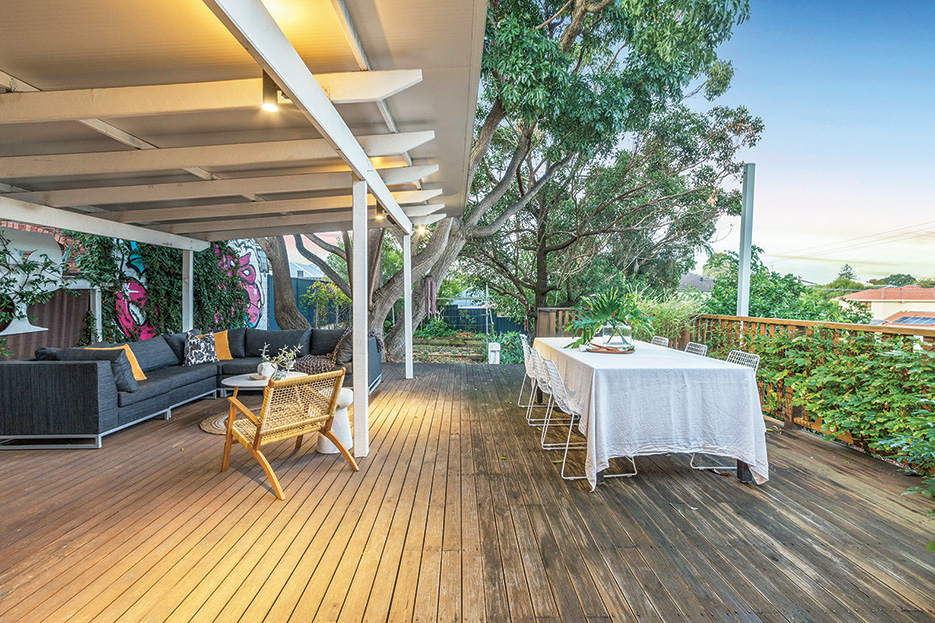
    After dinner open the French doors in the lounge and head out to the gorgeous sheltered patio, overlooking the sustainable back garden. The elevated patio is massive and has plenty of room for a large table, an L-shaped sofa, a pizza oven, a BBQ and lots more.

    With views of the treetops, it’s a lovely spot to relax with a glass of vino at the end of the day.

    Down in the garden there’s plenty of shade thanks to the leafy mature trees, and it feels like a nice spot to unwind and potter about.

    The home includes a recently installed double carport with electric roller door, under-house storage and a laundry.

    It’s situated on a whopping 723sqm block zoned R25, so there’s scope to subdivide further down the line.

    Located on a quiet cul-de-sac on Crowther Street, you are only a few streets away from Riverside Gardens and within easy reach of Bayswater Town Centre, Maylands cafe strip, the Perth CBD and the airport. 

    This is charming family home with a great sustainable garden.

    Home open today (Saturday May 15) 11am – 11:30am
    All offers presented by 4pm Monday (May 17)
    59 Crowther Street, Bayswater
    Bellcourt Property Group Agent Shaun Pratt 0466 822 050

  • India’s Covid disaster hits close to the heart
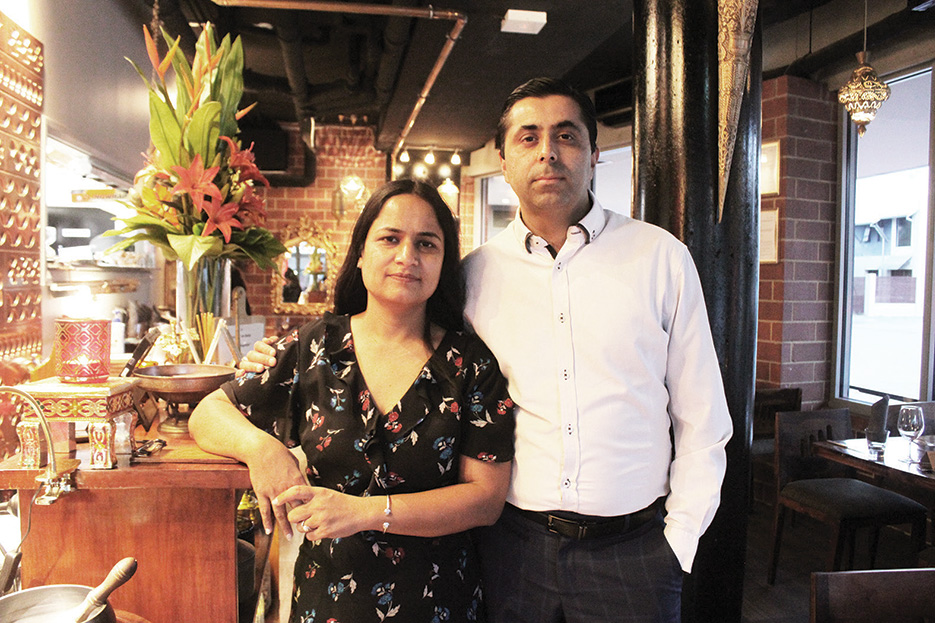
    • Chakra Restaurant owners Sonia and Kumar are devastated by news from India and wanted to help. Photo by David Bell

    SEEING devastating scenes from Covid’s latest wave in India, the owners of Inglewood’s Chakra Restaurant held a fundraiser night to help their birth country’s collapsing medical system.

    India was doing relatively well against Covid until last month when it was hit by a surge of the more infectious UK strain, exacerbated by mass gatherings allowed to go ahead because the worst of the pandemic was thought to be over.

    Mass cremations

    Now almost 400,000 new cases are reported each day, hospitals are running out of oxygen supplies and demand for wood to fuel the mass cremations is so high people are asking if they can strip the trees in local parks.  

    Chakra co-owner Sonia says she was moved to act after seeing footage of “mass cremations back in India”.

    She says on April 28 “the first thing I saw that morning was a community park filled with bodies”.

    She could hardly believe it and had to call home to confirm if the images were real. They were.

    Many Indians observe structured burial rituals to honour the dead, and Sonia and her husband Kumar say it would be especially hard for people who’d lost loved ones to have to forgo the comfort of those rites. 

    “We’re enjoying a cup of coffee here, and people there are struggling, the conditions are really bad,” Sonia says.

    “The stories from friends and family are devastating.

    “The residential buildings are sealed, so kids are not even allowed to come out of their houses.” 

    Sonia is originally from northern India and has lost two family members to Covid-19. 

    The medical system is under so much pressure train carriages are being used as hospital wards.

    One of her former students recently reporting he was struggling to find an oxygen cylinder for a family member. Other family friends have died within days of showing symptoms, one just in his 50s.

    “Two of my dad’s friends died in one day. That was scary. My in-laws,” Kumar’s parents, “both of them are there, and can’t go out.”

    After the fundraising night donations continued the next day as patrons found out about the cause and wanted to contribute and a total of about $4,000 was reached. Now another restaurant has heard the call and got on board.

    “Some very good news,” Sonia says. “Odyssea City Beach restaurant… they said ‘we’re so happy to see you  did a fundraiser and we want to help raise funds for India with you on a larger scale’.” The collaboration will see Chakra cooking at the larger venue for a sold-out 130-head fundraising night on May 17.

    “We’re excited that people are supporting it,” Sonia says.