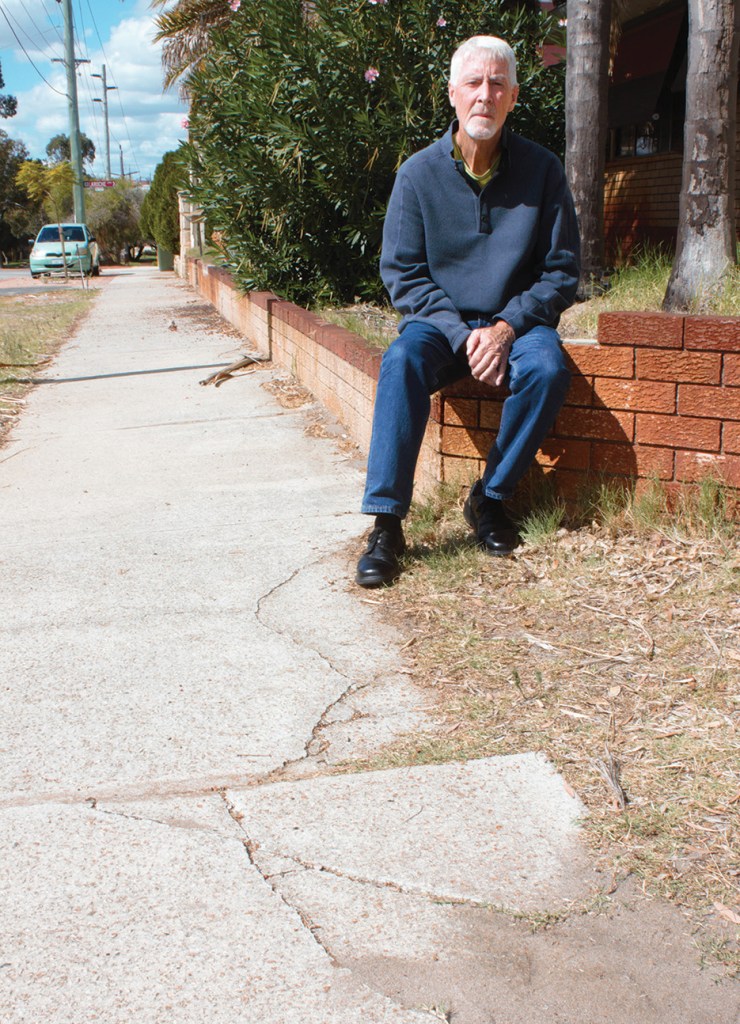
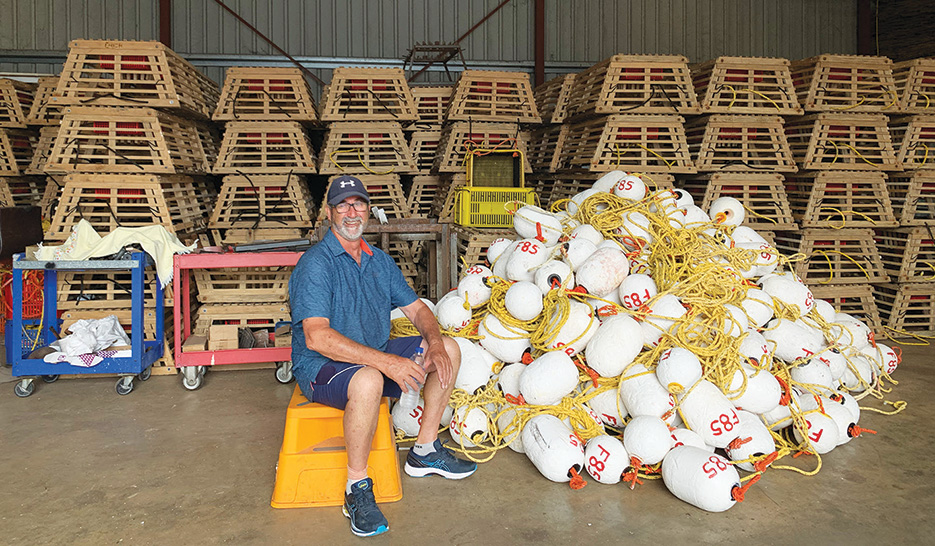
Chris O’Connor’s had 18 footpaths fixed so far after learning Vincent council only fixes what’s reported. Photo by David Bell
BEWARE cracked footpaths or uneven paving: Vincent council won’t accept liability for injuries unless they’ve previously been warned about specific problem spots.
Vincent resident Chris O’Connor reckons locals should start reporting every trip hotspot after his experience of being palmed off when he had a fall on a hazardous stretch near the corner of Vincent and Fitzgerald Streets.
“Where do you stand if you happen to fall?” he pondered in response to his fall last year.
“Interestingly enough, on your own and apparently 100 per cent responsible.”
Mr O’Connor says Vincent administration were lovely and helpful when he contacted them about the fall, but after that he hit a dead end.
“My still-to-be resolved resultant shoulder injury necessitated my putting in an insurance claim that was rejected by the City of Vincent, using the Civil Liability Act 2002, which provides protection to councils based on the premise that if they didn’t know about the footpath hazard, then they cannot be held responsible for any resultant injuries.
“On that basis, I have since sent notifications to the Council of approximately 18 potential footpath hazards, with photos and addresses, which have unsurprisingly solicited an immediate response in fixing each problem.
“The council’s stated preference for reacting to these footpath issues after public notification, in my case after falling and injuring myself ‚Äî collateral damage I guess ‚Äî does need to be balanced with a more proactive monitoring and maintenance of those footpaths by the council.
“Until then, I suggest we all notify the council of potential footpath trip hazards. They will react!”
Mr O’Connor was told by Vincent staff that they currently review footpaths once every three years and the council seemed happy with that level of service.
Mr O’Connor, 68, says his main concern now is for folk who aren’t as sturdy and might suffer a worse injury.
The council’s upcoming draft Accessible City Strategy aims to make the town more walkable for everyone but lists no change to the three year checks.
Mayor Emma Cole tells us “every year, we invest in Vincent’s footpaths and our various teams, from parks to engineering and rangers, proactively and regularly report damaged footpaths. Our community members also help us by reporting issues they find.
“This financial year, we are spending $200,000 on footpath renewal and last financial year we spent $380,000 on footpath and cycle way maintenance.
PERTH council planners have objected to the huge number of car bays at a tower proposed for Elizabeth Quay, not wanting a supposed pedestrian precinct to become a motorway.
The state government’s planning superbody DevelopmentWA gets the final say.
The Barnett government instituted a limit of 0.7 car bays per apartment at Elizabeth Quay towers but under Labor there’s already been developments go through far in excess that’ll add hundreds of extra bays to the quay (“Car Quay,” Voice, March 27 2021).
A new design by Element for Lot 4 wants a total of 204 bays for 168 apartments, blowing past the 0.7 limit to 1.2. There’ll also be 90 bays for office tenants instead of the 67 Barnett’s planner’s envisioned when laying out the rules.
The developer argues the bays are needed
to make the project viable because the wealthy residents will want to own cars.
City of Perth planning staff advised councillors to stand firm over the limit and tell the richies to take the bus, train, or ferry.
Their report says the limit should be heeded given “the increased traffic likely to be generated by other developments located adjacent … and the high accessibility of the site via alternative means of transport”.
Councillors will decide whether to kick up a fuss over the parking blowout at the upcoming April 27 council meeting, and their recommendation then gets passed on to DevelopmentWA.
The state-appointed commissioners approved the last big car-friendly tower in mid-2020, with chair commissioner Andrew Hammond saying they needed to support development during Covid.
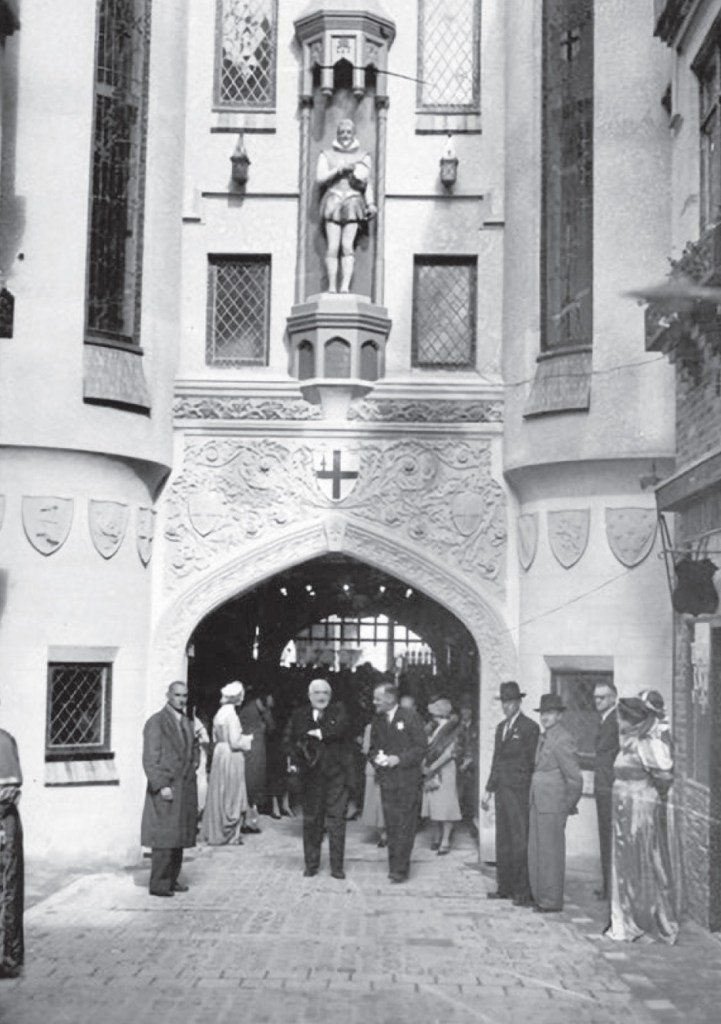
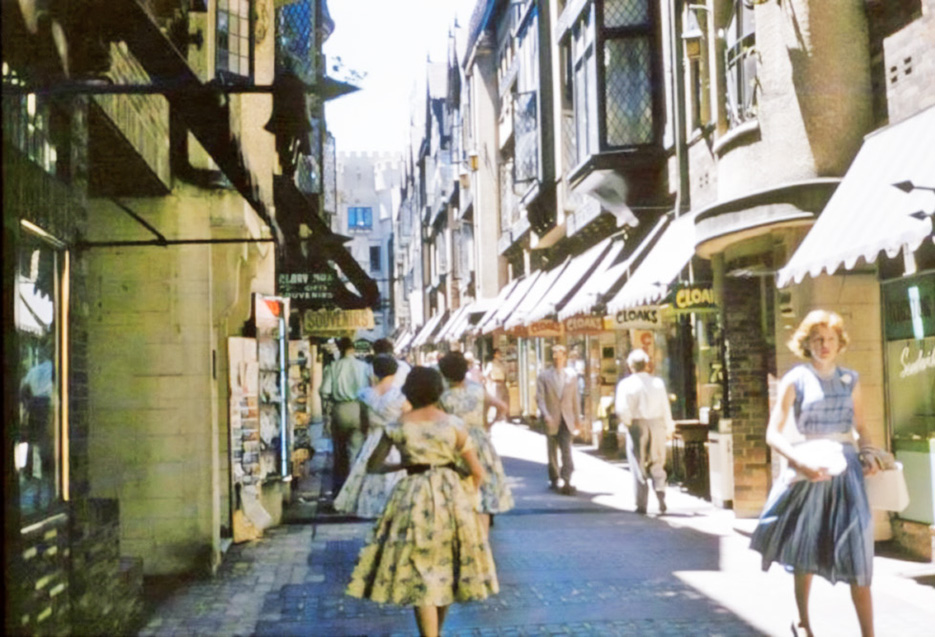
Opening Ceremony of London Court, Perth, Western Australia, 1937. State Library of WA 004003D London Court, Perth, Western Australia, 1960. State Library of Western Australia 145663PLondon Court today, as passersby learn of its past.
A HISTORY of London Court was launched over Heritage Weekend telling the swank arcade’s 85-year life story.
Local history non-profit Museum of Perth recently branched out into a vacant shop there and set up the volunteer-run London Court Books.
Volunteer Nicki Blake set about writing the court’s history, delving into archives to discover the lengths founder Claude de Bernales went to in order to find specialist artisans to build it: “The project managers were incredibly lucky to find, living in North Perth, an expert on 15th century wood-carving — Edward G Madeley — to carve the window-boxes from local jarrah timber and add details in the form of Tudor roses and gargoyles.”
Mr de Bernales wanted as much as possible to be made in WA, but he had to abroad to get parts for the famous clocks, and had legendary horologist Frank Hope-Jones brought over to complete them: “They were based on Le Grosse Horloge de Rouen in France, constructed in England by the Synchronome Company of Middlesex and shipped out to Australia to be assembled by their maker, Frank Hope-Jones, who worked in cooperation with a heraldry specialist to incorporate the figures of St George and the Dragon and the four tilting knights.”
Over the decades London Court was home to the the Red Cross, the Communist Party, and London Court Matrimonial, an ‘introductions service’ to matchmake couples. It was run by Viv James, an anti-communist speaker with no love for his upstairs neighbours selling the Worker’s Star newspaper.
Once thriving with residential life in its flats, modern zoning laws and insurance issues mean the flats are no longer lived in.
The display is on in the windows at London Court Books and a printed pamphlet version is on sale for $2 (proceeds to help run MoP).
Listed for sale
LONDON COURT has been listed for sale, the first time it’s been up for grabs since it was built.
Claude de Bernale passed it on to private family ownership not long after building it, and it’s remained in their hands ever since.
Agents Colliers are seeking expressions of interest, expecting offers to come in at a national and international level.
“London Court has stood as a unique and much-loved landmark in the Perth CBD for more than eight decades, and in all that time has had just two owners,” Colliers agency director Ian Mickle said.
It’s been on the state heritage register since 1996.
Distilled 1970s Western Australiana: The iconic swan is surgically removed for future reuse.
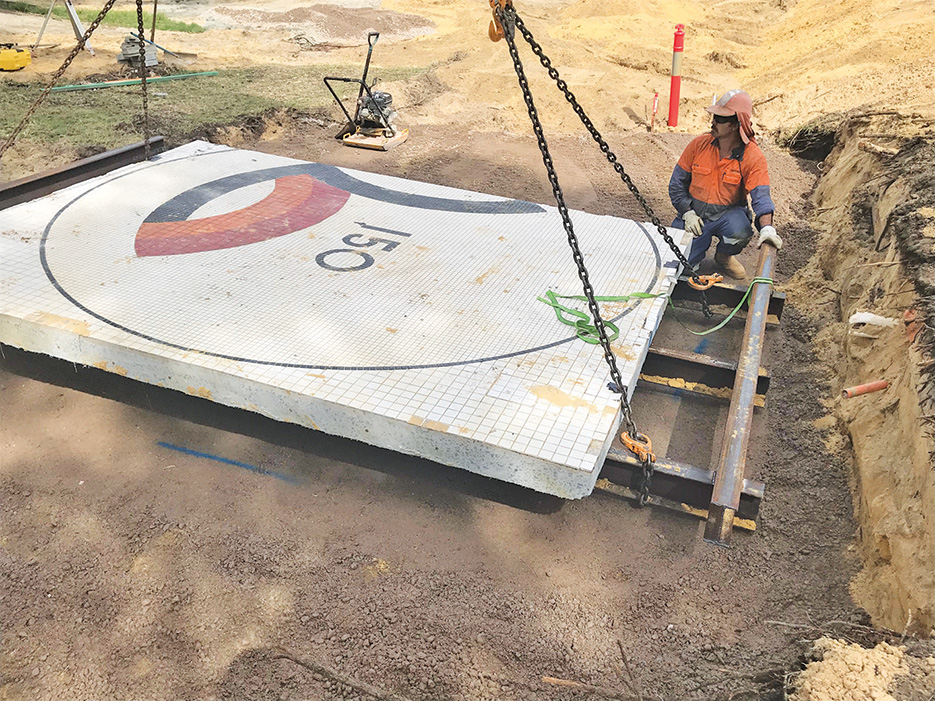
A CAUTIOUS operation has seen the Maylands swan mosaic removed for preservation.
The swan was installed at Maylands Waterland to mark 1979’s “WAY 79”, the 150th year since the founding of
the Swan River Colony. The sesquicentennial swan was ubiquitous back then and ended up on a swag of cultural items including coasters, ash trays, tea towels, bottle openers, and a massive one made up the tiling of Waterland’s largest pool.
Back in 2019 just before Waterland was decommissioned, Bayswater councillor Catherine Ehrhardt moved they preserve the swan so it could later be mounted.
Cr Ehrhardt reports the swan was carefully removed in two pieces to reduce the risk of cracking, and it’ll be reinstalled at the new replacement water park later this year.
Stage one of the $3.5 million replacement Waterland is
on scheduled to be open by November 2021 with a splash pad, water creek, wading pool, play areas and picnic and barbecue spots, while stage two with its bigger leisure pool is still a ways off and would need another $3.7m to fund it. Bayswater council’s looking for state or federal funding before diving in.
WAY 79 was an initiative of former premier Charles Court’s government and was some eight years in the planning.
Noongar activist Ken Colbung was invited to perform the didgeridoo at the opening event, and used the occasion to hand governor Wallace Kyle a notice evicting white people on behalf of WA’s Aboriginal community, done up in the style of a housing commission eviction. It sparked fury from Sir Charles who called it a cheap stunt.
Apart from that moment of praxis the rest of the celebrations were remembered by historian Geoffrey Bolton as a “sanitised version of the past” when he reflected on them a decade later.
“Nobody tried to replicate the heat, the insects, the dysentery, the alcoholism, the boredom and the discomfort which were so intimate a part of daily life in the Swan River Colony,” he reflected.
Anthony Santaromita has just retired from the fleet, but has provided McKendrick with a swag of material and will be helping pass on his skills. Photos by Sandy McKendrick
AN exhibition paying homage to Fremantle’s fishing community, as well as trying to preserve some of their dying arts, will headline a bumper local contribution to the Australian Heritage Festival which opens this weekend.
Fish Shack Exhibition will take over the B-Shed on Victoria Quay, with everything from fishermen showing how to make sticky cray pots and mend their nets in traditional methods to artworks and a real(ish) fishing shack with a coffee machine to reflect the importance of the Italian community to the local industry.
The exhibition was the brainchild of local artist Sandy McKendrick.
“This started off because I was a teen in Freo and one of the reasons I loved living here was because it was an active port,” McKendrick says.
As she started exploring whether that love could be channeled into an exhibition, she discovered the fishermen were glorious storytellers and the idea took off.
“This has given me a gorgeous opportunity to stick my head in and speak with the fishermen and they have all been really generous with giving information and their resources.”
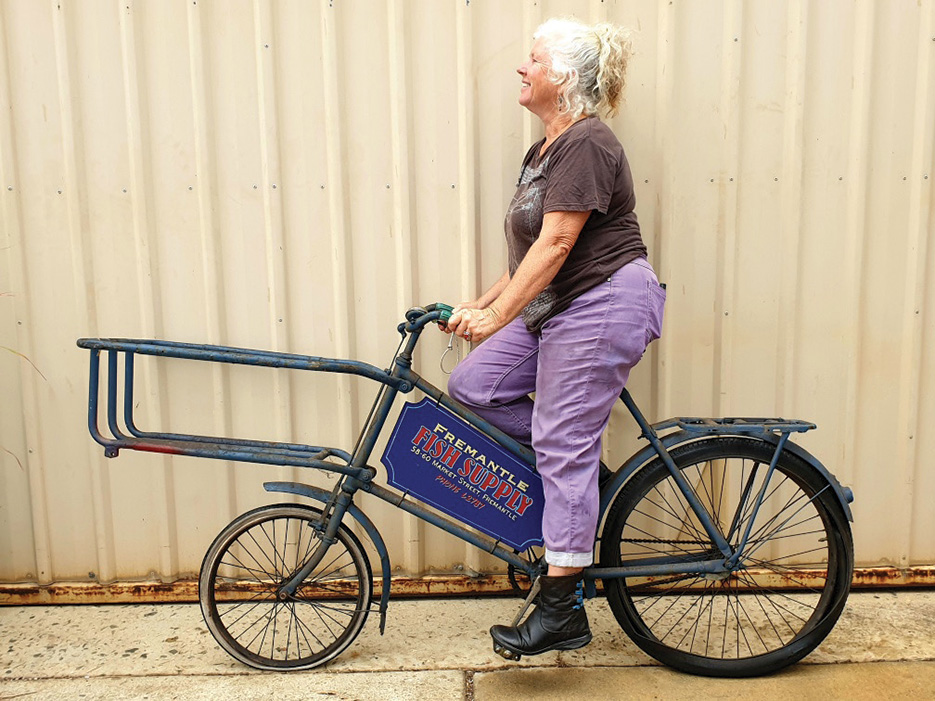
Artist Sandy McKendrick on an old Fremantle Fish Supply delivery bike.
But she also discovered celebration wasn’t the only thing on their minds.
“Over the last few years a lot of the skills from the fishing industry, from stick pot making to net mending have been dying out and a lot of young people had no idea that they were so big here,” McKendrick says.
She’s collected enough nets to trap a blue whale, but instead will drape them around the exhibition so they old blokes can demonstrate how to mend them. There’ll also be workshops on how to make the best, most reliable mats from recycled crayfish lines, which spend their working life under tension and drenched in salt water so they’re virtually indestructible.
Splicing and whipping exhibitions will reveal how to turn old rope into bracelets or quoits.
McKendrick says she’s also keen to build up her collection from stories and materials provided by the community itself.
“We’ve got a big screen of sailcloth and a great big map of the Mediterranean and beyond, so people can go and write a letter or a story about the many places they come from,” she said.
While she’s already been given a treasure trove of photos, she’s hoping to get more and will be bringing a scanner along so they can be added to a rolling display.
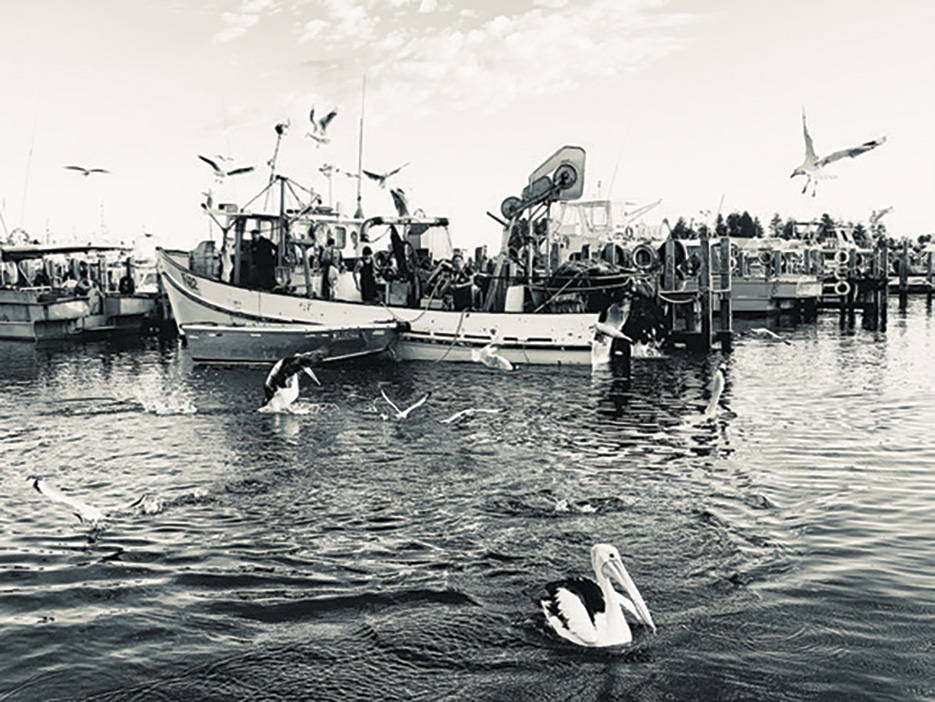
The Mendolia family boat; they’ve been integral to the growth of the fishing industry and will be providing the exhibition’s food.
“Another of the things I am doing is in the middle of B-Shed there’s a ticketing office, and I’m turning it into a fish shack with a coffee machine, and I hope the fishers and their families can come in so that I can sketch them.
“There isn’t really a place where they can come and talk about what they’ve done.”
Fish Shack Exhibition was due to open yesterday (Friday April 16) and will be running until May 2 in B-Shed.
Other events lined up for the Australian Heritage Festival include a look at Fremantle through the historic films of much-loved former mayor Sir Frederick Samson. Produced by local mixed media gurus Genrefonix in collaboration with the Samson family and the City of Fremantle, the online collection is a fascinating look into life in Fremantle, from troops marching through the city on their way to war to visiting dignitaries
to the Samson family’s quiet moments. There’s also a walking tour by local historians Mike and Joy Lefroy, which can be booked through https://www. freddysfilms.com.
There’s also a street art walking tour, the WA Dragon Boat Festival, an exploration of how to ‘read’ a museum, and exhibitions of everything from the Chinese community in WA to the rampaging and often misunderstood Vikings.
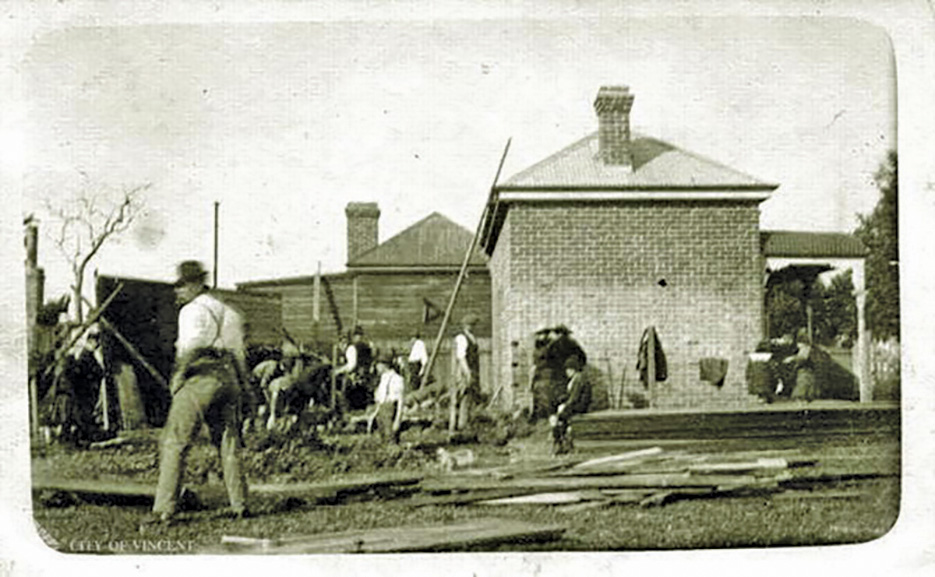
1. The Ugly Men’s Association volunteers working on house extensions at 210 Carr Street, Leederville. City of Vincent Local History Centre PH02460
In this week’s tale from the Vincent Local History Centre, we hear of the charitable efforts by returned servicemen who rebuilt their lives while rebuilding homes.
THE story of Anzac Cottage – the Mount Hawthorn house built in 1916 by community volunteers for returned WWI veteran Private John Porter and his family – is well known to many.
But there are other less well known ‘renovation rescue’ stories of local volunteers who banded together to support the families of returned servicemen in Vincent.
After WWI, life was tough for many widows and incapacitated veterans, and their families. Charities such as the Ugly Men’s Voluntary Workers Association of Western Australia helped those in need.
The ‘Uglies’ as they were commonly known, set up a training college and employment service for returned servicemen after the war. They also gave out relief payments and organised busy bees to build or fix homes for veterans and war widows in the Perth suburbs.
2. The Ugly Men’s Association help to renovate 210 Carr Street, Leederville, 1919. PH02459
The Uglies renovated the home of war widow Agnes Brackenridge at 13 Blake Street North Perth in July 1917.
After her husband Douglas died in action in France in 1916, Agnes was left to raise a family of five children in what was described in the newspapers as ‘a little hovel’.
The Ugly Men’s appeal saw a team of volunteers transform the timber cottage into a more substantial, watertight home for her five children. Agnes and her family remained in the home until her death in 1942.
In 1919 the Ugly Men pitched in again to refurbish the family home of returned soldier William Marshall at 210 Carr Street Leederville.
Marshall had migrated from England to Australia in 1910 and built a two-roomed house for his young family.
In 1916, he enlisted in the 16th Battalion AIF and left his wife and two children at home while he fought in WWI.
After being held as a German prisoner of war from 1917-1919, he returned home to Leederville. The Uglies built a wooden extension comprising of a kitchen and dining room at the back of the tiny house, which remained the Marshall’s home until the 1950s.
3. Family portrait of William Marshall in uniform with his wife Mary and children William jnr and Edith. PH02465
What about your home?
If these stories inspire you to find out whether your home has an interesting wartime connection, the City of Vincent Local History Centre, in collaboration with Anne Chapple from Friends of Anzac Cottage, are offering an Anzac-themed house history workshop on May 12. The workshop will highlight the information and resources that can help unlock the stories and secrets of your home.
Following the workshop, participants are invited to Anzac Cottage in Mount Hawthorn for a guided tour.
Bookings are essential: 9273 6090 or local.history@vincent.wa.gov.au
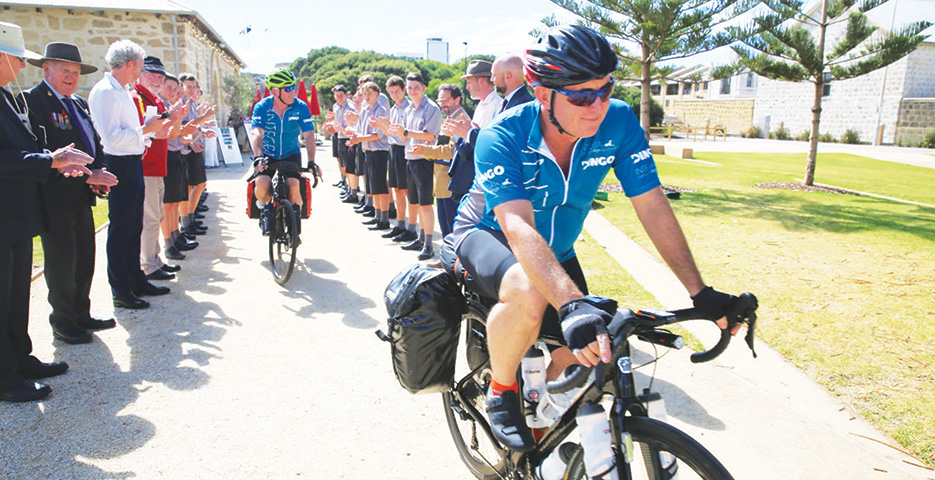
• Brian and Ian Schumacher leave Fremantle with a guard of honour from the local RSL.
TWO brothers have embarked on a punishing seven-week bike ride from Fremantle to Sydney to raise funds for service personnel and first responders suffering PTSD.
Brian and Ian Schumacher, both in their 50s, dipped their wheels in the ocean at Bathers Beach before starting the epic 4400km trip.
Funds raised from the coast-to-coast ride will be given to the charity Integra Service Dogs Australia, which provides assistance dogs to former and current serving ADF veterans and first responders with PTSD.
Brian, who has sons in the police force and army, decided to do the charity ride after the bushfires of 2019/20 put first responders under enormous pressure.
“The impact of providing vulnerable people with a support dog that gives them renewed purpose, greater confidence and unconditional support is life changing –and it saves lives,” Brian said.
Integra’s dogs are trained to become emotionally tuned to their handler and provide unconditional support through the trauma and stresses of everyday life.
It costs approximately $35,000 to train and place an assistance dog with a veteran or first responder suffering PTSD. Brian and Ian lost their sister Merilyn to suicide in 1997 after a long battle with mental illness, so the brothers have a passion for supporting mental health initiatives.
Brian rode almost 1000km from Hay NSW to Maitland NSW in January last year in support of his brother Ian, who was on the second leg of his Maitland SA to Maitland NSW ride in support of families who had lost a loved-one through suicide.
To donate to the Integra Coast-to-Coast Ride go to isda.com.au/coast-to-coast-ride/
THANK you for your lead article highlighting an important cultural and heritage issue for Maylands and indeed, for WA.
However, it’s unfortunate that the “tea wars” angle on proposals to convert the Peninsula teahouse portrays Maylands residents and others in a squabble that we don’t need or want to have.
Everyone has a right to express her or his points of view.
I understand that a key issue underlying the WA National Trust’s proposal is lack of funds to complete its restoration of Tranby House.
Their plan to address the problem neglected to first consult residents, wildlife and urban bushland experts and other important stakeholders.
I am a Maylands resident who supports retaining and renovating the Peninsula Teahouse building. It is seriously run down.
A liquor license combined with extended trading hours are residential location.
I walk by Tranby House several times a week. Before the Peninsula Teahouse closed it was well attended by local families, cyclists, kayakers and various groups. Its festive high teas for special occasions (byo alcohol) were booked months ahead.
It nestles by Tranby House/ museum, which attracts tourist buses, school groups and other visitors. The teahouse is not a heritage building, it is a converted caretaker’s cottage styled in keeping with Tranby House.
Tasteful renovation, new furniture and improved kitchen facilities will enable the tea house to be better utilised.
The lessees will improve online ratings by providing a wider range of fine foods, fresh produce and speedy service.
Holes to anchor the removable umbrellas shading tables on the bricked area beyond the oak tree will prevent them blowing over.
I see no need to pave the rectangle containing the old oak tree, or extend cover beneath its branches.
The cafe could provide a niche outlet for quality local and WA art and craft work. Information on hand about the traditional custodians of country, settlement times and later history and ecology of the peninsula would enrich customers’ knowledge of place.
Aboriginal people lived and raised their children along the Derryl Yerrigan for countless years, employing land use practices in balance with nature.
Speaking truth about the whole of colonial history and including Aboriginal people’s perspectives and stories is an essential part of WA’s reconciliation journey.
We are told that the traditional custodians of the land have been consulted.
In the spirit of respect and reconciliation I hope that we will soon hear their views.
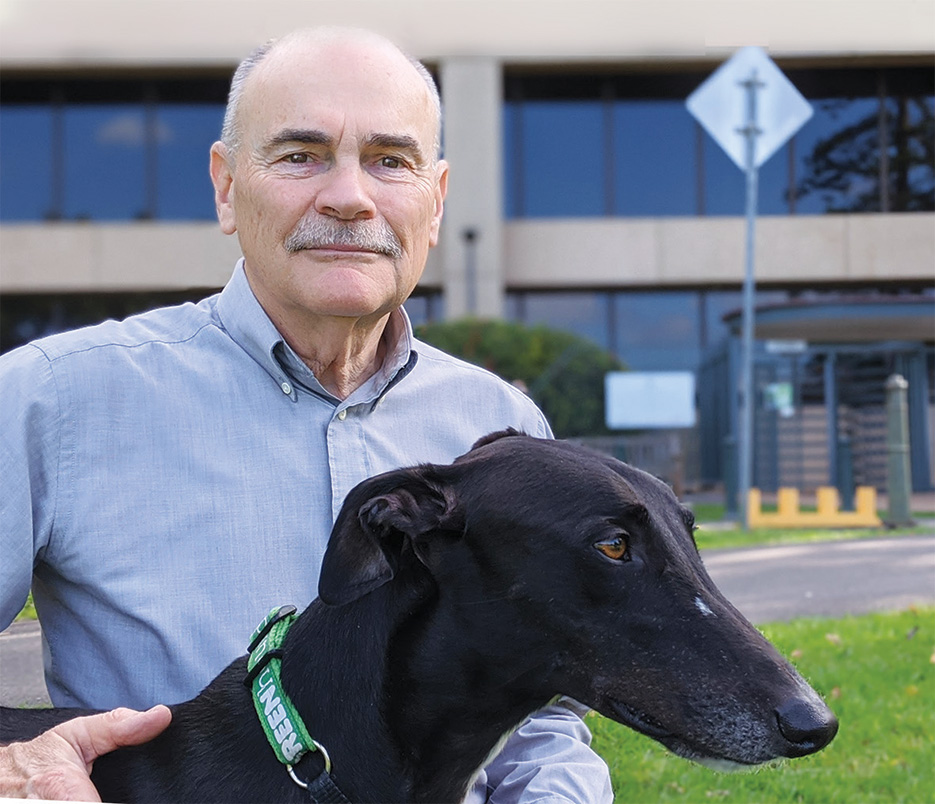
SATURDAY April 17 saw the finals for Perth’s two biggest greyhound racing events, with dogs injured in four races and one forced to compete with an existing leg puncture wound. Coalition for the Protection of Greyhounds president Dennis Anderson says we need to stop betting on cruelty.
PERTH’S two biggest greyhound races – the annual Perth Cup and the Galaxy – have again seen stewards stand down dogs due to injuries. Is it really worth betting on such animal suffering?
The dogs were competing in seven and eight-dog races, because Racing and Wagering WA has failed to introduce six-dog fields as per industry-funded research (2017). This shows smaller fields significantly reduce injuries due to less track congestion, especially at turns.
Six-dog racing is the norm in the UK and South Australia, but clearly betting revenue is more important than greyhound welfare in WA, despite RWWA’s claims to the contrary.
No-one would risk their pet dog like this, so why greyhounds?
Meanwhile, Perth Cup sponsor Sky Racing contributes nothing to greyhound welfare, nor does its parent company Tabcorp. All they care about is the betting revenue and so do governments.
That’s why in 2018, the WA government gave the dog racing industry $19.1 million. In 2019 it was $19.8 million and in 2020, this was raised by $2.3 million.
Given the racing industry upped its revenue during Covid there’s no reason to give taxpayer dollars to this cruel industry.
Reform is not difficult. The Coalition for the Protection of Greyhounds has a five-point plan for greyhound welfare: safer racing, whole-of-life tracking for greyhounds, a reduction in breeding, funding of sanctuaries and increased penalties for mistreatment.
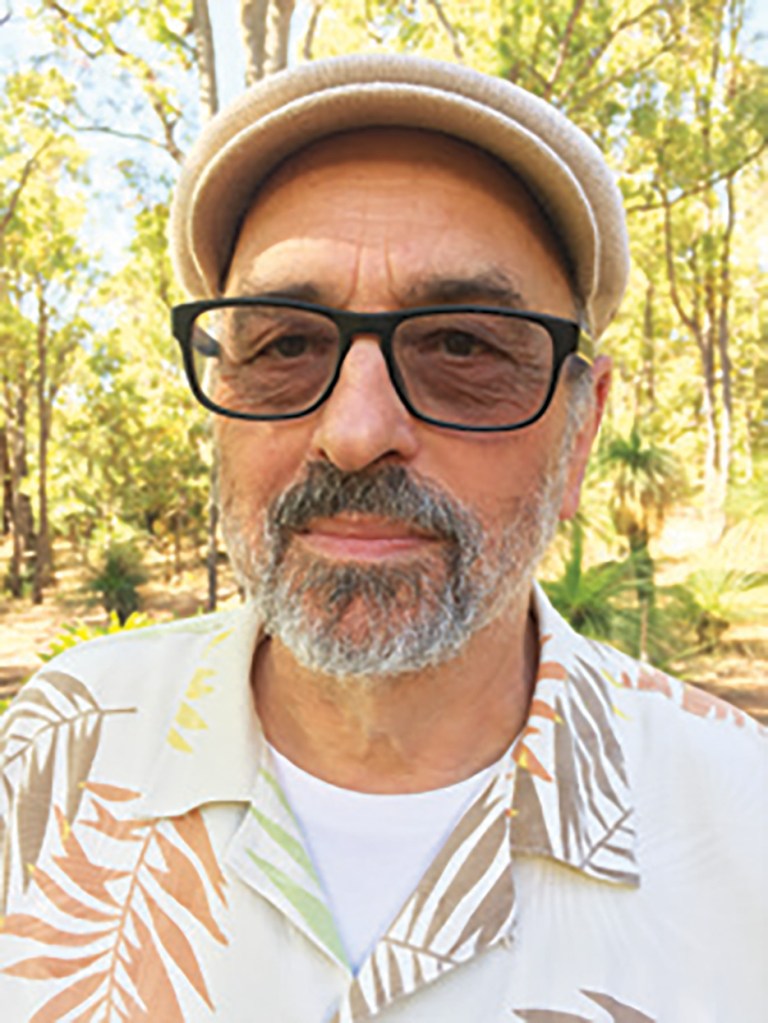
This week’s SPEAKER’S CORNER is by Legalise Cannabis Western Australia Party spokesperson Moshe Bernstein. “A historic victory for legal cannabis” argues that his party’s success in winning two seats during the March state election isn’t comparable to microparty vote rorts which have been blamed for undermining democracy.
IN the recent elections, the Legalise Cannabis Western Australia Party made world history by becoming the first, single-issue cannabis party to ever win a seat in a state or national election. LCWA won two seats in the Legislative Council, Sophia Moermond in the South-West and Dr Brian Walker in East Metropolitan.
The historic nature of this victory, however, was eclipsed by criticism of the “group voting ticket”, whereby, through group preferences, micro parties were able to harvest the votes of their opponents eliminated in each round of ballot counting.
Reform
This criticism, along with ensuant calls for electoral reform, was undoubtedly compounded by the success of the Daylight Savings Party in the Mining and Pastoral Region, where Wilson Tucker secured a seat with only 98 primary votes (0.2 per cent).
Because LCWA and DST similarly owe their electoral wins to the preferencing system, the media tended to conflate the two, despite significant distinctions between them.
First, as a small party established shortly before the election, LCWA managed to garner more total primary votes than all the other minor parties, surpassing Australian Christians, Pauline Hanson’s One Nation, Western Australian Party and Liberal Democrats, all of which held seats in the previous Legislative Council.
Furthermore, unlike the daylight savings issue, which failed four referendums, public support for legalising cannabis far exceeds the +2 per cent of the primary vote LCWA’s candidates received.
According to the 2019 National Drug Strategy Household survey, a plurality of 41 per cent of Australians supported legalising cannabis with 37 per cent opposed. That percentage of support is only expected to increase.
Recently, Virginia became the 17th US state to legislate the regulated sale, consumption, and cultivation of cannabis. Recreational cannabis is legal in Canada, Uruguay, and Georgia and in 2021 is slated for legislation in Israel, Brazil, Mexico, South Africa, and Luxembourg.
The reason for the clamour to enter the bourgeoning market of legal cannabis is that legalisation is proving successful, with none of the doomsayers’ predictions come to pass.
Back in 2003 WA premier Geoff Gallop’s government decriminalised the possession of up to 30 grams and cultivation of up to two plants.
With his “Tough on Crime” policy, in 2011 premier Colin Barnett rescinded the law, recriminalising cannabis to have another ‘crime’ to get tough on.
The current Labor Party’s state platform on decriminalisation, purported to conform with “the provisions of the Gallop government’s Cannabis Control Act 2003”, has stealthily removed the allowance for cultivation from its original.
Decriminalisation
While the unabridged 2003 decriminalisation model is a negligible first step, it still would not alleviate the concerns of LCWA’s electorate or the plurality of Australians supporting full legalisation.
• Merely decriminalising cannabis [where you take away the criminal charge but maintain possession as an illegal activity] perpetuates the black market.
• It fails to harness the entrepreneurship enhanced by a regulated industry.
• It denies WA’s farmers access to the nascent global cannabis market.
• It ignores those in need of medicinal cannabis, the current system stymied by the plant’s illegality.
• It disappoints WA taxpayers, losing out on the multi-million-dollar bonanza of cannabis revenue.
• It forsakes our children, some of whom might purchase cannabis of unknown potency or harmful additives from unscrupulous street dealers (who do not check IDs as do legal dispensaries).
• It neglects the environment, since the cultivation of cannabis as biomass crops effectively reduces greenhouse gas emissions.
• It disregards the social and health services which could be augmented with commercial cannabis proceeds packing the state’s coffers.
• Finally, decriminalisation falls short of the legal standard established in 2018 by Mexico’s Supreme Court ruling that cannabis prohibition was unconstitutional and a violation of human rights, specifically “the right to the free development of personality”.
Only the regulated sale, consumption, and cultivation of cannabis, comparable to the management of alcohol, can expedite all of the above considerations.
While electoral reforms may pose challenges to the LCWA Party, it would be mistaken to presume that its recent historic triumph will be its last.
Though a new party, only four months old, LCWA is driven by abundant enthusiasm, an unwavering commitment to the justness of its cause, and the assurance of broad public support.
Ultimately, the Party’s final victory will take place on that very same day when cannabis is at last made legal in Western Australia.