A DELAY in working out how much electricity it uses has contributed to a $1.6 million blowout in Perth council’s power bills.
Following the end of a deal with state government-owned Synergy in June 1 last year, the council has been paying “non-competitive rates” to the energy provider which saw its power costs balloon out to $2.82m in the last financial year.
The council has been trying to bundle more of its meters into the cheap energy deal, but a delay in getting the information has contributed to keeping the bigger bills rolling in for a full 18 months.
“This collation of information and negotiation took longer than expected, but it enabled the city to include a further 19 (out of 45) sites into the agreement as contestable sites, providing a better outcome for the city,” chair commissioner Andrew Hammond told the Voice.
Under WA power market rules only connections above 50MWh per year are considered “contestable”, which allows the user to pick and choose a retailer.
With the 45 contestable sites settled, the council put them out for tender, and at the December 17 meeting commissioners dropped Synergy in favour of a three-year deal with Hong Kong-owned Alinta Energy,
Although Synergy’s bid has a “negligible” price difference, staff recommended the council go with Alinta because it was also offering a dedicated account manager and quarterly energy use reports to help them cut down power consumption.
Higher rates
The city has 144 separate energy accounts and the remaining 99 not covered by the deal have to stay with Synergy on the higher rates.
Commissioners also decided to pay a little extra (the exact amount’s confidential) to switch 25 per cent of the city’s electricity to “green power”.
Staff wanted to stick with “black power” and using the savings to invest in local eco-friendly measures.
TOUGH negotiators from the state’s sports and recreation department have left Vincent council with a $3 million hole in a long-term investment.
The council built 246 Vincent Street in 2004 on the back of a 25-year loan, agreeing to a state government condition that the building could only be used for administering WA’s sport and recreation needs.
A 15-year lease was signed with the department (now rolled into the Department of Local Government, Sport and Cultural Industries) which currently pays $644,000 a year – a smidge over the market rate.
But the lease expires December 21, and with a condition making it the only plausible tenant, the department has played hardball for a better deal.
Initially it offered just $450,000, but after negotiations, settled on $546,000pa on a 10-year lease with a 5-year option.
Council staff called the deal an “incentive” for the department to stick around. While it’s a $3m drop in revenue over the life of the lease, they clawed back some territory when the department agreed to fund a $1.6m building upgrade.
The mood at the December Vincent meeting was more Chamberlain than Churchill as councillors accepted the state’s deal.
Councillors Dan Loden and Joanne Fotakis (whose background is in commercial property) acknowledged it would be difficult finding an alternative tenant.
Negotiations
“I know there has been a lot of negotiations back and forth on this. Whilst it is not a great outcome for the city, it probably is the best outcome we can get,” Cr Loden said.
Mayor Emma Cole described the state’s final offer as “a slightly better option than what first came before us”.
“We are actually in a slower market and a rent reduction makes sense,” she said, but pointed out the original deal left the council on uncertain grounds because it had a 25-year loan and just a 15-year lease.
“But I think given the circumstances and where we are, I do really appreciate the effort the administration has gone to tweak this and to work to secure the long-term tenancy.”
Ms Cole said the department had been a good tenant and it was good to have government workers in the building, with more department staff expected to join the sporties.
THERE’S still some Jesus in this year’s Christmas festivities among the city’s baubles, reindeer and lights, with the City of Perth Christmas Nativity running December 20 and 21.
The Christmas story will be brought to the stage with 100 performers and animals, plus traditional Christmas carols (and some new) in the Supreme Court Gardens. Santa and his elves will be there between 4 – 7pm each night.
Merry Christmas to our readers, advertisers and distributors. This is the last Voice for this year, but we’re itching to get back in January with our Summer Reading and all the news that makes Voiceland tick. See you then.
THE State Administrative Tribunal has overturned Perth council’s refusal of a luxury doggy daycare in West Perth.
In April commissioners refused Marian Gorman’s 60-dog daycare centre over fears the animals would be too noisy, and after hearing complaints from neighbours of the old scout hall in Murray Street, who said it was a bad fit for the area and would hurt their property values.
Ms Gorman came back in July with a beefed-up noise management plan and council planning staff once again recommended commissioners approve it, noting an expensive SAT trip would most likely be futile given Belmont council lost an appeal in a similar case. But commissioners Andrew Hammond and Gaye McMath were resolute in their opposition.
Seven months after the first refusal, the SAT has approved Ms Gorman’s doggy daycare, citing the Belmont precedent in its decision.
• Marian Gorman and friend. File photo
The SAT rejected a council argument that the business should be at least 500 metres from residences as would be the case for a kennel, which would be covered by Environmental Protection Authority rules. Perth’s planning rules don’t define a kennel, but the SAT ruled daycare definitely wasn’t one.
The SAT said Ms Gorman had “satisfactorily addressed” noise and odour concerns.
The approval comes with a list of conditions including bark-blocking measures, parking rules, and calling for “a revised colour palette of muted tones that are more consistent with surrounding development” (the first design was very pink).
Ms Gorman says she’s happy with the list of conditions.
“I can hardly describe how stoked I am today,” she said about the long battle to get approval.
There’s still some prep work to do on the building and she’ll have a timeline for opening in the New Year.
This is the first time anyone’s appealed a planning refusal by the commissioners since they were installed to replace the council in March 2018.
NON-STOP karaoke for “connection”, “consent” and “catharsis” will run across January 4 and 5 at the new Pig Melon project space on Lord Street. Karaoke healer and Chicken Treat showgirl Consensual Connie is holding the protest singalong and “joyful resistance” for those wearied by the federal government’s “actions and lack of actions” on just about every major issue.
Connie (aka local music scene-improver Rose Kingdom-Barron) says if you’re looking for a 24-hour party in Perth “it’s either this or the casino”. Also if you don’t like to sing you can say the safe word “kaya-no-ke” at any time. Pig Melon’s at 161 Lord Street and entry’s free or by donation, just RSVP at eventbrite (search “24 Hour Karaoke – a Very Political Sing-In”). The show’s a little preview ahead of Connie’s Fringeworld show Karaoke Rodeoke running at The Gold Digger January 17 and 18.
FORMER chair of the WA Planning Commission Eric Lumsden died Monday after a long illness.
After retiring from the WAPC he was Perth chair commissioner from March 2018 to August 2019 when he stepped down on his doctor’s advice after being on sick leave for most of 2019.
However he revealed at his final meeting he’d still had a hand in the council’s direction during his treatment, with texts and phone calls to fellow commissioners.
At the Perth council meeting on December 17 replacement chair commissioner Andrew Hammond announced Mr Lumsden “passed away yesterday after a brave battle with illness for some time”.
“Eric was a committed professional; incredibly loyal and dedicated to the development of Perth and the development of WA and a fierce advocate for the strength and importance of local government.”
Mr Lumsden was CEO at Melville and Swan councils, and spent six years as director general of state planning.
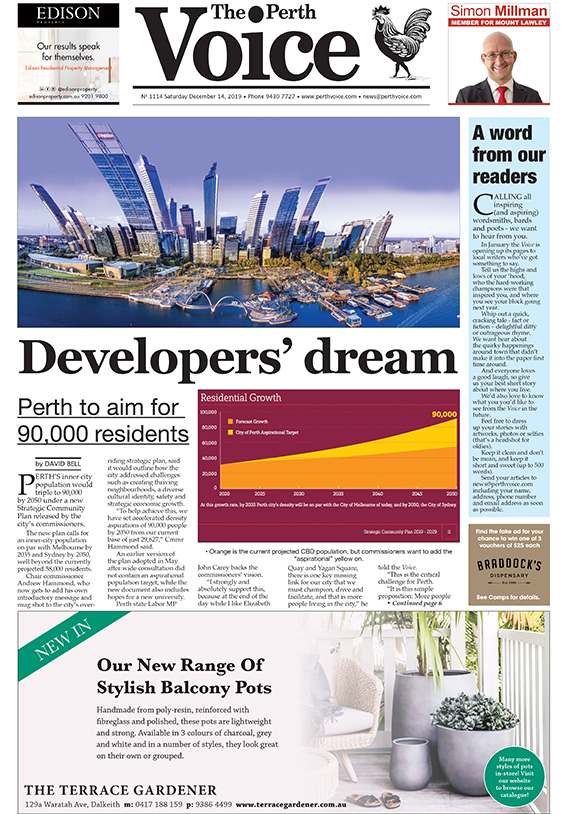
COMMISSIONERS at the City of Perth made a big call setting a goal of 90,000 people within their borders by 2050, so we invited former Perth council planning director Max Hipkins to take a look over the new Strategic Community Plan.
Mr Hipkins was director of planning at Perth from 2000 to 2005, and mayor of Nedlands for two terms between 2011 and 2019.
He reckons the plan to increase the city’s projected population up from the current estimate of 58,000 by 2050 is “worth trying,” though the SCP didn’t thrill him overall.
What can I say about the current SCP?
A fairly bland, steady as she goes, document… the most significant feature is increasing the population target to 90,000 by 2050.
My view is it is worth trying, with the carrots and sticks the city has available – it could, for example, give greater rate concessions for residential use and require a mandatory percentage of low income housing in residential projects. The more people there are the safer the streets will be and the more services will be provided.
While the document mentions some current issues – such as homelessness, anti-social behaviour, lack of a city university, rising urban heat and the importance of tree canopy – it does not indicate how seriously it takes these situations or how they will be tackled.
Urban heat, for example, can be expected to demand significant responses as all Australian capital cities will experience average temperatures of 50 degrees celcius by 2050.
The only practicable way of combatting the heat build-up is by greening the city and using the cooling effects of landscaping.
Radical change
It is possible to require landscaping with new buildings but to do so would be a radical change.
The document does not address matters such as the need for a city swimming pool, an Aboriginal Cultural Centre or an improved inner city transport system.
What happened to plans for light rail through the City Centre?
Perth is a linear city and it is a long way from East Perth to Kings Park, with many a wait at traffic lights.
What about extensions of pedestrian malls in Hay and Murray Streets?
Or introducing more pedestrian phases in traffic lights after each motor traffic movement?
The document could have flagged many things to stir the imagination.Unfortunately, the only thing worth commenting on is the increased population target.”
AFTER our first pass of the SCP last week we got back in touch with Perth council to ask how it arrived at a figure of 90,000 residents.
We’ve now learned the target was “approved by the commissioners using advice from the administration”.
Chair commissioner Andrew Hammond elaborated: “Based on a ‘moderate’ growth rate of 3.6 per cent, City of Perth modelling indicates that the city’s population could grow to 90,000 by 2050.
“This number is aspirational targeted after 2025 once the city and the state government have implemented fundamental structural changes including planning, infrastructure, transport, health and education systems to support accelerated residential growth rates.
• Last week’s Voice story on Perth commissioners’ dream of 90,000 residents. We asked how they came up with that figure.
“The 90,000 population projection is a realistic target for 2050 but to achieve this, both the city and state government will need to be proactive and invest in supporting infrastructure to accommodate this infill growth projection.
“At this growth rate, by 2035 the City of Perth’s density will be on par with the City of Melbourne of today, and by 2050, the City of Sydney.
“More people means busy streets, which feel safer day and night. More people means that investment in transformational community infrastructure is triggered sooner. More people means businesses and service providers, retailers, arts and culture and entertainment areas not only survive, but thrive.
“However, the city won’t pursue this growth rate ‘at all costs’. We treasure our heritage and green spaces, our envied position on the Swan River and we will demand sustainable building design and construction.
“We believe we can grow responsibly without compromising what is unique and valued, to create a better future for Perth city.”
POVERTY can sneak up on any family at Christmas – just ask Catherine and Dean and their four kids.
While Dean worked steady hours, Catherine stayed at home raising their children.
They were good budgeters and had everything they valued in life; most importantly a home full of love.
Then everything started to unravel: the family had to move house, Dean’s hours were cut and then Catherine was diagnosed with a rare brain condition.
“There was a day when one doctor told Catherine she would probably die or suffer a severe, debilitating stroke and ‘be left a vegetable’,” Dean says.
The couple were worried about how they would afford the medical treatment, let alone pay the mortgage.
• Catherine and Dean (not real names) with their four kids.
But most of all they were terrified of letting their kids down at Christmas.
Thankfully an act of kindness from a friend named Sandra turned Christmas back into a celebration.
Sandra put the family’s name down for a Salvation Army Christmas Cheer hamper, which arrived overflowing with much-needed food and Christmas presents for the kids, and Catherine and Dean.
This simple yet selfless gesture of kindness filled the family’s hearts with hope.
In the weeks following Christmas, Catherine’s treatment was successful and she continues to get stronger each day.
And with support from the Salvos, the family is slowly beginning to find their feet again.
A NATIONAL Indigenous “massacres” map will be reviewed after the Voice spotted errors in sites listed around Perth.
A fortnight ago the University of Newcastle launched stage three of its Colonial Frontier Massacres in Australia 1788-1930, adding 41 sites in Western Australia to the online map for the first time.
But of three sites listed in the Perth metro area, one’s in the wrong place and another appears to conflate deaths over an extended period and in various places into one event.
The first recorded affray in the colony occurred in the fledgling Perth townsite on May 3, 1830, after curious Whadjuks tried spearing chickens and, according to the commandant of the military contingent Lieut Frederick Irwin, “plundered the house of a man named Paton”.
• Whadjuk warriors watch James Stirling’s exploration up the Swan River in this 1827 painting by WJ Huggings. Three years later they’d discover their spears were little help against the intruders’ firepower.
Resisting
According to Lieut Irwin’s account an Aboriginal leader was shot in the jaw while resisting settlers who were trying to drive the Whadjuks away, but he was carried by his kin from the Perth townsite towards Lake Monger, where they were fired on by soldiers.
Irwin denied there was any massacre.
The day after the shooting, he had three Noongar men who had been regular visitors to his military cantonment brought in.
“They intimated, by signs, that some of their people were dead or wounded in the lagoon, after yesterday’s fire,” Irwin reported.
“When this was told me, I took them off to the lagoon, but they could show none, and I concluded they meant only to signify that some of their people had fallen there.”
The uni’s map places this incident near Ellenbrook, with a death toll of 30.
A second site on the map claims 16 deaths in the “Perth area” between April-September 1833, but that appears to be a reference to a meeting between Lieut Irwin and Whadjuk elder Munday in August 1833. At the meeting Munday complains not of a single massacre, but the death of 16 family members by various soldiers and settlers since the Europeans had arrived, detailing in great detail where they had been killed.
Dr Chris Owen, who worked on the list for the university, acknowledged the 16 deaths were unlikely to have been a single massacre, while also pointing out he wasn’t responsible for placing the sites on the map, which was done by the team in the eastern states.
“It is difficult to work out where massacres occurred, and there’s a lot of potential sites I left out, because they might be intimated at, but [colonists] weren’t writing down on the record ‘we shot the natives’,” Dr Owen said.
Numerous contemporary accounts the Voice trawled through also show a different style of occupation; settlers note the regular killing of Noongars – at some points it’s a weekly occurrence – however few incidents had the six deaths required by the university to qualify as a massacre.
Dr Owen says that is an issue in terms of representing the impact of occupation through a list of massacres, because the effect on the Noongar population was just as devastating.
“We’ve added 40-odd sites to the map; there were probably thousands of killings of one or two people,” he said.
“I have a list of deaths where the numbers were less than six across WA, and it would be hundreds and hundreds.
“It’s another research job in itself.”
Dr Owen hopes these incidents will be represented on the map in some form as it is constantly reviewed and updated.
But he says one of the biggest hurdles researchers face is the difficulty sourcing funding for this style of project; he’s been a lone hand in Western Australia.
“I did it for almost nothing, so yes, getting money is like pulling teeth.”