• Freo long table dinner

    The night of nights

    THIS year’s Long Table Dinner in Fremantle is set to be the best yet with a host of top acts lined up to help the homeless.

    John Butler, Mama Kin and The Fling will bang out classic tunes while more than 1100 guests enjoy a delicious three-course dinner on High Street in the city’s West End on Thursday night (November 28).

    Funnyman Sam Longley will MC the night and dinner guests will enjoy roving performances from CircusWA and the flamboyant carnival band Wasamba.

    If that wasn’t enough, there’s Moore and Moore Cafe’s Christmas Markets on nearby Henry Street, with more than 40 homemade craft, gift and food stalls.

    Gypsy jazz act the Witchy Djypsies will be busking and the community is invited to come along and join in the festive street celebration.

    All proceeds from the dinner go to St Patrick’s Community Support Centre in Fremantle, which provides an invaluable lifeline to the homeless and disadvantaged. Last year’s dinner raised $110,000.

    With a serious mission

    THERE has been a distressing rise in the number of families and women on the poverty line, says St Pat’s Community Support Centre CEO Michael Piu.

    “More women than ever are presenting for assistance – numbers were up 4 per cent on the previous year – and day centre management has noticed an increase in parents with children seeking assistance,” Mr Piu told the Voice.

    Lifeline

    Most of the funds raised from Fremantle’s Long Table Dinner will go to St Pat’s day centre in the port city, which provides an invaluable lifeline to the homeless and disadvantaged.

    Whether they are in dire need of a meal, medical care, a shower or just a chat, the staff at the Queen Victoria Street centre are happy to help.

    In the 2018-19 financial year, St Pat’s provided 18,369 meals, 5035 showers and 3994 health appointments, including counselling, chiropractic and dental.

    It also organised 3062 emergency appointments for issues like paying utility bills and rent.

    In 2017 St Pat’s was forced to close its day centre on the weekend as government funding fell behind rising costs.

    Mr Piu says the money raised by the long table dinner ensure the centre can maintain its high level of support during the week.

    “With reductions in homelessness services across the city, it’s crucial that we retain an accessible place where people experiencing or at risk of homelessness in Fremantle can go for help,” he says.

    “St Pat’s works with people of all ages and backgrounds. Our accommodation options cater for families in crisis, young people, women and men.

    “In 2018-19, St Pat’s Day Centre assisted people with 66 different countries of birth, who speak 18 different languages – 59 per cent were male and 41 per cent were female.”

    In addition to the centre’s core lifeline services, it also has extensive social activities including a choir, exercise group, sewing class and computer literacy tuition.

    “Our team of staff and volunteers develop strong relationships with clients which enables us to facilitate genuine improvements in their lives and empowers people to reach their full potential.

    “Our goal is to end homelessness, and to build a community where all people can live secure and independent lives,” Mr Piu says.

  • IT’S ALL ABOUT THE BASS

    BASS players and subwoofers are proving to be the mythical brown note in plans to protect music venues from whingeing neighbours.

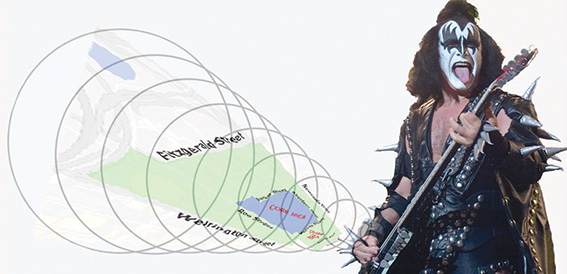
    The McGowan government is looking to tighten up laws in entertainment precincts to prevent people who move in from lodging noise complaints against pre-existing pubs and clubs, but how to deal with a growly Gene Simmons riff has caused a split between Perth council’s planners and the state’s noise regulator.

    The problem is that the deeper you go, the more a sound can blast its way through soundproofing.

    The Department of Water and Environment Regulation found soundproofing is “impractical and cost prohibitive” if bass emissions exceed 79dB (imagine a really deep vacuum cleaner).

    The department says a 79dB level would see developers paying an extra 8 per cent to construct apartments with enough soundproofing to keep internal noise at a sleepable 47dB (think Simon & Garfunkel quietly arguing off mic).  

    But Perth council’s planners reckon the limit’s too quiet and want a “core” area of Northbridge where all venues, new or old, would be allowed to emit 95dB. In the state government’s proposed “frame” area surrounding that core, the council says venues could stick to the mousey 79dB.

    If existing venues voluntarily stuck to those limits they’d be given blanket protection from noise complaints.

    They looked at three bass limit scenarios based on what existing businesses were pumping out, and reckoned the lowest they could go while balancing competing needs was 85dB – still above the department’s recommendation.

    The state’s “agent of change” rules could face other challenges as well, with venues over east that supposedly have the same protections being tangled up in long and expensive lawsuits with clever developers.

    Music Victoria looked into four cases and found the established venues ended up paying between $10,000 and $200,000 dealing with the lawsuits.

    Natural attrition also undermines the intent of the rules; rather than venues coming and going, they can only go and go, according to a NSW review.

    When the issue came before Perth’s commissioners on October 22, they deferred the item, concerned the proposal could still harm existing businesses.

    Cmmr Len Kosova wanted to know why the core zone didn’t include the Perth Cultural Precinct and why some existing prominent venues had been shunted to the quieter frame area. 

    The Court Hotel and William Street’s Alabama Song bar are in the hushed frame area, while Ellington Jazz Club and Badlands are outside it altogether. 

    by DAVID BELL

  • Mystery ailment knocks off trees

    A LOCALLY-BRED bottlebrush known as the “Kings Park Special” is mysteriously dying off in Vincent.

    The Special is one of the Kings Park and Botanic Garden’s proudest plant achievements; internationally recognised as a “cultivar” distinct enough from its wild ancestors to deserve a special name of its own. 

    It was developed from a seedling of “unknown origin” according to the park authority; selected, propagated and registered back in 1980. It’s good for bees, birds and butterflies, and is known for tolerating dry conditions or frost, flourishing in full sun, and coping with poor soil. 

    But Vincent council’s latest report on tree removals showed six of the seven dead trees were Kings Park Specials, while a closely-related callistemon viminalis was deemed too sick to revive. 

    • The Kings Park Special has been an international success story. This one (photo by wiki commons user Melburnian) is flourishing in Maranoa Gardens in Victoria.

    Vincent mayor Emma Cole confirmed the parks team had noticed the bottlebrushes dying but the cause remained a mystery.

    “We have had a qualified arboricultural assessment undertaken, however they cannot identify anything specific that is affecting them,” Ms Cole said.

    “As the Kings Park Special is a cultivar, some of these varieties can be quite sensitive to environmental changes, such as a drop in the groundwater table.”

    The council’s been trying to increase Vincent’s greenery under its Greening Plan, but the KPSs aren’t getting a second chance in these spots; they’ll mostly be replaced by weeping bottlebrushes and WA peppermints.

    by DAVID BELL

  • Yolk: Demolition ban ‘inconsistent’

    YOLK Property Group will appeal a ban on demolishing two buildings on King William Street.

    The developer applied to demolish 9 and 11 King William Street after plans for a previous apartment block and partial demolition expired earlier this year, but on November 5 Bayswater councillors dashed  its hopes for a clean slate.

    Yolk director Pete Adams says the council is being inconsistent.

    “Demolition approval was granted back in 2015 as part of our due diligence prior to purchasing the properties,” Mr Adams said.

    “Nothing has changed since this date, so it is difficult to understand the inconsistency of decisions at both officer and council level at the City of Bayswater.”

    Mr Adams was angry at Bayswater’s proposal to increase the buildings’ heritage protection “with zero justification”, saying an independent assessment by leading heritage architects Griffiths recommended they be demolished.

    Peculiar assemblage

    Griffiths said houses like number 9 were well represented in Bayswater: “The loss of one of the type is not a matter for concern”. Number 11 was a “peculiar assemblage of parts” with little aesthetic value.

    The council’s own heritage assessment was more glowing.

    Councillors feared the demolition would create two vacant lots in the middle of town, but Mr Adams said Yolk wouldn’t leave the sites barren. 

    “For the past three years we have given several pop up shops, including Howdy Coffee and community uses, free rent in the buildings. 

    “We would have liked to continue this and create a short-term temporary pop up space using containers and landscaping on the site.

    “We informed the council of our plans and we have honoured gifting our properties to the community to date, so I am disappointed the council questioned our intentions in this regard.”

    by DAVID BELL

  • Stroke of genius a purrfect solution?

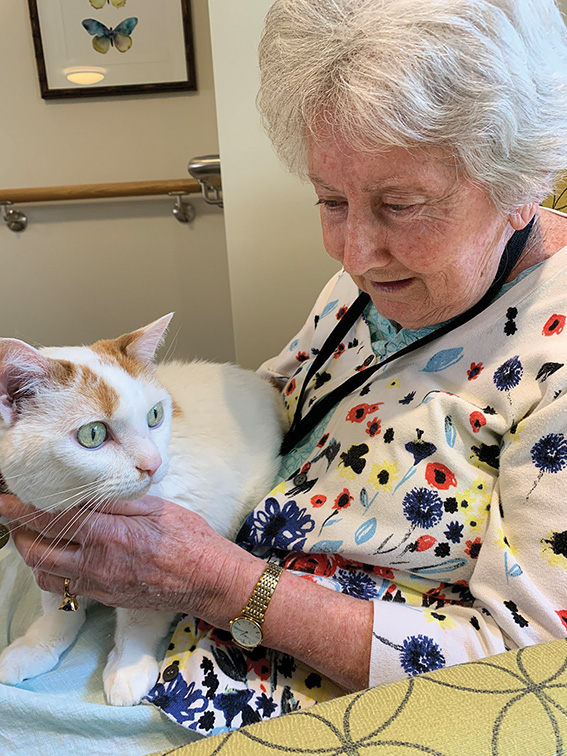
    AMONGST the harrowing evidence that led the Aged Care Royal Commission to name its interim report Neglect, an Adelaide researcher had some simple advice which has been adopted by Leederville’s Rosewood aged care facility.

    Get more pets, health sciences lecturer Janette Young told commissioners, saying there were many benefits of having some purring companions around old folks’ homes.

    Dr Young has spent years combing literature and interviewing senior citizens about pet ownership and says not only do they make people more active, healthier and happier, they can literally be lifesavers: “Another man who talked about having serious depression, just kept saying ‘if it wasn’t for the dog, I would have done something’.”

    • Joy de Berg Morrison and Maya the cat at Rosewood. Photo
    supplied

    Positive

    Rosewood adopted 10-year-old brindle Jeanie in early October and 14-year-old Maya this week, and executive manager Philippa Hinton says she’s astounded by the positive impact they’ve already had.

    “The feedback has been unbelievable. It’s lovely to see the enjoyment the cats have already brought. When Jeanie and Maya walk into the room, you see the faces of our residents light up,” Ms Hinton said.

    “Research has shown that pets offer significant benefits by encouraging socialisation, particularly for residents living with dementia, as well as offering a sensory experience with residents able to touch, pat and play with the animals.”

    The new pets came from Cat Haven’s companion cats program and CEO Roz Robinson says it was great to find two old moggies a new home.

    “This program has been running for a number of years years with over a dozen nursing homes and their residents enjoying the wonderful companionship of loving and laid back cats in their twilight years,” Ms Robinson said.

    “We understand that the cats have helped some of the older residents to communicate again, and help calm them.”

    by ATSU TSURU

  • Go Dutch for safer cycling

    A CYCLIST injured after crashing into a car door that suddenly opened in front of her last week says a solution could be WA joining the “Dutch Reach” revolution.

    Louise Curtin was pedalling her way to work around 8am on Wednesday when a passenger jumped out of a car that had stopped at a red light.

    “What I recall next was being on the footpath, my bike somewhere else, their car window smashed and passerbys around me asking if I am okay and whether I need an ambulance,” Ms Curtin said.

    She sustained soft tissue damage to her neck, whiplash and cuts and bruises

    “To say I was shaken up is an understatement; I haven’t been up on a bike since the accident.”

    Car dooring, as it’s known, is covered in WA’s Road Traffic Code but Ms Curtin says awareness seems to be the bigger issue.

    “I think motorists who have never cycled or who don’t have a family member or friend who cycles are very unaware of cyclists on the roads.”

    Like 95 per cent of Australians, Ms Curtin was unaware of the Dutch Reach, but when she heard about its adoption in other countries and success in preventing accidents like hers, she was all for it.

    “It’s definitely something that can easily be used, even promotion on social [media] would hit a lot of people.”

    The method was developed in the Netherlands in the 1970s, but got international recognition and a catchy title following the death of American Amanda Phillips in a dooring incident in 2016.

    It involves motorists using their far hand to reach across their body when opening their car door.

    That forces them to turn their head and look for cyclists.

    Ontario’s provincial government is planning to legislate the Dutch Reach into its road rules, while across America it’s being introduced into driving schools. Uber’s even on the bandwagon, sending passengers an animation and reminder while they’re en route.

    Victoria and South Australia reference the technique in their traffic safety guides.

    by INDIANA LYSAGHT

  • Bayswater picks up award for budget panel

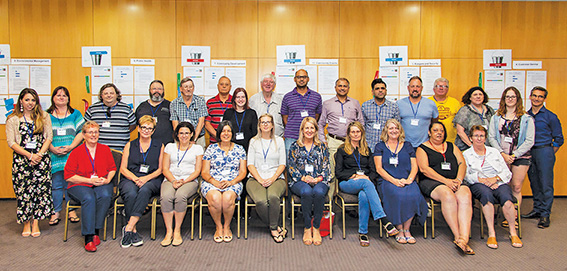
    BAYSWATER council has won a local government award for being the first metro council to give locals a say on how its entire operating budget was spent.

    Mayor Dan Bull said he was especially proud the city had snagged a local government honour award in the “connecting communities” category.

    “I am incredibly impressed with the passion and commitment of the community panel,” he says.

    • Bayswater council’s participatory budgeting panel – made up of conscientious locals – helped decide how the city’s budget was spent.

    “It was a big job for them, and one that carried significant responsibility – the community panel spent three days deliberating over the city’s operating budget.

    “The city was then able to align the 2019/20 budget with many of the panel’s recommendations, and adopt a budget that reflected the services valued by the community.

    “This level of community engagement is bold and the city is the first metropolitan council to challenge the status quo.

    “It’s projects like these that help us build stronger communities.”

  • Complaints prompt new review of signage laws

    ELECTION signs that linger after the polls shut, have been placed dangerously or are nailed to innocent trees are in Vincent council’s sights.

    The council is to take a look at its current signage laws and how staff handle rule-breakers, after councillor Joanne Fotakis said there had been a surge of complaints about signs being slathered across the city during October’s election.

    There are more than 20 council rules governing election signs, which must be freestanding, at least 30m from an intersection, and must be taken down within 24 hours of the poll closing.

    Cr Fotakis (who was not up for election this year) said at the November 12 meeting that she’d heard “a lot of concerns expressed about signs being adhered to existing signposts, many of them traffic or wayfinding signposts, and concerns about the potential safety risk especially with distracted drivers”.

    She said people were “certainly upset about signs being adhered to trees, and about the lack of respect that some community members felt that showed.”

    Some signs are still hanging around more than three weeks after polling day.

    “It’s not my intention to propose a prohibition on election signage … there’s been enough high court and supreme court decisions pointing to the implied freedom of communication that exists under the constitution in relation to political and government matters,” Cr Fotakis said.

    But she reckons it’s a good time to review where signs are allowed to be placed in the public realm.

    Council staff are in the midst of writing a new version of Vincent’s Local Government Property Local Law, a broad tome which covers everything from shooting a bow and arrow in a public park to the $100 fine you can get for going into a pool “whilst unclean or suffering from a contagious disease”.

    The existing wording on election signs is as flimsy as corflute, and under a strict interpretation election signs are exempt from most of the fines that would leave a commercial spruiker’s wallet $100 lighter. 

    After October’s election, Vincent rangers collected improperly placed signs and gave them back to candidates.

    The whole local law is currently being rewritten from scratch, but a now-scrapped draft from earlier this year proposed a $250 fine for election sign breaches to keep candidates in line. 

    The new draft will be ready for councillors to peruse by June 2020.

    by DAVID BELL

  • Making martyrs?

    PRIME MINISTER Scott Morrison’s threats to clamp down on environmental activism won’t curtail the antics of climate campaigners say members of Perth’s newly-formed Red Rebel Brigade, warning it may push some towards “martyrdom”.

    The brigade is a theatrical offshoot of Extinction Rebellion and has been appearing around the Perth metro area since October.

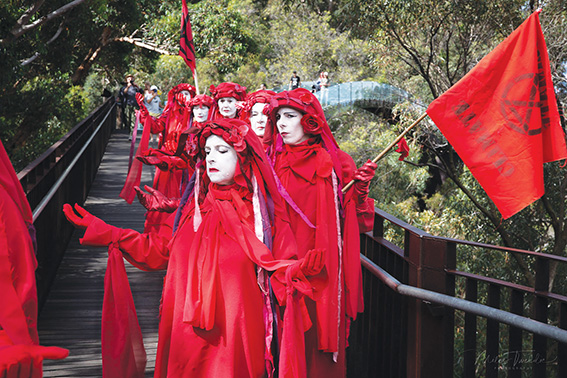
    Influenced by Brazil’s Theatre of the Oppressed, Japan’s Butoh Theatre and the humanitarian protests of The Invisible Theatre of Iran, the troupe is completely silent, with members wearing red robes and painting their faces white.

    They’re not as keen to get arrested as their ER brethren, says Sally (who didn’t provide a last name), preferring to tell police they attend protests such as last month’s Flood the City in order to quell “difficult emotions” on both sides.

    • Red Rebel Brigade walked through Perth’s King’s Park Botanic Gardens last Sunday November 10. Photo by Miles Tweedie

    But they use dramatic gestures to echo their frustration at Australia’s glacial response to reducing carbon emissions and share XR’s aims of change and regenerative culture.

    Sally, whose background is in theatre, clowning and higher education, says the prime minister’s threats to outlaw secondary protests and shareholder action is worrying.

    “It’s an example of an authoritarian crackdown,” she says.

    “If protesters are demonised some may be pushed to martyrdom.

    “Political protest is a form of political communication essential to the maintenance of democracy – this has been ruled by the High Court.

    Fellow performer Tara saw the effects of violent confrontation play out for years in her home country, Bosnia, and wanted a different path in tackling climate change.

    “Red Rebels have a confronting presence,” she said.

    “They bring stillness and space where one can rethink things and contemplate them on a deeper level.

    by TATIANA DALIN

  • Handy win for Goerke

    DAMIEN GOERKE has won the acquisitive award at this year’s City of Stirling Art Awards for his cathartic work Primary.

    Goerke took home $5000 in prize money and the piece has been added to the city’s art collection.

    The artist said the burst of colour in the drawing/mixed media artwork reflected his new lease of life.

    “For half my life I have been on medication for a heart condition which has finally been rectified,” he said.

    • Damien Goerke with his winning artwork Primary (above) and Julie Silvester with Morning Begins (below). Photos supplied

    “My imagination, once held at bay due to my medication, is now desperate to come out. 

    “After nearly always drawing exclusively in greyscale, I am now using primary colours.”

    Other winners included Rachael Woodward, who snagged the Jackson’s Drawing Supplies Young Artist Award with her innovative digital work There Once Was… 

    Kate Rae and Kerry O’Flaherty collaborated on In The Round to take out the sculpture category, and Norm Wilson’s South Terrace Neighbours 2 was top painting.

    The local artist award went to Innaloo’s Julie Silvester for her captivating pastel piece Morning Begins. 

    Stirling deputy mayor Bianca Sandri presented the awards and said the entries were of a very high standard.