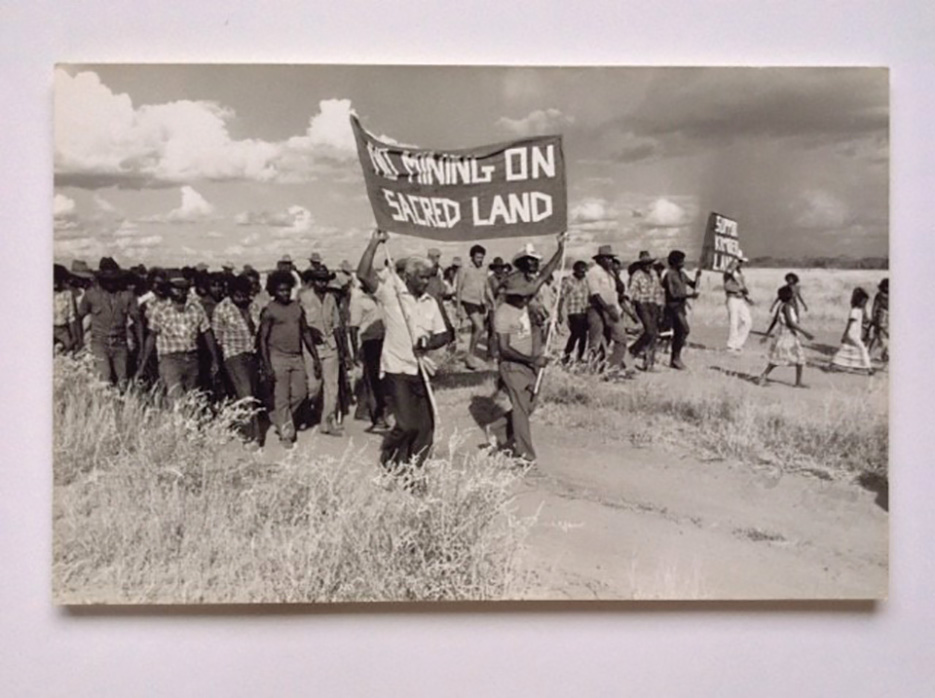
A FILM detailing the fight by Aboriginal communities to stop mining on their country will get a free screening in Perth tomorrow (Sunday, February 24).
The 1980 documentary On Sacred Ground documents the Noonkanbah land rights movement, when the Yungngora people protested the drilling for oil on sacred sites.
Noonkanbah is a station in the far north of WA, and it already had a politically-charged history.
In 1971 Aboriginal workers walked off the site after becoming fed up with their pay and conditions.
The federal government bought up the land and returned it to traditional owners in 1976.
Shortly afterward the area caught the interest of mining company Amax who wanted to drill for oil.
The traditional owners opposed mining on their spiritually significant land and protested, and the Charles Court government assigned hundreds of police as corporate bodyguards to escort the mining rigs.
Yungngora man Ribnga Green Snr narrated and presented the film, and he’ll be giving an introductory talk at the Perth screening at the Perth Cultural Centre big screen.
Just a shed PERTH federal MP Patrick Gorman having a wet-pants moment over the redevelopment of the old Bunnings site (“MP calls out Woolies”, Voice, January 16, 2019). Mate, the proposal is basically replacing a tin shed – get over it.
Then there is Perth state MP John Carey harassing Coles over their little toys (“MP rubbishes toys”, Voice, January 16, 2019).
They may well prove to be collectables – have a peak at the Antiques Roadshow for proof.
As for the environment, he should walk up Guildford Road from Eighth Avenue to Lyric Lane and see the amount of pigeon dung which is collecting (pun intended).
And while on the subject of the local environment, the growing number of feral and domestic cats accompanied by foxes continuing to wreak havoc around the Maylands peninsular wetlands and golf course should be of more concern to local politicians, as the local council sure don’t give a fig. Ernie Painter Maylands
What about our artists? STIRLING council’s percent for art scheme 1989 was introduced into WA to help created a sustainable industry for WA artists; not architects.
Woolworths is a multinationally-owned company, not WA- or Australian-owned.
There is no exceptions on the scheme rules for a “wonderful architectural design”, or company taking the profits out of the country.
Architects continually claim the percent for art scheme funding for themselves, leaving the artists in the community totally unable to access the growth development industry, likes with Elizabeth Quay, Fiona Stanley Hospital and Optus Stadium footbridge.
Regardless of the architectural plans (which were probably done overseas), the percent for art scheme is enforceable and should be followed as it allows community and local ownership of the development.
There is a reason why WA is so unsustainable for artists: the GDP for the visual arts in 2016-17 was $63.5 billion.
Only 6 per cent of all registered artists make a living and their average income is $16,000.
Based on this, Woolworths can afford to put one per cent back into the arts community of Stirling. Di Taylor, DiVerse Studio Angove Street, Perth
A bit more imagination than that LAST week’s Voice Mail did not give a true picture of the way the City of Vincent values community consultation (“Streets away from satisfactory,” February 16). Our Imagine Vincent community consultation in 2017 really changed the way we engage with our community.
A three-month deep dive into all areas of our community led us to develop our strategic community plan with community values and priorities at its heart.
This now informs everything that we do. In fact, this consultation won the 2018 community development award from IAP2 Australasia, the peak public participation body.
We advertise our consultations in our council news advert, on our website and through our imagine Vincent consultation portal at imagine.vincent.wa.gov.au.
Please visit this page–it will give you a taste of the breadth of initiatives that we are currently seeking community feedback on.
In relation to a purported “lack of consultation” on specific projects:
• Oxford Street North upgrade – we door-knocked and made personal contact with all businesses on the street, and we planned the project with local town team Mt Hawthorn Hub.
• Loftus Street bike lane – the lane is being realigned, based on feedback from a community member and arborist. No trees will be lost or impacted.
• Robertson Park – the consultation was run by the department of local government, sport and cultural industries, with Vincent hosting their consultation page. Residents within 400 metres of the park were invited to give feedback, two public forums were held and an online survey was open for two months.
• Name the Laneways Project – residents and businesses within a 250m radius of each laneway were consulted and we advertised widely on radio, in local newspapers and on our website. Emma Cole Vincent mayor
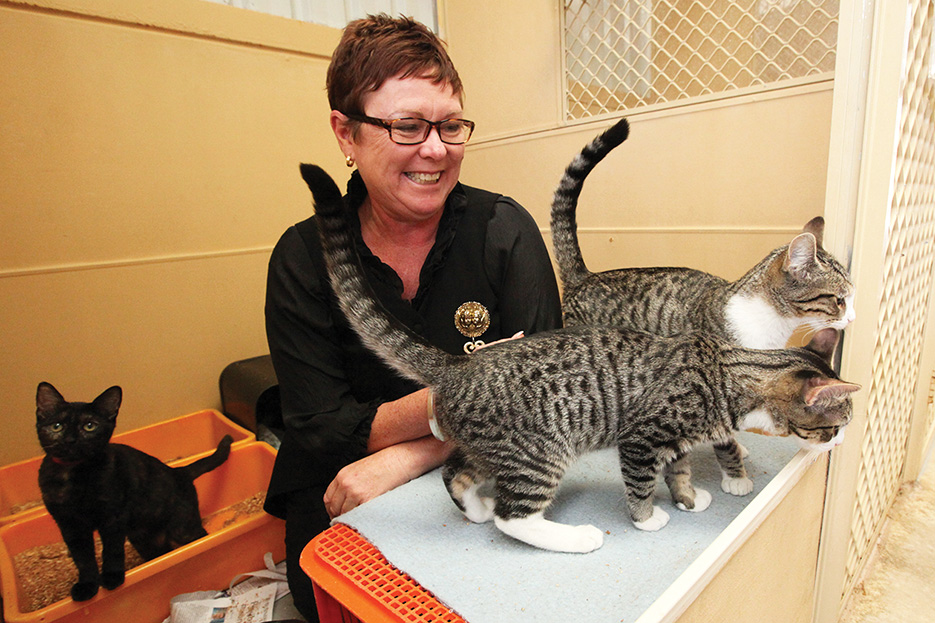
• There’s no doubt about Lisa Baker’s love for furry creatures, but her attempt to raise a parliamentary debate about meat consumption has led to some pretty oulandish (and we think at times fairly defamatory) claims on social media.
DOROTHY HENDERSON is a regionally based journalist with 30 years’ experience reporting on rural issues. In this week’s SPEAKER’S CORNER, she calls for calm and consideration following the huge backlash against Maylands MP Lisa Baker’s call to reduce meat consumption.
SO this has happened.
A politician raises the issue of livestock production in parliament, a place where our elected politicians discuss issues and debate thinking that will eventually inform and frame the policies and legislation that we live with.
In doing so she quoted some research published by others.
That is the politician’s job.
All around the world, there is discussion about the future of food production in the face of climate change, deforestation, degradation of our landscapes and in the light of human health issues, those known to be a consequence of the transitional diet (basically where we all adopt Western diets that are too high in fats and sugars etc), which include a skyrocketing diabetes rate in China, increasing obesity in Australia and starvation and a lack of protein in other countries in the world.
In the US, it has been suggested by some researchers that the average person eats five times more meat than they need to to be healthy, for example.
A quick glance at Google Scholar indicates that there are at least 79,000 scientific articles that show in response to the phrase “transition diets and meat consumption”– 223,000 when you plug in the words “impact of meat consumption on food security” and 638,000 when you consider “the impact of livestock production on climate change”: if nothing else, this indicates that a lot of people are putting a lot of time and effort into studying these subjects.
Globally, our meat consumption is increasing. That may be good, and it may be bad … it depends on how we produce the meat and distribute it – but that is a subject for another discussion on another day.
What I find distressing about this is that, as a journalist who has been reporting on rural issues for over 30 years and who has spent most of my life living on farms, I see an alarming trend here that is not going to do any of us any good in the long run.
As soon as we interpret anyone as being critical of what we do, we lower ourselves to the usual Facebook standard of behaviour.
Before you react to the comments reportedly made by this politician (and having worked for a few, I know how hard most of them work and how much they care), actually take the trouble to read what she said in parliament.
Farming
Do some work, find the link to Hansard, read her speech.
Then fly off the handle and abuse her if you like, or, take the time to digest the research she has quoted, and think about your own farming futures.
We cannot ignore the issue of climate change.
We have changed the landscape in the quest to feed the world, and in order to sell our products, we have inadvertently become part of a system that has changed people’s diets.
For the better in some places, and to the detriment of other people where food production systems have been destroyed by conflict, climate change and other events beyond their control.
Please, take the time to think about what you say, read and do your research and hope that smart, forward thinking and passionate people like Lisa Baker simply don’t bother to read the things you post on Facebook in the heat of the moment.
P.S. And just so you know, Ms Baker did not “demand” anything. Her closing words simply suggested the issue be discussed, as it is being in parliaments all around the world.
And why have I bothered writing this? Because, as Katharine Murphy points out, the truth matters, “journalists need to turn up to work.”
Tucked between a tiny hardware store and a chemist on Beaufort Street, it’s easy to miss, but well worth seeking out.
The eatery’s website claims it’s dedicated to providing a superlative Japanese dining experience and there’s no argument from yours truly.
There’s a variety of sashimi and a mind-boggling assortment of sushi, along with tempura and teppanyaki, all served with the beautiful minimalism that is synonymous with Japan.
A Japanese couple seated beside us were tackling an artistically-presented prawn katsu ($13.90 entree), in-between slurps of miso soup.
The katsu looked so good I ordered the scallop version ($14.90).
Expecting a modest serve, I also ordered a fish teppanyaki ($18.90).
In hindsight this was a mistake, as I got a huge serve of scallops in crispy breadcrumbs.
They were melt in the mouth –so tender I could slice them with a chopstick – and so large I struggled to fit one in my mouth.
The accompanying rich plum sauce had a pleasant sharpness and a mild smoky flavour.
Meanwhile the fish teppanyaki was sitting enticingly on the table; the fillets a picture-perfect golden-brown and dotted with slices of fried garlic and onion.
The tropical salsa on the salad was fresh and sweet and a great foil for the firm fillets, which were simply fantastic, especially when dipped in a particularly good soy sauce.
Sips of green tea ($2) fused the various flavours on my tongue, and was a great finish to a very enjoyable lunch.
The service is fast and efficient, and the decor traditional with minimalist furnishings.
By JENNY D’ANGER
Hanami Japanese Restaurant licenced Mon-Fri 11.30am-2.30pm, Mon-Sun 5.30pm-10pm
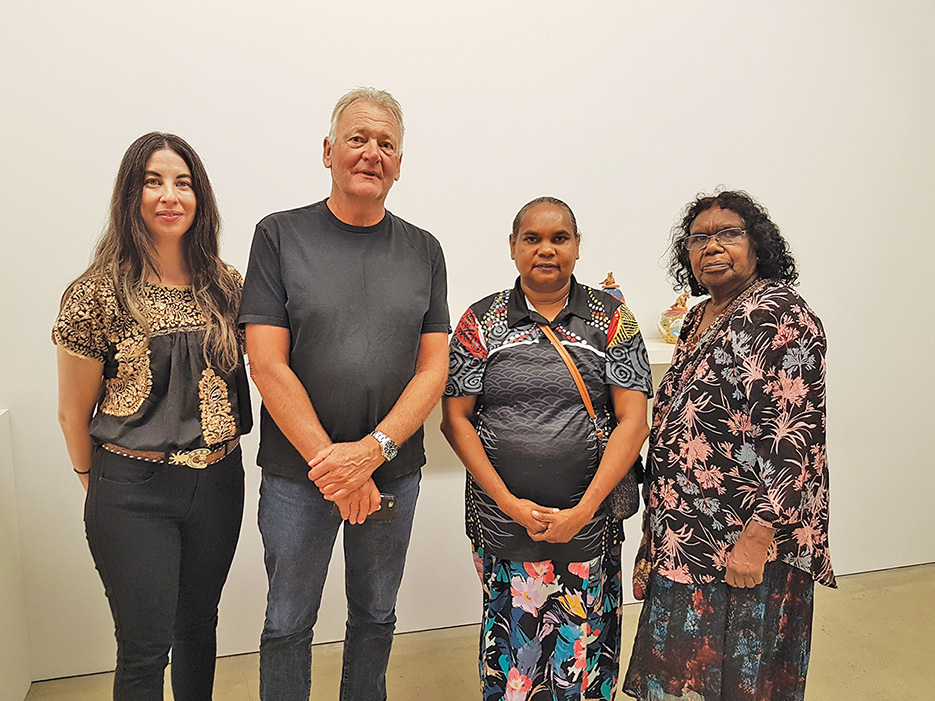
• Artists Elizabeth Marruffo, Harry Hummerston, Beth and Judith Inkamala. Photos supplied.
TURNER GALLERIES have kicked off the year with three eclecticexhibitions that include everything from Mexican religion to jarring thoughts.
If artists were good with words they’d be authors says Perth sculptor Harry Hummerston, demonstrating the point when I phoned him last week.
“Trying to explain the work becomes a struggle to replace images with text and is usually done clumsily,” the North Fremantle artist says.
Thankfully he was better on email, giving an overview of his exhibition Don’t Blink Twice, where he experiments with materials like epoxy resin to explore the relationship between unrelated images.
“Forcing an unusual relationship between them in the hope that this coincidence will spark some sort of emotive response in the viewer,” Hummerston says.
“The title refers to those moments fleetingly glimpsed; that niggling something that slid briefly behind the inside of your eyes and disappeared somewhere down the back of your brain.”
Pmara Nuka, Our Country features hand-coiled terracotta pots made by the Arrernte people of Central Australia.
The pots are on display across the nation and reflect the Arrernte people’s deep connection to the land.
Last but not least, Elizabeth Marruffo draws on her Mexican/English heritage in Worthless Remains.
Her works are inspired by her childhood in a small border town in Mexico, where tiny toys were made from pipe cleaners, tin cans and wire, and religious votive paintings were fashioned from repurposed tin.
Mexico’s streets and going to church with her English grandmother infuse her small, detailed paintings, which have sculptural frames and delicate textiles.
The three exhibitions are on at Turner Galleries in Northbridge until March 9.
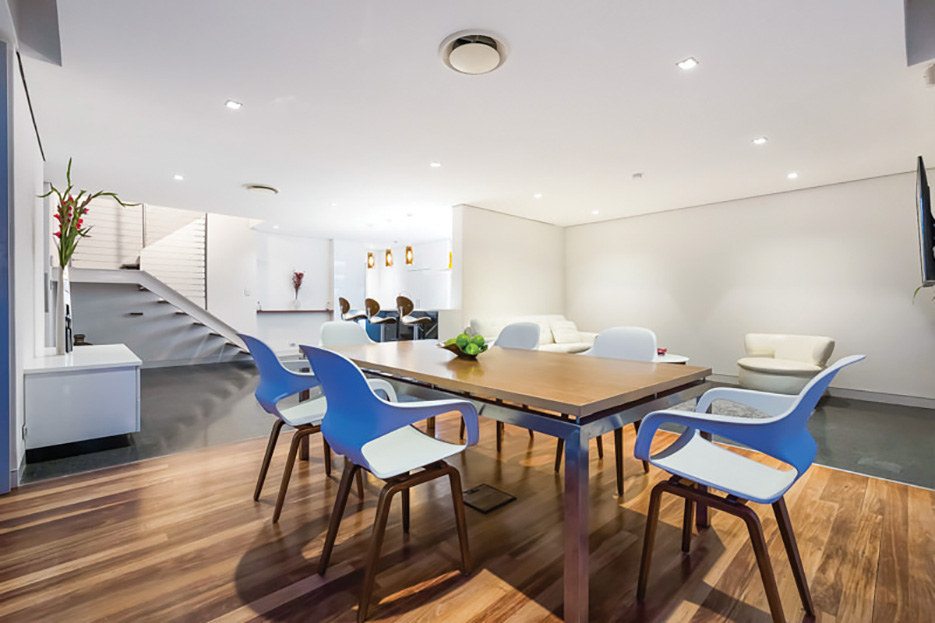
THE sleek modernity of this North Perth home defies its 16 years and it could have been built yesterday.
The builders scratched their heads when plans called for concrete floors.
“It was 2003 and they hadn’t done polished concrete before,” the owner says.
The result is an exquisite black-and-grey flecked floor, contrasting with crisp white walls in the downstairs kitchen and lounge.
Solid white acrylic tops the sweep of benches and the classy island in the kitchen.
The island’s stylish black kick-plate ensures no marks from exuberant guests or unruly kids sitting at the breakfast bar.
The oven, flanked by two massive pull-pit pantries, is set into an alcove with elegant, floor-to-ceiling sliding doors.
Along with a heap of drawers and cupboards there’s a wine rack and a space for a wine fridge.
“There’s lots of storage everywhere,” the owner says.
Banks of glass stacker doors in the dining/lounge area peel back to reveal an entire corner of the home, which has access to a courtyard garden.
Reflections from a stream-lined pond, stretching the width of the property, dance across the dining area, adding to the serenity of the manicured garden, which has raised beds and high fences.
When the mercury rises there’s a two-metre plunge pool nearby, and if you’re feeling energetic there are swim jets that can be used to do a work out like a deranged hamster, says the owner.
Or just chill with a vino on the drinks ledge and let the day’s stresses melt away.
The bedrooms and two bathrooms are on the second level, including the spacious main with its street-facing balcony, walk-in-robe and en suite with double vanities.
This striking Norfolk Street home is within walking distance of Perth and Hyde Park, and is “very close to the airport”, according to the owner, who clearly likes to travel.
By JENNY D’ANGER
67 Norfolk Street, North Perth expressions of interest Donna Buckovska 0419 928 467 Bellcourt Property Group
PERTH federal MP Patrick Gorman has stepped into a local planning issue, imploring Woolworths to cough up for an artwork at its proposed Beaufort Street store.
The supermarket giant is planning a shop on the site where Bunnings burned down last year, but has told Stirling council it doesn’t want to put in an obligatory artwork because its architect has designed something so art deco the building qualifies in its own right.
Mr Gorman wrote to Woolies saying he was “disappointed” by the company’s stance.
“Woolworth’s proposed project sits along the historic Beaufort Street, well known for the heritage buildings which run along either side of the road,” Mr Gorman wrote.
Stylistic
“It is important for all new construction projects to meet the stylistic standard of the area, ensuring a continuity of design along this stretch of road.
“It is my belief that all individuals, including companies, should contribute to the building and the beautification of a community.
“Woolworths’ proposal to build a new store at this site is a welcome move for the suburb of Inglewood and surrounding areas.”
Stirling council’s draft local planning scheme requires developers to set aside at least one per cent of construction costs for public art if their development is worth more than $2 million.
That policy won’t take effect until it is rubber stamped by council later this year, so Woolies can avoid an art bill if they submit their development application now.
But if the project gets delayed, then the policy could come into effect.
In their application to Stirling, Woolies’ planner Rowe Group wrote that because the proposed building looked nice, “we are of the view that it would be inappropriate for the city to impose a condition requiring the provision of public art on-site or…in the locality”.
Mr Gorman says art can “add a lot to the feeling and vibrancy of a street.
“Further down Beaufort Street in Mount Lawley is the prominent Beaufort Street sign, which creates a strong sense of community along the strip.
New customers
“This in turn helps local businesses attract new customers.
“That’s what an outstanding piece of public art outside Woolworths in Inglewood could do for surrounding businesses and bring local residents together.”
We asked Woolworths if they were considering adding some art.
Their regional development manager Jarrad Wilson says “we are currently working through feedback received from the community and council in relation to our plans for Inglewood and we look forward to providing more updates as we move through the planning process”.
AFTER seven months of radio silence the state’s planning and heritage department now expects to release a report on the future of the heritage-listed Maylands Brickworks before July.
A year ago this month the department released four proposals for a $7.7 million redevelopment of the 1927 brickworks, three involving apartment complexes to fund the makeover.
Financial
The department then announced it was undertaking a more detailed report, including looking at its financial feasibility, but seven months later had no timeline for its release, frustrating locals and Bayswater council.
The department said Bayswater could expect a copy “in the first half of the year”.
“The report responds to community feedback and will address heritage building repair and maintenance requirements, options for adaptive reuse, financial analysis of reuse options and relevant case studies,” the department responded to Voice questions.
The 1927 brickworks, which have been closed for 30-odd years, are owned by Bayswater council and are heritage listed.
They contain the only remaining Hoffman Kiln in WA (there was another, but it was damaged during the 1968 Meckering earthquake and dismantled).
Friends of Maylands Brickworks don’t want any part sold off and aren’t keen on building flats to fund the redevelopment.
The group submitted a petition to council last year saying they’d prefer a community space, museum, historical interpretation centre or art centre “to preserve its historical authenticity and integrity”.
During public consultation 88 per cent of respondents said they supported the repair and reactivation of the Maylands Brickworks as a heritage place and local amenity
Six per cent said they opposed it.
THE Hoffman kiln is significant as the last of its type in WA, and one of only a handful anywhere in the world.
The kiln’s technology was patented by German inventor Friedrich Edouard Hoffman in 1858, and was a breakthrough in brick making because the fire could burn continuously. Older style kilns required the fire to be put out and restarted between loads.
Few kilns have been preserved, though ironically contamination in Box Hill, Victoria has seen the local brickworks spared redevelopment.
What the Friends of the Brickworks don’t want is to see their kiln go the way of others in Victoria and South Australia. Brunswick’s two surviving kilns were gutted to become flats while in South Australia, a smoke stack preserved at a cost of $1.5 million stands lonely amid a shopping centre.
• An infant turtle from the movie Rubber Jellyfish, a documentary about the devastating impact balloons have on sea animals.
TURTLE-murdering helium balloons are in the crosshairs of Stirling council, with mayor Mark Irwin calling on the state government to ban balloon releases.
In a letter to WA environment minister Stephen Dawson, he says that under the 1979 Litter Act it’s not littering if you release a balloon into the air, only if it can be proven it fell back to earth.
Stirling council officers discovered that’d be near impossible to enforce when they were looking at their own ban last year, as balloons can travel hundreds of kilometres.
“…for a prosecution to be successful, the city would require infringement officers to witness the actual release of helium balloons and prove that they were intentional releases without negligence.”
Instead the city has embarked on an educational campaign, pointing out the dangers to wildlife and asking people not to release balloons at Stirling reserves or facilities.
In his letter to Mr Dawson, Cr Irwin wrote that balloons can land in seawater, and when they break down they “often resemble jellyfish or squid”.
While it’s only a small proportion of aquatic litter, “turtles and birds will selectively ingest balloons, rubber and hard plastics” with fatal consequences.
While the industry sometimes describes balloons as “biodegradable”, they can take centuries to breakdown.
Mr Dawson’s response, tabled at this week’s council meeting, said “the state government shares your concern about the negative environmental impacts of plastic waste, including helium balloons”.
He said as part of premier Mark McGowan’s anti-plastic drive he was “considering the most effective ways of taking stronger action on a range of single-use plastic products, including actions to discourage the release of helium balloons,” and anyone wanting to be consulted could register via http://www.dwer.wa.gov.au/node/79
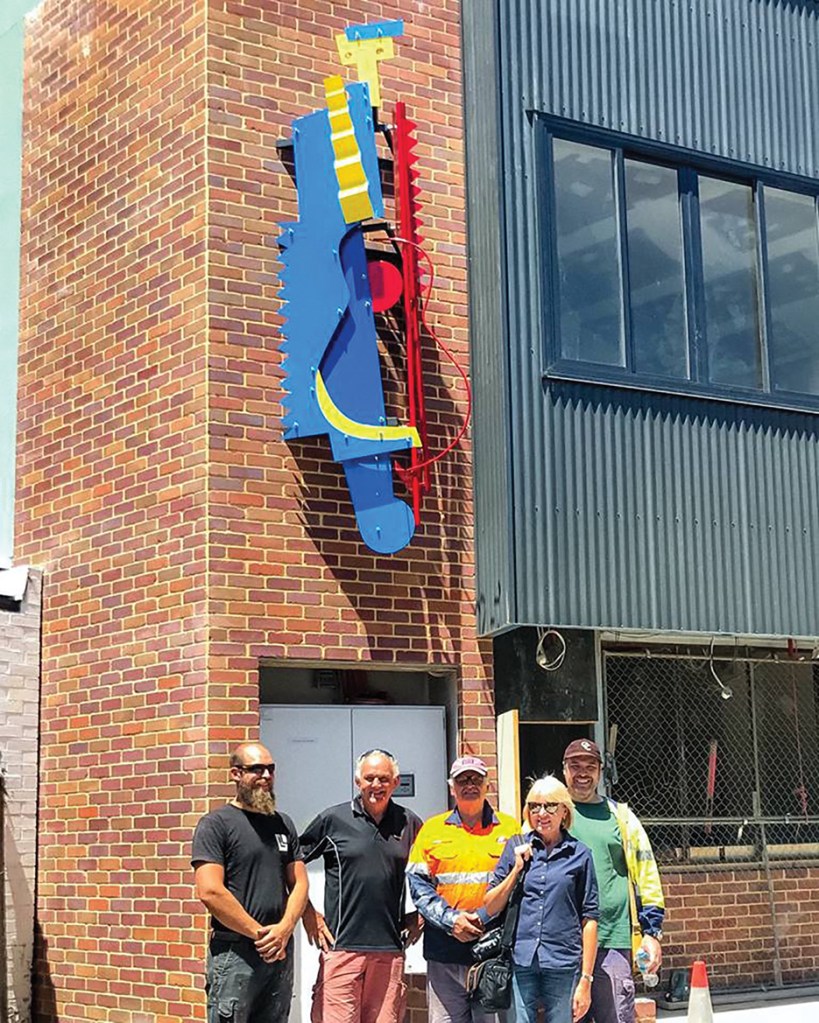
• Sculptor Tony Jones (second from left) with the Lyric Lane team after his new artwork was installed at the soon-to-open music venue in Maylands. Photo supplied
AFTER five years of development delays, Lyric Lane co-owner Michiel de Ruyter says he hopes toopen the venue late next month.
The de Ruyter family first floated the idea of an ambitious music bar/cafe on the site of the old Speelite bike shop on Guildford Road in May 2014.
At the time Mr de Ruyter was hoping to open in 2016, but after dealing with numerous planning travails and construction issues, he is finally edging closer to opening day.
“We are hoping to open late March but no fixed date yet,” he says cautiously.
A commissioned sculpture by renowned Fremantle artist Tony Jones is one of the finishing touches recently installed at the venue.
He says the work was loosely inspired by the Picasso painting Three Musicians, and includes the body of a guitar and other subtle nods to the musical world.
Mr Jones says he’s been collaborating with the De Ruyter family on the design since 2015.
“We produced about eight miniature models so they could see exactly what they would be getting,” he says.
“It’s powder coated and has a figurative element to it. I’m pretty happy with the final result.”
Famous sculptures by Mr Jones include Eliza on the Swan River (frequently dressed-up by locals) and CY O’Connor in North Coogee.