A PROPOSED ban on plastic bags needs to be tweaked if it’s to be effective, says Fremantle mayor Brad Pettitt.
The McGowan government has committed to banning lightweight single-use plastic bags, which are usually less than 35 micrometers thick, from July.
But Dr Pettitt wants people to pay for plastic bags and the ban to include bags up to 60 micrometers thick, otherwise he says lightweight bags will just be replaced with slightly thicker ones.
Robust
“We are very supportive of the statewide ban, but I think there’s a good opportunity for WA to learn from other states and what hasn’t worked as well as it should have,” Dr Pettitt says.
“We have asked to tweak the recommendation: WA can have the most robust ban in the county.
“Looking at some examples from the UK and others show that even a small price on plastic bags is a discouragement, just making sure there are none for free.”
Western Australians used approximately 360 million lightweight plastic bags in 2017, with an estimated five million ending up as litter.
The ban will also include biodegradable plastic bags because they do not readily break down in the environment or in domestic composting units – they require a commercial composting facility in order to fully decompose.
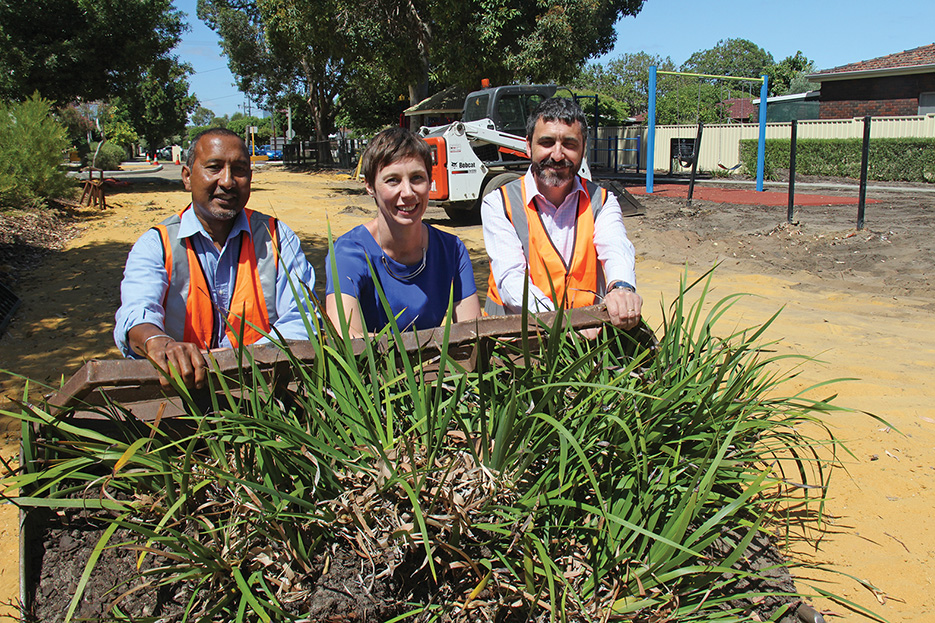
Vincent mayor Emma Cole dropped in with the council’s new engineering director Andrew Murphy (right) and parks co-ordinator Ian Ellies (left) this week to check the ongoing work to double the size of the neighbourhood park at the end of Hyde Street.
Beefing up the little reserve is a pilot project for the council’s new “Roads to Parks” initiative, which Ms Cole says is part of a “commitment to more parks and open space, and was an idea pitched to us by passionate locals living close by”.
The section of road being converted, at the Hyde Street/Forrest Street intersection, was pretty low use, only getting an average of 128 cars per day, which can easily be redistributed with a “negligible” effect on surrounding streets. Works will continue for a couple months and the revamped park is scheduled to open in April.
AFTER years of protests from locals and multiple applications, a contentious six-storey development in King William Street, Bayswater has been approved.
On February 15 the Development Assessment Panel gave the green light to Yolk Property Group’s “Heir” development, which has won both praise and criticism from various community groups (Future Bayswater for it, Bayswater Deserves Better against).
In 2016 a billboard advertising the apartments was vandalised by opponents who graffitied “POXY FLATS” on it.
Yolk initially got approval for a bigger seven-storey version of the development in February 2016, after winning an appeal, but with a sluggish property market, construction didn’t go ahead.
They came up with a new smaller version, but the majority of Bayswater councillors weren’t happy with it, and recommended the DAP knock it back.
Bayswater mayor Dan Bull attended the DAP meeting to speak against the development, arguing it was too tall and did little to preserve the heritage in the area.
The DAPs are made up of two councillors (Catherine Ehrhardt and Chris Cornish) and three state-appointed experts, Charles Johnson, Sheryl Chaffer and Michael Hardy
But the final vote saw it approved 4/1, with Cr Cornish the only vote against.
Tessa Hopkins from Bayswater Deserves Better wrote of the decision: “The state’s planning regime is broken and it is certainly not equipped to deliver high quality, harmonious and respectful development retrofitted into heritage precincts such as Bayswater town centre. That has always been our key concern and why we have fought so long in a battle we knew we were unlikely to win.\
“We take some heart from the fact that Yolk’s fourth and successful development application does, for the first time, include architectural details at the ground and first storey levels at number 9 King William Street which ‘give a nod to heritage’.
“Sadly, it isn’t enough to ensure this building will harmonise with the heritage precinct and streetscape in which it will sit. And – at six storeys – it sets a precedent for other similarly sized, architecturally bereft, developments to follow,” Ms Hopkins wrote.
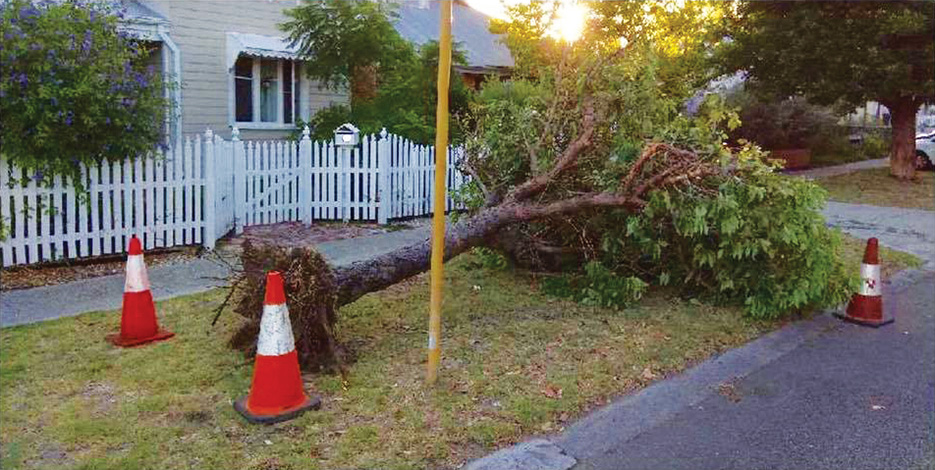
THE problematic rollout of the NBN continued in characteristically bumpy fashion this week, with contractors allegedly killing a mature tree at the corner of Central Ave and East Street in Bayswater.
Cr Catherine Ehrhardt has reported it to the city, calling it “absolutely disgraceful”.
She says a passerby was told by workers a “truck backed into it”, but she notes the tree doesn’t look like it has any impact marks, and doesn’t seem to be missing any bark, sparking her suspicions that it might’ve just been in the way.
While it’s just one tree, the council has been fighting tooth and nail to retain and increase its threadbare canopy cover in the past couple of years after it was rated one of the least leafy suburbs in WA in a 2015 study.
• Wow, good work NBNCo contractors. Photo by Catherine Ehrhardt
Complaint
We contacted the contractor, Downer Group, and asked what happened with the tree: they forwarded our query on to their press handler, and the internal email subject line was “FW: another NBN complaint to send on please”.
Rebecca Papillo, NBN Co spokesperson says: “We can confirm that unfortunately one of our contractors accidentally caused a tree to fall over while reversing their vehicle.
“We apologise for the damage caused and any inconvenience to neighbouring properties. In its place we will be planting two mature WA Red Flowering Gums.”
Previous NBN complaints we’ve heard have included flyers advising residents of upcoming construction weeks after it had actually started, workers showing up with power tools at 5.45am on a weekend, and furious residents finding out they’re getting a big green tombstone-looking node box installed outside their heritage houses without consultation.
Cr Ehrhardt says she was told by workers they had council approval to start working on her verge—but they didn’t.
“They shut up when I said ‘actually, I’m a councillor’.”
She says she later had workers trespass on her property to dig a trench on her side of the fence line.
She says they’re tearing up the suburbs to install a dud technology.
“I’d characterise the NBN full stop as an absolute joke and anyone with half a brain would’ve known it was an outdated technology and by the time it was rolled out it would be out of date.”
Even with an NBN node right outside her house, she has no plans to connect to the NBN—”I’m going wireless.”
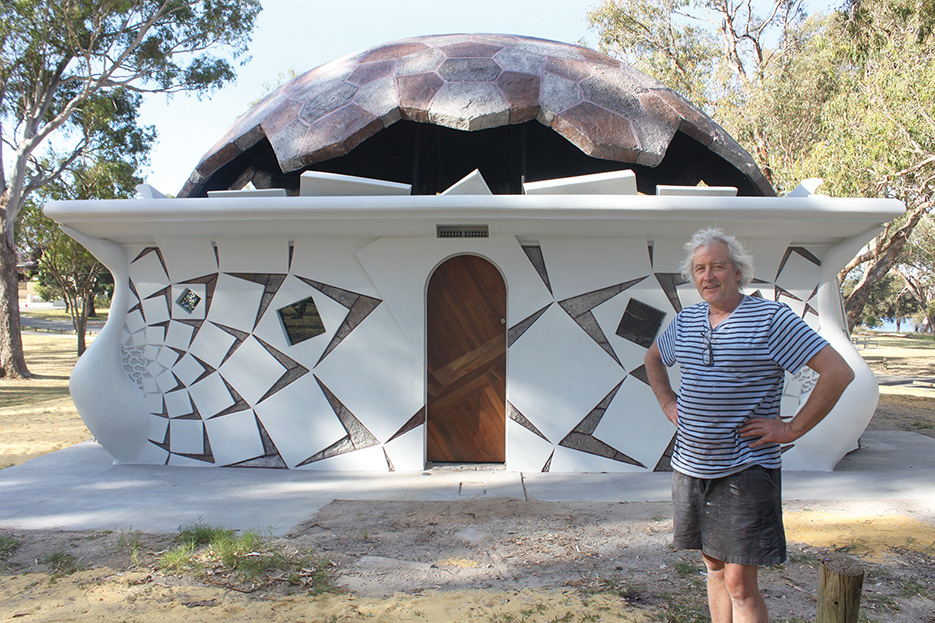
HANGING around a toilet block too long can get you in trouble, but it’s hard not to linger outside the most artistic loos in the country.
Duncan Moon’s masterpiece The Nearest of the Faraway Places at Claughton Reserve is ready for its official opening and tour, and the artist will be down there to talk about the intricate design concept.
• Duncan Moon’s dunny masterpiece.
Bayswater council funded the project after wanting to do something a bit different when it came to sprucing up the tired old brick block and budgeted $64,000 for the artistic upgrade.
The opening’s today (Saturday, February 24) at 4pm, and the Friends of Claughton Reserve will be sizzling a snag or two. Flick them an RSVP email at friendsofclaughtonreserve@gmail.com
PERTH’S unusually mild summer made Hyde Park the perfect place for our photographer, Steve Grant to stop for lunch this week.
In fact, it’s so mild that one pair of coots seems to have got their seasons mixed up and are already swimming around with a brood of five tiny ducklings.
A lazy visit from a couple of oblong turtles was a little reassuring following studies which showed something might be preying on their little ones, as there’s no little ‘uns swimming around, while the thick algae gave us pause to wonder whether the restoration works done by the City of Vincent will be enough to cope with all the nutrient run-off from the neighbouring suburbs and the decaying leaf litter from the beautiful flame and plane trees.
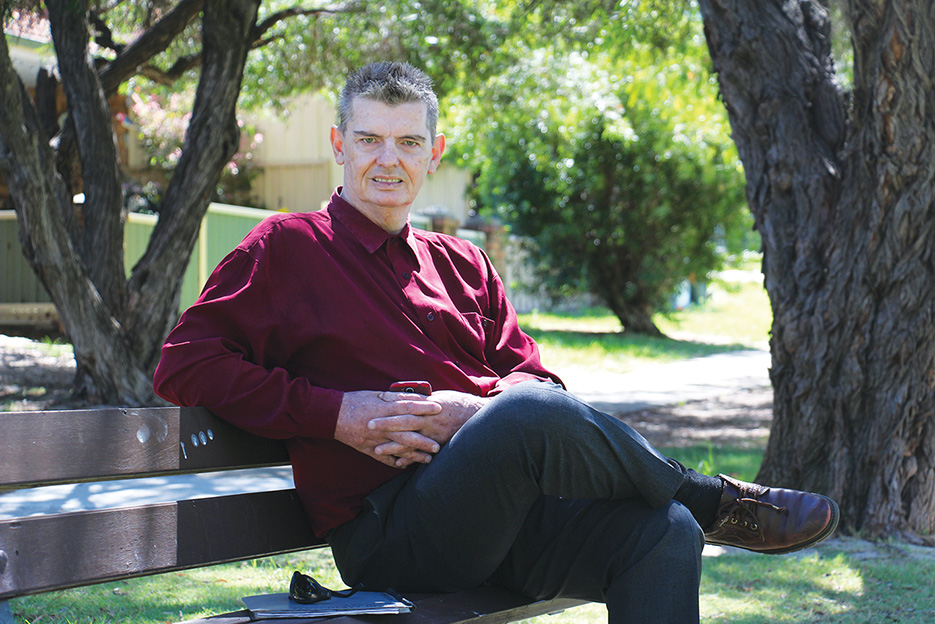
A PERTH man who served Australia’s longest driving licence suspension before it was overturned on appeal has been knocked back for an ex-gratia payment, despite claims it ruined his life.
David Tubbs was just 19 in 1985, when he made the fateful decision to get behind the wheel of a mate’s car after a couple of beers. The car was a bit of a clunker and caught the eye of two police officers on patrol, who pulled him over for a breath test.
Mr Tubbs blew slightly over the limit, but despite this being his first offence and there being no car chase or accident involved, the police prosecutor went hard and convinced a stand-in magistrate to hand down a 50-year suspension.
“I had a family, a mortgage; my partner had just become pregnant and we’d just bought our first house down in Kwinana, but the buses didn’t start until 8.30am,” Mr Tubbs says.
He’d been working at the Robb’s Jetty abattoir, but without public transport it was impossible to get there for the start of shift.
“I wouldn’t drive for six, seven months, then the bills would get too much and I’d start driving to support my family.”
Eventually that would land him back to court, but as the decades stacked up, even the most severe judges were finding it uncomfortable punishing him further.
• David Tubbs served Australia’s longest-serving driving license suspension and says it ruined his life. Photo by Steve Grant
Tragic turn
“I got gaoled for four months.
“It was when the government introduced legislation where you were automatically gaoled if you got three strikes.
“The judge was sympathetic, saying ‘the government has tied our hands. I have to send you to gaol even though you are innocent’.”
The strain on his family became intolerable and Mr Tubbs and his wife split. It took a tragic turn when she suffered a breakdown and stabbed him in the heart, nearly taking his life.
“The reason my wife had a breakdown was because of the stress of living for 15 years not knowing if she was going to have a home over her head,” Mr Tubbs said.
The pair are still in contact now, but the impact of the injury has left him permanently disabled.
Although the court visits were costly for Mr Tubbs, ironically they ended up being his salvation; a police prosecutor who’d sat on four of his cases was so moved by what he perceived as a gross injustice that he personally approached legal aid to take on Mr Tubbs’ case.
He’d previously been knocked back eight times, making it impossible to lodge an appeal.
Rubbing salt in the wound, it’s his lack of appeal that the attorney general’s office quoted as the reason for knocking back his compensation bid.
Mr Tubbs said there’s one more sting in his tale; just after his initial sentencing his lawyer received a letter from the court acknowledging there’d been a miscarriage of justice and telling him to appear again for a re-sentencing.
Sans lawyer, who’d thought a sentence reduction was a no-brainer and he’d not be needed, Mr Tubbs appeared in court and was mortified when the original magistrate only knocked off a few dollars from his fine.
It was the last day he’d have been able to appeal the decision before he’d need to take it to the Supreme Court.
Mr Tubbs says he’s speaking out now because he doesn’t want to give up his fight for compensation.
Attorney general John Quigley wouldn’t comment on the case.
ON February 16 the Perth district court sentenced a woman to six years in jail for transmitting HIV to a man—a sentence longer than that doled out to some one-punch killers in recent years. The transgender woman, who told the court she did not know she had HIV, will have to serve her time in a male prison. In this week’s SPEAKER’S CORNER, WA AIDS Council CEO DAVID KERNOHAN looks at the ramifications this verdict could have on the stigma surrounding HIV, and asks has justice been served?
IN the majority of cases heard before the magistrates and district courts there is a clear perpetrator and victim.
Sometimes, the dividing line between perpetrator and victim is not as easy to demarcate.
In the recent court case of C J Palmer, there are two victims. The young person who has contracted HIV and C J Palmer.
Both have particular personal challenges, the one to learn to live constructively and with dignity with a chronic illness and the other to live constructively and with dignity in a system that would seek to take these away from her.
Apart from the above, it is not my intention in this article to deal with the personal realm but to ask a broader question – has justice been served and at what cost?
Those within the community who are perhaps unaware of the advances in medical treatment for HIV may think that with a sentence of six years, justice has been served.
Yet, as I pointed out in an earlier article, retributive justice is only one aspect of justice. Justice has other strands to it, for example reconciliation as evidenced by the reconciliation tribunals in South Africa at the end of apartheid.
• WA AIDS council CEO David Kernohan
Another aspect of justice is education. Officials with the justice system would argue strongly that prisons have an educative role in educating prisoners for re-entry into the community after the sentence has been served.
Retributive justice is always the most expensive form of justice because it involves incarcerating people and employing staff to ensure the prison system remains coherent and not disintegrate into violence and riots.
With a six-year sentence and a minimum four-year non-parole period, have these other strands of justice been served? While acknowledging the young person may not want or be ready to consider reconciliation, does a six-year sentence allow for the possibility of this to occur should the parties so wish?
It is more challenging for this to happen within the prison system. What about the educative aspect of justice?
What skills does a woman learn during four years in a male prison? What programs are in place for a woman in a male prison that will assist her re-integration into the wider community once the four-year period is over?
Therefore, I ask again – has justice been served? I would argue strongly that justice has not been served for several reasons. The possibility of reconciliation or at least rapprochement between the parties has been made more difficult.
The educative aspect of justice is compromised for a woman in a male prison. The economics of justice is not sustainable. As a community our taxes will spend close to one million dollars for one person for four years when they could be accommodated within the community for far less.
The United Nations and successive Australian governments are all agreed HIV is no longer a criminal matter but a public health issue.
This case highlights the need for governments to rescind and remove outdated laws such as the criminalisation of HIV and ensure that public health policy and laws do not contradict each other. It also highlights the need for the judiciary to keep abreast of current medical opinion and scientific knowledge and where necessary tread lightly until laws are updated to reflect current understanding rather than handing down sentences that can potential reinforce stigma and social isolation.
I HEARD the thumping chorus of Another One Bites the Dust as an old bloke on a pimped-up gopher barreled down the pavement on Beaufort Street.
He made it across the busy Newcastle Street, but only just, and I had to admire his taste in music, and zest for living on the edge.
Seems like there’s never a dull moment sitting outside Source Foods, an eatery that prides itself on embracing life with healthy food.
The menu had a great range of vegan and vegetarian dishes, and plenty of meaty ones too.
“Our menus are designed with all eating requirements in mind,” states the cafe’s blurb.
“We take great pride in knowing what is in our food and maximising taste so that’s why we cure our own salmon, smoke our chicken, and slow cook all our own meats.”
A couple of blokes at the next table were tucking into a nasi goreng, with quinoa, crispy shallots, coriander and pomegranate and a soft fried egg ($22 with pork).
They gave it the thumbs up, and a third bloke happily tucked into kasundi fried eggs, with wild mushrooms, rocket, avocado and Manjimup truffle oil ($18.50).
I’ve never been a fan of the big breakfast—too much fat and too meaty—and until now the vegetarian version has never appealed.
But then I spotted Source’s vegan feast ($22)—a tower of chickpea and black bean falafels, smoked mushrooms, asparagus and rocket.
And it was so fantastic I dived rather than tucked in, although I did pause to appreciate the butternut hummus, and the artful dollops of smooth avocado.
Both were great, and the hummus was sharp with a sweet finish.
The falafels were virtual slabs of rich nuttiness, and the mushrooms had a terrific, smoky flavour.
Together the various layers of flavour were magnificent.
And the crispness of the charred asparagus was the icing on this particular cake.
Speaking of which, my raspberry chocolate brownie ($5) didn’t need any icing.
Slightly warm, it was soft and gooey, and so rich I almost couldn’t finish it–almost.
“Our coffee is an experience that chalk is unable to convey,” was ironically scrawled on a chalkboard outside the cafe.
So rather than having my usual cup of tea, I put the brazen claim to the test, and absolutely agree—the coffee was rich and very palatable, with not a hint of bitterness.
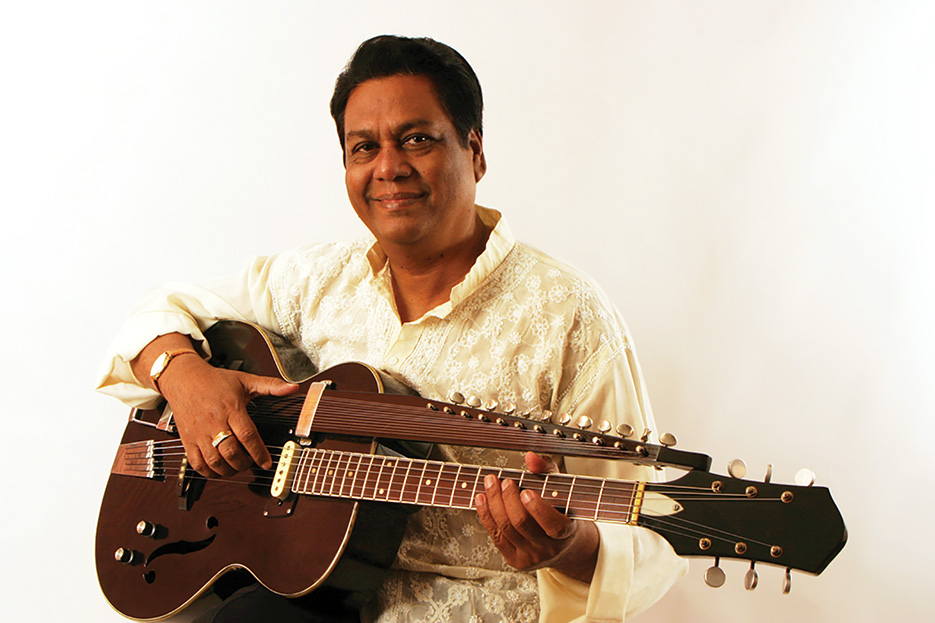
TUNE in to 6EBA’s Blues, Jazz and Beyond, and you could be sharing the airwaves with audiences as far away as Europe and the USA.
Presenter Arthur Gracias notched up his 100th edition of the Perth community radio show in January, and over the years he’s built up a loyal fan base, including renowned international musicians.
“Friends in Spain, England the US and India tune in regularly,” he says. “You can tune in anywhere in the world.”
His weekly 90-minute show is an exploration of jazz from its earthy beginnings, when it was the music of the American slaves, to contemporary jazz masters.
And Gracias usually closes the show with one of his indo-jazz compositions.
Growing up in Kolkata in India, music was a family affair.
“I come from a very musical family and was playing aged three or four,” he says.
“Music was in the house everyday.”
• Arthur Gracias. Photos supplied
Kolkata was an RnR base for Americans in the 60s, and Gracias began to experiment by fusing Indian classical music with the sounds of jazz records brought in by yanks.
He soon became a central figure in indo-jazz, a style that would later influence bands like the Beatles.
Based on rhythmic cycles, rather than harmonies, the Indian “tunes” are perfect to mix with the improvisation of 20th century jazz, Gracias says.
“You can bring out subtle moods of the season and explore it,” he says.
At just 11 he was playing professionally with his cousins at hotels, cabarets and concerts around Kolkata.
He quickly mastered a variety of instruments, including mandolin, keyboard and banjo, going on to study at London’s Royal School of Music, and furthering his musical career under German musicologist, Hans Jurgen Nagel.
On his return to India, Gracias’ compositions were in demand, and pretty soon he was in the thick of India’s Bollywood film industry, “writing for up to 40 piece orchestras.”
He also wrote the music for the BBC program Beyond the Himalayas, Music of Central Asia, and was commissioned by the UN to compose Brotherhood for its Harmony Day celebrations.
Immigrating to Australia, Gracias’ brand of indo-jazz has seen him regularly perform at the Ellington Jazz Club, and every Friday he’s on 6EBA.