ROWS of prunus cerasifera, or to given them their more catchy name crimson spire, add a beautifully dramatic backdrop to the courtyard of this Eleventh Avenue, Inglewood home.
Following the fence line you can see how the tree got its name, as the slender branches covered in lovely red-toned leaves stretch upwards like church spires.
In ecumenical fashion, some of the branches frame a giant Buddha water feature.
The agent tells me she’s just planted three of the ornamental plum trees outside her own house, because they are the perfect specimen for small gardens, like the one at this 260sqm property.
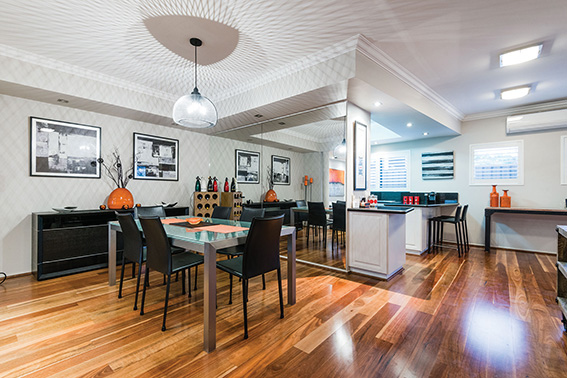
Just about everything in this modern and elegant three-bedroom home is perfect: from the glossy, milk chocolate timber floors and recessed ceilings to the contemporary bay window, framed by white shutters.
Plantation shutters can be found on all the many windows, giving this modern abode the look and feel of a modern holiday home in Spain.
The ground floor is designed for living the good life, with an open plan that stretches from a sunken lounge, protected by huge columns, to a spacious dining and kitchen, and a study area.
There’s black granite bench tops and a heap of white cupboards and drawers—including a double floor-to-ceiling pantry—in the sparkling kitchen.
Huge sliding glass doors lead to the covered alfresco, which provides easy access for pleasant Sunday morning brunches or convivial summer barbecues.
Black wrought iron girds the timber stairs, which lead to the second level bedrooms, including the spacious main.
The shuttered windows follow the line of the soaring cathedral ceiling, framing a balcony with views of the leafy streets beyond, including a heap of jacarandas about to burst into glorious purple blossom.
Less than 250 metres from Beaufort Street, this home is close to cafes, restaurants and shops.
Inglewood Primary School is just up the road and the Perth CBD is a mere 12 minutes drive.
Or use the 12 minutes to walk to the Maylands train station and leave the car in the garage.
37th Annual Awards Exhibition of the Watercolour Society of WA
Once again the members of the Watercolour Society of WA are preparing to delight collectors and fans of watercolour at their 37th Annual Awards Exhibition. The opening night and awards presentation will be held on Thursday 12th October, with the exhibition continuing over the weekend of Friday 13th, Saturday 14th and Sunday 15th October.
This year’s exhibition is set to be an exciting one, with over 200 entries. One of the main aims of the exhibition is to promote the value of having art in one’s life. Members of the Society will be giving demonstrations during the weekend and will be available to chat and answer questions.
Geoff Bull SPONSOR
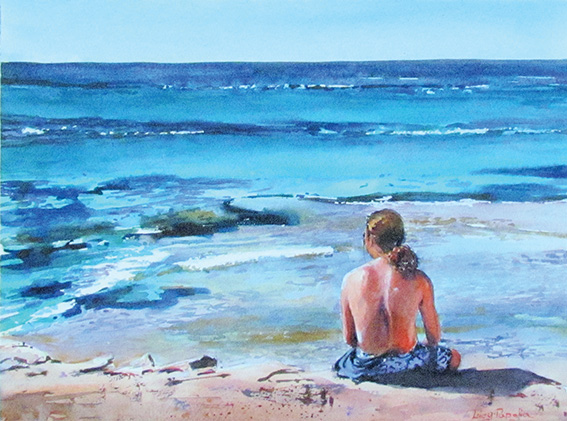
The paintings are judged in several categories with a special section named “Figure, Face, & Form” and the always popular “Innovative Section” where artists get the chance to “let rip!” The public can also play judge and vote for the “People’s Choice” and perhaps win a prize too.
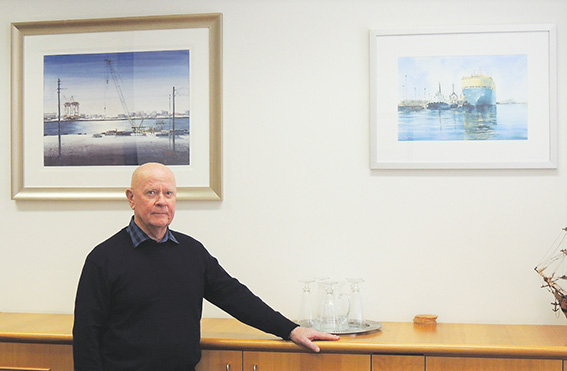
When asked what is special about watercolour, local sponsor and collector, Geoff Bull of Allegro Pty Ltd in Fremantle, said: “They brighten the main living areas of our home especially if placed in close proximity, creating a gallery effect. They sit well with paintings by other masters of the medium.”
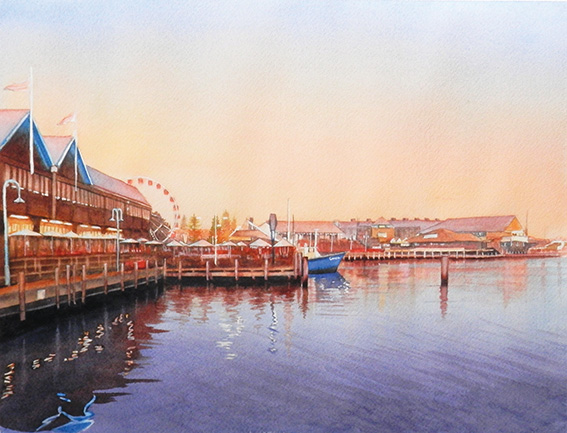
Geoff also has a group of Fremantle-themed watercolours in his business boardroom, all created by members of the Watercolour Society and purchased from the Annual Awards Exhibition. Geoff feels WA lends itself to watercolour with its bright and contrasting scenery and there are some very talented artists in the organisation who are in his opinion underrated and undiscovered.
FREE ENTRY The Watercolour Society of WA Annual Awards Exhibition 2017 The Italian Club, Marine Terrace, Fremantle Opening Night & Awards Presentation Thursday 12 October 6.30pm (all welcome)
Exhibition opens Fri 13 Oct 9am – 5pm Sat 14 Oct 9am – 5pm Sun 15 Oct 9am – 4pm
“Mental health just isn’t ‘I’ve got something wrong inside me’; it’s an explosive package that people don’t understand.”
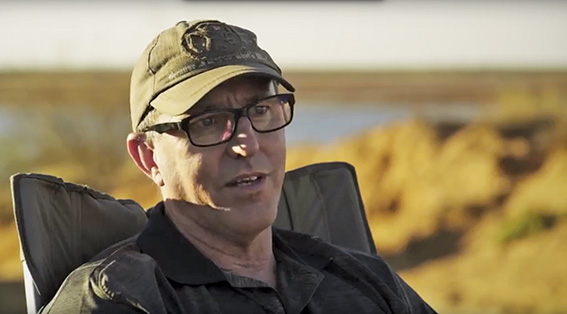
These aren’t the words of a mental health patient, but those of Terry, who gave up work to become carer of his wife, who suffers from mental illness.
“Shelley used to self harm,” says Terry.
“One day she just had a complete breakdown; she just stopped functioning as a person, she just…stopped.
“It was like holy crap, what do we do now.”
Terry is just one of the many unsung, “forgotten” carers who bear the psychological brunt of looking after a family member with mental health issues.
• A scene from Terry’s Story.
And it can often be harder for male carers, who find it uncomfortable to discuss mental health issues with their larrikin buddies.
“You go to your mates and say ‘Listen I’m quitting work because my wife’s got mental health problems’ and they look at you and go, ‘What—tell her to get over it’,” he says.
“I had to go from being dad and working, to being mum and dad. So you had to learn to do everything.
“I think it was very emotionally draining and it also physically drained me.”
Terry is one of many carers profiled by mental health support group HelpingMinds, which has released a series of YouTube videos featuring families affected by mental illness.
In a raw, unflinching interview, tears well up as Terry describes the impact his wife’s illness had on his family.
“Shelley might have mental health problems, but it affects five people in our house,” he says.
“For years I took it all on myself.”
He eventually found solace at HelpingMinds, a place “where you can go and just blurt out what you’re struggling with; and that’s what you need—a place to go and talk to other carers and have a cup of coffee.”
He says he still struggles every day to cope, but will never give up because he loves Shelley.
“Don’t ever give up. You can’t, it’s the biggest job in the world and you can’t quit…that person depends on you. Strive to find any help you can and take advantage of it.
According to a recent study commissioned by Mind Australia, an estimated 240,000 Australians care for an adult with a mental illness.
Mandurah Seniors and Community Centre 7th Oct 2017 & Cockburn Youth Centre 4th Nov 2017
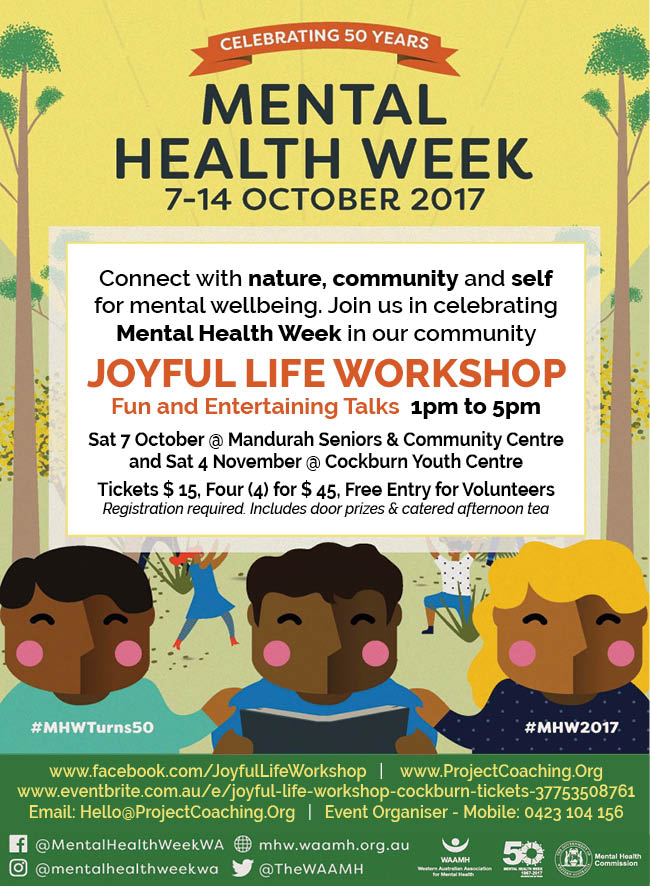
Project Coaching Institute, will be holding Joyful Life Workshops, as part of Mental Health Week 2017. Featuring a host of experienced life coaches and speakers, the workshops will inspire you to laugh more, live more joyfully and to socialise in a meaningful way. It’s a chance to connect with the community and yourself for mental wellbeing.
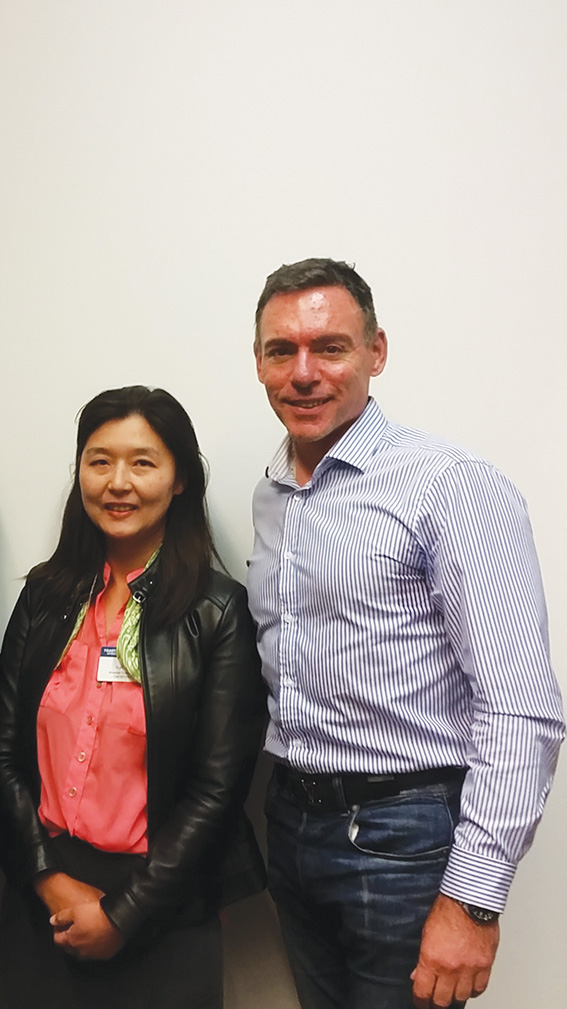
Project Life Coaching’s Yun Choi and David Crispin from Valere Coaching.
Just some of the workshops include: Norita Omar, of http://www.striveandthrive.com.au will talk about Resilience; Toastmaster Peter Law, will make you laugh and cry; leading life & fitness coach Danny Marriner, will present Be Your Own Hero workshop. Relationships expert Dave Crispin from http://www.valerecoachingperth.com.au and Jürgen Schmechel from http://www.inspiring-relationships.com.au will talk about post-natal depression in men and where to get support. Project Coaching Institute will also offer Fathering in 15™ – an online parenting program aimed at new dads, FIFO workers and single dads who may be at greater risk of depression and anxiety.
The workshops run from 1pm to 5pm. The first runs this Saturday 7th October at the Mandurah Seniors and Community Centre, with free entry & the second one will be Saturday 4th November at the Cockburn Youth Centre. Entry for the Cockburn workshop is $15 pp, or $45 for a group of 4 and includes giveaways, prizes and afternoon tea. Bookings are recommended, visit: http://www.projectcoaching.org
About Project Coaching Institute Founded by Yun Choi and run by a group of skilled project managers and toastmasters, The Project Coaching Institute aims to provide personalised mentoring about life, work and in between.
Attention Deficit Hyperactivity Disorder (ADHD) a effects an estimated 1 million children and adults in Australia, and those affected usually have difficulties with attention and impulse control.
ADHD is more common in boys, and most children with ADHD will continue to experience problems into adulthood. Recent studies have also highlighted late-onset ADHD where symptoms do not show until adulthood.
What causes ADHD ?
Research shows that ADHD has a strong genetic basis. So, when a child is diagnosed, it is very likely that at least one of the parents will also have ADHD. It is not yet clear exactly what causes ADHD, but research shows that there are changes in the structure and function of key areas of the brain involved with attention and impulse control.
Diagnosis
The formal diagnosis of ADHD is usually made by a paediatrician or psychiatrist. Assessment involves a comprehensive examination, and information from the patient, parents and teachers. For adults with suspected ADHD, input is often sought from partners, work colleagues and friends.
At The Perth Brain Centre, established in 2007, we use special brain scans called QEEG that measure brainwave activity to identify potential problem areas in the brain. Brainwave analysis was approved by the US Food and Drug Administration in 2013 for assisting in the accurate diagnosis of ADHD. The scans are performed whilst awake, and careful analysis generates detailed images that pinpoint areas of abnormal brain activity.
Treatment
In the past, treatment for ADHD was often limited to medication. However, now it is generally accepted that treatment should be ‘patient-centred’ and involve a range of interventions. Aside from medication, other treatment options that can be effective include behavioural therapy, lifestyle and dietary changes, neurofeedback therapy and psycho- education.
There is no ‘one size fits all’, and at The Perth Brain Centre we believe that individuals and families should be able to make an informed choice based upon the range of treatments now available.
The Perth Brain Centre focuses on providing neurofeedback therapy in conjunction with behavioural interventions, psycho-education, lifestyle and dietary advice. Neurofeedback is recognised by The American Academy of Paediatrics to be an effective treatment for ADHD, and is featured in Dr Norman Doidge’s book ‘The Brain’s Way of Healing’, the sequel to his international best-selling book ‘The Brain That Changes Itself.’
Neurofeedback Therapy
Neurofeedback is suitable for people of almost all ages and uses a sophisticated brain-computer interface to ‘strengthen’ and ‘re-train’ the brain. Patients sit comfortably during training whilst sensors precisely detect and measure brainwave activity. This information is analysed in real-time and presented as audio and visual feedback, which is used to strengthen and re-train the ‘weak’ areas in the brain. There is extensive research supporting neurofeedback as a safe and effective treatment for ADHD. Studies specifically show that neurofeedback therapy can result in significant and sustained improvements in the key symptoms of ADHD.
Getting successful treatment for ADHD can change your life and the lives of people around you.
For further information about how neurofeedback therapy can help you or someone you know, please call
08 6500 3277, or visit our website
www. perthbraincentre.com.au
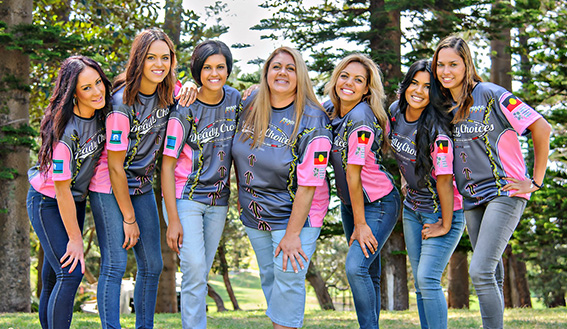
ABORIGINAL women are 16 per cent less likely to survive breast cancer compared to non-indigenous women.
The shocking statistic has been the catalyst for a new social media campaign to increase early detection, with Indigenous cancer survivor Jacinta Elston telling the ABC that indigenous women tend to put off going to see the doctor about breast changes and don’t stick with treatment.
Dr Margaret Latham, a radiation oncologist, says getting more indigenous women to undergo treatment is a “complex problem”.
“Awareness campaigns can be improved but it is quite a complex problem not only due to remote location but also the way Aboriginal people deal with health and health issues in general,” she says.
“Many are reluctant to put their needs ahead of their community needs and there is not one simple solution.
“Anything that can be done to help women to be diagnosed as early as possible and to support them through the appropriate treatment and thus give them the best chance of cure is welcomed.”
• The National Aboriginal Community Controlled Health Organisation has previously tried to raise awareness about breast cancer.
For those unlucky enough to have developed breast cancer already, a lumpectomy (Breast Conserving Surgery) and radiotherapy can often be an alternative to having a devastating mastectomy followed by breast reconstruction.
“It gives similar excellent results in prevention of recurrence in the breast area but enables women to keep their breast,” Dr Latham says.
“Some people are surprised to know that breast cancer can return sometimes even after they have had a mastectomy but nothing is perfect.
“In some occasions after having BCS the tumour may be so small and low grade that patients can consider omitting the radiation particularly if they are over 70.
“There are some trials showing that patients can be considered for partial breast radiation rather than the full breast. The data here is still a bit immature so its not considered routine but it is an emerging area.”
Typically a course of radiotherapy to treat breast cancer takes 10-20 minutes a day, Monday to Friday, and runs over three to seven weeks.
“The main benefits of radiation are in preventing breast cancer recurrence,” Dr Latham says.
“It is usually given in a post operative setting where all the known tumour has been removed.
“We know however in a lot of patients there are still microscopic cells left behind and radiation can help kill these minimising the risk of recurrence.
“The alternative is to take a watch and wait approach but this is not recommended except for very low risk patients.
“Most breast cancers are treated with a multi pronged approach attacking it from different angles of surgery, radiation, chemotherapy or hormone treatment. Not everyone needs everything but options should be considered.”
Genesis CancerCare have centres in Bunbury, Joondalup, Murdoch and Wembley.
Meanwhile a new Australian trial has raised hopes that mastectomies could eventually be replaced by chemotherapy and hormone treatment.
The trial is attempting to shrink breast tumours before surgery, meaning patients only require a less invasive lumpectomy, rather than a mastectomy followed by breast reconstruction.
AFTER 10 years of documenting crappy architecture, tasteless coco palm arrangements, terrible street art, and countless graffitied “cock and balls” motifs, The Worst of Perth founder Andrew McDonald is calling it a day.
theworstofperth.com started September 27, 2007, when Mr McDonald promised to post “the worst examples of Perth design, art, culture and architecture,” as well as taking plenty of shots at the standard of news coverage in The West Australian (dubbed “The Worst Australian”).
The site’s had 4000 posts and 5.6 million views since then and fostered a mini-subculture around its hidden history of the city that doesn’t make it into mainstream media outlets.
From the earliest days, uninspired public artworks were a frequent target. The site was even instrumental in getting the risible concrete “arse and boozies [boobs]” sculpture removed from the front of the Perth railway station after featuring it in 2007.
• The best of The Worst of Perth: Arse and boozies, and (below) an example of the unique Perth architectural style of Shedism.
Embarrassing
New lord mayor Lisa Scaffidi saw the post, and her first thought was “how embarrassing”. The crumbling statue was soon moved away from the public eye to Gomboc Gallery out in Middle Swan.
“Vanished Worsts”—things that had been featured on the site and then disappeared out of shame or just coincidence—became a category of its own, with 69 now listed.
At first glance the site looks pretty sardonic to a newcomer, but Mr McDonald says there’s a real fondness for Perth at the heart of the posts by regular contributors like “Bento” and Post Newspapers journo David “Outrage” Cohen.
“I don’t like things to be too nasty,” says Mr McDonald.
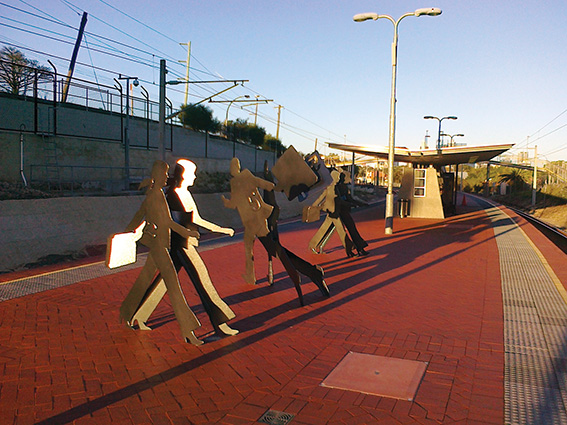
• Mt Lawley train station artwork. “Perth has the world’s worst street art”.
“[We’re] pretending to be nasty, but not really. It’s all quite good natured.” (though as a hard-nosed journo, Mr Cohen’s put up a few contentious ones when he takes over for Outrage Sunday).
A glut of new public artworks in Perth has been a frequent target of TWOP critiques. Mr McDonald, who this week was highly commended for his stamp artwork in the Fremantle Print Awards, says “Perth has the world’s worst street art”.
He says our artists themselves might be alright (maybe), but the way councils choose the murals leads to the most milquetoast outcomes.
“We don’t have anything that makes you stop and think,” says Mr McDonald.
“There’s nothing with an edge, nothing to make you discomforted, it’s just all decoration…it’s just visual muzak. Not every wall would be better with leaves painted on it.
“In other parts of the world, even down on the local level, they choose the artist, not the piece,” rather than councillors choosing what goes up.
“They’re not very good at being councillors, most of them, let alone being judges of art. If we had just one piece that police painted over, I’d be happy.”
More low-brow street art has been been thoroughly documented and even celebrated. The site has an enormous number of pictures in the “cock and balls” category, showing spraypainted, marker-penned or scratched-in penises on every conceivable surface in Perth.
And it’s taught us something about our city: “That was really interesting, finding out there was a different style of cock and balls in Perth: here it’s disembodied, drawn on anything. In other parts of the world they’ll draw it on someone, or doing something to someone. In Perth it’s just ‘ah, I’ll draw a cock on that’,” he says.
The site’s also waged a long-running low-key war against WA writer Tim Winton. Mr McDonald conceded early on “I haven’t really got anything to base my irrational hatred on” but something about the “fake WA nostalgia” grates.
“I thought I was the only person who loathed Cloudstreet,” he says, but found out “there is quite a community of people who cannot stand his work.”
• “No one should have to see this,” Mr McDonald wrote of this sad but artfully captured octopus covered in ants at a Mt Lawley bus stop on January 13, 2009
Phwoar
For months the site even hosted a collaborative project to write their own Tim Winton book, titled “Phwoar” (colloquial: WA term of excitement). A novel’s worth of satire was written by TWOP contributors, chock-full of references to Wintonesque cliches like going barefoot in Freo.
“Some of them were a lot better than Tim’s writing!” Mr McDonald says. “They were so amazingly written and funny and vicious.”
Winton’s never contacted him about the eight-year-long online critique, but Mr McDonald said when he attended the opening of one of those plays “he did really glare at me”.
In the final post, Mr McDonald asked “was anything achieved? Bland wall murals still go up. Tim Winton still writes his WA cliches of fish and wind. Even She-Ra [Lisa Scaffidi] and Paul Nurrie [Murray] hang on grimly. And yet, the city, Perth city, is a different planet for sure.
“Some of that we can claim as ours perhaps?
“At least there’s thousands of tiny pieces of original scenes that would have gone unrecorded otherwise.”
STIRLING WITH sitting councillor Rod Willox retiring after 25 years, there’s a big field of nominees for Stirling’s Lawley ward.
Lawley Ward (1 vacancy): SUZANNE MIGDALE works in marketing for Fairfax and wants rates frozen for two years and compensation for seniors who lost their rates concession. She opposes any increase to the height of highrise developments currently proposed in Menora, and says Nollamara and Yokine are areas that need improved security measures for citizens.
JEREMY QUINN works as a recruitment consultant and had a tilt at federal politics running for the Liberal party at the last election. But he’s long had an interest in local government (having considered running back in 2013) and says if elected he’ll be in it for the full four years. He’s been in the area all his life and his priorities are cost of living (he wants rates kept low given how big a surplus Stirling is sitting on), heritage protection for the area’s character homes and buildings, and he wants improved home support services for seniors
CHRIS HARGREAVES says “the core reason of my decision [to nominate] is: I was unhappy with the level of attention the council put on my local area, Yokine, and I thought we needed somebody in my area to actually represent them on council…and I personally feel that small business is underrepresented on council” and suffering from steep rates. He says Yokine and the northern part of Beaufort Street need improvements to bring in more foot traffic, and says with Stirling sitting on such massive surpluses they need to ease up on rates next year.
PAUL COLLINS is current president of pro-heritage group the Mount Lawley Society, and was a councillor from 2007 to 2013 and says “the timing is right, because Rod Willox is not re-contesting. He decided to stand down, he’s endorsed me and said he’d sleep a lot better if I was elected”. Mr Collins wants new sports club facilities for Hamer Park and Inglewood oval (the facilities there were installed decades ago by the Shire of Perth) and more open space when new developments go up because fitting so much on every block is “turning Perth into one big heatsink”.
GAVIN WATTS has lived in the area for 20 years and having raised two kids in local schools says he’s running for council to give something back. He now works in government in a regulatory role, but has experience at the City of Stirling working with rangers, and resident security is a big issue for him, along with keeping rates low and maintaining environmental and financial sustainability.
IT’S a two-horse race in Stirling’s Inglewood ward, with newcomer Bianca Sandri running against veteran councillor Terry Tyzack.
Inglewood Ward (1 vacancy): TERRY TYZACK has had two previous spells as mayor (1984-1986 and 2005-2007). “Restraint in spending” is a key focus and he says “Stirling’s debt free status resulted from a strategy initiated during my first mayoral term”. He says he’s renominated because “my passion for local government is strong as ever. I get great satisfaction from using my experience in architecture and planning to help individual ratepayers, community groups an sporting clubs navigate through council regulations to obtain the desired outcomes”.
BIANCA SANDRI runs a boutique town planning firm and has previously worked in local government. She wants to bring a sensible planner’s perspective to some of the city’s current policies. “Theres’s definitely room for improvement at every local government. At Stirling, I think they could offer some flexibility to get some better design outcomes.” She says it’s a bureaucratic obstacle course to try and get approval for multi-generational suitable housing (like two touching houses on one block, which would suit a lot of families living with parents as the area’s population ages), because the current laws classifies them as “group dwellings” and there needs to be more flexibility. She says “I would like to honour my family’s 50-year history with the Inglewood Ward by ensuring that any proposed changes don’t come at the expense of the uniqueness of Inglewood and Dianella”. She also wants more bicycle paths saying “the fact we don’t have them in Inglewood and Dianella is absurd” and wants incentives for owners of long-term vacant blocks to allow them to be used for public means, like community gardens.
BAYSWATER THERE are three people in the race to replace Bayswater South ward councillor John Rifici, who after one term has decided not to re-contest his seat.
South Ward (1 vacancy): ELLI PETERSEN-PIK is the current president of the Maylands Residents and Ratepayers Association, and has been involved in previous community campaigns to get Coles to clean up their derelict vacant lot on Guildford Road that was attracting garbage and graffiti. If elected he wants the city to explore options to get Coles to do something with the site or charge Coles higher rates for leaving it as a tip. He has a background drafting policy for government, he was also involved with the efforts to keep Maylands Waterland open and urged the council to go for the community’s favoured option of costly repairs. He wants a greener Guildford Road and better bike and pedestrian facilities.
ROBYN WALSH works in child protection and says “I’m a social justice advocate and I’m passionate about the environment”. She’s lived in the area for 17 years, is 53 years old and a Greens party member, and has been working on the “Yes” to equal marriage campaign lately (she has a female partner of 15 years but “we wouldn’t be entitled to the same legal protections should anything happen to one of us”). She says she’d like to bring some diversity to council, from the perspective of being a woman, a lesbian, and someone not involved in the business or development world. She was involved in the local “No Houses in Wetlands” campaign to save the land around Eric Singleton bird sanctuary, and that’s partly what spurred her to run. And also wants the city to pursue stronger links with Indigenous people and set up a formal “Reconciliation Action Plan”, as Perth and Vincent have done. She says fixing Maylands’ antisocial problems requires a long-term solution, based around early intervention to stop young people from getting into offending behaviour. “The problem isn’t the people, the problem is homelessness, that we have people who need to come here for food”.
KATE THOMSON wanted to run for council after getting involved in the campaign against the widening of Guildford Road, proposed by the previous state government, and is now chair of the Guildford Road Revival group pushing for improvements to the strip. An environmental scientist by trade and a newish Labor party member (getting involved after seeing Lisa Baker’s efforts to halt the Guildford Road widening), she’s also big on place activation to liven up the town centres and is chair of the Creative Maylands community group. The increase in crime in Maylands town centre lately is also a big issue for Ms Thomson and she’s said she’ll push for more security patrols, quicker police response times and for the guidelines of the “Crime Prevention Through Environmental Design” findings to be rolled out, which recommended measures like having more open shopfronts since having that passive surveillance helps discourage crime.
THERE’S a large cast of characters for Bayswater’s West ward, with some familiar faces who’ve graced our pages before and some new names popping up.
West Ward (2 vacancies): TERRY KENYON’S renomination is an odd one given he hasn’t been able to go to a council meeting for almost a year (but still got paid the sitting fee). He was declared bankrupt by the federal court in January after an expensive legal case against two former councillors which would normally mean he’s ineligible to run, but he’s in the midst of a lengthy appeal leaving him in councillor limbo, and his spot in the chamber has been empty for the past eight months. We asked via email why he was running given he can’t sit in the chamber at the moment (and may never be able to if the appeal fails) but he didn’t respond.
GIORGIA JOHNSON runs Cool Breeze Cafe, known for top coffee and its waste-reducing innovations that have seen them cut their garbage down to one bag a weekend. Given that background (plus she’s an accountant), she’s keen on supporting the local economy and the environment.
GREG SMITH is a town planner and guerrilla gardener who’s been in our pages plenty of times, passionately defending trees and heritage buildings—even dressing up as the Lorax during the campaign to save the Carters’ Wetland block—and wants “good town planning” to retain the garden city’s amenity.
LORNA CLARKE’S a Coode Street resident who loves the town for its open green spaces, its history and sense of community, and she wants more trees on verges and a “no empty shops” policy to encourage landlords to use unleased spaces for events.
BEN DELLAR says his experience leading complex hospital projects at St John of God Healthcare and his finance background give him plenty of experience to run for council and he wants a responsible reduction in rate rises.
MARTIN TOLDO’S back for another tilt having previously served on council 2011-2015. He’s a volunteer transport driver for People Who Care and says he has “good financial management” and will be “keeping rates low as possible and be fare [sic] and equal with everybody”.
The “Safer Maylands” Facebook page was started up by Bayswater police in 2015 with hopes that community members would take over the day-to-day running of the site, but this election the community page hosted a paid-for ad for candidate Kate Thomson.
If coppers endorsed a party-aligned candidate it would surely raise eyebrows, but it’s a mystery who’s actually running the page now, with the last official post from police coming in November 25, 2015.
Fellow south ward candidate Elli Petersen-Pik posted under the ad: “in the interest of transparency, and as this page represents itself as an independent, can you please share with us who is managing the page?”
“Can you also tell us who has paid for the sponsorship of this post promoting a political candidate?”
His post was deleted by the page’s anonymous administrator. The Voice contacted the page too, asking who the administrator was and who put up the ad.
“There are multiple admins on this page,” the anonymous page-owner said. We asked again, who paid for the ad.
“The police have had no input into this page for over 18 months. The promotion was stopped as soon as it was raised as an issue. Someone just got excited at seeing a candidate talking about the issue of safety.”
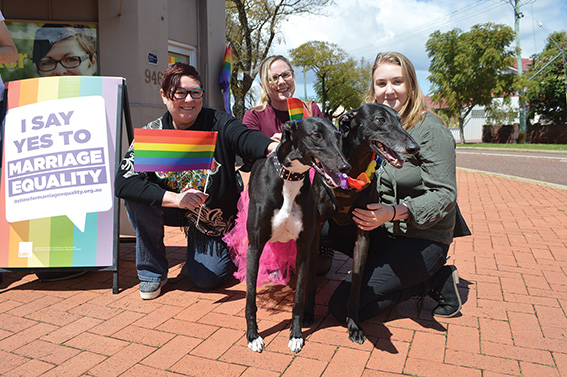
TWO pet projects of Labor MP Lisa Baker collided this week when a pack of greyhounds dressed in rainbow clothes swung by her Maylands electoral office.
• Labor MP Lisa Baker gets a visit from greyhound advocates/same-sex marriage supporters at her Maylands office. Photo supplied
The greyhound advocates/same-sex marriage supporters came to Ms Baker to chat with her about improvements to the greyhound racing industry, as it currently results in overbreeding and a lot of dogs being injured during races, or put down because they can’t be rehomed. It’s a venn diagram that’s just about a circle for Ms Baker as she’s campaigned on greyhounds and marriage equality for years: “Greyhound Adoptions WA have been talking with Paul Papalia, minister for racing and gaming, about how the industry might change in the future.” Ms Baker says there’s hope on the horizon for the greyhounds: “We have a minister that’s extremely interested in this issue and very open to suggestions” and there’d be an announcement down the track.