• Good Kosmic vibes

    BAYSWATER mayor Dan Bull – who previously toured with Eskimo Joe and other high-profile WA bands – is delighted Kosmic Sound has been rescued and will live on.

    Last month the family-owned Perth music store went into liquidation after more than 50 years in business, but it’s now been acquired by the South Australian Cleves family, who own Australian Piano Warehouse in North Perth and were behind the recent revival of Billy Hyde Music in the eastern states. 

    Cr Bull, who also played piano with The Sleepy Jackson and End of Fashion, says he bought two keyboards from Kosmic back in the day.

    “Instruments are like clothes and you really need to go to the shop and see what fits you. Especially guitars – the wood on each one creates a unique sound,” he says.

    “Most of the guys that work in the shops are gigging musos as well, so you get to pick their minds about what models are reliable and work well in a live situation.

    “Music shops like Kosmic are still important hubs for local musos and I’m glad it’s going to live on in some form.”

    • Dan Bull with his axe in Bayswater. File photo

    Michael Cleves, managing director of Dale Cleves Music Group, says he admired what Kosmic’s previous owner John Goldsmith achieved.

    “It’s been a family business all this time, and it will still be part of a family business so there’ll be real people in control rather than a faceless corporation,” he says.

    “That was really important to me. There’s a couple of those sorts of businesses around at the moment and that’s not what Kosmic has ever been about. 

    “We’re a third generation music family that’s been in the business since the 60s. We care about people. And we love music. Customers can smell a lack of authenticity a mile away, especially musos.”

    Mr Cleves says Kosmic will now be part of a larger group that will provide a better service to local musos and online customers in the eastern states.

    He expects that Kosmic will be back up and running at the same location on Hector Street West in Osborne Park by late March.

    There’s still some details to be worked out before the reopening but the staff will be a mix of old and new faces.

    After the announcement Kosmic’s social media was peppered by questions from a few people who had outstanding orders that did not get delivered when the business closed, including some very late Christmas presents.

    They’re likely out of luck: A representative from Cleves told them the payments went to the old business, and they didn’t have the money or even the details of the orders. The liquidation means a lot of other creditors are in line to be paid off before customers with orders would get a look in.


  • Council quizzed over power plan

    A PLAN to get underground power for Vincent residents has been dismissed by council staff as unaffordable, even though it wouldn’t draw on their current coffers.

    The current system sees homeowners presented with a chunky bill ($8000 or more per house) and can be a big deterrent, killing projects in the community consultation stage.

    Former councillor Dudley Maier put up a motion at Vincent’s last electors’ meeting suggesting the council look at Subiaco’s approach of collectively paying for underground power, taking out loans to get things rolling then increasing the rates a small amount to split the bill over many years. 

    He says the increase in property values, more trees, more birds and more shades makes the rates rise more palatable.  

    Residents who’d already paid for underground power would be exempted by area from having to pay the rate rise.

    Popular

    The Subiaco model was deemed a hit when Vincent council staff reviewed it back in 2008: “Politically it is very popular with the Council and we have had relatively few complaints from the community about this method.  It is also very simple to administer,” a dusty old report states.

    But Vincent staff have suggested councillors don’t pursue Mr Maier’s motion, saying the city “is is not in a financial position to be able to fund an underground power proposal at this time”. 

    Mr Maier doesn’t think they understood his question, or the Subiaco model. He says he just wanted them to look at Subiaco’s homework, prepare a long-term financial model and ask the community what they thought of it. 

    Cr Josh Topelberg quizzed staff on it at the March 10 briefing.

    “My understanding of the request was that it was to look at a funding model that didn’t require the city to use its financial position, and the response is we’re not in a financial position,” Cr Topelberg said.

    He said Mr Maier had made it clear “that’s not the question that was asked”.

    Cr Topelberg requested staff show what work they’ve done so far looking into the idea and include that in the report for the March 17 council meeting, where councillors decide whether to pursue it any further.

    by DAVID BELL

  • A rough count

    ABOUT 35 people have volunteered to help Bayswater council count the city’s rough sleepers in the early hours of Tuesday morning. 

    Volunteers will use a phone app developed by council to record the locations of people across Bayswater between 1am-3am.

    The data collected will be used to shape the city’s homelessness strategy and help local support services.

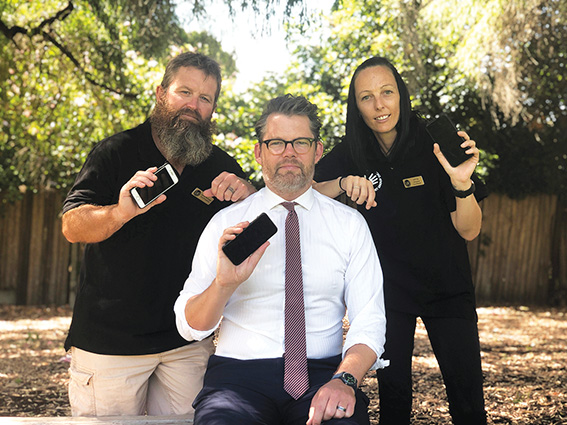
    • Aaron McGregor (left) and Jed Fay (right) from Perth Homeless Support Group with Bayswater mayor Dan Bull.

    Training

    Bayswater mayor Dan Bull said volunteers attended a free, 1.5-hour training session held by the city.

    “Ensuring participants are able to collect data without disturbing those sleeping rough is essential,” he said.

    “The city has developed an app for use on the night, which will help ensure we can do just that, in a fast and accurate way.

    “People can experience homelessness for many reasons – including domestic violence, ill-health, long-term unemployment and mental health issues. The City of Bayswater is committed to advocating for those who don’t have a voice on this issue.”

    The Voice understands the majority of volunteers have a background in homelessness support services.

    It is the first time Bayswater has done a “rough sleeper count”, which is being held in conjunction with other local governments across Perth.

  • A splash for 2021

    THE first stage of the reimagined Maylands Waterland may be open by November next year.

    Bayswater councillors unanimously approved a draft concept plan for the redevelopment, pulled together by a working group of councillors and community members, at their last meeting.

    The kids’ water park was too run down to open this year, and the council cried poor over a multi-million dollar restoration.

    The first stage to open will be free to the public and have a shallow pool, splash pad, picnic area and toilets/change room. Being a freebie, the council can draw on $1.5m cash-in-lieu it’s collected from nearby developments to help cover the $1.7m – $2.2 construction cost.

    Beach

    Stage 2 will have the main pools, possibly including a beach-style pool.

    Its estimated cost is $2.5m – $3m, with funding subject to budget time, with the city keen to keep an eye out for available grants. It’s likely be paid-entry to help offset maintenance and staff costs. 

    The Friends of Maylands Waterland contributed members to the working group and is happy with the outcome.

    FoMW chair Josh Eveson says the approval was a fantastic outcome, while “keeping the pools was a vital piece of its appeal and long-term viability”.

    “We also believe with the funding model used, returning Waterland to a free facility (as was the vision of Cr Alma Venville in April 1977) will assist in it being a far more inclusive and accessible option, complementing modern life.”

    Ward councillors Catherine Ehrhardt and Elli Petersen-Pik like the concept.

    by DAVID BELL

  • A class above

    JUST up the road from the bustling Leederville strip, my lunch companion and I relaxed under a lemon scented gum tree at Oxford Yard cafe.

    It was a great spot to watch hungry students amble over from the Leederville Tafe next door.

    Bowls of chips were a bit hit, followed closely by toasties ($13 for a bacon and egg version, $10 for a vegie one), while a young bloke wolfed down a chicken waffle ($20).

    The buttermilk-crumbed chicken must have been great judging by the speed it disappeared, or maybe he was just late for class.

    My mate went for the halloumi stack ($18) – two large slices of perfectly grilled Cyprian cheese topped with runny eggs. 

    “It’s great,” she said. “The beetroot and walnut pesto adds a real zip.”

    My eye had been caught by the special of the day – a vegie patch smash ($18).

    Slices of roasted sweet potato were topped with mushrooms, sharp roasted tomatoes and wilted greens.

    A liberal shake of smoked paprika and a handful of crunchy chick peas took this delicious dish to another level.

    My friend and I finished our meal with a coffee ($4.20) and an earl grey tea ($4.50) – and of course a couple of cakes.

    My mates’s caramel slice was moist with just the right amount of sweetness.

    “And the coffee is great,” she said.

    My chocolate raspberry brownie ($5.50) was fantastic – soft, moist and so rich I almost didn’t finish it, but I made a valiant effort and left the plate clean.

    by JENNY D’ANGER

    Oxford Yard
    196 Oxford Street,
    Leederville
    open seven days

  • Award-winner

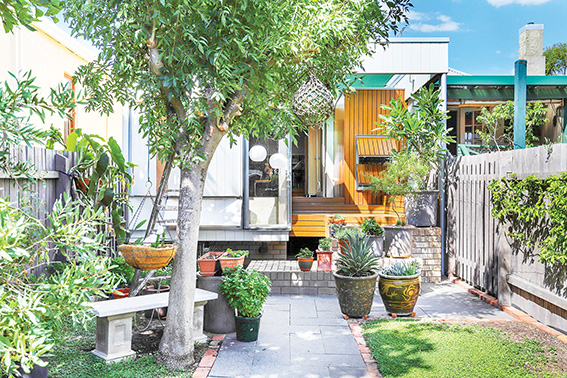
    THE quirky extension to this heritage-listed Fremantle cottage won state and national architecture awards.

    The original garden fell away sharply, so Freo architect Philip Stejskal bridged the old and new with floor-level drops and a flexible space that’s not really a room or an alfresco, but acts as both.

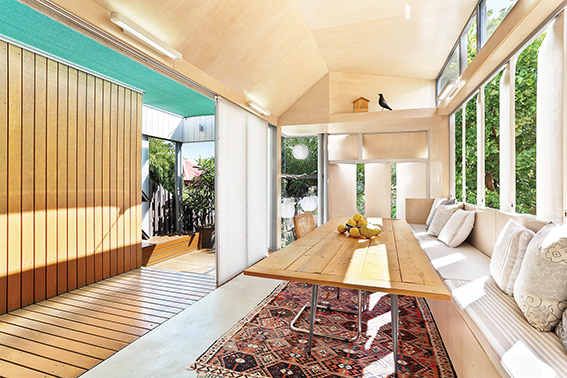
    A bank of polycarbonate doors open onto a timber deck, creating an extra “room”, with stairs leading down to the garden.

    At the western end of the house a wall of glass overlooks the manicured garden, and on the northern side, marine-ply shutters let in the summer breeze.

    The mix of shutters, sliding panels and bi-fold doors create a versatile space, whether home alone or entertaining friends and family. The delightful garden, with its smooth dichondra lawn, is dominated by a claret ash tree and visited daily by a variety of birds including hand-fed kookaburras and magpies expecting dinner.

    The bathroom in the extension is a long, lean and very modern space with a frameless shower.

    The deep bath has timber, angled shutters, so you can enjoy views of the garden while having a soak, and there’s a laundry tucked behind attractive marine-ply doors.

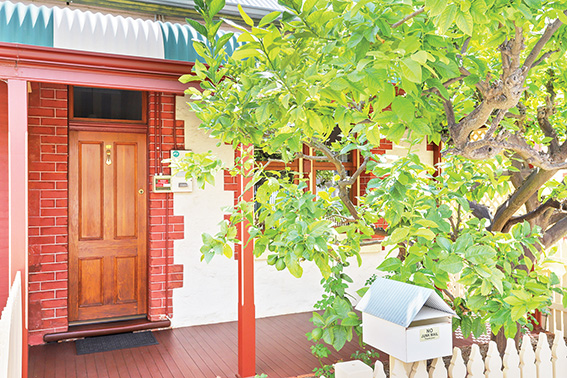
    When the owners moved into this 1890 cottage on Bellevue Terrace, it was in need of a lot of TLC.

    They replaced floorboards eaten by white ants with Tasmanian oak sourced from an old school, and old ceiling roses were restored or replaced with perfect replicas.

    While the floors were being replaced, a huge cellar was dug under the home.

    by JENNY D’ANGER

    59 Bellevue Terrace,
    Fremantle
    auction March 21, 12 noon
    Barbara Roberts
    0477 172 240
    Acton Fremantle 

  • Transformed courtyard yields urban crop

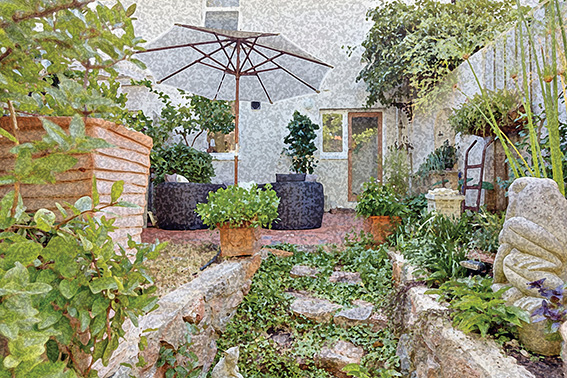
    THE Fremantle Doctor tickles at the tree tops that protect a small, limestone walled garden. Leaves rustle in a soft symphony of appreciation.

    The setting could be southern Europe, so magical has been the makeover of a dusty, exhausted patch of ground in Palmyra.

    In only eight months, senior citizen Lorraine Burke has transformed the once-neglected courtyard at the rear of her rented villa from rubble into an edible garden.   

    From the moment Lorraine took possession of the property, she visualised a garden room where she could entertain friends and grow pesticide-free, edible greenery. 

    Rescue

    To rescue the small back yard, Lorraine dug out the rubble and scant patches of buffalo grass. Then, with a mallet, she and her son broke up and loosened the hard, compacted soil. 

    The next task was to level the area in preparation for laying pavers. At this stage, Lorraine had none. But she drew out a plan for how she would like paving to be laid and went online to look for freebies. 

    Hunting for free or low-cost pavers, Lorraine found some south of Warnbro at a limestone paving company. She needed more and found terracotta coloured pavers north of Perth at Greenwood.

    Singlehanded, in five back-and-forth trips she transported them to her villa. After drawing a plan for how they should be laid, another one of her sons helped her place them. 

    The excitement and pleasure of seeing the courtyard take shape flowed over to Lorraine’s friends. One joyfully provided an unwanted outdoor round slumped-glass table, an original created by a Fremantle glass artist. 

    To attract birds, the same friend provided a ceramic bird bath on a sculpted concrete stand. Chairs followed. Table and chairs were free, except for a grouping of cheerful blue and white chairs bought from a nearby chain store. 

    While the courtyard was undergoing its makeover, Lorraine’s potted blueberry bushes were fruiting. 

    Ever the hostess with the mostest, Lorraine resisted picking the fresh crop, keeping these for me to try. Tasting blueberries right off the bush was a first for me: how sweet they are! I felt so privileged, especially as I knew they were organic.

    Lorraine had invited me to lunch and I was treated to a garden salad grown in this magical space with some extra luxuries, such as camembert and brie cheeses. For dessert, an almond meal cake emerged from her kitchen, so delicious yet so healthy. 

    Munching like a spoiled rabbit, I was in awe of how an exhausted patch of dirt had succumbed to Lorraine’s creativity. She’d seemingly conjured a charming garden room and was cropping blueberries, tomatoes, watercress, celery greens, fennel, basil, mint, lemon grass, chive, aloe vera and lettuce: all growing in pots. 

    Lorraine mainly uses her current crops in smoothies, pestos, salads and soups.

    More plantings will take place over time and she already has some robust looking pumpkin seedlings almost ready for in-ground planting. Next will be potatoes. She also plans to introduce a bee-hive: one that releases the honey without interfering with the bees or the hive structure. 

    Her efforts prove that a small space can yield a lot pesticide free food for any size family. 

    Wanting to avoid toxic pesticide use, Lorraine has gathered bargain-priced potted calendula {marigold) plants and placed them throughout her garden. As well as being a companion plant that keeps pests away, they form an uplifting tapestry of orange and yellow blossoms. 

    The calendulas are the first plants to be noticed when entering her garden room, so the viewer’s eyes are greeted with instant joi de vivre. 

    Lorraine believes no one is too old or too young to have a go at growing their own. There is little cost if plants and cuttings are shared. She has also found bargains at garden centres and markets. Scouring the roadside collections is a way of rescuing treasures and even plants, she advises. 

    Needing to upgrade her compost pots, she found a bin at Fremantle’s recycling centre: another freebie. All her food scraps go into it. 

    Lorraine has a way of telling herself what she needs, and then, voila, it manifests.

    by COLLEEN M WEST

    ———————

    What’s your garden story?

    HAVE you created a healthy haven from the world, even in a tiny little courtyard? Or have a friend who’s green thumb inspires you? A story about a favourite (or secret) garden from years ago? We’d love to hear about them as well. Send us an email at news@perthvoice.com or give us a call on 9430 7727.

  • If only toilet paper grew on trees…

    THE functional limitations of Perth’s grocery supply chains have been exposed by the recent shortages of rice, beans and even toilet paper, and in response many people are beginning to wonder if it’s too late to plant a garden in order to ensure some measure of self-sufficiency if there’s a Coronavirus lock-down.

    I always tell people that it’s never too late to plant a garden, and as current WA Health Department modelling has the Coronavirus outbreak peaking in WA around August of this year, there is more than enough time to get some decent amounts of food happening in your backyard by the time a trip to the supermarket becomes something many will want to avoid.

    In this brief guide, we will focus on two broad groups of things to plant; those which give the quickest result, and those that will yield a useful harvest of food.

    In order to be successful, ensure that you have at least the basics for a successful garden prepared, such as sufficient sunlight, weed-free and nutrient enriched soil and measures in place to keep pests away from your precious food. 

    Even if you’re just pulling up a patch of grass to repurpose as a garden bed, mixing in a few bags of organic potting mix with your existing soil will be a start, as well as aerating and refreshing your soil that may have been locked up under grass for decades. 

    Raised garden beds are even better if you can buy or make them, but many people have success with foam eskys and even large buckets with drainage holes in the bottom – your imagination is the limit here, aesthetics can wait.

    The first group of plants to get you started is leafy greens and Asian greens – think spinaches, silverbeet, lettuces, bok choi and tatsoi. 

    The key advantage of these, especially the Asian varieties, are that they grow fast and can be picked at an early stage if need be, or left to grow larger before harvesting. 

    Some greens will be ready in just over a month, and can be eaten as sprouts if things get desperate, or mixed in with smoothies if you prefer.

    Enjoyable

    The second group is plants that not only provide a decent crop, but are enjoyable to eat frequently. 

    For this reason, I don’t include radishes on the list, which add zest to salads and dishes but would be unfortunate to eat as a meal on their own every day. Beans and peas are definitely on the list though, as they are easy to grow, even in pots, don’t take up much ground space, can be eaten fresh, cooked or stored, and produce loads of seeds to ensure an ongoing supply. 

    Beetroot and carrot are probably the most difficult to grow out of this group as they need properly prepared garden beds with nice, loose soil, but fortunately grow underground away from most pests.

    Another crop to consider is potatoes, however there is a risk of introducing soil diseases by growing supermarket-bought spuds, so it’s worth considering certified seed potatoes from a garden centre.

    That being said, this still entails a small amount of risk that perhaps should be avoided for now. 

    Broccoli, cabbage and cauliflower are also great food crops but are more susceptible to pests so require more care and are therefore not recommended for beginners.

    by JUSTIN STAHL

    QUICK, EASY VARIETIES
    Beans (bush, climbing, broad and borlotti)
    Beetroot
    Bok choi
    Carrot
    Catnip (for lockdown laughs)
    Chard
    Kailaan
    Kale
    Lettuce
    Peas (snow and sugar snap)

  • Blanket heritage splits city

    BLANKET heritage zones may be applied to Bayswater and Maylands town centres.

    Dozens more individual properties have also been added to Bayswater council’s heritage list despite many owners saying they were not alerted.

    Huge dissent preceded the vote at Bayswater council’s February 25 meeting, with one deputation after another calling for the Baysie town centre heritage area to be scrapped.

    Councillors were also divided, with Michelle Sutherland saying the blanket heritage zones had already scared some investors out of town.

    • Councillor Filomena Piffaretti didn’t support the heritage zone and tried to get the item deferred.

    Sold up

    “I do know late last year some landowners in Maylands, on Guildford Road, had sold their properties because they’d heard about this and they got out,” Cr Sutherland said.

    Respect Bayswater’s Heritage Heart member Keith Clements fronted the meeting to support the plan, saying most locals valued the town centre’s history.

    But others were furious the city was ploughing ahead with its blanket declaration.

    “It’s clear that no business or property owners were consulted,” said pharmacist Greg Da Rui. 

    Future Bayswater chair Paul Shanahan told the Voice he has a number of concerns about the plan, saying red tape would discourage investment and constrain revitalisation of the town centre – “a very important Metronet precinct where the government will spend over $200m of taxpayers’ money”.

    Mr Shanahan said businesses were already struggling, with several shops vacant, other businesses up for sale and nearly everyone else struggling along.

    “It is clear that there was no community momentum for this heritage area to be formed in the first place, while all community submissions were nearly unanimously against the proposal when it was advertised by council,” he said.

    Mr Shanahan says news of the consultation only spread through word of mouth and when property owners looked into the proposal they were very unhappy.

    “Sufficient heritage protections already exist for individual places…there is no need for another layer.”

    Cr Filomena Piffaretti moved to defer the item but with a 4/4 split mayor Dan Bull used his casting vote to push it through on the night. 

    Eventually councillors voted to proceed with heritage listing the Maylands town centre, but will only ask the WA government’s Metronet developer Development WA to adopt a heritage zone over Bayswater and work with the council on guidelines.

    It has yet to flesh out the details of how the heritage areas would work and the areas aren’t yet fully defined. 

    A staff report said heritage areas don’t stop all development: “The designation of a heritage area is intended to conserve and enhance the existing places that contribute to the cultural heritage of an area. This does not preclude alteration of or addition to places that contribute to this cultural heritage. Similarly, it would not preclude the demolition of places that are considered to make no contribution. However, any new development would be required to respect and enhance the cultural heritage of an area, which can still be achieved while accommodating modern buildings and higher density of development.”

    Crs Lorna Clarke, Catherine Ehrhardt and Barry McKenna declared a financial interest and did not vote because they owned properties in the municipal heritage inventory.

    by DAVID BELL

  • Owners say they weren’t informed

    ALONG with the two town centres, a split council also voted to apply heritage classifications to dozens of individual properties.

    Those rated category 1, 2 or 3 are added to the official “Heritage List” in the town planning scheme and need planning approval to make changes. Category 4 and 5 are included in a “survey” with a note calling for heritage to be recognised and interpreted “if possible”.

    Deputy mayor Filomena Piffaretti said there were problems with an unnamed consultant’s report and she couldn’t support its recommendations.

    “We do not have an accurate report. The quality of the external consultant’s report is very lacking…it’s not robust enough,” she told the February 25 meeting.

    Many owners affected by listings complained of not being alerted, while some disagreed with the report’s findings.

    “I also do not feel comfortable supporting the inclusion of private residential properties where the owners are not supportive of this and have demonstrated that there are inaccuracies specifically with their properties assessment in the report,” Cr Piffaretti said.

    Bayswater City Soccer Club president Gerry Maio said he wasn’t aware their home ground Frank Drago reserve was proposed to have its listing upgraded from category 5 to category 3, which would put it on the official heritage list and calls for the clubhouse’s original fabric to be retained.

    “When I got a phone call this afternoon telling me this situation was happening, I couldn’t believe it,” Mr Maio said.

    Ridiculous

    “It’s just ridiculous, but the most important thing for me was the secrecy of not telling us, not warning us what this council’s…intentions were. For me, I feel very disappointed.”

    Cr Piffaretti said she was astounded the club didn’t know given they’d been working with city officers on a multi-million dollar redevelopment.