• Water-free Waterland? 

    MAYLANDS Waterland could become Maylands Landland, with plans afoot by Bayswater council to get rid of the pools.

    Maylands ward councillors Elli Petersen-Pik and Catherine Ehrhardt are dead against the plan and want the pools to stay.

    A couple years back the city was looking at closing the pools because they were in need of expensive refurbishment and it cost a lot to keep them running.

    They held an intensive community consultation process costing $50,000 and the message from participants was loud and clear – Waterland should stay.

    In June last year councillors approved a $3.2 million plan to restore Waterland, which included a new cafe. So far they’ve spent $20,000 on design work and $50,000 on consultation.

    This week the draft budget was released, and a single seemingly innocuous line item could spell doom for Waterland – instead of money for an upgrade there’s a proposal for a regular, open playground.

    • Youngsters having a splash at Maylands Waterland in 2016. File photo

    Cr Petersen-Pik says: “The community has been consulted and made its views clear. Two public commitments to keep the Waterland have been made. Ratepayers money has already been spent. Nevertheless, a closure is now being proposed without explicit justification for the change.”

    “Such a major, irreversible decision should not be mentioned in one line in the budget papers”.

    He cites attendance figures from the past few years, saying they show increasing popularity, with 29,000 people visiting in 2015-16 and nearly 36,000 last summer.

    “Maylands Waterland is a unique facility in the whole of the state, if not the whole of Australia,” said Cr Ehrhardt.

    “At a subsidy of $5.50 per head that’s not too bad in terms of public enjoyment.

    “It is really important that local governments think about service provision as a core role rather than trying to be a business entity. If we did that, there would be no Bayswater Waves, which loses around a million dollars a year and is currently in a staged $12 million redevelopment, and we certainly wouldn’t have any libraries or such.

    “The community spoke, and the majority said they wanted Waterland.”

    The budget is due to be voted on Tuesday July 3 at 6.30pm. Cr Petersen-Pik is urging anyone who wants to save the Waterland to come along and speak up during public question time.

    The Voice contacted Bayswater council, but they didn’t get back to us.

    by DAVID BELL

  • Collins in the mix

    WITH the Liberals not running a candidate for the federal seat of Perth, Liberal party member Paul Collins has announced he’ll stand as an independent.

    A former Stirling councillor and current president of the Mt Lawley Society, Mr Collins says he’s a Liberal party supporter primarily because of their pro-small business policies.

    But he hasn’t always agreed with the party line, having gone against Liberal doctrine by opposing local government amalgamation, and he disagreed with the party’s decision not to field a candidate in the July 28 by-election.

    “I’m very disappointed that they have effectively abandoned the people of Perth,” he says.

    “However the decision gives a person like me the opportunity to stand as I have always done, as a community candidate.”

    “I understand who my stakeholders are,” he says.

    “When I was a Lawley ward councillor from 2007 to 2011, there were plenty of times when I disagreed with the decisions of the Liberal government at the time.”

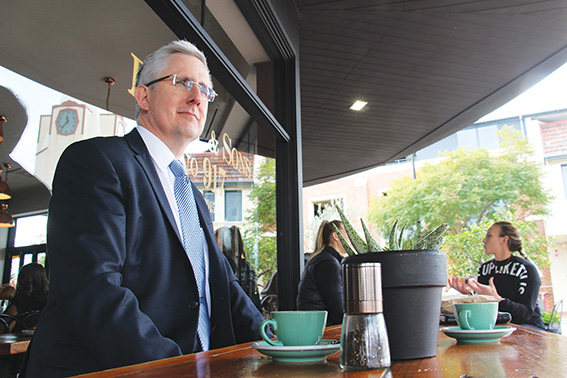
    • Paul Collins on his beloved Beaufort Street, just near the Civic clock tower. Photo by Steve Grant

    Policy-wise, he wants a floor on the GST return to WA. Last year we got 34 cents back for every dollar sent to Canberra. He wants a minimum of 70 to 80 cents. Federal Labor policy is for a 70-cent floor.

    Mr Collins worked as a lawyer and is currently a property consultant with his family’s CBD-based real estate business.

    He opposes abolishment of negative gearing, saying most people benefiting from it don’t fit the millionaire, property mogul stereotype.

    “I can say that they’re not millionaires. People have one or two residential properties at most, and that would be 90 per cent of our clients. People fall in love, and they’ve each got a unit or villa, and they say ‘let’s not sell it, let’s rent it out’.”

    He says if negative gearing goes that’ll mean fewer places available for renters and rent prices will soar.

    “I think I’ve got the best credentials to represent the community,” with a multi-generational link to the area: His great grandfather drove the Perth to Midland train line and was born in St Anne’s Hospital in Mt Lawley, living in the electorate for 40 years.

    In the 2016 election Liberal Jeremy Quinn won the primary vote – 42.3 per cent to Labor candidate Tim Hammond’s 37.4 – but preferences carried Labor over the line.

    With no one officially donning blue this by-election, Labor’s candidate Patrick Gorman remains the front runner with the bookies.

    by DAVID BELL

  • Can’t beat it

    WA-BASED filmmakers working on a project that has a social or community impact have a chance to snag a $12,250 grant next month.

    The grant is part of the Brian Beaton Award, with the recipient announced at the 2018 Screenwest Industry Celebration on Wednesday July 18. Applications close on Monday July 2. Submission details at http://www.revelationfilmfest.org/brian-beaton-award.php

    by MATTHEW EELES

  • CBD mutt crackdown

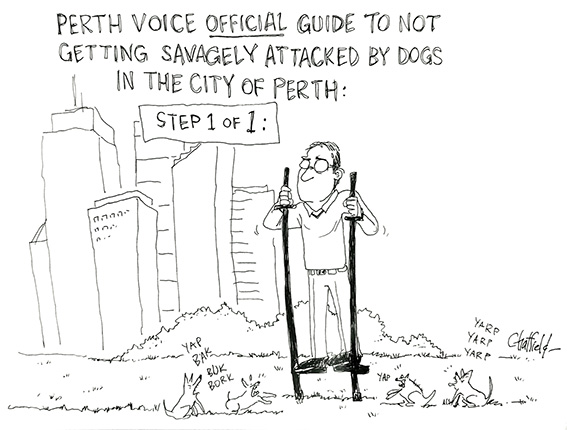
    PERTH council rangers are cracking down on irresponsible dog owners who can’t control their pets.

    While many designer inner-city pooches aren’t much bigger than your common rat, there was a bad dog attack in Northbridge on April 28.

    A man on Francis Street was attacked by a large hound described as either a pitbull or staffy cross, and had to go to Royal Perth Hospital to get 57 internal stitches. The owner walked off.

    In the wake of the attack, City of Perth commissioner Gaye McMath announced: “The city is taking an active stance to ensure owners are compliant with regulations to reduce the risk of anyone being bitten, or other dogs being attacked.

    “The initial phase of the operation will be educational, focusing on identifying breaches and discussing issues with owners.

    “Any continued breaches will then be met with infringements being issued.

    “Rangers are taking this action to make parks and reserves as safe as they can be for people, especially children.”

    Rangers will target dogs that are off-lead in leashed areas and ensure they are microchipped and registered.

    by DAVID BELL

  • Too much to Bear

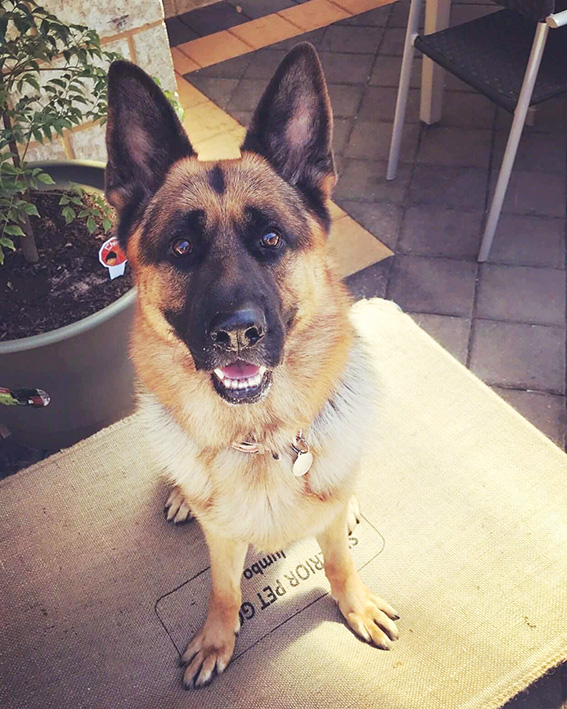
    BAYSWATER councillor Brent Fleeton will resign on June 29, saying the role is so demanding he’s had to rehome his german shepherd, Bear.

    “Being a councillor is a tough and interesting job,” his statement read.

    “When I ran for election in 2015 I didn’t fully appreciate what the role entailed.

    “The complexities and the demands were something I was happy to carry while raising issues I campaigned on and pressing the city on things I believe a lot of people cared about in the wider community.”

    • Cr Brent Fleeton and his beloved German Shepherd Bear.

    “Over the past few weeks I have increasingly found myself working long days and nights setting up my own business. That meant I was not dedicating sufficient time towards the role of representing ratepayers and residents in the city of Bayswater. Add in the goal of trying to be reasonably healthy and staying mentally fit, something had to give,” Cr Fleeton said.

    It got to the point where he didn’t have enough time for his beloved dog: “I’ve had to send my best mate Bear up to live with my parents in Geraldton because the late nights meant I couldn’t look after him properly. This was a hard decision to make, considering his german shepherd good looks featuring in my campaign photos probably won me those extra 54 votes to get me over the line!”

    A postal by-election has been scheduled for later this year and Mr Fleeton says he feels bad about throwing in the towel, but hanging around is “not fair on the community I am supposed to be serving week-in week-out, to be increasingly disengaged from what’s happening locally.”

    Bayswater mayor Dan Bull acknowledged Mr Fleeton as “a firm believer of transparent and open governance”, who’d focused on ensuring local government sticks to its core focus.

    His new business will partly involve helping small companies navigate the bureaucracy of local government.

    by DAVID BELL

  • ‘We can’

    My mum, she was a strong lady, a cultural lady,” says Evelyn Mitchell.

    “She helped us, talked to us and taught us, she put us on the right track.

    “The big role of the woman is holding the family together.”

    The role of Aboriginal and Torres Strait Islander women as leaders, trailblazers, politicians, activists and family caretakers is celebrated in this year’s NAIDOC Week, which has the theme “Because of her, we can”.

    Perth photographer Sasha Mortimore says she decided to get involved in telling those stories after recently having a child.

    “I think it’s important to tell their story and our story as women,” she says.

    “There’s so many different things we can do that we couldn’t do before and it’s because of women from the past and their ancestors and our ancestors.”

    Feeling inspired, Ms Mortimore decided to get in touch with Anne Mitchell, who she hadn’t seen in more than 20 years.

    “We were at school together when we were about 12, and I had this idea for a project in relation to her family, because I knew they had in interesting story.”

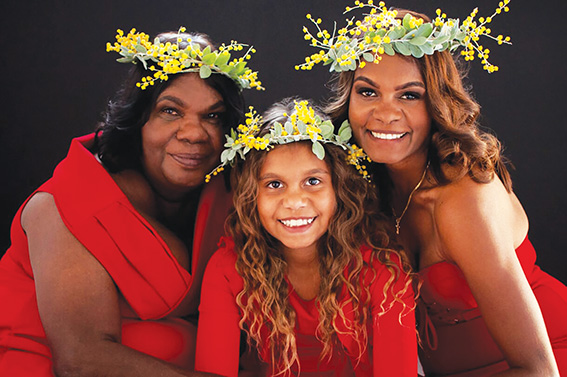
    • Grandmother and Nyangumarta woman Evelyn Mitchell is featured in a generational photograph alongside her daughter Anne and granddaughter Dana as part of this year’s NAIDOC week. Photo by Sasha Mortimore

    Ms Mortimore photographed three generations of women from the Mitchell family – Evelyn, Anne and Dana – using the colours of the Aboriginal flag.

    “My favourite image is the three generations looking towards the light and they are stacked on top of each other and they have little white dot paintings on their faces and wattle flower crowns,” explains Ms Mortimore.

    Evelyn Mitchell shared her family’s story with the Voice.

    The Mitchell family are originally from Port Hedland, and both Ms Mitchell’s parents were heavily involved in fighting for the rights of her people.

    Throughout her life, Lucy Mitchell was a prominent activist involved in native title and land rights protests.

    “My mum, she was a strong lady, she been in the strikes and she go to meetings and AGMs and talk about things: She wanted to help her younger ones,” Ms Mitchell says.

    “We are the traditional owners you know, so we wanted the government to recognise us.”

    Ms Mitchell says in her culture, women are the workers.

    “We do more work than the men. Us women are strong in culture,” she says.

    “Mum taught us to teach our grandchildren, teach our younger ones. My big sister Doris and I, we stay strong and stay on track like our mother.”

    Ms Mitchell says something powerful happens when women come together.

    “We always go off, ladies, and talk amongst each other.

    “Talk about it, what we going to do and how we going to help our younger ones, that’s why we strong.

    “It doesn’t matter what language we talk, you know when we get together and follow our dreams.” Ms Mortimore is currently seeking a space to exhibit her photos.

    by MOLLY SCHMIDT

  • Life in focus

    FREE films celebrating Aboriginal women will be screened daily in Perth city centre during NAIDOC week.

    The Goologoolup NAIDOC screenings reflect this year’s “Because of her, we can” theme, honouring “the invaluable contributions that Aboriginal and Torres Strait Islander women have made – and continue to make – to our communities, families, and country”, says the organisation.

    Darlene Johnson’s The Redfern Story traces the 1970’s story of a group of Aboriginal activists hailing from Redfern in Sydney, who created Australia’s first Aboriginal theatre company, National Black Theatre, and used the arts as a platform to protest for equal rights.

    A Dunghutti woman, Ms Johnson says she spent her early childhood in Redfern, immersed with “eclectic and politically motivated people”.

    She says as a child she would dance on the table while her mother engaged in political discussions and played music with the actors.

    Forty years later she was inspired to tell others about the “strength and motivation of a group of Aboriginal people who came together to address big issues and fight for a chance.”

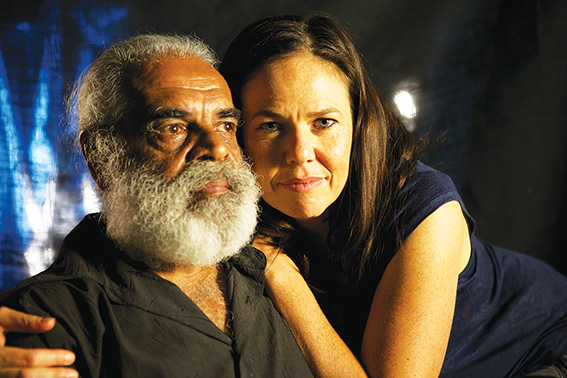
    • The Redfern Story director Darlene Johnson with actor Bindi Williams. Photo supplied

    “In the period when the National Black Theatre was set up, Redfern was the largest blackfella community in all of Australia, with over 20,000 people,” she says.

    “People came from all over the place to join forces and rather than just ending up in land rights marches and being bashed by cops they decided to use theatre as a political tool to get their message across.”

    The theatre company’s grassroots approach combined street performances, dance, demonstrations and workshops as tools to highlight the systematic oppression of Aboriginal Australians.

    Ms Johnson says the movement paved the way for cultural, social and political change in an extraordinary legacy that still has an impact for her people today.

    You can catch The Redfern Story at the State Theatre Centre at 2:30pm on Saturday July 14, and a variety of other films from the NSFA Black Screens collection and the WA Indigenous Community Stories collection, on July 8-12 at 12:15pm at the State Library Theatre.

    by MOLLY SCHMIDT

  • Leading the way

    TWELVE diverse community-driven projects have been given the green light by Vincent council.

    A spruced-up dog park in Highgate and a mountain bike track in Mount Hawthorn are just some of the fun projects that have been approved for funding.

    It’s the third year the city has run an open budget program, letting locals pitch ideas on how to spend council money.

    About 1 per cent of the city’s $340,000 rates revenue will go towards the projects this financial year, with others having money pencilled in for future budgets.

    A $25,000 upgrade to Jack Marks dog park is one of the projects that has been approved.

    Currently there’s just a couple of old bench seats there, so local pooch owner Joshua O’Keefe submitted a petition on behalf of the tight-knit dogwalking community that gathers there every afternoon.

    • Joshua O’Keefe (right) with the Jack Marks Dog Park community. Photo by Steve Grant

    “[The benches] under-cater for the needs of the park users given that sitting on the grass is quite unhygienic for obvious reasons (dog pee and poo)”, Mr O’Keefe said. They’ve asked for more sociable, semi-circular-seating and new paving to liven it up a little.

    He says it’s a simple improvement that will help the area become a community hub.

    Mr O’Keefe notes that “in a world which is incredibly ‘plugged in’, it’s hard to find a place in an urban setting where people can be bothered to look up from their phones and talk to one another. Actual strangers, talking. Jack Marks dog park is one of those places”.

    “The park has transformed itself from simply a corner park into a social hub of activity attracting not only local residents and their fur children but those from afar who – as a bonus – also get to experience the Vincent offering of nearby Beaufort Street and the Mount Lawley town centre when they visit the city.”

    Seven ideas were approved in full and five had parts of their proposal supported.

    Council also gave the preliminary thumbs up to a plan to install a mountain bike track on the green space on the west side of Britannia Reserve.  It’ll be a little while in the making – the $150,000 is tentatively scheduled for the 2020/21 budget – and it’ll be subject to it fitting into the long-awaited Britannia Reserve masterplan.

    by DAVID BELL

  • England v itself

    WORLD CUP RUSSIA 2018

    LIKE a middle-aged woman on Tinder who’s been through decades of heartbreak, England arrived in Russia with low expectations and their emotions guarded.

    Since England last lifted the Jules Rimet trophy in 1966, the national team has endured 50 years of hurt on the world stage, including some excruciating penalty shoot-out losses.

    Even at the World Cup in 2006 when they had the “golden generation” in their ranks – Beckham, Scholes, Gerrard, Lampard and Rooney – the Three Lions limped out at the quarter final stage.

    It seems being an England supporter has become an exercise in sadomasochism.

    But could this be about to change in Russia? Do England fans dare to dream again?

    The Poms won their opening two group matches, securing a place in the last 16 with their biggest ever World Cup victory – a jingoistic 6-1 thumping of Panama.

    Optimism is beginning to filter through Wellington’s ranks again.

    But will it be déjà vu when they reach the quarter finals; collapsing to the ground, draped in the Union Jack, to the strains of Elgar, after another agonising defeat?

    That thought must be lingering in the back of every supporters’ mind.

    Maybe this half-century malaise goes beyond players, tactics and groin strains.

    Maybe it goes right to the heart of Britain’s national psyche?

    A psyche best described by author Martin Amis.

    He noted that in an American novel if a man met a woman he fancied at a swimming pool, he would brazenly stride over and ask her out.

    In an English novel the next 30 pages would be about the man agonising over whether he should give her a call or not.

    In crucial moments does the English subconscious whisper; “We’re going to blow this, old chap”, instead of roaring; “I’m gonna win”?

    Historically the English have been an introspective bunch; a trait moulded by assiduous drizzle forcing people indoors to ruminate.

    It’s no accident that some of the world best bands hail from rain-sodden Manchester and Liverpool, where teenagers spent years in their bedroom practising guitar and fine-tuning their angst.

    The English press hasn’t helped the national team’s cause either. Decades of hype and a level of media scrutiny normally reserved for NATO war criminals has heaped inordinate pressure on players’ shoulders.

    By the time they get to the World Cup they are already wetting their pants about misplacing a five-yard pass.

    That scrutiny reached its preposterous nadir in the build up to the 2002 World Cup, when Fleet Street went completely berserk over David Beckham injuring his metatarsal.

    The media coverage was akin to a civilisation-ending meteor strike.

    And when things do start to go wrong, the tabloids round on their victim like blood-thirsty hounds in a fox hunt.

    In 1993 The Sun’s front page featured a picture of Graham Taylor’s face superimposed onto a turnip after he resigned as England manager.

    He had been nicknamed “Turnip Taylor” by the newspaper  after England’s defeat to Sweden at the European Championships a year earlier, and the media successfully campaigned for him to go.

    It was cruel nickname that would stay with him until his death in January last year.

    Some commentators argue that England’s malaise transcends sport and the country has been in free-fall since the fall of the British Empire in the first half of the 20th century.

    • The Sun’s front page after Graham Taylor resigned as England manager in 1993.

    “We [England] lead the world in decline,” Amis told Newsnight in 2012.

    “…We rose earlier than any other country, with the exception of Holland, perhaps.

    “We had our revolution a century before the French and the Americans.

    “We were further along, and we’re further along in decline.”

    Rabbit hole

    Maybe I’m going down a Freudian rabbit hole and it’s as simple as other countries have better players than England. Who really knows.

    But with expectations low and a fresh approach from new manager Gareth Southgate, maybe, just maybe, England can do it this time and bring the World Cup back to the hallowed shores of Blighty.

    At the time of going to print on Wednesday (June 27), The Three Lions were due to play their final group match against Belgium on Friday at 2am.

    by STEPHEN POLLOCK

  • LETTERS 30.6.18

    Take a stand
    DROUGHT: the word causes shivers of fear in many Australians, particularly those in the bush.
    A 2015 poll found that people were more worried about drought than any other consequence of climate change.
    Now farmers are complaining that the big dry means that they are having to “de-stock” or, in plain English, kill thousands of animals even earlier than they would usually be killed.
    Meat and Livestock Australia have revised the number of lambs that will be slaughtered this year to 22.85 million, while sheep slaughter is expected to reach 7.8m.
    That’s more than 30m animals, most of them little more than babies. Many of these animals will have suffered barbaric treatments such as mulesing, ear-tagging and castration, and will have been repeatedly mutilated during shearing.
    The Climate Council has concluded that droughts are likely to worsen in severity and duration in southern Australia if greenhouse gas emissions are not cut deeply and rapidly.
    The quickest way to achieve this is to eliminate the wool and sheep meat industries. These businesses add significantly to greenhouse emissions through “enteric fermentation,” or animals belching and passing gas, as well as causing vegetation change and soil erosion and water pollution through faecal contamination and sheep dips.
    For the farmers it’s an easy equation: if you can’t feed them, don’t breed them. The rest of us can take a stand for animals, and help to preserve natural ecosystems by not buying woollen garments and not eating baby lambs.
    Desmond Bellamy
    PETA Australia, Byron Bay

    Promises…
    LABOR leader Bill Shorten was in Perth recently and again promising voters another $400 million.
    Mr Shorten and the Labor party has already stated – regardless of what the productivity commission report recommends – that he and his Labor colleagues will not vote in favour of the change in either house of parliament.
    So anything Mr Shorten offers to WA is only an offer.
    So the $2 billion offered by Mr Shorten could be somev time in the future.
    The voters in upcoming by-elections in Perth and Fremantle need to send a message to both Labor and the Greens that WA will not accept anything less than 80 per cent of our GST allocation.
    WA will never get their true allocation of GST because the Labor party and the Greens have already stated they will block any change to the GST that affects other states.
    Remember Victoria and NSW do not have to pay GST on their income from the poker machines, which equates to hundreds of millions of dollars each year that WA doesn’t receive.
    We should not be fooled by Mr Shorten’s promises, because we know where WA Labor promises have got us in the past.
    Steven Cruden
    Witts Lane, Kwinana Town Centre