• An Englishman abroad

    RICHARD OFFEN says he is busier than ever since stepping down as executive director of Heritage Perth.

    The English ex-pat was in the role for 12 years, but is now doing a lot of heritage talks and is flat-out working on the follow-up to his hit book, Perth: Then and Now.

    On March 26 he’ll be sharing some of his favourite historic tales in An Audience with Richard Offen, hosted by ABC journo James Lush.

    “I’ve always maintained that what makes WA history so fun is that it was a pioneer state,” Mr Offen says.

    • Perth’s favourite heritage uncle Richard Offen. Photo by Steve Grant

    Post-colonial era

    “People were miles and miles away from officialdom and they did what they wanted and got away with it.”

    Perth’s post-colonial history was appealing to Mr Offen because the city was being developed in an era of widespread literacy, and that’s left us with a lot of documentation compared to people in early London, then called Londinium, about 2000 years ago.

    “When they came here in 1829 there was a much higher degree of literacy than say 200 years earlier when the British colonised North America; therefore we’ve got far more contemporary evidence of what life was like here,” Mr Offen says.

    “While much of his research has been on the more heavily documented post-colonial era, he has a deep appreciation for the older local histories.

    “He says the continuation of people living on this spot across more than 50,000 years could well make us the oldest city in the world.

    “I find it very humbling … to listen to an Aboriginal story that’s been told for 20,000 or 30,000 years, is mind-blowing in my book.”

    “It wasn’t until I got here and got to know people like [traditional owners] Noel Nannup, Richard Walley and Len Collard that I started to understand how awe-inspiring that history is.”

    Mr Offen moved to Perth 13 years ago and says it sometimes takes an outsider’s eye to show people what they’ve got on their doorstep.

    An Audience with Richard Offen is at St Georges Cathedral (38 St George’s Terrace Perth) on March 26 at 6pm, tickets available at http://www.heritageperth.com.au

    by DAVID BELL

  • LETTERS 24.3.18

    So, what’s the plan?
    THE Rethink the Link campaign worked really well.
    There was only one major flaw—they didn’t have a viable transport solution instead of the Roe 8/9 project.
    Their campaign was emotive not factual:
    “Save our wetlands and our animals”. Building a bridge over the area and closing Hope Road would have done this. Instead, the current plans force rat runs all through the area, and increased traffic means increased road kill and emissions.
    Instead of using reserved land to build the link, let’s destroy Cockburn Sound instead. Why on earth would they wish to destroy a large marine ecosystem and native bushland to build an outer harbour and port area, especially as the current port in Fremantle is at 50 per cent capacity.
    “Don’t build Roe 8 we don’t need more roads”. So instead let’s just duplicate all the roads around the wetlands and build the biggest roundabout on Leach/Stirling Highway, destroying homes. While not removing any of the trucks/traffic congestion from Leach highway. For trucks/road trains to safely go around, this roundabout will have be massive. Wouldn’t a tunnel beneath the area be so much better?
    It would remove the trucks off the highway, and decrease traffic and we wouldn’t need a roundabout.
    But, hey, let’s just Rethink the Link because this sounds better than a federally-funded, planned, approved, safe and viable transport infrastructure that the state didn’t have to pay for. It would have created jobs and future revenue.
    If the Rethink the Link campaign results in an outer harbour it will end up being one of the most environmentally damaging campaigns ever run.
    And that doesn’t even begin to mention the billions of dollars of WA taxpayers money paying for the bandaid ‘rethink’ traffic solutions.
    Lorna Hardy
    Bibra Lake

  • A right to seek refuge

    DR TOM VOSMER is a maritime archaeologist who lived and worked in the Middle East for decades.

    Grappling with a refugee crisis of boat people after the end of Vietnam War, the Fraser government was offered some options for dealing with it:

    1.Reprovision and refuel all boats, tow them beyond the three-mile limit and encourage them to find some other country to land in.

    2. Treat boat refugees almost as lepers, segregating them into special camps and giving them minimal standards of support.

    3. Construct a major holding centre in some very remote area … and hold them in such a camp indefinitely.

    The Fraser government rejected these and all similar suggestions, declaring

    ‘We will not risk action against genuine refugees just to get a message across. That would be an utterly inhuman course of action.’

    That message was heeded, with Immigration demanding procedures ‘consistent with Australia’s international obligations.’ The United Nations High Commissioner for Refugees noted ‘a high degree of compassion, interest and preparedness to help’ the boat arrivals.

    How far we have fallen. Our current and previous governments have enthusiastically embraced all three of those odious suggestions.

    Current asylum seeker policy amounts to deliberate punishment of vulnerable people and holding them in remote and inadequately equipped detention centres just to ‘send a message’.

    Dispensing cruelty and uncertainty to the helpless is counter to everything Australia allegedly stands for. ‘Saving lives at sea’, the banner vigorously waved by government, is just an empty slogan; there are many ways to save the lives of refugees at sea other than by punishing the victims themselves.

    The government may have a mandate to stop the boats, to put the people smugglers out of business, but must we enforce that mandate by inflicting long-term incarceration and distress on innocent people whose only act was to try to escape danger and persecution?

    It is commendable that Australia has taken positive steps to reduce its number of refugees in detention, and that it has even increased its total refugee intake, but the issue of those people who arrived by boat remains, gnawing at the very humanitarian principles we supposedly defend.

    There was a time when our government encouraged us to understand and sympathise with refugees and the situations in which they found themselves, and to understand our obligations in regard to refugees under international law.

    But under John Howard’s leadership during the Tampa incident that all started to change.

    These people, we were misleadingly told, ‘could be terrorists, these people throw their children into the sea, these people will take our jobs.

    These are not the kind of people we want in Australia.’

    Due to government secrecy and spin a great deal of misinformation still swirls around the issue of asylum seekers and refugees. First is the sticky tag of boat people being labelled ‘illegal maritime arrivals’.

    There is nothing illegal about seeking asylum, by whatever means. The mode of transport should not be a determinant of refugee status.

    Immigration minister Peter Dutton states that there are no children in detention.

    That is disingenuous, a semantic trick, labelling the facilities on Nauru as ‘processing centres’, not detention centres.

    There are still about 150 kids on this island nation, which is barely larger than Rottnest (some have ‘celebrated’ their fifth Christmas there).

    There is a parallel on Manus: that detention centre has been closed and hundreds of refugees forcibly moved to ‘transitional accommodation’.

    The government claims there are no refugees in detention on Manus, but where are the hundreds being held there being transitioned to exactly?

    Being trapped on Manus or Nauru, whether confined to a processing centre or not, is anyone’s definition of detention.

    As of October 2017, the number of children detained on Nauru was:

    • OPC 3 Camp (the old tented detention camp on the white gravel) – 52
    • EWA Camp – 22, aged 2 to 18 years
    • Nibok Camp – 20, age 1 to 15 years
    • Anibare Camp – 3, age 7 months, 2 years, 12 years
    • Eloo Camp – 12, including four 2-year olds
    • Anijo Camp – 51, aged 6 months to 18 years

    Deprivation of any semblance of a normal childhood is proven to lead to the development of significant psychological and social problems that can persist throughout a lifetime.

    The Nauru files (leaked in 2016) included over 2000 incident reports by staff; 1086 involved children and included sexual abuse, but by late 2016 nobody had been charged for these abuses.

    The Committee for the Rights of the Child and the UNHCR’s specific guidelines for asylum-seeking children emphasise that immigration detention of children must primarily have an ethic of care prioritising the best interest of the child above immigration enforcement. Australia seems to have that concept backwards.

    The original agreements with Nauru and PNG declared that all detainees would be processed within six months or a ’reasonable time’, yet asylum seekers have been on Nauru and Manus Island for years. More than 80% on Manus and 87% on Nauru have been declared genuine refugees yet they remain in limbo with nowhere to go and no hope or prospects for the future. No one can consider years a ‘reasonable time’. In the UK the maximum time an unaccompanied child refugee can be held in detention is 24 hours, and the vast majority of all immigration detainees in the UK are released in less than 29 days. In the US the average detention period is 30 days, in France 10 days and in Canada 25 days. In Australia the average is 454 days.

    There are avenues to expedite the resettlement of refugees. New Zealand has offered to accept 150 asylum seekers annually from Australia on several occasions, but we have rejected this offer every time, ostensibly because the government is worried about ‘backdoor’ immigration. If that is the real concern, surely some special arrangement could be made that would apply to those asylum seekers. In Canada, individual families can sponsor a refugee. In the UK, refugee sponsorship can be made through charities and organisations separate from government. The benefits of private sponsorship have been found to include improved community integration, strong bonds between refugees and sponsors, engaged communities and the fostering of positive attitudes towards refugees.

    The government claims that the facilities on Nauru and Manus are acceptable but housing in tents in the hot, humid conditions on Nauru causes mould to develop, leading to such serious health problems in refugees and staff alike that the government purchased a $50,000 industrial steam cleaner. It proved to be so ‘industrial’ that its use damaged the accommodation. It is now relegated to cleaning the bottoms of buses.

    Medical facilities

    Medical facilities are adequate to treat some common ailments or minor injuries but there have been ten deaths on Manus and Nauru, some of which could have been prevented by timely transfer to Australia for necessary treatment. Twenty-three year old Iranian Omid Masoumali died of burns that could have been successfully treated in Australia. Hamid Kehazaei, also 23, died after a cut on his foot became infected and he developed septicaemia; transfer to Australia for treatment was delayed until it was too late to save him. Another Iranian man, Reza Barati, 24, died after being beaten by locals on Manus with nail-studded timber and rocks. Australia’s duty of care has failed.

    Recently it was reported that Australian Border Force officials are telling refugees on Nauru they should separate from their wives and children — and face never seeing them again — in order to apply for resettlement in the US. Several immigration department sources, as well as sources on Nauru, have confirmed that it is ‘unofficial policy’ to use family separation as a coercive measure to encourage refugees to agree to return to Nauru from Australia, or even to abandon their protection claims altogether. In one instance the ABF sent a Release of Custody Agreement document to a refugee on Nauru asking him to relinquish all claim to his infant daughter born in Australia in order to be considered for resettlement in the US. Such separation is inhumane and in contravention of international law.

    Families are the building blocks of society, the mechanism for imparting cultural values, promoting education, encouraging social cohesion and building economic independence. Intentional family separation, even as unofficial policy, is unconscionable.

    The Economics

    Economically, Australian policy is irresponsible and makes no sense at all. In 2016 the average cost per day per refugee in detention in the UK was £86 (AUD152). We spend over $1000 per day per refugee for offshore detention, which is approximately $400,000 per refugee annually. For an asylum seeker in mainland detention the cost is about $100,000 and less than $50,000 for an asylum seeker on a bridging visa in the community.

    It would be far less expensive to integrate these people into the Australian community.

    By their incessant shrill demonisation of boat arrivals, the government has painted itself into a corner. How can it now do the right thing, the humane thing, the honourable thing?

    It is time that government, in fact both major parties, rediscover their moral compass and take steps to resolve this situation. We are better than this — aren’t we?

    For people who care about people, there is a march in support of refugees on Palm Sunday, March 25, starting from St George’s Cathedral in Perth at 1 pm.

  • Dainty treat

    MY burgeoning love affair with Beaufort Street grew stronger over the weekend thanks to the friendly service, great cocktails and phenomenal food at Dainty Dowager in Mount Lawley.

    Dainty is Perth’s first Asian roasting house, according to the restaurant’s website, and while it’s not fine dining, the food is fresh, smart, well-presented and packed with flavour.

    It’s best to take your time here and I recommend you ease into the Dainty experience with a cocktail prepared by expert barman, Vedran.

    I warmed up with the Three Six Nine ($20)—a rum, whisky and bourbon concoction—while Kylie was seduced by the Limping Dragon ($18), a floral, sweet-and-sour gin blend.

    Savoury

    We wanted to try a wide range of Dainty’s cuisine, so we ordered a dish from all four savoury menus.

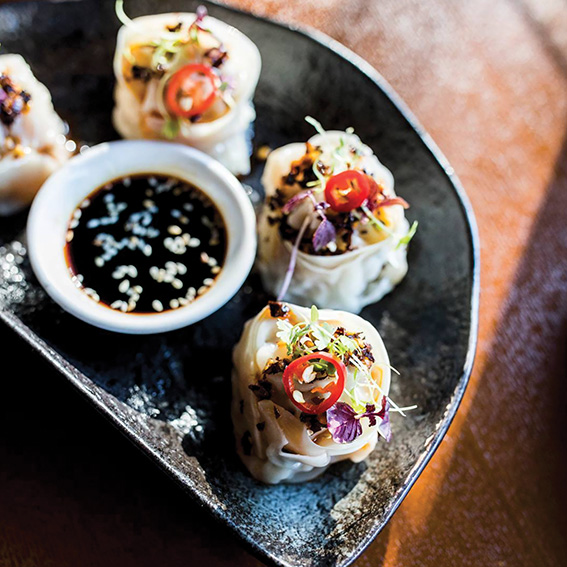
    Our helpful waiter recommended the daily dumpling ($14) from the “Smalls” menu.

    The intense flavour from the dense pork and ginger filling left us in a state of near-euphoria.

    Topped with a mix of fresh and dried chilli and some micro herbs, these dumplings are spot on. They’re the best I’ve ever had in Perth.

    The “Middles” menu had us at soft shell crab ($26).

    Served on a green papaya salad, the generous portion of deep fried crustacean was pure lip-smacking goodness, thanks to its delicate tempura batter and that solid chilli dressing.

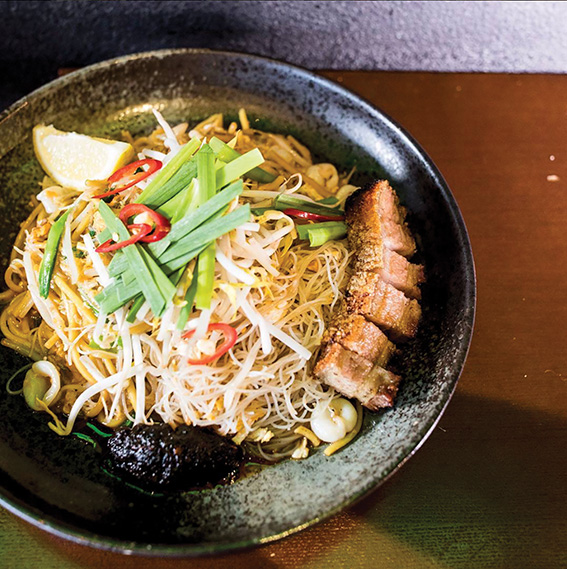
    The best-value dish we tried was the wok-fried egg and rice noodles ($26), from the “Substantials” menu.

    Crunchy

    Big enough to feed four, the dish comes with a mound of crunchy caramelised pork belly and is dotted with tender slices of stocky, baby squid rings.

    The combined textures of the firm egg and soft rice noodles makes for a fun, divine dish. When mixed with the caramelised chilli jam, the whole thing is wondrous.

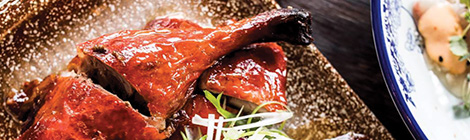
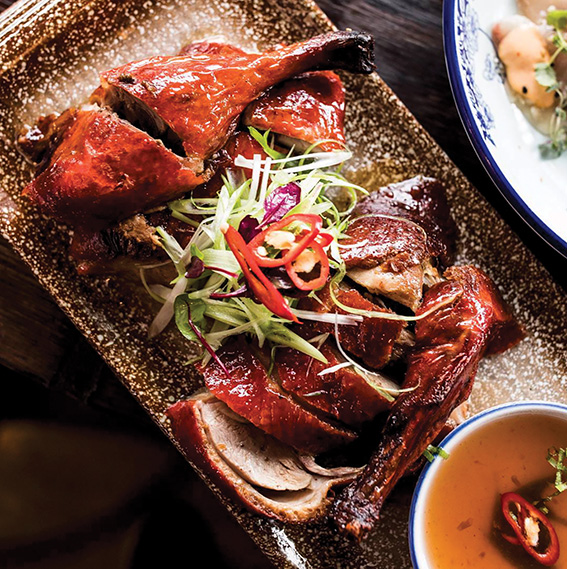
    Taking our experience to the next level was the in-house roasted duck leg ($20 350g/$38 700g).

    “Our children … you … this duck,” Kylie mumbled through a mouthful of gamey protein, diplomatically listing the top three things in her life.

    I nodded in agreement as I gnawed every morsel of sweet duck meat from the bone.

    The accompanying plum sauce is made in-house, according to our enthusiastic waiter, who told us we couldn’t try our duck without it. It was a worthy recommendation.

    If you like Asian food more upmarket than your average chinese takeaway, but less ritzier than somewhere like Silks, then a visit to Dainty Dowager is essential.

    by MATTHEW EELES

    Dainty Dowager
    564 Beaufort Street,
    Mount Lawley
    Phone 9328 9728
    http://www.daintys.com.au

  • Lest we did forget

    THE camaraderie and valour of diggers in World War I is seen as the beginnings of what it means to be Australian.

    But that’s not the story for the first Australians.

    Aboriginal service personnel were whited-out of the “heroic” narrative when they returned home after the war, author Rachel Bin Salleh says.

    The indigenous soldiers overseas were brothers-in-arms and for the first time were allowed to go to the pub with their comrades and were paid the same wage.

    But back home they weren’t allowed to live in towns or go into a pub and their lives were heavily policed, Salleh says.

    Her children’s book, Alfred’s War, exposes the lack of recognition for returning indigenous service personnel.

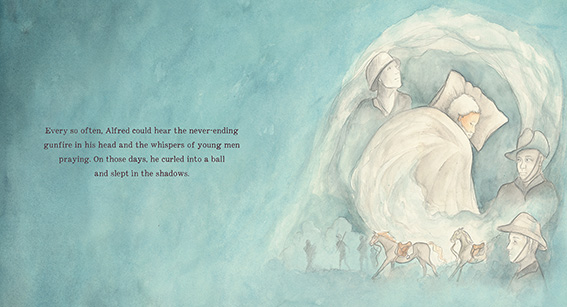
    • Excerpts from the children’s book Alfred’s War. Illustrations by Samantha Fry

    Salleh is a descendent of the Nimunburr, Bunuba and Yawuru people of the Kimberly, has worked in publishing for more than 20 years and is a publisher at Broome’s Magabala Books.

    Alfred’s War is a bittersweet tale, simply told for a young audience. “I wrote it for children because we need to start educating them,” she says.

    The character of Alfred is based on public records from the time and indigenous families who lived through the Great War.

    Wounded and shipped home from France, he’s neither honoured as a returned soldier nor given the government support provided to non-indigenous soldiers.

    Poignant story

    Alfred lives a solitary life, walking the back roads with a billy tied to his swag, finding work where he can.

    “Although he had fought bravely in the Great War, as an Aboriginal man he wasn’t classed as a citizen of his own country,” Salleh writes.

    Alfred never forgot his friends in the trenches, but as an Aboriginal wasn’t welcome to march on Anzac day.

    “Every year he would quietly stand behind the people gathered and pay homage to his fallen mates,” Salleh writes.

    Samantha Fry’s illustrations are gentle and ethereal, adding to the poignancy of a story aimed at 11–12 years olds.

    A book launch for Alfred’s War will be at Moores Art Gallery in Fremantle, Saturday March 31, as part of the inaugural Aboriginal Australian Kids Story Festival.

    Indigenous author Sally Morgan will attend the event as a special guest.

    by JENNY D’ANGER

  • ASTROLOGY March 24 – 31, 2018

    ARIES (Mar 21 – Apr 20)
    There are way too many pragmatic influences coming down the highway from Capricorn for you to get too carried away. This is even though the Sun, Mercury, Venus and Uranus are all in Aries. Though you have energy and power to burn, your feet are planted firmly on solid ground.

    TAURUS (Apr 21 – May 20)
    Venus is in Aries giving you a kick inside. There’s no point in sitting around waiting for love to come through the door. It’s time to get all dressed up and go get ‘em ,tiger. To sit and wait is proving way too precious to come to any good. Though there are butterflies, move anyway.

    GEMINI (May 21 – June 21)
    The Moon begins her week in Gemini. She is being charged up by Jupiter in Scorpio, who gives you the impetus to explore all your hidden feelings – and Pluto in Capricorn, who gives you courage to challenge your own beliefs. Listening and learning will take you into brand new places.

    CANCER (June 22 – July 22)
    The movement of the Sun into rambunctious fiery Aries, doesn’t cower you in any way. The Moon passes through Cancer early in the week, giving you all the courage you need to stand up for all that you feel, in the face of all sorts of daunting challenges. You will not be walked all over.

    LEO (July 23 – Aug 22)
    Your dreams and your capacity for action come together in a magical and extremely healthy confluence. Weave together your visionary and pragmatic threads. You can! And the results will take you where you need to go. There’s no point in being down the track wondering what if.

    VIRGO (Aug 23 – Sept 22)
    With Mercury traversing the semi-volcanic territory of Aries, you are likely to be somewhere out of your comfort zone. Conscious incompetence is the most disconcerting part of the learning cycle. Yet it’s probably the most important. Be humbled by not knowing. Hang in with skilling up.

    LIBRA (Sept 23 – Oct 23)
    With four planets now traversing your opposite sign, Aries, you are face to face with all that you keep in the shadows. There’s a feisty expressive adventurer under the surface of every chilled out charming Libran. It’s all coming to the surface. To ruffle feathers is not the end of the world.

    SCORPIO (Oct 24 – Nov 21)
    The Moon in Gemini at the start of the week, makes light of issues that have been weighing you down. Laughter surfaces where there has been an over-supply of gravitas. At the same time, Venus in Aries shows you a door to impulsive delight. To shrink is unhealthy. Keep expanding.

    SAGITTARIUS (Nov 22 – Dec 21)
    Now that Mars is gone, you can rest more easily in your own skin. There’s no need to constantly peddle your bicycle just for the sake of it. Take time out. The presence of four planets in fellow fire sign Aries, means that life will not be dull. No need to push. Things are already moving.

    CAPRICORN (Dec 22 – Jan 19)
    There are now four planets in Aries. They are all on to you to hurry up, to keep things moving. You aren’t about to alter your pace. The risk of going off track isn’t worth it. There is tension in the air. Your job is to make sure all stress gets turned into creative tension. Don’t let awareness slip.

    AQUARIUS (Jan 20 – Feb 18)
    There are all sorts of positive omens on the career front. Good things can happen even when all the surface indicators seem to be pointing in the other direction. Life is vast. There are powerful currents operating out of our sight. A real career is a calling. Be sure you are right on track.

    PISCES (Feb 19 – Mar 20)
    Every illusion that bites the dust brings us one step closer to reality. Your capacity for love is deeper than your dreams. It’s as real as real can be. There’s a healing happening. Everyone has a wounded animal inside that needs love. Be kind to yours. Chiron and Neptune are turning you around.

  • Poetry in motion

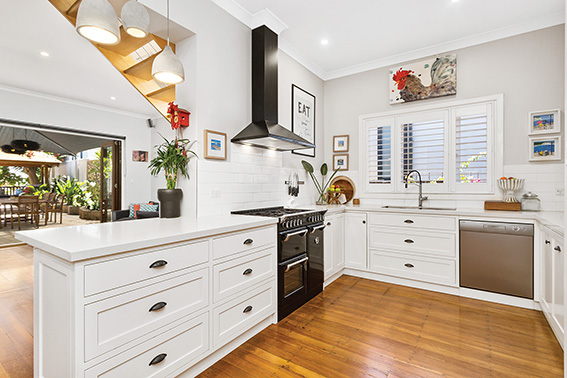
    I’VE never seen anyone get so excited about opening a pull-out pantry than the owner of this Mt Hawthorn home.

    The drawers are so deep the owner jokingly refers to them as coffins.

    “You could fit a whole supermarket in this pantry,” she says proudly.

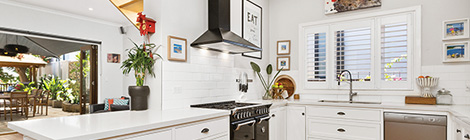
    The kitchen in this art deco home had a total overhaul a couple of years ago, and it’s no surprise it’s her favourite room.

    “I love the big cooker,” she says, pointing out the shiny- black stainless steel monster that boasts three ovens.

    It’s set amid a bank of white drawers, with white Caesarstone tops, and a matching set of almost floor-to-ceiling cupboards.

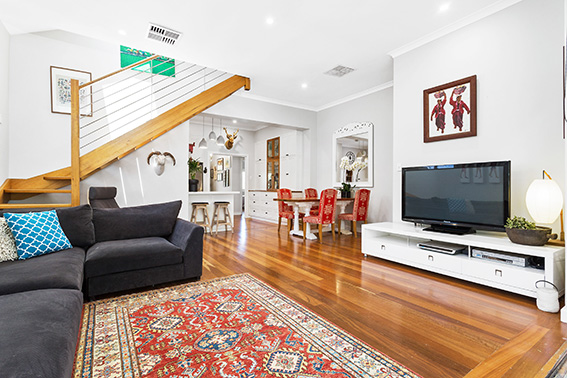
    The formal lounge has a gas “fireplace” and is in the original section of the home.

    Close by is the main bedroom: a huge space with a generous walk-in-robe and an ensuite tiled in neutral, earthy-stone colours.

    A huge glass door shuts off the front of the home from the rear, which is great for climate and noise control.

    The bleached jarrah of the original section flows into the open plan—a commodious space that looks even larger thanks to the bifold doors that lead to the alfresco.

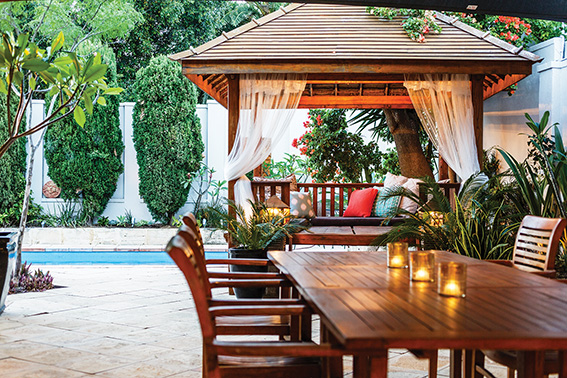
    Indoor meets outdoor in this semi-tropical paradise, which includes sandstone flagstones, and shade cloth that forms a peaked ceiling, creating an exotic tent-like effect.

    The soothing tinkle of a water feature adds to the ambience, as does the Bali-style cabana next to the sparkling pool.

    High fences and attractive plantings make the garden private and there’s plenty of opportunity for a bit of skinny dipping. A spacious loft has city views and would make a great play room, sewing room or teenage pad.

    Located on Shakespeare St, this family home has plenty of areas to have fun together and some nice spots for a bit of solitude.

    by JENNY D’ANGER

    125A Shakespeare Street, Mt Hawthorn
    Offers over $1.2 million
    Susy Kohn
    0418 944 293
    Louise Simonette
    0424 205 440
    Edison Property Residential
    9201 9800

  • Wikiwomen needed

    LESS than 10 per cent of Wikipedia contributors are women, leading to an “alarming gap” in content related to gender and feminism.

    Independent art space Paper Mountain is teaming up with the Lawrence Wilson Art Gallery at UWA to rectify the imbalance with a “Wikipedia Edit-a-thon” this weekend, as part of the global campaign Art+Feminism.

    They’re inviting people to come along to either location and learn how to become an editor and improve Wikipedia’s coverage of gender, feminism and art-related topics.

    The Art+Feminism campaign has helped create and improve more than 11,000 articles, having been hosted at the Tate in London and the Museum of Modern Art in New York.

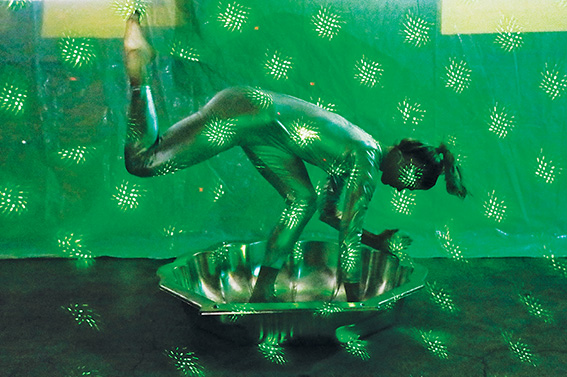
    • Michelle Aitken in Future’s Eve, a feminist statement on technology, presented as part of Paper Mountain’s PEAKS 2018 program for the Fringe World Festival. Photographer: Naoto Hara

    Artists

    Locally there’ll be a focus on creating and improving pages for Australian women artists, especially those based in WA.

    Paper Mountain’s Megan Hyde says many WA women artists still don’t have Wikipedia pages, and those who do have lots of of information or citations missing.

    She says often male wikipedians “aren’t necessarily drawn to the work of women artists”, so the gender imbalance often means those topics are neglected.

    All genders are invited to attend the edit-a-thon, but Ms Hyde says one aim is “getting women comfortable with using Wikipedia: showing them how to do it, trying to break down whatever barriers are in place that prohibit women and making women feel like it’s a space for them.”

    “You don’t need to have any experience with Wikipedia,” she says, with tutorials on the day covering the basics.

    “Once people feel familiar enough with it to start going in and making little edits, we have a bunch of resources about women artists from Australia, and specifically from WA for people to have content at the ready.”

    As a peer-reviewed site, other editors are always checking to make sure the facts on a page have references behind them, so they’ll have resources on hand to cite.

    At LWAG there’ll be information on the artists featured in the Cruthers Collection of Women’s Art, while Paper Mountain has gathered crowdsourced material to cite.

    The edit-a-thon, part of Women’s History Month, will be on Saturday March 17 at LWAG (UWA Crawley campus) and at Paper Mountain, upstairs at 267 William Street Northbridge, on Sunday March 18. Both events are from 11.30am to 3.30pm.

    It’s free but there’s limited space so register via Eventbrite

    by DAVID BELL

  • Log-in failed

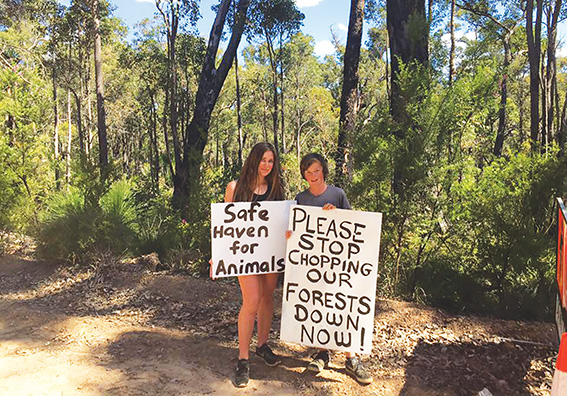
    PROTESTORS complaining the McGowan government hasn’t lived up to its pre-election promise to stop logging in high conservation value forests will gather at Parliament House this Wednesday at noon to present a 10,000-strong petition.

    The WA Forests Alliance says it has plenty of proof that old-growth forest in the South West is being clear-felled, aided by changes to the rules which mean fewer areas qualify for protection.

    The flashpoint is the Barrabup Forest near Nannup, where logging was put on hold after complaints it contained old-growth forest.

    • Barrabup Forest is a flashpoint for conservationists who say rule changes have quietly opened the door to old-growth logging in WA. Photo courtesy Barrabup Conservation Group.

    A review by the state’s parks department found 43 hectares of protected forest had been overlooked and it was subsequently taken off the Forest Products Commission’s books for logging. A further 1.2 hectares of old-growth jarrah had been destroyed when a road was pushed through for the logging trucks.

    The Forestry Products Commission says more than 62 per cent of the state’s native forests have been set aside in reserves and all old-growth forest protected under WA’s Forest Management Plan which was adopted in 2013.

  • All for one to go

    NEW laws giving the state government the power to suspend or sack an individual councillor have been introduced to parliament.

    Currently the local government minister can only suspend an entire council.

    Discussions about the law started shortly after the McGowan government’s election and Perth lord mayor Lisa Scaffidi’s appearance at the State Administrative Tribunal over undeclared gifts and travel.

    Local government minister David Templeman says; “this is an important and overdue reform that will increase the state’s powers for the benefit of the community”.

    Reece Harley, who’s now sidelined following the McGowan government’s decision to sack the council, says the bill is “29 months too late”.

    Mr Harley had called for Ms Scaffidi to resign in the wake of investigations which found she’d breached the local government act on multiple occasions, but the lord mayor refused to walk, taking the matter to the WA Court of Appeal in a bid to hold on to power.

    The bill would let the minister suspend a councillor if any of the following conditions are triggered:

    • They are charged with an offence that would disqualify them from being a council member if found guilty;

    • The local government department CEO has referred an allegation of serious or recurrent breach of the act to the SAT (which would apply to Ms Scaffidi);

    • The council member is failing or has failed to perform their role, functions or duties as defined in the LG Act;

    • The council member’s conduct is adversely affecting or has adversely affected the ability of another person (including the local government) to perform their role, functions or duties; or,

    • The council member’s conduct is adversely affecting or has adversely affected the ability of the local government to comply with the employment principles in the LG Act.

    Currently the minister can sack an entire council if an inquiry panel investigates and recommends dismissal.

    Most Perth councillors were fuming over the suspension, when they perceived the lord mayor to be at the root of the problem.

    Ms Scaffidi released a statement following the full council’s suspension saying: “On the one hand, speaking as the lord mayor, I am extremely disappointed. The minister’s decision in effect means that the council, of which I am the head, has lost the confidence of the government.

    “It means that those who the ratepayers have elected to represent them will, at least for a period, not be able to do so.

    “Today’s decision therefore means that, as the head of the City of Perth, I have failed in my responsibility to deliver to the ratepayers effective local government. For that I apologise to all ratepayers.

    “Also, to the extent that the ‘serious breaches’ of the Local Government Act have impacted on the government’s decision, again I apologise to all ratepayers.”

    by DAVID BELL