THERE are plenty of life lessons to be learnt through taking risks, and where better than at a circus school, says Isobel Lyall.
The CirQuest managing director warns that wrapping kids in cotton-wool puts their physical and mental health at risk.
“[Playing] safe, but challenging, unlocks many skills,” she says.
Late last year the not-for-profit circus school moved from City Farm in East Perth to new digs in North Perth.
• CirQuest students direct traffic. Photo by Justin Tompkin-Drew
Ms Lyall founded the Fremantle circus school 20 years ago and performed with Bizicircus before heading to Europe to busk.
Back in Perth in 2007 she wanted a circus school focused on the “social” aspects of learning skills and meeting new people: “Circus changed my life for the better…and I wanted to make it more accessible to more people.”
Students and teachers will join forces for an April Fools’ performance followed by a free circus workshop at CirQuest HQ, 17 Howlett Street, North Perth, Saturday April 8, 5–8pm.
AFTER six months of delays a modest cut to Vincent councillors’ generous allowances has been proposed by staff.
Last October staff recommended slashing the phone, computer and communications allowance from $3500 to $1500, and if councillors exceeded that figure they could put in a claim.
The move would’ve saved the council $18,000 a year. But councillors deferred it to review the figures (in the meantime they got paid the higher rate) and staff have now now recommended reducing it by only a grand.
“It’s been nearly six months since this was first mooted and all that has really changed in the last six months is that the size of the allowance is increased from $1500 to $2500,” former councillor Dudley Maier told councillors at a briefing this week.
Flaw
“We have an independent body, the Salaries and Allowance Tribunal, saying that an allowance should not be a mechanism for council members to increase their income, and that the best practice is to simply reimburse genuine costs.
“One flaw with having a high allowance is that council members get to pocket the unspent amount of the allowance.
“So why not have a clause that says the unspent amount is to be repaid at the end of the year?”
He added that, “council members are required to work out that information for tax purposes”, so there’s no extra paperwork.
One argument for giving the councillors cash in hand rather than making them file reimbursements is that it means less paperwork for staff since they won’t have to process receipts.
Mr Maier said 20 per cent of metro councils already do the reimbursement method and it’s likely to work out to only two transactions a week.
Councillors will vote on whether to cut their own allowances at the next full council meeting.
BAYSWATER council is set to spend $1.65million on reviving three ailing lakes in Maylands following emergency works on Tuesday.
The works prevented further collapse at the small lake near the old brickworks and the other two major lakes are in dire straits, prompting Bayswater councillors to unanimously vote to support a rescue plan created by the Friends of Maylands Lakes.
Council workers installed a filtration buffer at the putrid lake so it doesn’t spill muck into the bigger Bungana and Brearley lakes nearby, and they’ll consider dredging if necessary to remove more nutrients that cause the thick soup of algae that reduces water oxygen levels.
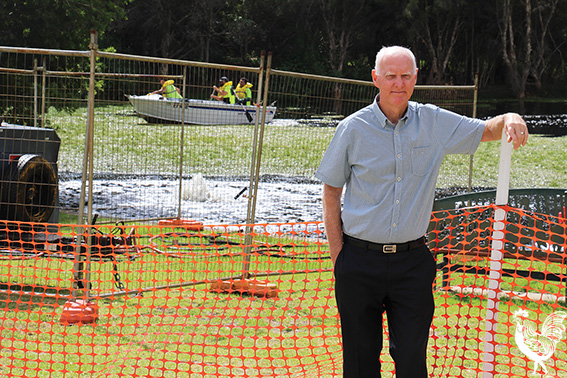
• Friends of Maylands Lakes chair Geoff Trott at the smaller brickworks lake.
The council’s first attempt at a buffer, a couple of hay bales, proved so popular with nesting birds that it was soon replaced with a mesh filter.
The situation is so smelly that Bayswater is liaising with the Water Corporation to double check there hasn’t been a sewage spill into the lake.
FOML chairman Geoff Trott says they formed last year after a meeting organised by councillor Catherine Ehrhardt to discuss ongoing problems, including algal blooms, fish population fall offs, dying birds, moribund turtles and other animals migrating away.
In a deputation to council Mr Trott said the issues could have been nipped in the bud with small prevention measures, but it’s been allowed to drag on for nearly 10 years and has snowballed. He says the council seems the work needed to restore even the smaller of the lakes appears to have taken the council by surprise.
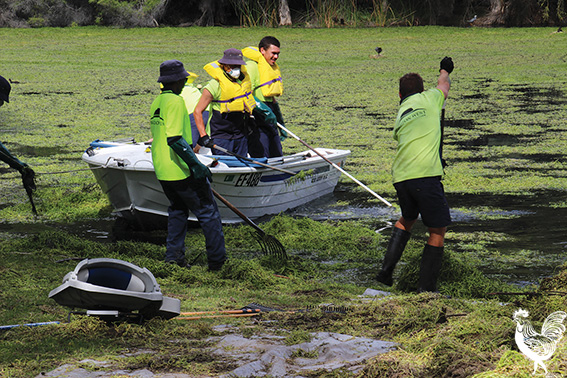
• Workers clear choking weed from the small lake behind the old brickworks. Photos by Steve Grant
At Wednesday’s council meeting Cr Brent Fleeton, elected in 2015, asked why the long-running problem hadn’t been addressed.
“How on earth has it got to this, that an asset in the community has been left alone for so long? …why weren’t we dealing with it before?”
Cr Chris Cornish said the council needed better asset management so cash could be set aside over time rather than councillors being presented with huge bills when things became dire.
“This hit is not acceptable,” he said of the impending $1.65m bill. “We cannot operate this way.”
Staff replied that “asset management principles have only recently been embraced at the City of Bayswater” and hopefully they won’t get caught out again.
Major items on the works list include dredging Lakes Bungana and Brearley ($1m), $250,000 for pollutant traps on drains (stops muck like road run off and fertilisers getting into the lakes), $50,000 to test out floating wetlands, $125,000 for solar pumps and $144,000 for revegetation.
Bayswater council will decide whether to approve the $1.65m works when it sets its budget later this year.
Meanwhile, Bayswater mayor Barry McKenna claimed the council were short changed in 1998 when the Maylands area was transferred over from Stirling city council, leaving them in the financial lurch and struggling to care for local assets.
“We got dudded,” he said.
At Wednesday’s council meeting Cr McKenna said the Maylands area represents five per cent of Stirling’s domain.
Residents had been paying money into City of Stirling reserves for years, so when it got transferred over to Bayswater he reckoned it was fair that the money they’d paid got transferred too.
That cash “came to $11.5million. We got $1.6m,” Cr McKenna said.
“We were told [the lakes] were sound and in good order.
“Quite clearly they are not. Regardless of all that, it is now in the City of Bayswater, and now we have to fix it.”
Mr Trott said “the Maylands lakes residents feel dudded as well. We paid a lot of money to live there and there were lovely promises, and we found our dream became a swamp, less than a swamp”.
SENIORS should seek independent legal and financial advice before signing complex retirement village contracts, says Consumer Protection.
Substantial exit fees of up to 30 per cent often come as a nasty surprise when residents have to sell up and move into aged care.
“When they terminate their residence contract it will usually be subject to a range of conditions and substantial exit fees,” says CP acting commissioner David Hillyard
“There can also be long delays in receiving their refund amount if they do move out or relocate to a new facility.
“Retirement village contracts are more complex than the usual documents relating to the purchase/sale of residential housing or residential tenancy.
• National Seniors chief advocate Ian Henschke
“Most retirement village contracts are also ‘standard form’ – this means they will be put to residents on a ‘take it or leave it’ basis, without any real opportunity for them to negotiate changes they may want.”
Mr Hillyard says his agency’s Seniors Housing Advisory Centre is regularly contacted by elderly people surprised or baffled by the terms of their contract.
Earlier this year, the commerce department introduced a new requirement for developers to provide all potential buyers with a statement outlining the costs and conditions of the contract.
But National Seniors chief advocate Ian Henschke says legal advice is still a must.
“National Seniors also has long been concerned about the complexity of contracts for older people moving into residential aged care, not only in Western Australia but also nationally,” he says
“Two years ago, WA amended its laws to give more protection to residents of retirement villages, with the changes in line with those of other states.
“But retirement village contracts remain complex documents and people should seek expert advice before signing them.”
Recently a number of WA councils that owned retirement homes starting pulling out of the sector due to rising maintenance costs (many villages were built in the 1970s) and sold them to private operators.
Mr Hillyard says all operators are subject to the same legislation, regardless of whether they are local government authorities, not-for-profit operators or for-profit businesses.
“Any residence contract entered into by a resident and a retirement village operator is binding on any new owner of a retirement village in the event of a sale,” he says.
“Seniors who contact the SHAC often report that they would like to “right size” into a newer property in the area where they have lived.
“However, they struggle to navigate the details of a variety of options available to them. “SHAC provides a service to assist potential buyers understand all the issues and options they face.”
Keep it clean
IN response to Ian Anderson’s misinformed, misguided and old-fashioned idea about renewable energy (“Recycling ‘facts’”, Voice, March 25, 2017).
Rather than criticising clean, renewable energy, Ian should look at the work done by Sustainable Energy at http://www.sen.asn.au.
SEN has been working with businesses and government to show that wind and solar CAN indeed provide all our energy needs (with 15 per cent biofuel as interim back-up).
Wind and solar are already, yes already, cheaper than base-load fossil fuel, so his statement about cost is actually incorrect.
I’d suggest that Ian get off Facebook and Twitter and look at the real facts.
Quoting South Australia’s recent failures shows that Ian is out-of-touch with reality and follows the usual fossil fuel (aka fossil fool) rhetoric that renewables were to blame.
This has been consistently rebuffed. Gilda Davies Outreach Team Leader, SEN
Hanson humility
WHILST I vehemently disagree with One Nation’s policies, I have to admire Pauline’s humility when she has made a mistake.
Her apology about the misinformation she gave on vaccinations comes to mind.
Humility coupled with the ability to admit one’s mistake is clearly missing from others in Parliament.
Scott Morrison refuses to admit his error in falsely accusing Save the Children workers on Nauru of being political activists who were inciting asylum seekers to self-harm which resulted in the Save the Children workers removal from the island.
This is despite the fact that the government has paid financial compensation to Save the Children and made a public statement of regret for Morrison’s actions.
In June last year when Peter Dutton told Australians ‘I’ve got every child out of detention’, there were, in fact 50 children being detained on Nauru with more than 300 detained in Australia.
His claim was quickly found to be false by the ABC Fact Check.
Maybe his Chief of Staff forgot to bring this misinformation to his attention.
Last year prime minister Malcolm Turnbull, deputy prime minister Barnaby Joyce and federal energy minister Josh Frydenberg repeatedly blamed power blackouts in South Australia on the failure of wind farms and the state’s high renewable energy targets.
These deliberate lies were told despite being informed by the public service within 24hours of the blackout that storm damage to the electricity distribution network was responsible.
Whilst loathing what you stand for, Pauline, our more experienced and frequently arrogant politicians could certainly benefit from a dose of your humility and honesty.
I wonder if this could make them appear more human, honest and believable and perhaps even electable. Pamela G Leeson Hulbert Street, South Fremantle The Ed says: In response to the above letters, the latest report from the Australian Energy Market Operator has shown that windfarms were responsible for the blackout, but only because of human error – someone had botched the settings.
Human rights
IN 2016, hateful language and fear-mongering were prevalent in politics across the world.
The world’s most vulnerable people were the ones who suffered as world leaders turned their backs.
This and more was revealed in Amnesty International’s report on the state of the world’s human rights launched this week.
As an Australian citizen I like to think that I am part of a society that stands up as a beacon against this darkness in the world.
I was ashamed to see a list of serious human rights abuses that took place on our watch in our own country, due to our government’s policies.
The abuse of children in prisons, and the fact that Aboriginal kids are 24 times more likely to be separated from their families and communities in prison is unacceptable.
Similarly, the trauma faced by children, families, and vulnerable people in Australia’s offshore detention centres must end.
We as members of Amnesty International volunteers are proud, it seems that taking a stand for human rights right here in our country has never been more important.
We all should be working to return Australia to its position as a leader on human rights.
Protecting each and every person’s right to live a safe, fulfilling life is what our society is all about so let’s join together and make Australia a great place again. Christa Kaltenbrunn Long Fremantle and Melville Amnesty Group
Roe what?
A LOT is made about the deal with One Nation that the Libs made as an explanation for their loss.
My opinion is that a lot of votes went to Labor for one reason alone: Mark McGowan’s promise that Roe 8 would not go ahead if Labor won.
I don’t hear that mentioned all that often, though.
Am I the only one who didn’t hear him?
One of the first things I would do if I were Mark McGowan is to restate that promise with oomph.
How about it, Mark?
Can you?
Will you?
We are straining to hear…! Carla van Raay Kirby Street, Willagee
I HAVE a crushing sense of regret about my time spent in South Korea.
I flew to Seoul a few days after my 18th birthday and I remember the chaotic city harried my senses with its neon signs and overpopulation.
I was too busy drinking and partying to appreciate the cuisine and ironically it wasn’t until I was at university back in Australia that I truly discovered Seoul in the ‘Little Korea’ district in Brisbane.
Wandering around Perth one afternoon I decided I could no longer ignore my cravings for Korean food, so I stopped for lunch at the Arirang restaurant on Barrack Street.
Delicious delights
While I’m not totally averse to eating alone, my social anxieties were eased when I saw the large number of folk eating on their tod.
I was a little disappointed at the smaller lunch menu and eyed the array of delicious delights that were served at dinnertime.
Nevertheless, my appetite prevailed and I ordered the dolsot bibimbap with typical Korean sides of vegetables, kimchi and miso soup ($19).
I’ve always admired the unique beauty and complexity of the bibimbap, and the chefs at Arirang certainly delivered.
The foundation of a classic bibimbap is a bowl of steamed rice topped with pickled Korean vegetables and sliced meat, usually beef or chicken.
Authentic
Added on top is a generous lashing of ‘gochujang’ (Korean chilli paste) and typically a raw egg.
It might sound like a flavour hotchpotch, but the magic lies in the large bowl the sizzling meal is presented in.
A satisfying stir of all the ingredients ensures the egg is cooked and all the flavours blend effortlessly together.
The bibimbap at Arirang was almost perfect, while the kimchi (Korean pickled cabbage) was delicious and authentic.
It was an enjoyable experience overall and after much Seoul-searching I think I’ve found somewhere to satisfy my Korean cravings.
LIFE’S big Cs — cancer, communism and Catholicism intertwine in the poignant Royal David’s City.
The quotidian characters in this play are instantly recognisable as anyone’s next door neighbour, mum, aunt, or those annoying religious door knockers.
And while their stories are confronting, like real life there’s plenty of laughs during the darker moments, including a ridiculously cheery song and dance number that comes out of nowhere, complete with reindeer antlers.
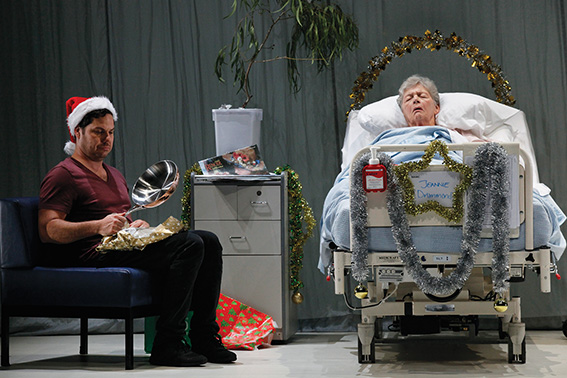
• Jason Klarwei and Penny Everingham in the play Royal David’s City. Photos by Philip Gostelow
Will Drummond (Jason Klarwein) had been planning a peaceful beach Christmas at Byron Bay with his mum, following the death of his father.
But she falls seriously ill, and as Will holds vigil at her bedside he questions his work as a theatre director (his mum wanted him to be a teacher) and his place in a world that has suddenly been upended.
Although for much of the play she is speechless in a hospital bed, Penny Everingham plays the moribund Jeannie Drummond with so much realism and pathos that she moved me to tears remembering my own mother’s death.
Designer Stephen Curtis and Matt Scott’s lighting creates the sterility of a public hospital, with ward-like curtains introducing set changes or providing the backdrop for a 1950s communist rally.
Life-affirming
Once in Royal David’s City, written by Aussie Michael Gow, is life-affirming, but also thought-provoking, and the last word goes to physicist and 1960s television personality Professor Julius Sumner Miller, who poses the question we all ask.
“Why is it so?”
You might find the answer at the State Theatre, where the play is showing until April 9.
ARIES (Mar 21 – Apr 20) Having stepped of the starting blocks with all the power and passion that one would expect of a Ram who is celebrating their own existence, you now feel proud. The problem with pride is it’s potential for leading a person to get too big for their boots and suffer a fall. Be alert to this.
TAURUS (Apr 21 – May 20) Mars continues to be your driving force. Mars is simple – you need to have adventures, or you’ll end up getting cabin fever and doing something inappropriate. You must use your energy in a creative, playful and adrenaline affirmative way, or it will turn and bite you. Have some fun.
GEMINI (May 21 – June 21) The rising Moon begins her week in Gemini. The Moon tends to pull feelings that have been lurking in the basement, up to the surface. Get friendly with parts of yourself that you disown. They need your love. As Mercury moves into Taurus, so your adrenaline levels will return to normal.
CANCER (June 22 – July 22) Communication is the key. The Moon begins her week in chatty Gemini. If you have a good go at articulating your feelings and identifying and expressing your needs, you will soon come back to feeling at home in your own skin. Connect in meaningful ways and anxiety levels will drop.
LEO (July 23 – Aug 22) The wildly unpredictable first week of the Sun’s run through Aries is over. Self-reflection is in order. Bring your passion for self-discovery to the centre of your attention. The more you engage with life and feel everything that surfaces, in all your encounters, the more you will learn.
VIRGO (Aug 23 – Sept 22 Mercury has moved into the placid terrain of Taurus. The tension and anxiety caused by his hair-raising run through Aries is over. It’s all very well to be stirred up in the name of change, but there’s a point where it ceases to be creative and rather becomes destructive. Rebalance yourself.
LIBRA (Sept 23 – Oct 23) The challenge that life is offering you this week is to get grounded, to get practical and to immerse yourself in all dimensions of the earths physical beauty. If you insist on staying in the land of ideas, or being at all disassociated, you will be buffeted by the fires of the Aries Sun. Be grounded.
SCORPIO (Oct 24 – Nov 21) No matter what unfolds, keep returning to the emotional alchemy that can only happen in relationship. Intensity is fine if it leads to breakthrough. Know well the difference between breakthrough and breakdown. It’s not always obvious. Make relationship transformational.
SAGITTARIUS (Nov 22 – Dec 21) The planets are lining up to give you a free ride to a thousand blessings. To get your ticket, stay disciplined and organised. Changes you have been craving, are in the air. Though life is helping, it is you who needs to be taking responsibility and driving things. Watch out for wooliness.
CAPRICORN (Dec 22 – Jan 19) It’s all very well to stay focussed on the practical, but nothing really changes unless one can also focus on the beautiful. There is something to the adage ‘if it’s beautiful it’s right’. As Mars assists you in your endeavours, from the lush pastures of Taurus, let this maxim sink into your heart.
AQUARIUS (Jan 20 – Feb 18) Breathe deep. You are out of the line of planetary fire. Stay social, plan your journey to the pinnacle of your field and don’t let the razzle-dazzle that is going on around you distract you from your game. Others are busy. You have a perfect chance, to move surreptitiously under the radar.
PISCES (Feb 19 – Mar 20) There are enough blessings coming your way to keep you dancing. Influences coming from Capricorn and Taurus are helping you to keep your feet firmly planted on mother earth. When we mix pragmatic steps with what we love to do and feel, then miracles are bound to happen.
A SUITE of bifold doors frame a picture-perfect poinciana tree in the garden of this North Perth home.
The rich green tones of the foliage, punctuated with a scattering of red flowers, look enchanting and in full flower this tree must look magnificent.
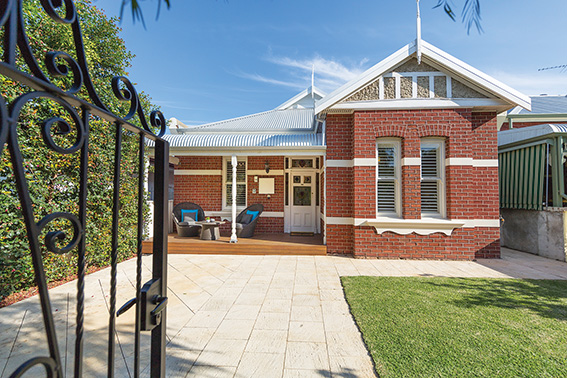
Turn of the century character and state of the art modernity meld with equal perfection in this three-bedroom abode, tucked behind decorative wrought iron fencing on tree-lined Marmion Street.
All the charm of the early 1900s can be found in the original home, with high ceilings, a gorgeous stained-glass front door, rich jarrah floors and dainty ceiling roses.
The bedrooms are in this section, including the main which is large and has a generous walk-in-robe and spacious ensuite.
The loo here has a jungle view, thanks to a wall of glass that overlooks a lush atrium garden.
Old jarrah morphs into new in the spacious modern extension, which has soaring ceilings and sleek lines.
Spick and span is the theme of the kitchen, including a long Caesarstone island bench, and a raft of cupboards and soft-close drawers. You’ll have to seek out the double fridge/freezer because it’s integrated into what looks like a bank of pantry cupboards.
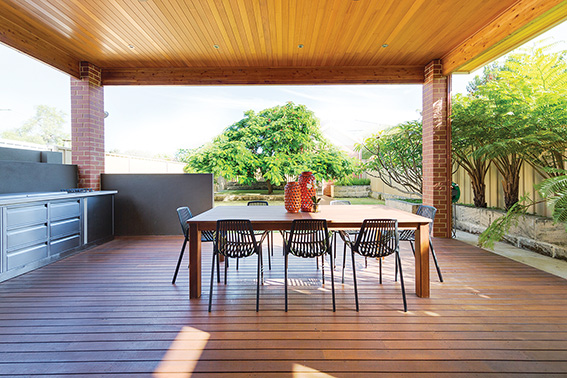
There’s room in the dining area for a 10-seater dining table, and even more space to entertain guests on the timber deck alfresco area.
Delightful abode
Whether it’s a formal or informal get together, this is a lovely space with a built-in-stainless-steel-barbeque kitchen, sink and bar fridge.
Sitting on 506sqm there’s a swathe of lawn for the kids, and several raised limestone garden beds.
And if any of the guests have had one too many there’s a studio guest room at the bottom of the garden.
This delightful abode is a mere 10 minutes walk from Hyde Park and the Beaufort Street strip, or pop down to Angove Street where’s there’s no shortage of shops and cafes.
19 Marmion Street, North Perth from $1.399 million Pam Herron 0413 610 660 Jon Adams 0413 610 662 Beaufort Realty 9227 0887
MOST people associate radiation therapy with fighting cancer, but not many know it’s successfully used to treat less serious skin growths and musculoskeletal conditions.
For decades, radiation therapy (also known as radiotherapy) has been used to reduce pain from degenerative and inflammatory conditions, including tennis elbow, rotator cuff syndrome, Dupuytren’s contracture, plantar fibromatosis, and Achilles tendinopathy.
It can also be used to treat golfer’s elbow, moderate osteoarthritis of the knees and hips, rheumatoid arthritis and psoriasis where other conventional treatments may have failed.
Radiation oncologist Dr Sid Baxi says the treatment has emerged as a non-invasive alternative to steroid injections, anti-inflammatory drugs and on some occasions, even surgery.
• Dupuytren’s contracture
“One of the most common treatments is for keloid scars, which are excessive scars after an injury or surgery. It’s very useful for stopping that dead in its tracks,” he says.
“Around forty per cent of patients notice that radiation therapy stops scars and problems like Dupuytren’s contracture from getting worse, and forty per cent say it actually improves the condition.”
Radiation therapy is a well proven technique for cancer, but Dr Baxi says many doctors are unaware it is a treatment option for benign or non-cancerous conditions.
“As a field of medicine, we have not actively informed GPs and other practitioners about how radiation therapy can help,” he says.
“Radiation treatment has traditionally been a limited resource in Australia because it’s been prioritised for cancer treatment.
“But in the last 10 years or so it has become more available in public and private hospitals.
“Now we have the option to present it to patients as an alternative treatment option for many benign conditions.”
Aside from some redness of the skin, which usually disappears after two to three weeks, there are little side-effects.
“It’s a non-invasive outpatient treatment. There’s no cutting, stitches or needles, and it’s usually administered in five to ten 15-minute sessions, so it’s not a lengthy process,” Dr Baxi says.
Genesis CancerCare’s central hub is located at Perth Radiation Oncology in Wembley, but there are three other treatment facilities across Bunbury, Joondalup and Murdoch. Genesis CancerCare radiation oncologists are some of the leading practitioners in radiation therapy for benign conditions.





















 Perth Voice Interactive