• More to volunteering

    WA Seniors Week: November 6 – 13

    VOLUNTEERING is playing an increasingly important role in the lives of seniors, whether  as a participant or recipient.

    Marlene Oostryck, who set up the Fremantle Volunteer Service after retiring and finding herself at a loose end, says the more the issue is researched, the more benefits are uncovered.

    “All of the latest research is showing that to stave off alzheimers and all the other degenerative diseases, you have to be connected to the community, and volunteering is one of the best avenues,” Ms Oostryck says.

    “Apart from participating, you’re also passing on your skills – sharing them whether it’s with kids or other older people – and that’s really important for the community.”

    For the last five years Ms Oostryck has been organising a culture club at East Fremantle’s Glyde Inn, organising trips to concerts and events for participants, who mainly tend to be somewhere between their 50s and their 80s.
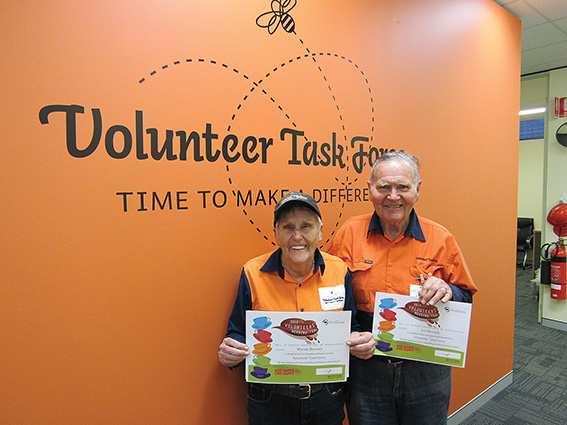
    • Wanda and Jim Bennett love volunteering.
    • Wanda and Jim Bennett love volunteering.

    Rewarding

    ‘“That’s very rewarding, because I get great enjoyment from bringing people together,” she says.

    Ms Oostryck’s husband suffers from alzheimers, and like many other seniors she’s found the prospect of attending events on her own daunting, so having the culture club has also given her more opportunity to get out.

    “A lot of the people who come would be single and they would not go to a play or a concert by themselves, but as a group they find it easier to go, and then we have a coffee afterwards.

    “I do matinees so single people don’t have to be walking home unaccompanied, so it’s a safe and secure thing to do and people appreciate that.”

    Jim and Wanda Bennett are also long-term volunteers with Volunteer Task Force (VTF), giving a hand in the garden for elderly people or those with disabilities so they can stay independent at home.

    Once a week they volunteer, although a flexible agreement with VTF means they opt out when the sun’s a bit too hot.

    “It’s good that older people can get out and volunteer,” Ms Bennett says.

    VTF’S volunteer supervisor Michelle Williams says the couple have been an inspiration to younger volunteers.

    “It’s great that we have a number of retired couples who chose to volunteer with us,” she says.

    Many benefits

    Ms Williams says there’s many benefits to volunteering, as it brings greater health and happiness through new friendships, purpose, and more physical and mental activity.

    VTF offers a wide range of volunteering and services to people requiring support including gardening, shopping, companion services and community outings. VTF boasts a team of more than 100 staff and nearly 500 volunteers and helps out more than 8000 people in Perth every year.

    To find out more about them, email info@volunteertaskforce.org.au, or if the internet’s a bit too newfangled for you, give them a call on 9318 5700.


    956-volunteer-task-force-20x7

  • Mighty mito mum

    MOUNT HAWTHORN local Fiona Elmer has won a national award for supporting fellow families affected by the potentially fatal mitochondrial disease.

    Her four-year-old son Aidan failed to thrive after birth and was diagnosed with “mito” following a lengthy two-year process.

    It’s the second-most commonly diagnosed serious genetic disease (after cystic fibrosis) but little is known about it. There’s no cure and very few effective treatments. Many people go undiagnosed because there’s so little awareness, and they go without the available support.

    “[Aidan] cannot produce enough energy to allow his cells to function properly,” Mr Elmer says.

    “This means he struggles to do the everyday activities that three-year-olds love doing.”

    • Fiona Elmer and her son Aidan, who has a mitochondrial disease that means his cells are underpowered. Photo by Steve Grant
    • Fiona Elmer and her son Aidan, who has a mitochondrial disease that means his cells are underpowered. Photo by Steve Grant

    Aidan’s now able to get about with a frame or walk about 20 metres unaided, and is moving on to using multiple words to communicate.

    Ms Elmer, whose husband Dan Loden sits on Vincent council, says one of the hardest things for them is the uncertainty for his future. Half the children who develop mito will die in childhood.

    “It is very difficult to give Aidan a prognosis and this is probably the hardest aspect for my family to bear,” she says.

    Life expectency

    “It is clear that without finding the key to proper treatment and a cure, Aidan’s life expectancy will be much reduced and his health and development are at risk when he contracts common illnesses.

    For her work helping families affected by the disease, Ms Elmer won the Australian Mitochondrial Disease Foundation’s chairman’s award. CEO Sean Murray says she’s done a lot of hard work “setting up an AMDF support group in Perth, bringing together members of the mito community who would otherwise be quite isolated.

    01-955news-2

    “She also campaigns to raise awareness for mito and spearheaded the Perth arm of ‘Light up for Mito’, which saw Perth’s council house lit up green recently for Global Mitochondrial Disease Awareness Week.”

    In the UK, mothers likely to pass on the disease can undergo “mitochondrial donation” to receive a small number of healthy cells from a donor egg to replace the faulty mitochondrial DNA. Australian laws don’t allow that technique, and that needs awareness and political momentum to change.

    The AMDF doesn’t get any government funding and relies solely on donations, running fundraisers like The Bloody Long Walk series August to November, and an annual ‘sleep in’ day every September (people with mito need frequent rests to recharge).

    There’s more info on those at amdf.org.au

    by DAVID BELL

    955-ibiza-n2-10x4-6

  • Maylands buses a ‘disaster’

    MAYLANDS’ main street will have a “bleak future” if it gets turned into a thoroughfare for buses, the Maylands Business Association warns.

    The Public Transport Authority is looking into running a permanent bus route down Eighth Avenue between Whatley Crescent and Guildford Road, but the MBA says a trial has proven it will be an “unmitigated disaster”.

    The MBA wants a pedestrian-friendly street “with large leafy trees and a slow, quiet environment”.

    In a letter to the PTA, chair Michiel de Ruyter says the frequency of the buses during the trial has made that vision unworkable.

    “This section of road is almost a quasi-mall with lots of pedestrians and very slow vehicles,” Mr de Ruyter wrote.

    “This all changes when a bus drives within a few decimetres of pedestrians at 40kp/h or more.”

    They also worry it’ll kill the burgeoning alfresco culture in the area since buses will be roaring past just a few feet from customers enjoying a morning coffee.

    “Given the size, speed and shape of these buses, they create a significant headwind and when combined with noise and other pollution it basically destroys any chance of achieving a comfortable environment for patrons.”

    The MBA’s collected 150 signatures so far in a petition against the route becoming permanent. A final call’s yet to be made and the trial’s intended to monitor passenger numbers to see if it’s viable long term.

    There were similar concerns at Vincent council which opposed bus lanes along Beaufort Street, saying they would further cement Beaufort Street as a thoroughfare and not a destination. The PTA installed them anyway.

    by DAVID BELL

    955-tint-a-car-10x3

  • Transition in focus

    TWO local artists have won a commission by Perth city council to add to the city’s ongoing photographic record of Perth.

    Graham Miller’s work A Place in the Sun focuses on people captured candidly around the city streets or lounging in local public spaces. As a foil, Jacqueline Ball’s work Swimming Home focuses on the built environment, the people just incidentally dotted amongst the towering architecture.

    • A picture of pictures: Rebecca Mansell’s photo of Jacqueline Ball’s installation.
    • A picture of pictures: Rebecca Mansell’s photo of Jacqueline Ball’s installation.

    Opening the exhibition Perth councillor Reece Harley said the photos showed the old, the new, and Perth’s current transition.

    The photographers have used their cameras and their creativity to explore, reflect and reveal new perspectives of the city,” Cr Harley said.

    “This commission captures Perth in the midst of rapid transformation while retaining essential characteristics familiar to all of us.”

    It’s the city’s third photographic commission and it’s at the Perth Centre for Photography, 18 Colin Street, West Perth, until November 13.

    955-il-pasto-10x7

  • Scaffidi hearing may go public

    PERTH lord mayor Lisa Scaffidi and the local government department have failed to reach  agreement during mediation at the State Administrative Tribunal.

    The department’s now in charge of prosecuting Ms Scaffidi over failing to declare gifts and travel, and the mediation was intended to prevent the issue going to a full public SAT hearing.

    Ms Scaffidi has publicly maintained no wrongdoing, variously blaming poor practices at the city, the media and bad advice from staff (though a media release from CEO Martin Mileham earlier this year disputed that explanation).

    A second round of mediation is due in November.

    And while Ms Scaffidi has found an ally in new local government minister Paul Miles who’s backed her on a couple of issues lately, Opposition leader Mark McGowan says Labor will sack the whole council if elected in March, saying it’s too “dysfunctional” and commissioners need appointing.

    by DAVID BELL

    955-john-carey-10x7

  • Gumnut baby replaced

    AFTER a fruitless search for the stolen gumnut baby sculpture Perth city council has installed a newly commissioned replacement.

    Based on May Gibbs’ Snugglepot and Cuddlepie, the artwork at Stirling Gardens was installed more than a decade ago but last March a hooligan stole one of the babies.

    It would’ve required a fair amount of effort because they were secured with four steel anchors.

    The council put out a $1000 reward for the return of the kidnapped bronze baby but there were no bites.

  • Waterlands needs a flood of Baysy cash

    THE future of the ageing Maylands Waterland park is at stake with Bayswater council facing a big repair bill if it’s to stay operational.

    The place opened in the late 70s and is nearing the end of its operating life.

    It’ll cost around $2.7m to $2.9m to fix, plus another $220,000 to run between November and April — and that’s after entry fees are taken into account).

    The play equipment and rubber soft fall surfaces are being eaten away by bore water, and this year could be its last.

    • Youngsters having a splash at Maylands Waterpark earlier this year before it closed down for this winter. File photo
    • Youngsters having a splash at Maylands Waterpark earlier this year before it closed down for this winter. File photo

    A council report from March says “much of the equipment should have already been replaced, however due to the uncertain future of the Maylands Waterland, where possible the equipment has been patched to extend usage without replacement”.

    Some locals have called for an earlier opening time so the kids can have a splash before the height of the summer sun (it currently opens at 10am). Maylands ward councillors Catherine Ehrhardt is running an online poll to survey thoughts on this and will move a motion at the December meeting to investigate whether it’s a good idea.

    The council will decide by April 2017 and community consultation is open now at engage.bayswater.wa.gov.au

    by DAVID BELL

  • Lakes seminar

    MAYLANDS’ ailing lakes and how to address their degradation will be the focus of an information session this coming Monday, October 24.

    The session follows a 12-month water quality study, with consultants preparing a range of options on how to deal with toxic levels of algae and contamination from the old brickworks.

    • More than 80 locals turned up to a lakes crisis meeting earlier this year, forming the Friends of Maylands Lakes in its wake. Photo by Roger Tomlins
    • More than 80 locals turned up to a lakes crisis meeting earlier this year, forming the Friends of Maylands Lakes in its wake. Photo by Roger Tomlins

    Chlorinated

    Whatever the council-led option for the recovery, residents will be asked to take some responsibility.

    Over-use of fertilisers on lawns and gardens is leading to algal blooms, one neighbour was spotted emptying his chlorinated swimming pool into storm drains which go straight to the lakes, while another resident’s pooch was spotted running around the reserve with a tortoise in its mouth.

    The information session is at 6.45pm at the Rise.

    To register attendance call Wardia on 9272 0654.

    Meanwhile the Friends of Maylands Lakes, which residents formed earlier this year at a lakes crisis meeting called by Cr Catherine Ehrhardt, is now up and running and has a website at http://www.friendsofmaylandslakes.org

    by DAVID BELL

    955-aranmore-catholic-college-20x4

  • Home chemo a winning idea

    NORTHBRIDGE pharmacist Julie Adams has won WA’s leg of the Telstra Business Woman of the Year.

    Ms Adams joined forces with nurse Lorna Cook in 2013 to create Chemo@Home, which as the name suggests allows cancer patients to receive their treatment without having to attend hospital.

    Nationally accredited, the pair’s treatment is covered by private health insurance and business is booming; they now send nursing teams as far as Mundaring, Mandurah and Yanchep.

    • Chemo@Home now covers the whole metro area. Photo supplied
    • Chemo@Home now covers the whole metro area. Photo supplied

    Safest and cheapest

    Ms Cook says treating people at home is the safest, easiest and cheapest option.

    “The patients are safer in their own home as they are not exposed to the various germs that can be found within hospitals,” she said.

    “It also means that patients can avoid the effort of travelling to the hospital, perhaps having to find and pay for parking and other obstacles along the way,” she told the Voice.

    “We have treated truck drivers at their truck stops, teachers on their lunch breaks in schools and others in their offices.”

    Chemo@Home staff also treat patients with chronic illnesses such as rheumatoid arthritis, multiple sclerosis and inflammatory bowel diseases such as Crohn’s disease.

    “The multiple sclerosis patients love the service as they are very limited in mobility so it is a lot of effort to make their way to a hospital,” Ms Cook said.

    Unusually, despite the business being a partnership, Ms Adams will travel to Melbourne to compete for the national title without Ms Cook, who withdrew so the pair wouldn’t be competing against each other.

    “I didn’t want to compete with her as she was the brains behind the whole business, so she deserved it more,” she said.

    “It is wonderful recognition for Julie as it was her vision and courage which started such an innovative and worthwhile service to the community”.

    Chemo@Home is in the process of trying to gain state government contracts to treat public patients who can’t afford private health insurance.

    The pair will expand the business to Adelaide next month.

    by HOLLY COOMEY

    TTH PVoice Advert 1016

  • Stirling: Plan too heavy on the rail

    STIRLING has suggested a few tweaks to the Barnett government’s transport plan for Perth.

    The document lays out an overarching plan for handling the transport needs of 3.5 million people (Perth’s expected population by 2050), but Stirling reckons the transport department is too fixated on heavy underground rail and underestimates how many people will walk, cycle or catch light rail.

    In a submission approved by council earlier this month, Stirling identified the Scarborough Beach Road activity corridor as the most significant urban regeneration project in Perth, and said a light rail system was essential if it’s to reach its potential.

    The transport plan was vague on whether light rail or bus rapid transit was slated for Scarborough Beach Road, but Stirling made it clear buses would be noisy, polluting and limit development.

    Its submission also called for the DoT to provide a specific timeline for the plan (it currently relies on population estimates instead of fixed dates) and include a more detailed cost analysis.

    Director of planning Ross Povey acknowledged the plan as a key step forward for Perth, but criticised it for failing to integrate with other government planning documents.

    “It does not work in harmony with the land use plans already developed by the state government”, Mr Povey said.

    “The City of Stirling believes there must now be a significant engagement process with key stakeholders before the plans are finalised.”

    955-a-fish-called-inglewood-10x3