• The names that mapped a land
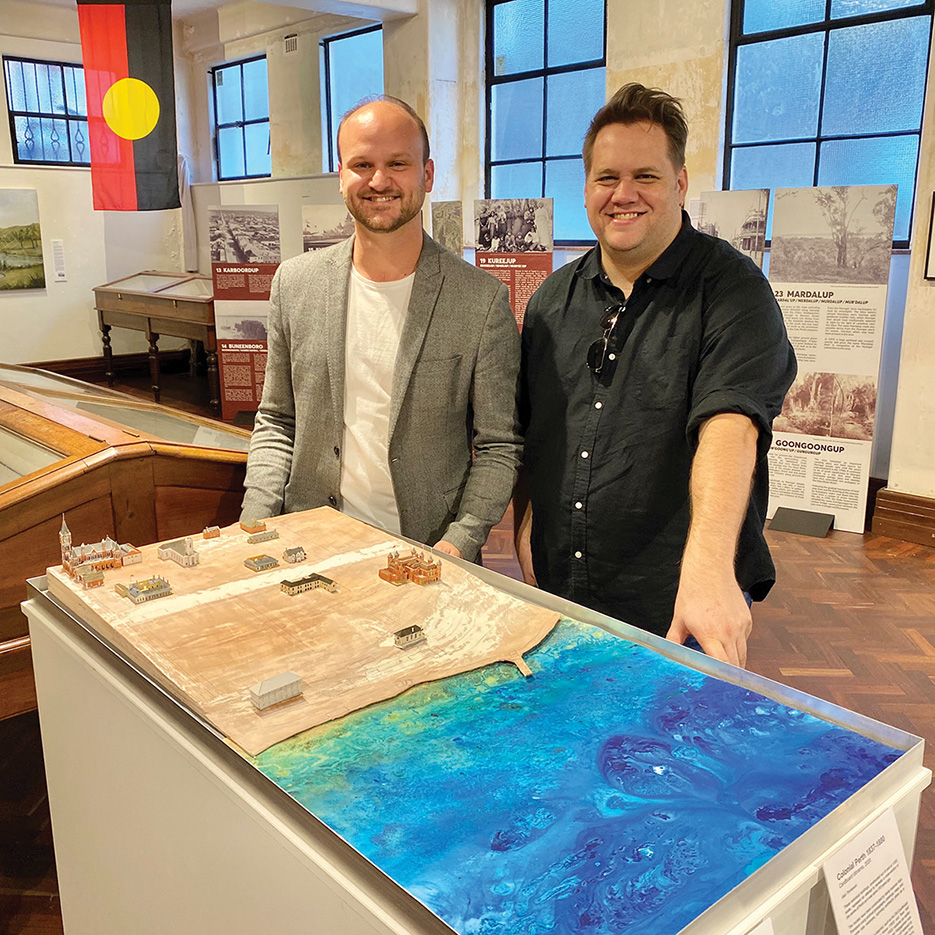
    Museum of Perth’s Reece Harley (left) with models of the early colony’s buildings by Alan Thompson, artist Bradley Kickett (right) created the artwork of the Derbarl Yerrigan.

    ELIZABETH QUAY was once known as Gumap, Mount Eliza was Kata Moor, and Claisebrook Cove was a freshwater stream called Goon’goong’up, and so narrow you could step over it. 

    A new exhibition Gnarla Boodja Mili Mili (Our Country on Paper) at the Museum of Perth tells the stories behind 31 Noongar names for places around Perth.

    It draws on research done over the past five years by the Aboriginal history unit at WA’s cultural industries department, which partnered up with the museum to deliver the exhibition. 

    The research produced an online map launched in September 2019, and now the exhibition takes them into the physical realm and accompanies the stories with early portraits of Noongar people, paintings, early translation dictionaries, artistic impressions of how the land might’ve looked, a model of the colony’s early days, and with a soundtrack of kids from Bibra Lake primary school pronouncing the Noongar names.  

    Museum executive director Reece Harley took on the project as his first solo curatorship.

    “At the time of the colonists’ arrival in 1829, Indigenous languages and knowledge were essential for the survival of the colony,” he says.

    “Aboriginal place names tended to describe the usefulness or importance of that location, whether it was a good place to cross a river, to hunt, or to access clean drinking water. 
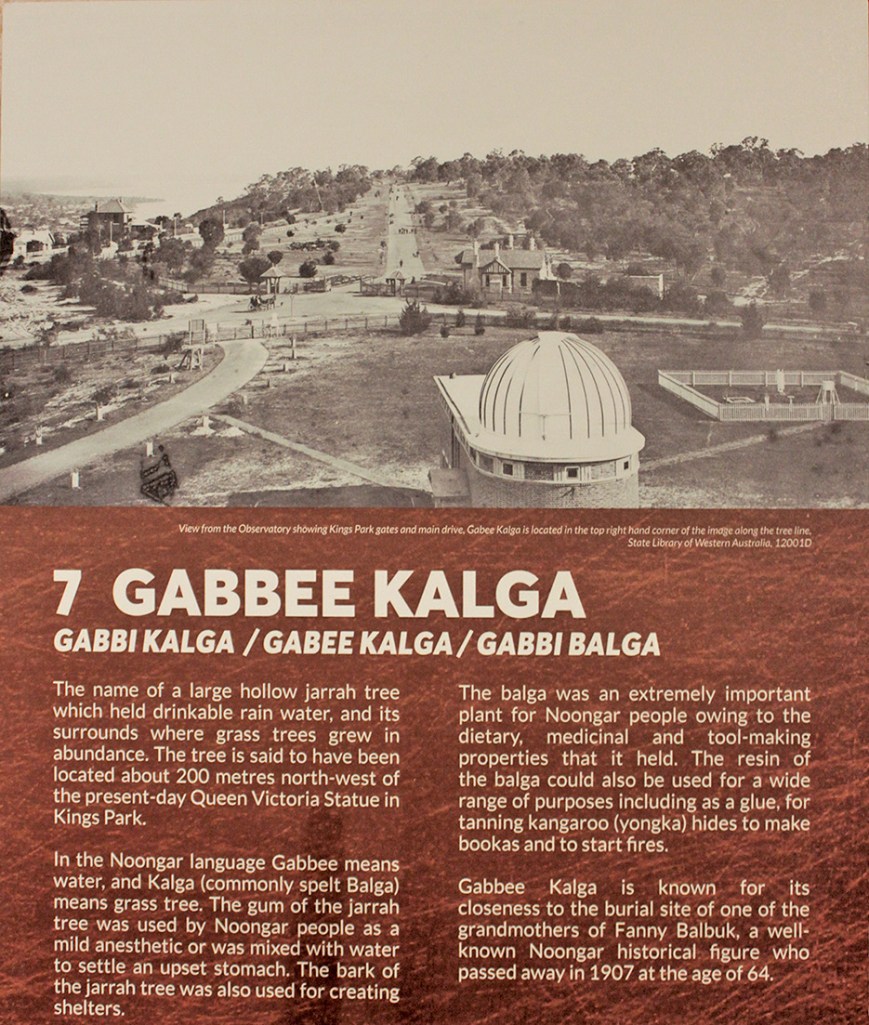
    The view from the observatory of Gabbee Kalga. Photo from the State Library WA, 12002d.

    Hollow tree

    “For example, ‘Gabbee Kalga’ was the name of a large hollow jarrah tree which held drinkable rainwater, and its surrounds where grass trees grew in abundance. The tree is said to have been located about 200 metres north-west of the Queen Victoria Statue in Kings Park. In Noongar language Gabee means water and Kalga (commonly spelt Balga) means grass tree.”

    Another is Kooyamalyup, one of the names given for the camping ground at the foot of Kata Moor/Mount Eliza, that means place of the frog camp. The name corresponds to a diary entry from early colonist George Fletcher Moore who wrote of spending an afternoon there with a Noongar boy who showed him how to dig up the ‘kooya’, frogs, prized for their tasty eggs.

    Some places had multiple names, and often the Noongar names don’t correspond to modern sites as the land’s been changed so much. “Goodinup” describes the springs that used to flow into a large pool of water at the west end of 

    the Perth Foreshore. It was a favoured campground for the Whadjuk leader and peacemaker Yellagonga. The modern street name is “Spring Street”. 

    Mr Harley says in the early days “colonists were eager to learn these Aboriginal names and interpreters regularly published columns in early newspapers giving dictionaries of place names and common words”.

    He says understanding the original place names gives a greater connection to history and culture, and adds “I hope our exhibition helps to rekindle this flame and encourages the people of Perth to learn more about the history of their city”. 

    The exhibition’s on at the Museum of Perth until the end of the year (8-10 The Esplanade, Monday to Saturday, 10am to 4pm), then the panels will be available to go on tour.
  • Charlie’s struggle
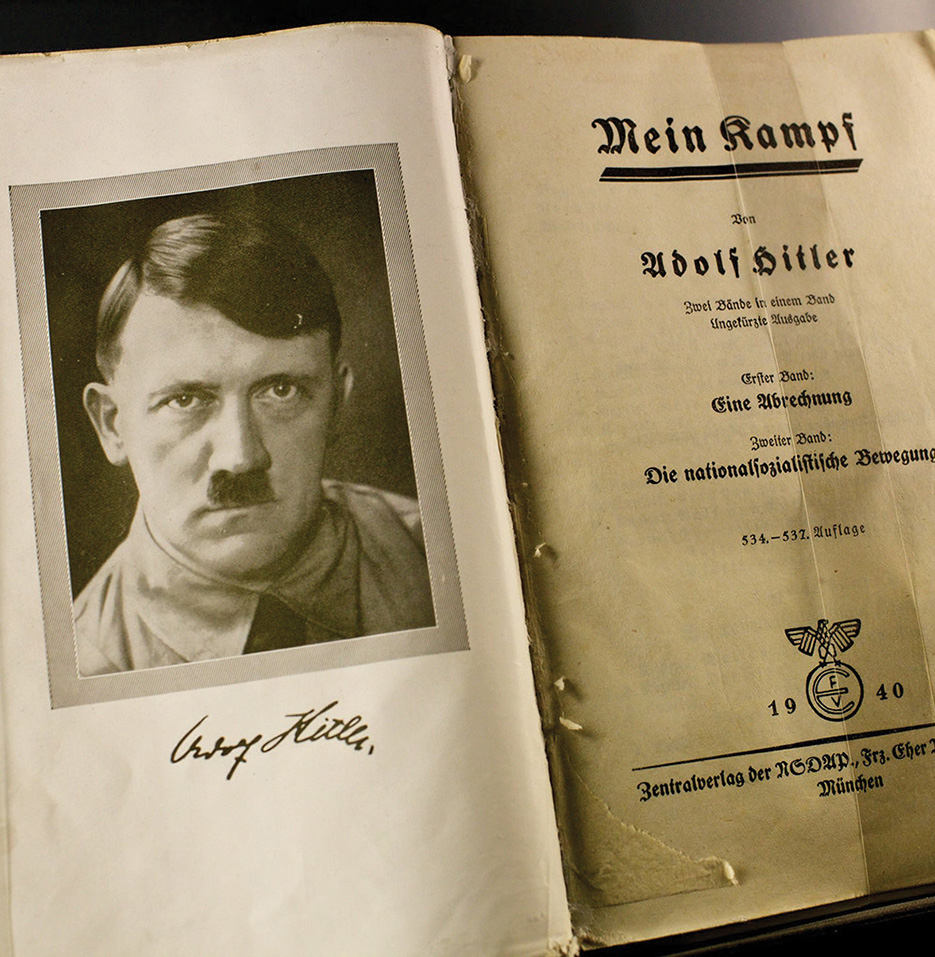
    Charlie Dortch said he was affronted to find Adolf Hitler’s Mein Kampf is in the Freo and John Curtin college libraries.

    BROWSING the shelves of Fremantle Library for the latest bestseller recently, local resident Charlie Dortch says he was “bewildered and affronted” to come across a copy of one of the most infamous books of all time: Adolf Hitler’s Mein Kampf. 

    The former curator of anthropology at the WA Museum, Dr Dortch said his outrage grew when his 15-year-old granddaughter revealed Mein Kampf was also on the shelves of the library at John Curtin College of the Arts. 

    “Let’s not mess about: the book is the Nazi bible and should not be on the shelves of any library apart from those used by researchers of political history,” Dr Dortch said.

    “Among these I would include the State Reference Library and all university libraries, but not school or municipal libraries.” 

    Written while Hitler was in prison from 1923/25, Mein Kampf is both an autobiography and a political manifesto. Now widely reviled for its virulent anti-semitism, the book has also been criticised for being badly written and incoherent.  

    The library defended the book’s inclusion on the shelves. 

    “The aim of any library collection is to make accessible materials to support a broad range of views and to enable their communities to make their own informed decisions,” a spokesperson said. 

    “Fremantle library, and public libraries generally, adhere to the Australian Library and Information Association’s policy on free access to information.” 

    This policy is based on Article 19 of the UN Declaration of Human Rights, which protects freedom of expression. 

    However, Article 29 of the declaration states freedom of expression can be limited if it threatens the “rights and freedoms of others” or the “just requirements of morality”. 

    Peter Wertheim, Co-CEO of the council of Australian Jewry, warned the book encouraged prejudice against the Jewish community, a phenomenon on the rise.

    “On February 25, 2020, the director-general of ASIO Mike Burgess warned about the rapid increase in neo-Nazi activity in Australia,” Mr Wertheim said.

    “We would ask any public library to consider carefully the use that such groups would make of the editions of Mein Kampf that they currently make available.”

    In 1945, the book was banned in Germany, but the copyright expired in 2016 and it entered the public domain. A critical, annotated edition became an unlikely bestseller. The copy held by the Fremantle library isn’t annotated, but has a critical introduction and afterword, unlike many of the free-to-download online editions. 

    Leigh Straw, a history professor at Notre Dame, said critical editions could be useful in understanding Hitler’s thoughts, but only when read alongside credible histories of the holocaust. 

    “It’s a very poorly written book which only came to any prominence in Germany because of the rise of the Nazi Party,” Dr Straw said. 

    In addition to Mein Kampf, the library contains many WWII histories and commentaries. The online-catalogue page offers a collection of “self-education anti-racism resources”. 

    But to Dr Dortch, these other texts don’t make the presence of Hitler’s book acceptable. 

    “I am among the scores of millions who need not read the not very intelligent words of the hellish deceiver who did far more than any other individual to instigate the most hideously cruel war in modern history,” he said.

    by LOTTIE ELTON

  • Reframing Islam
    • The Kebab Man: The story of Ahmad Al Karanouh who moved to a small NSW town, opened a kebab store, and became mayor.

    PERTH will be hosting the only live screenings oft the Muslim Film Festival this year.

    Festival executive producer Tarek Chamkhi said the Covid risk made gatherings in Melbourne, Brisbane and Sydney too problematic this year, but Perth was still going ahead “due thanks to the state government for the measures which have made us all safe in this beautiful state”.

    Films will be shown at Backlot Theatre, the state library theatre and the Canning Town Hall.

    Festival director Joanne McKeown says they’ve picked 55 films from 24 countries: 

    “We were surprised with the huge diversity of Muslim communities worldwide, from the African continent, to Iranian villages, to the streets of Chicago, the freezing prairie of the Russian Federation, and last but not least the kebab man from the outback of NSW.”

    The Kebab Man tells the story of Ahmad ‘Al’ Karanouh, who left Lebanon amid the war and moved to rural NSW where he took a punt on a pop-up kebabbery to cash in on the Coonamble rodeo and eventually became the town’s mayor.  

    “We hope that watching our films will break down prejudice and misconceptions about Muslims and illustrate their diversity in Australia and worldwide,” Ms McKeown says. 

    With so much of the film world locked down and so few places to screen new movies, the MFF screening here has been international news.

    Perth got a shout out in Iran’s English-language newspaper The Tehran Times, owned by the Islamic Ideology Dissemination Organization. It reported several new Iranian movies would screen only in Perth “due to coronavirus and the resulting unusual circumstances”. 

    Iranian films on show include Maryam Mohammadi’s Unlock, a documentary about the 300-year-old lock making industry in the town of Chaleshtar in southwest Iran.

    Iran’s coronavirus situation has had an unexpected impact on the film scene, having led to the reopening of drive-in movies. They were banned following the 1979 revolution as cars were considered to give couples too much privacy. 

    In May an outdoor theatre in Tehran was allowed to show the first drive-in film in 40 years with Exodus, the story of a group of cotton farmers who drive their tractors to the president’s office to protest the government dams that killed their land.

    The local sessions are September 5 at the state library theatre, September 6 at Backlot, and September 19 at Canning Town Hall, tickets or online stream passes via muslimfilmfestival.com.au

  • Food haven

    IF my recent dining experience in Perth is anything to go by, the inner-city restaurant scene is bouncing back following months of uncertainty. 

    I tried to get a table at three different restaurants and they were all fully booked – a great sign for the local hospitality industry, but annoying for me.

    I was catching up with two old school friends who put me in charge of finding a restaurant close to The Comedy Club, where we were going after our meal.

    Thanks to Google Maps I was reminded of The Stables, a place I’ve been wanting to try for years. 

    In case you’re wondering about the name, the restaurant building was originally one of the first horse stables built in Perth in 1894. This multi-level building has a basement for functions, a bustling bar and casual eating area, and an elegant dining space upstairs with bentwood chairs, equestrian-themed art, and magnificent wooden beams which I suspect are an original and have survived endless renovations over the past century.

    The food is highly approachable – it’s casual, familiar and very well priced. 

    I was grateful my dining companions were easy going foodies and we quickly agreed on some dishes to share.

    As far as plates go, let’s start with the weakest link and work our way up to the best. 

    The beef brisket sliders ($20 for three) were smoky and cheesy and I appreciated the well-toasted brioche buns that weren’t too dry. 

    All the right flavours were there, but the minuscule serving of brisket was disappointing. I had to open mine up to double check they didn’t forget it.

    Next up were the Mac & Cheese croquettes ($15 for 4).

    The croquettes were cubed-shaped and packed full of creamy al dente macaroni with a strong parmesan flavour that really packed a punch. Simple stuff, but a real treat. 

    The menu says truffle oil, but I’m always suspicious when it is included on a menu. 

    An earthy truffle flavour was missing in action. There’s no need to include something so luscious in a pedestrian offering like Mac & Cheese anyway. 

    Next up were four delicious barramundi fillets ($18). 

    The fillets were moist and flakey and the tempura batter was light and crunchy. 

    The house-made tartare was zesty and light. Za-atar, an Arabic spice blend, added an extra dimension. Top stuff. 

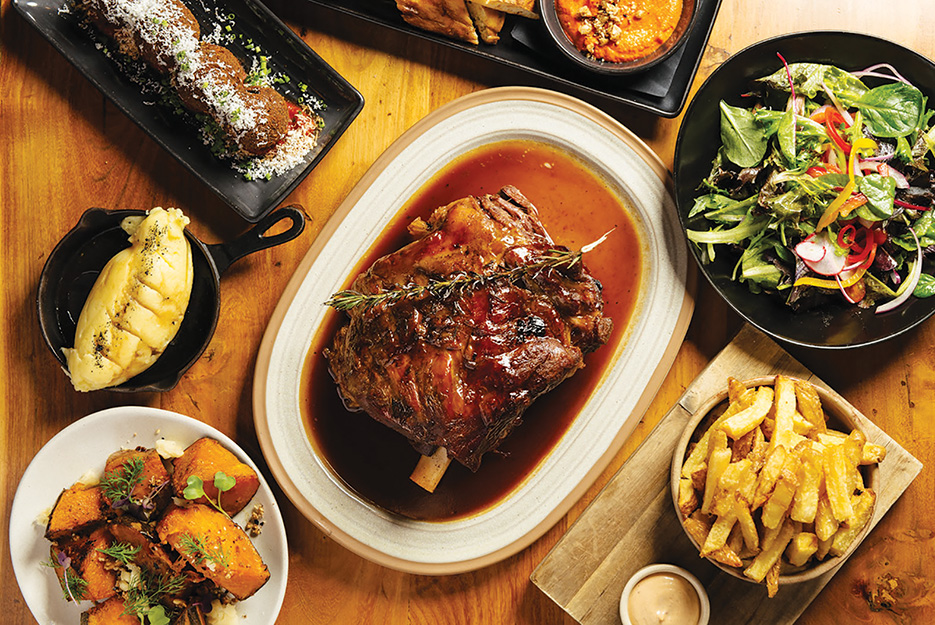
    The crowning dish of the night was a stunning beetroot gnocchi ($32). The dish is deceiving and looked like a fruit salad – the magenta-coloured gnocchi looked like watermelon, the sweet potato cubes looked like rockmelon and the dill could have been mistaken for mint. It was a tremendous dish packed full of flavour thanks to the tangy goats curd. The walnuts added texture and a squirt of lemon gave it a zesty kick. 

    For bigger tables, there’s a 1.5kg BBQ Stirling Range beef brisket ($70), and a 2kg Amelia Park lamb shoulder ($90) to share. 

    I’m already eyeing them off for my next visit.

    The Stables
    888 Hay Street, Perth
    Phone 6314 1300
    thestablesbar.com.au

  • Radio Ga Ga

    PERTH radio station RTRFM is going ahead with its annual Fremantle music festival, despite Covid-19 restrictions pushing back the date.

    The Fremantle ‘Winter’ Spring Party will now be held on Saturday September 19, three months later than usual.

    More than 20 bands will play across five venues in North Fremantle, including Mojos Bar, the Railway Hotel, Port Beach Garden Bar, and the Swan Hotel lounge and basement.

    The line-up features a diverse range of new and experienced bands playing everything from hip hop to alternative folk.

    “Noah Dillon and Jack Davies and the Bush Chooks have been kicking around for some time now and they have really grown into their sound which is so great to see,” says RTR acting general manager Chris Wheeldon.

    “New Talk have a new record coming out and I’m excited to see their new songs live. 

    “Superego who are playing at Mojo’s have been exciting for some time but their live show is now pretty special. 

    “All the bands at the Swan Hotel Basement are super young but so unbelievably talented I’m pretty excited to see how they perform. 

    “Upstairs at the Swan Lounge is a selection of brilliant song writers who will be amazing.”

    This year’s festival has a dance twist with the old Naval Store on Canning Highway becoming ‘Mojo’s Octopus’.

     “We’ve teamed up with Mojo’s and Cool Perth Nights to a rave as a collection of some of the best DJ crews in Perth take over,” Mr Wheeldon says.

    “It will give our punters somewhere else to go and have a dance, something slightly different to the other venues. We love an experiment when it comes to venue.”

    The festival will raise much-needed cash for RTRFM, a not-for-profit community radio station that largely relies on fund-raising and listener subscription to stay afloat.

    Many of their fundraisers had to be cancelled because of the pandemic, but thankfully the Mt Lawley station received $272,256 in Lotterywest grants in early August.

    “It was pretty challenging at the height of the lockdown and restrictions,” Mr Wheeldon says.

    “We had to shift all our presenters to making their shows from home and sending it in to be automated, which for 300-odd broadcasters is quite the task.

    “We, like everyone, lost a number of sponsors and our revenue dropped pretty significantly but we have been lucky in that a lot of our ongoing sponsors have been able to reopen. Our listeners have been amazing and we have just completed our most successful Radiothon (Pledge Drive) on record which will help stabilise the station from a financial stand point. 

    “We did have to cancel a number of events and shift them to other times but slowly as things change and restrictions are lifted we can start to get back to some form of normalcy.”

    For more info and tickets for the Fremantle ‘Winter’ Spring Party go to rtrfm.com.au or oztix. com.au

    by STEPHEN POLLOCK

  • 21st century comeback?
    A public health poster from the 1940s and 50s urging men to get tested and treated for syphilis.

    THE WA Aids Council is urging Sandgropers to get regularly tested for syphilis after notifications were up 20 per cent since last year.

    Typically viewed as an old-school STI, syphilis could be set for a 21st century comeback with notification rates shooting up 40 per cent for men who have sex with men and more than doubling for heterosexuals since 2015, according to the WA health department.

    There was even one case of congenital syphilis, transmitted from mother to baby during pregnancy, in the first quarter of last year.

    Syphilis is caused by a bacteria found in the blood and can be transmitted during sex, close skin-to-skin contact and through the placenta during pregnancy.

    If left untreated it can lead to skin lesions and eventually cardiovascular and/or neurological disease.

    But about 50 per cent of cases show no symptoms at all, so it’s important to get tested.

    “We as a community have recently learnt the value of contact tracing to break the cycle of transmission, so if you do test positive for syphilis it’s important to alert your sexual partners that may have been affected,” says the WA Aids Council.

    “That means for primary syphilis, notify anyone you’ve had sex with for the duration of the symptoms and three months prior, and for secondary, anyone whilst you were experiencing symptoms and six months prior to that.

    “Testing is the key here, as condoms are not always foolproof when it comes to syphilis. Luckily, we’re getting a leg up against congenital syphilis, as we test as part of the routine antenatal screen, but it’s important to include syphilis in routine STI checks.”

    The WA Aids Council holds free sexual health testing for men at the Perth Steam Works in Northbridge, every Tuesday from 2pm to 4pm, where they also give out free condoms.

    It had been closed for six months due to covid-19 restrictions and reopened in August.

    The WA Aids Council also recently launched a free-of-charge LGBTIQA+ youth counselling service for 14 to 26 year olds.

    WA Aids Council councillor Alex Kendrew says that since the pandemic there has been a spike in young people asking for help with anxiety.

    “Youth Counselling is tremendously helpful for young people who don’t necessarily have an outlet or a means of expressing themselves and what’s going on in their lives in a non-judgemental environment,” he says.

    “The young people we are supporting report great relief at being able to talk about things that concern them without having to worry about how a parent, guardian or peer will react. This builds resilience and stronger belief in self.”

    Mr Kendrew says they have also launched a telehealth counselling service for rural and remote communities living with or affected by HIV. 

    “At the moment I support two clients living remotely via our telehealth service.”

    For more info go to waaids.com

  • Unique abode

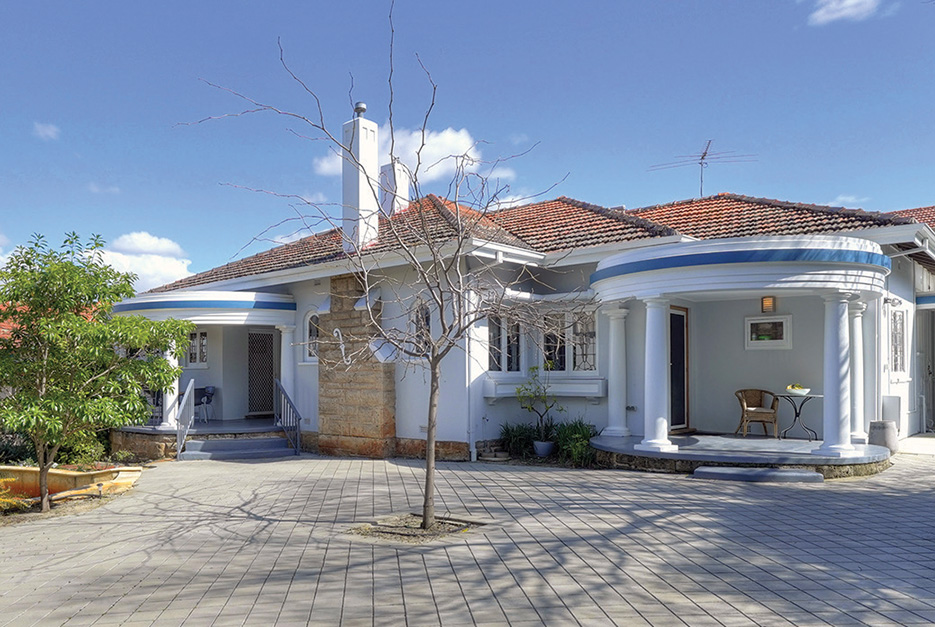
    THE entrance to this Mt Lawley home is stunning and very unique.

    There are two large porches with Roman columns at either end of the house, creating a grand and eye-catching symmetry.

    Built in the 1920s this home was built as a duplex but designed to appear like a single residence; no doubt to comply with zoning restrictions at the time.

    A century later this four bedroom two bathroom property has been lovingly restored, and the unique layout means there are several options for the astute buyer.

    You could move in and enjoy the whole property or rent it out (the current owner previously rented half through Airbnb with repeat guests, great reviews and stays of up to three months).

    The architecture in this gorgeous house is a fine example of the late 19th century Arts and Crafts Movement, which re-established the skills of craftsmanship threatened by mass production and industrialisation.

    There’s stunning attention to detail throughout, with exquisite lead light windows and doors, picture rails, and decorative cornicing and ceiling medallions.

    Everything feels like it has been put together with love.

    I like how the owners have kept the original vintage fireplaces, and the polished floorboards complement the neutral colour scheme.

    With kitchens in each “half” of the property, this would make a great multi-generational abode (Getting mum to babysit would be a cinch – just walk to the other side of the house)

    There’s a nice alfresco out back, featuring a roof with louvre slats that can be retracted to suit the weather. It’s a great feature and means you can sit outside all year round. 

    There’s also a wisteria vine, some fruit trees and a veggie patch, so you will be able to enjoy your own homegrown produce.

    The back garden includes a studio with its own laundry and WC, so there’s lots of scope for expansion or for the mother in law to stay.

    There’s a storeroom and space for four cars (where else would you get that in Mt Lawley?).

    Situated on a 722sqm block on Thirlmere Road, this property is close to the Swan River foreshore and Bardon Park, the Mt Lawley train station, and is midway between East Perth and Maylands with umpteen options for eating out and shopping.

    This is a unique and stylish property in a great locale.

    From $1,195,000
    12 Thirlmere Road, Mt Lawley Harcourts City Central

    1300 149 116
    Craig & Penny Brosnan 0417 937 938
    0408 950 574

  • Baz’s plan: Let’s park homelessness

    ‘Behind these numbers are the very real stories of people who have fallen through the cracks.’

    PERTH lord mayoral candidate Basil Zempilas wants to turn the upper floors of Perth’s carparks into overnight shelters for homeless people.

    Mr Zempilas’s “Pop-up Places for Homeless People” policy is based on a recently-trialled Brisbane model developed by the not-for-profit group Beddown, and has received qualified support from advocates and business owners.

    Each night when office workers head home, Beddown volunteers set up blow-up mattresses and bedlinen to provide a safe place for homeless people to bed down. Support services such as counselling and health checks are also made available.

    Mr Zempilas, who’s been briefed on the issue by homeless services, supported the McGowan government’s “Housing First” program but says there’s a lag before people get a permanent roof over their head, whilst emergency accommodation like St Bart’s and The Beacon is overflowing.

    “If there are no beds there, people end up on our streets,” Mr Zempilas said.

    “I aim to adopt the approach or partner with Beddown, from Brisbane, to turn our carparks into safe places for people who are homeless to take refuge from the cold and the danger of sleeping rough.

    “It works in Brisbane, it can work here.”

    Mr Zempilas said lockers would be provided to people using the car parks at night so they could store their belongings during the day, which helps prevent them being stolen or destroyed, and stops nooks and crannies in the city getting clogged.

    The media star’s new approach comes as a stark comparison to a column last year when he spoke of forcibly removing homeless people from the CBD: “The look, the smell, the language, the fights – it’s disgusting,” he wrote.

    The turnabout caught one homeless advocate on the hop: “That’s not the worst idea around,” he said with some surprise.

    Shelter WA CEO Michelle Mackenzie was aware of Beddown’s initiative through a national homelessness network, but says she’d be wary of deviating resources away from the Housing First model, which has a proven track record overseas.

    She says the carpark model might also struggle to provide a suitable place for extremely vulnerable young women – particularly those from Indigenous backgrounds – if it put them in close quarters with people who might trigger responses from previous trauma.

    Ms Mackenzie said Victoria and New South Wales had taken all rough sleepers off the streets during Covid-19 and provided them with accommodation in under-used hotels, and had recently invested more money into the system with the aim of getting people into housing before they ended up back on the streets.

    While the McGowan government tried that at the Pan Pacific hotel, Ms Mackenzie said despite the manager’s “heart of gold” the hotel wasn’t suitable to cater for its unusual clients’ needs. But she says it’s an option the government shouldn’t abandon.

    “It’s a solution that has a bit more dignity than a carpark,” she said.

    A local commercial landlord who’s had homeless people camped outside one of his properties “for a couple of years on and off” says having somewhere to refer them would be a huge relief.

    Intervene

    Despite being sympathetic to their plight, he said he was regularly finding syringes, drug sachets, rotting food and faeces outside his building. “I was literally dry retching cleaning it up on Monday,” he said.

    He’s sought help from police, but has been told they won’t intervene until a crime is committed, while the security company he hired won’t let its staff go near the homeless group because of threats.

    The owner, who didn’t want to be named, said tenants have been actively trying to break long-term leases because of the mess they have to step over every time they arrived for work, which would be devastating for his “mum and dad” investors already struggling because of Covid-19 business closures.

    “How they are going to administer it is up to them, but the concept of having somewhere you can direct people to – if someone is coming up with a pro-active approach to move these people to somewhere in an evening, that’s really great.”

    By STEVE GRANT

  • Harley calls for extended probe into voter fraud
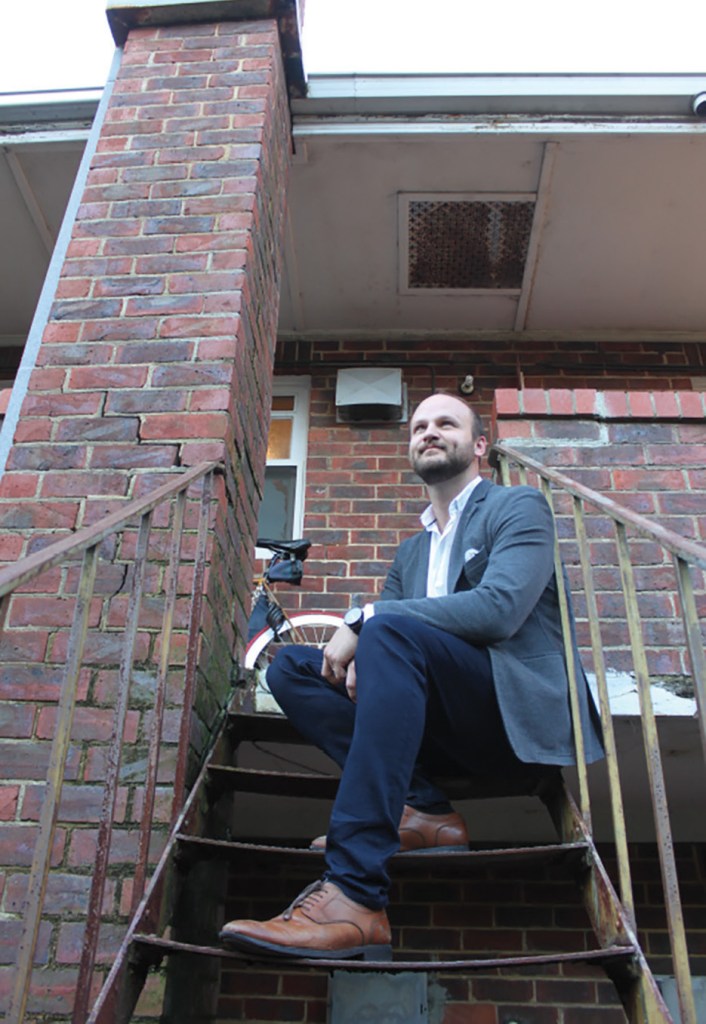
    Reece Harley.

    PERTH council electoral rolls not covered by the Power inquiry need to be audited to root out voting fraud, a former Perth city councillor says.

    Reece Harley was a councillor from 2013 to 2020 and after reading the August 11 inquiry report says the council needs to review electoral rolls from 2013, 2015 and 2017 and refer any suspicious activity to police. 

    “Without a full audit it is impossible to know just how many electors were fraudulently enrolled to vote or how many former councillors or council candidates might have been ineligible to stand,” Mr Harley says. 

    “Any instances of suspected enrolment fraud that the City uncovers must be referred to the WA Police.”

    Sham

    The inquiry uncovered evidence that sham voters were common, and controls were so lax they risked affecting who won elections given there were just a few dozen votes between winning a seat and losing out: “It was a common practice for candidates and council members to organise for companies owning or occupying property in the city to enrol people to vote who had no business or organisational connection with the company,” Mr Power found.

    Businesses are supposed to be allowed to nominate two voters to represent them so traders still get a say in council matters. But at least one business owner interviewed by the inquiry had no idea his companies had been enrolled to vote by a candidate. 

    Some nominees, when contacted, were unaware they’d been registered to vote, because their ballots were piped directly to a candidate’s post office box then filled out without their knowledge.

    The inquiry focused on the case of former councillor Keith Yong, found to have organised for “at least” 45 ballot papers to be sent to PO boxes he had access to ahead of the 2017 election (some were noticed by city staff ahead of time, and he lost, but no action was taken. The inquiry says staff should’ve investigated it further or referred him to police or the WA Electoral Commission). 

    The report says there’s evidence Mr Yong wasn’t the only one.

    The inquiry had Royal Commission powers to demand councillors hand over boxes of documents, and found “some of these boxes contained numerous completed and partially completed enrolment forms for companies owning or occupying property in the City of Perth”. 

    Mr Harley has looked over past electoral rolls and has provided the City of Perth with several examples of “anomalies,” including nearly a dozen votes going to a single office suite instead of the two normally allowed. 

    The Voice asked the council if they’d review previous rolls. We hadn’t heard back before going to print, but were previously told the city wouldn’t be weighing in on issues raised by the inquiry report until commissioners formulated a proper response to the local government minister.

    However the council has taken up a recommendation from the inquiry to ensure a more legitimate election this time round, and is now requiring occupier nominees show actual proof of a lease before allowing them to vote this time round. 

    The inquiry does not have prosecution powers and its “findings” can’t declare whether someone’s broken a law, leaving that up to other authorities.

    By DAVID BELL

  • Cycle network doomed to fail
    North Perth resident Andrew Main’s been campaigning for years to get the streets a bit more human-friendly. Photo by David Bell

    A LOCAL active transport advocate warns the WA government’s long-term cycle network will pit riders against cars on busy roads.

    Andrew Main, who’s spent years dealing with councils and government departments advocating for safer streets for humans on foot and on bikes, says the plan won’t hit its aim to increase the number of people riding.

    He says it puts many routes on distributor roads with high volumes of traffic, and bike riders won’t like it due to “conflicts with vehicle drivers, and the noise and air pollution from vehicles”. 

    “The aim of the LTCN should also be to minimise conflict between drivers and riders, because when you introduce conflict between these two user groups, bike riders will generally lose out,” he says.

    Cheaply

    Mr Main says other countries like the UK and places in Europe have had a lot of success getting people riding through lower traffic neighbourhood streets, making them safer by encouraging only local traffic. It can be done pretty cheaply by closing off a road with a pocket park or just some hefty planter boxes (the latter having the advantage of being cheap and movable). 

    Along with making it safer for bike riders and walkers it cuts down on rat running. Barcelona’s in the midst of closing two thirds of its roads to through traffic in this way. 

    Mr Main says “this approach is far less expensive and quicker to implement”.

    Each suburban council has been asked to endorse the LTCN, and only routes outlined in the path will be eligible for funding for the next year.

    The routes in the LTCN are only “aspirational” and just mark where matched state funding might be available – they’d still have to go through the usual approval process before any paint gets sprayed or lanes go in.

    Mr Main’s submitted his thoughts to Vincent council, though only a couple of his earlier suggestions made it into the amended plan endorsed by the council last week (such as removing the unpopular route through Hyde Park). 

    At the August 18 meeting Cr Joanne Fotakis moved that the council request the WA government chip in more funding for bike lanes, upping the WA Bicycle Network grants from 50 per cent of the cost to 75 per cent given how councils have been especially hammered by Covid-19. Her motion said councils having to pay 50 per cent for a state network that’d be used by many people just passing through, rather than residents, “places a disproportionate and unfair level of burden on ratepayers to fund the network”.

    They unanimously voted to write to the WA Local Government Association and see if it would lobby on behalf of councils to get a bigger state government spend. 

    Perth council commissioners also endorsed their patch of the LTCN this week, without complaint. WA’s transport department proposed two routes cutting north/south through Langley Park, but those were downgraded to “indicative only and subject to change,” depending on what’s in an upcoming Perth Waterfront Master Plan.

    By DAVID BELL