• Recycler negligent over severed arm

    BAYSWATER waste recycling plant Resource Recovery Solutions has been found guilty of “gross negligence” after a worker’s arm was amputated at the shoulder in 2016.  

    It’s the first time a company has been found guilty of gross negligence under the Occupational Safety and Health Act’s requirements to provide a safe work place; “the most serious offence under that act,” WorkSafe WA commissioner Darren Kavanagh said in a statement.

    The penalty is pending and the maximum is $500,000. RRS director Sam Mangione is also facing an upcoming court date on the same charge. As an individual, he faces a $250,000 fine and up to two years’ gaol. The labour hire company Mode2 Group is also being prosecuted.

    The labour hire worker was a “picker,” whose job was to manually remove unsuitable items from a conveyor belt and clear blockages.

    In September 2016 the worker had cleared a blockage, and when the belts were restarted he reached in to remove a rock.

    He was dragged into a “crush point,” and the machine removed his arm.

    Worksafe WA says there was no guard around the belt’s crush points and no lockout tag procedure followed. A lockout tag procedure sees a worker lock the power supply to a machine in the off position and take the key with them before doing any work on the moving parts, meaning only they can power it back up.

    Mr Kavanagh said the gross negligence verdict on Friday July 10 was significant.

    “The obligation on WorkSafe as a prosecutor to prove that a company has been grossly negligent is particularly difficult.

    “[RSS] had a long history of flouting workplace safety laws, particularly by failing to guard dangerous machinery despite previous serious injuries and despite being instructed to fit guarding by WorkSafe inspectors.”

    Killed

    In September 2013 worker Mohammad Hadi was killed at the plant when a roof panel, overloaded with five times its safe working weight, collapsed on him. Resource Recovery Solutions was fined $85,000. 

    WorkSafe inspectors visited the site after the death and found conveyor belts unguarded, but Mr Kavanagh said they “were reassured that the plant was fully automated and workers were not present when the plant was running”.

    The plant continued to operate without guarding, and a worker suffered a broken arm in February 2015.

    Mr Kavanagh said “WorkSafe issued an Improvement Notice requiring guarding to be installed on crush points of the belts, but this was not complied with despite several reminder letters being sent to the employer”.

    “The company director advised that the notice had been complied with, but this worker had his arm literally torn off by an unguarded conveyor belt.”

    He says the magistrate described the disregard for safety as “blatant” and going well beyond mere neglect.

    Resource Recovery Solutions didn’t respond to our request for comment. 

    By DAVID BELL
  • Heritage exodus
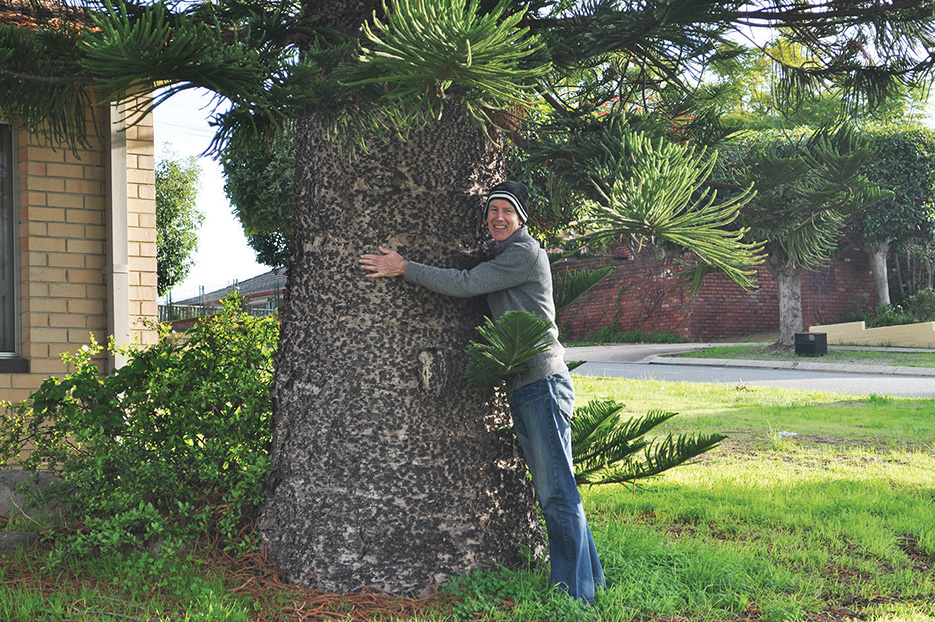
    A tree-lover convinced Bayswater council to shunt this pine into a higher heritage character, but they didn’t let the owner know.  Photo: National Trust.

    Council didn’t alert tree owner 

    OWNERS of historic properties are starting to pepper Bayswater council to get their places off its heritage list.

    In February the council added dozens more properties to its heritage list, giving them some statutory protection against demolition.

    The decision followed a long consultation process but some owners said they never received letters advising them their property was list-bound. 

    A few complained ahead of the February meeting and got the listing cancelled, and now more are coming forward to get off the list.

    Masonic Hall

    The owner of the 1937 Druid/Masonic Hall at 130 Guildford Road was able to get the property off the list in June, arguing it was dilapidated and hadn’t been used as a hall since the 90s. Council staff wanted to keep it on the list but only Cr Elli Petersen-Pik voted for its retention, and it’s now free to be developed.

    Two more unlisting requests face the council at its next meeting on July 21.

    The owners of the 10 Falkirk Street want the circa-1925 cottage off the list so it can be demolished for a bigger family home. 

    Council staff recommend keeping it on the list, noting the lowish classification (category 3) won’t outright prevent redevelopment, but encourages an adaptation. They also don’t reckon a listing hurts prices.

    Another resident has requested the unlisting of the 105-year-old pine tree on their property at 35 Drake Street, planted by prominent early citizen and road board member John Whittaker. The Norfolk Island pine is considered to have “state” level significance by the National Trust.  

    When the council advertised the upcoming listings, the tree was only going to be “category 4”, which just puts it on the separate “Heritage Survey” document of notable places and doesn’t have the legal protection of being one of the category 1, 2 or 3 places on the official “Heritage List”.

    But an interested history buff put in a submission about the tree being an important historic landmark so council listed it as category three without going back to the owner, who’s complained due process wasn’t followed. They don’t want it on either the survey or the list.

    Oversight 

    Council staff are recommending it stay listed as a category 3, but after a 21-day consultation to correct the “oversight” of not asking the owner about the upgrade to the big list.

    Given the requests trickling in, the council’s looking at coming up with a proper policy to handle removal requests.

    They’re browsing over other councils’ removals policies, including South Perth where they don’t allow for list removals, and Vincent where you can get a property off the list if it’s deteriorated so badly it can’t be restored and has no more heritage value (but that might get you in trouble if you’ve purposely neglected it).

  • Homeless Connect cancelled

    HOMELESS Connect Perth will not run in 2020. 

    The big one-day annual event usually runs in November at Russell Square, connecting homeless people with a variety of support organisations and offering services like dental work and haircuts. 

    Volunteering WA organises the event but says along with major partner, Perth city council, it had decided not to go ahead this year due to concerns about large gatherings during the Covid era.

    “This year’s event would not be safe for our guests, service providers and the volunteers, Volunteering WA said in a statement. 

  • Pica-boo

    PICABAR’S just hibernating and will return. 

    As other bars reopen through the CBD, Picabar’s remained pointedly shut, with furniture cleared out and the courtyard emptied, raising fears it might’ve closed for good.

    It turns out the owners took the lockdown time to do some extensive renos, thinking bars might be closed longer than they were. Picabar’s Conor Buckley tells us they are coming back, and are about five weeks away from reopening.

    A big renovation was part of the agreement reached in October 2019 to get a new five-year lease on the WA Government-owned building.

  • There’s more to Wuhan
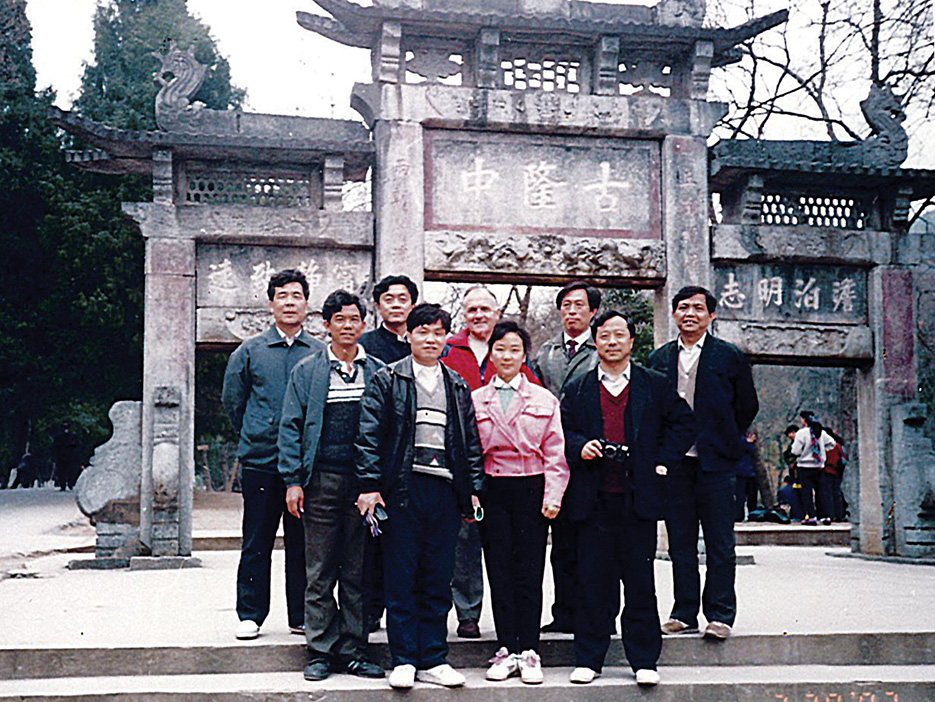
    • George Neilson with some of his Chinese students.

    GEORGE NEILSON is a senior teaching fellow at Curtin University’s business school with a speciality in management techniques. In today’s THINKING ALLOWED he gives a personal perspective of Wuhan, up until recently almost an almost unknown Chinese city – until it was identified as the breeding ground of the Covid-19 pandemic. Mr Neilson says WA’s got a strong connection to the city, which has a lot more to offer than just gloomy headlines.

    IN the early 1900s and up to the 1930s China’s city of Wuhan was the international hub of American, British, French, German and Japanese enclaves – all representing their countries in international trade.

    In Hankou, a district within the municipality of Wuhan, one can still see the large merchant buildings and trading houses of these busy trading times.

    Today, Wuhan is known in China as the crossroads of nine provinces and is an important hub of commerce with a significant connection to WA – our iron ore which helps feed Wuhan’s iron and steel foundries, as well as our expertise which helped to make it the powerhouse it is today.

    Up until a few months ago the city of Wuhan, in the central Hubei province of China, would have been little known in Australia.

    Now, due to the outbreak of the coronavirus in this city, most people in Australia and around the world have heard the name, know of its existence in China, but know little else.

    Wuhan today is a city of over 11 million people.

    Collective

    It straddles the famous Yangtze River and is the collective name for the cities of Hankow, Han Yang and Wuchang, and these three are considered a single political and economic unit.

    Wuchang lies on the south bank of the Yangtze River with Hankow and Han Yang on the northern bank. The Han River separates Han Yang and Hankow and bridges and ferries provide transportation between all three cities.

    One can travel west from the eastern seaside city of Shanghai by boat to Wuhan on the Yangtze River passing the old capital city of Nanjing; a pleasant two to three-day voyage.

    The port of Wuhan is the furthest west boats and ocean-going vessels can navigate safely before reaching the internationally famous and majestic Three Gorges Dam of the upper Yangtze River.

    In contrast to other Chinese cities like Shanghai, Xian, Beijing and Hangzhou, each of which has its own particular attractions – Shanghai for example has its Bund, Peace Hotel and harbour; Xian for its internationally famous terracotta warriors; Beijing for its Emperor’s Palace and Tiananmen Square and Hangzhou for its lakes and gardens.

    Wuhan is the industrial city in mid China famed for its age and history.

    It was in Wuhan that the Chinese Revolution was born and which overthrew the 4000 year Chinese dynasty in 1911.

    Not only does Hubei Province and Wuhan in particular have a long and respected tradition in iron and steel making, but also the region is one of the most dynamic industrial and agricultural regions within China.

    Wuhan is known in China as “the crossroads of nine provinces” because of its central mid-China communications, railways and highways and because of its huge iron and steel mill second only to  Beijing in the north.

    Former Australian prime minister Bob Hawke led a delegation to China in the late 1980s and this resulted in joint Chinese/Australian cooperation for several projects. One of these particularly pressing projects was the iron and steel industry.

    There was a crying need to improve the production, quality and management of China’s iron and steel production.

    The quality fo steel being sold to countries like North Korea, Vietnam, Laos, Myanmar and Mongolia was well below world standards and to be competitive, urgent attention and positive action was required.

    In the late 1990s I was approached by a semi-statutory corporation, the Overseas Projects Corporation, along with seven other colleagues from different Australian tertiary institutions, to participate in a two-year enterprise management project with Wuhan Iron and Steel Corporation.

    Initially in Melbourne for six months, we sat down with our Chinese counterparts and wrote the course subjects that we were to teach in China.

    Management

    For example; organisational behaviour and international business were my areas, financial management and strategic management were someone else’s, accounting and finance, etc.

    On arriving in China the two-year training project was officially opened by the then Australian minister for foreign affairs Neil Blewitt, attended by several high ranking ministers from China’s Ministry of Mines and Metallurgical Industries.

    Continued next week.

  • Vive la Basil  

    As my wife drove through Perth CBD, I looked out the car window and saw a 1000ft statue of Basil Zempilas looming over the city.

    Perched on his chest was Steve Mills, rubbing brasso into Basil’s bronze nipples and mayoral chains.

    “No,” I mumbled as we pulled into the Inglewood Hotel car park. “It can’t be true.”

    “We’re here”, said my wife. 

    “Wake up!”

    Thankfully it was all just a silly dream and could never happen…

    As we walked through the Inglewood Hotel, men in cherry-red berets were zooming about.

    I was a bit confused until we sat down at our table and saw there was a special menu to celebrate Bastille Day (Tuesday July 14).

    It was a nice touch and added some joie de vivre to the buzzing restaurant, which was packed to the gunnels during school holidays.

    The small menu had all the hotel classics (burgers, pie, parmi and the odd curveball like cajun crusted salmon) and the Bastille menu included beef bourguignon, duck a la orange and some French vino.

    The service was superb throughout the night and the young waitress offered to get some colouring-in books for our kids and made sure their meals came first.

    She didn’t try and fleece us on the drinks and got them kids lemonades instead of adult ones.

    As we waited for our food I had a snoop around: the hotel lounge was quite plush with designer lampshades, a nice carpet and contemporary artworks hanging on the walls. It felt modern but quite cosy, and diners were laughing and having fun. There was a good vibe about the place.

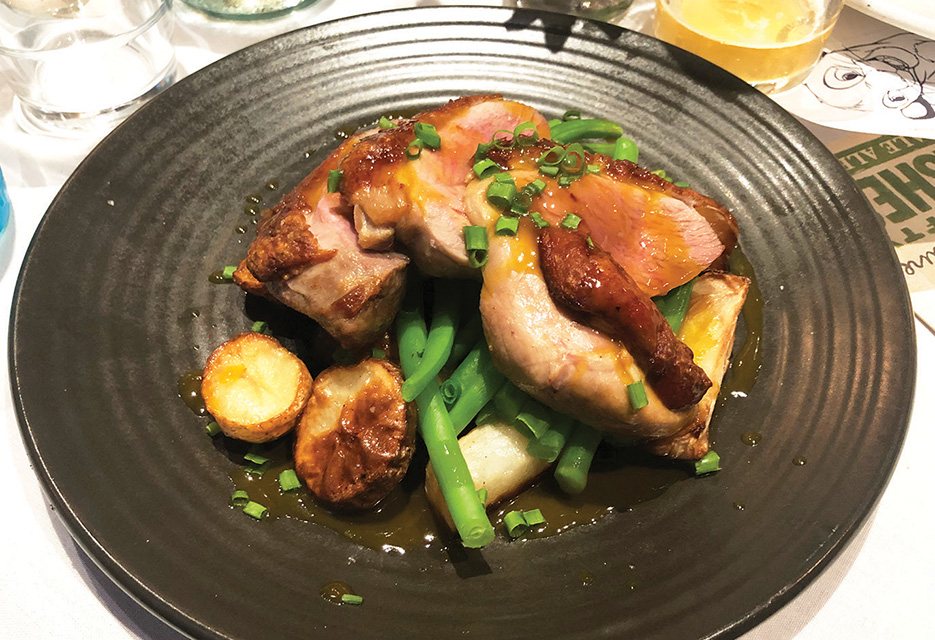
    The waitress was soon back with my duck a la orange ($28).

    I was hesitant about ordering this dish, as growing up in the UK it was somewhat of a 1970s cliche (dreary couples in middle England enjoying Mateus Rose and duck a la orange was the height of sophistication back then).

    It became one of those so-naff-it’s-cool dishes that Heston Blumenthal would reinvent by stuffing a Terry’s chocolate orange up a duck’s bottom and then freezing it with liquid nitrogen.

    Anyway, I took the plunge and was rewarded for my courage – it was amazing.

    Thick slices of tender duck –  pink hue wtih a thin crispy layer of fat – formed a neat mound on my plate.

    The dark meat was cooked to perfection, and the subtle orange sauce wasn’t cloying and had a pleasant sweet-sour tang.

    Nestled underneath were some green beans, roast turnips and baby potatoes, adding the requisite crunch. A fantstic dish with loads of duck meat and subtle flavour.

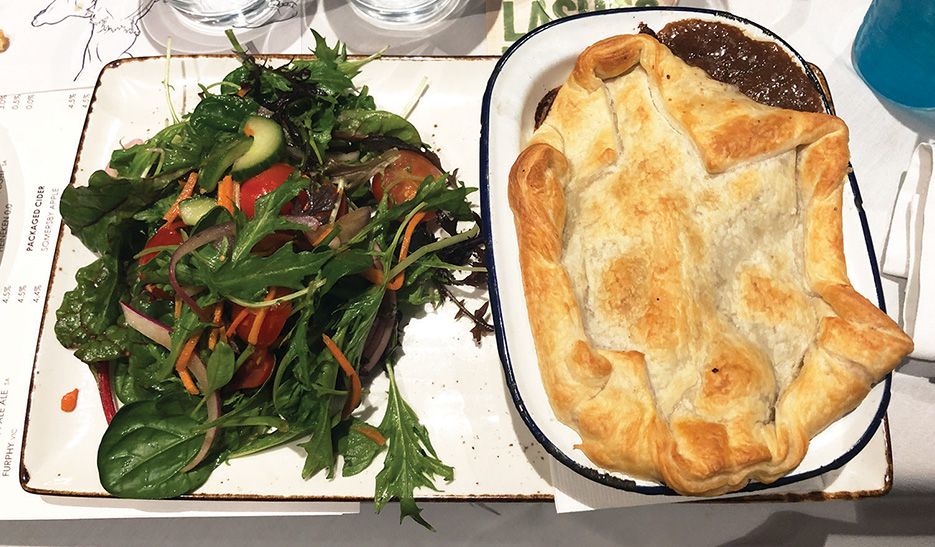
    Across the table, my wife was enjoying her old-school treat – a beef, Guinness and mushroom pie ($23).

    “The gravy is the star of the show – thick and packed with flavour it’s great for a winter’s night,” she said.

    “The flaky pastry is spot on as well, and the chunks of beef are nice and tender. A delicious authentic pie”

    My wife opted for salad instead of chips, and said the heap of fresh greens was a refreshing alternative.

    Talking of chips, the little rascals were busy demolishing their fish and chips (kids menu $10).

    I had a sneaky taste and can confirm the light, golden batter was yummy and the thick fillet of fish fresh and moist.

    Everything at the Inglewood Hotel was spot on – the food, service and ambience – and I could see why the carpark was chockas on a Tuesday night.

    It’s serving up restaurant-quality food in a pub setting.

    Inglewood Hotel
    803 Beaufort St
    http://www.inglewoodhotel.com.au
    9370 5511

  • Cool comeback
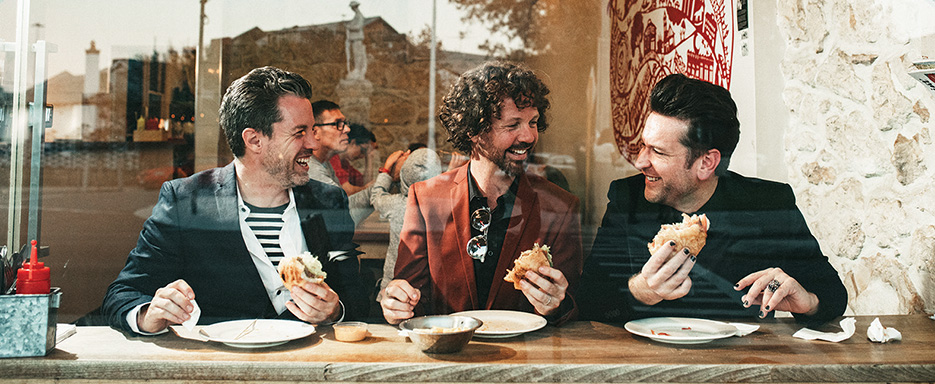
    • These days the founding members of Eskimo Joe are in their 40s and prefer a nice burger to groupies. Photo supplied.

    ESKIMO JOE’S collaboration with the WA symphony orchestra was the catalyst for their first new music in seven years, says lead singer Kav Temperley. 

    Last year the Perth band performed two sold-out shows with WASO to celebrate their 21st birthday. 

    “These amazing arrangers were turning our songs into beautiful orchestral pieces,” Temperley says. 

    “It re-inspired our love of our back catalogue and our love for each other. 

    “After that, I had this little itch to scratch and I was in Melbourne where Joel [Quartermain] lives and said I’ve got an idea for a song – let’s have a jam…” 

    Eskimo Joe’s comeback single Say Something is a catchy triumph; blending huge production with thumping beats and thought-provoking lyrics. 

    The sound is contemporary, but there’s a nod to 70s bands like ELO, and the video features desolate city streets, mirroring the covid-19 lockdown in Melbourne.

    Temperley says the song was written about a year ago, when Greta Thunberg was whipping the world into a green frenzy.

    “The song was initially inspired by climate change activism and how youth were getting everybody to situp and listen,” he says.

    “That was the beginning of it, and by the time we got to recording it in February this year, it had evolved into a song more about being a humanitarian, treating each other and the world with respect and love. It feels like now is the time to talk about important things we have been putting off for years.”

    Eskimo Joe formed in 1997 and the three founding members are now in their 40s, with babies, partners, wives and a few grey pubes under their middle-aged belts.

    Temperley says he’s more likely to write about social issues these days instead of chasing girls and heartbreak.

    “In our mid 20s living in Fremantle that’s what we wrote about, but now we are all in a pretty good place and we don’t want to write about where love went wrong. We’re a little bit more inspired by social statement. We’ve all got kids and we’re starting to think about the world these kids are going to grow up in. I always write from a very personal space, but try to put it in a universal story.”

    So could the single Say Something be the precursor to a new Eskimo Joe album?

    Temperley says they are taking it a song at a time, and with Quartermain based in Melbourne, getting together could be tricky.

    “I hope it evolves into a record, but I think the best I can promise is that we’ll get another song done before the year’s out. I’ve got a little studio space in Fremantle, and when I’m not working on other people’s music, I’m in there working on stuff that could become new Eskimo Joe songs.”

    Temperley has been on the road with Eskimo Joe from the age of 19, enjoying the sights of the world, but still lives in Freo and says it’s the place to be.

    “I explain to people that it is one of the few places where if someone asks you “What do you do?”, and you reply “I play music.” They would never say, “But what do you do for a real job?”

    Watch the video for Say Something here: http://www.youtube.com/watch?v=mtWeAspTz0g   

  • Two for one 

    IF you love a two-for-one deal then this Mount Lawley home will be right up your street.

    Situated on a 916sqm block on First Avenue, it was originally a single brick home that has been subdivided into two.

    Potential buyers have loads of options – renovate and turn it into one big family home, demolish and build a new house on a generous block, or keep the two properties and rent them out (the combined rental income in March was $825).

    This is an old-school brick house with solid foundations and you can tell it was built to last.

    Each property has two bedrooms and the street-fronting one includes two bathrooms and the rear property one.

    The home has a nice frontage with a green wooden fence supported by brick columns, providing privacy and security.

    The cream render on the facade is also appealing, and the bedroom on the first floor is almost like a cute turret, peeking out over the leafy avenue.

    Inside there’s lots of high ceilings and jarrah floorboards, and a classic narrow hallway with rooms off either side.

    The lounge has a lovely old fireplace and there’s a vintage cooker in the kitchen.

    This home definitely has lots of character and ehm, yellow paint, but that can easily be changed.

    Both homes have verandahs and the front property has a cute sunroom for catching some rays, and the rear property includes a pergola.

    Out the back is a massive empty  garden which could be used for anything really – an alfresco with a pool, massive workshop and garage, or even a studio flat. 

    The driveway goes all the way to the rear of the block, which is handy if you want a garage there or own a boat. 

    Each property has an undercover carport at the rear and secure gardens.

    Situated on First Avenue, you are only about 100m west of all the cafes and restaurants on Beaufort Street, and close to Copley and Hamer Parks.

    Perth College is around the corner and Mount Lawley primary and high schools are in the catchment area.

    This property has loads of potential, and will appeal to an astute buyer in a competitive covid-19 market.

    EOI low $1 millions
    69A and 69B First Avenue,
    Mount Lawley
    Home open today (Saturday July 18) 2pm – 2.30pm
    ACTON Mt Lawley Agents:
    Carlos Lehn 0416 206 736 Paul Owen 0411 601 420

  • WACA pool plan for Perth City Deal
    Perth MP John Carey says the CBD could use an aquatic centre like Beatty Park. Photo by David Bell.

    ‘An asset for kids, families and city workers’

    A NEW inner-city pool is being floated as part of the Perth City Deal, with the old East Perth WACA ground pitched as a possible site. 

    Perth state Labor MP John Carey and Perth council are gauging interest in the idea, which emerged at the Perth City Summit consultation days Mr Carey ran shortly after being elected in 2017.

    “We have an opportunity with the Perth City Deal,” he says, “an agreement between the federal government, state government and the City of Perth to encourage city renewal, activation, and transformation of the city.

    Slides

    “Some people may ask why’s a swimming pool in that mix… look at the potential of not just the public swimming pool, but recreational facilities, slides, a kids’ water playground to really make it an asset for kids, families and city workers.”

    In December 2019 the federal government announced it’d pitch in $30 million alongside $40 million of state money for the WACA redevelopment, including indoor training facility and a public gym.

    Mr Carey says it’d be ideal to have something like Beatty Park Leisure Centre at the WACA, close to the East Perth’s high residential population and on the CAT bus route: “Beatty Park is a great example,” he says, adding manager “Dale [Morrissy] and his team have really created a community hub, it is a place where community groups meet, where residents connect.”

    The WA government and PCC have joint-funded a business case already and Mr Carey says it showed adding extras like a water playground enhances the viability.  

    The council’s survey is up at engage.perth.wa.gov. au and Mr Carey’s got his at http://www.surveymonkey.com/r/PerthSwimmingPool.

    Perth federal Labor MP Patrick Gorman says “a community pool at the WACA is a great idea and the community should have their voice heard,” but he said “I am disappointed that the federal liberals are 15 months late in finalising the Perth City Deal, denying our city critical funds for projects such as this”.

  • Youth leads calls for BLM changes
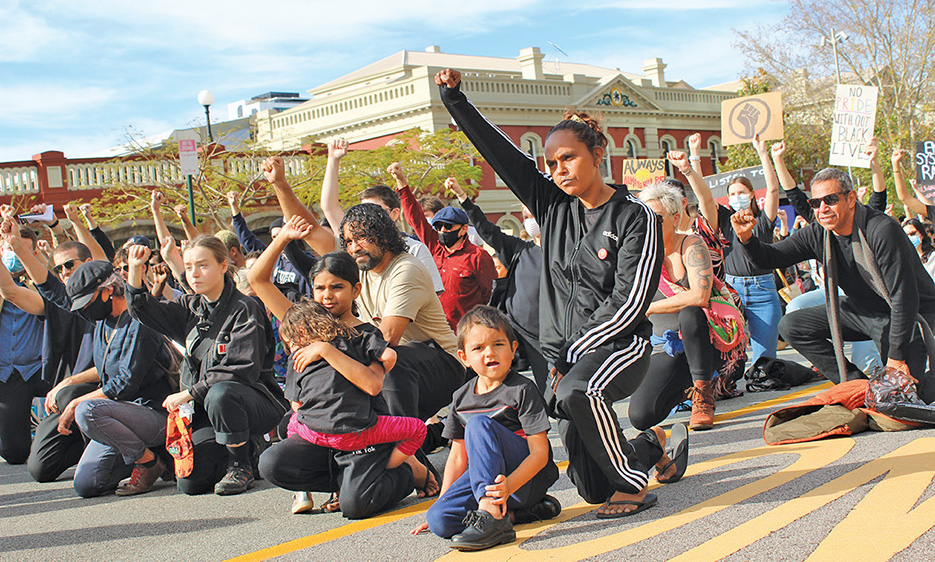
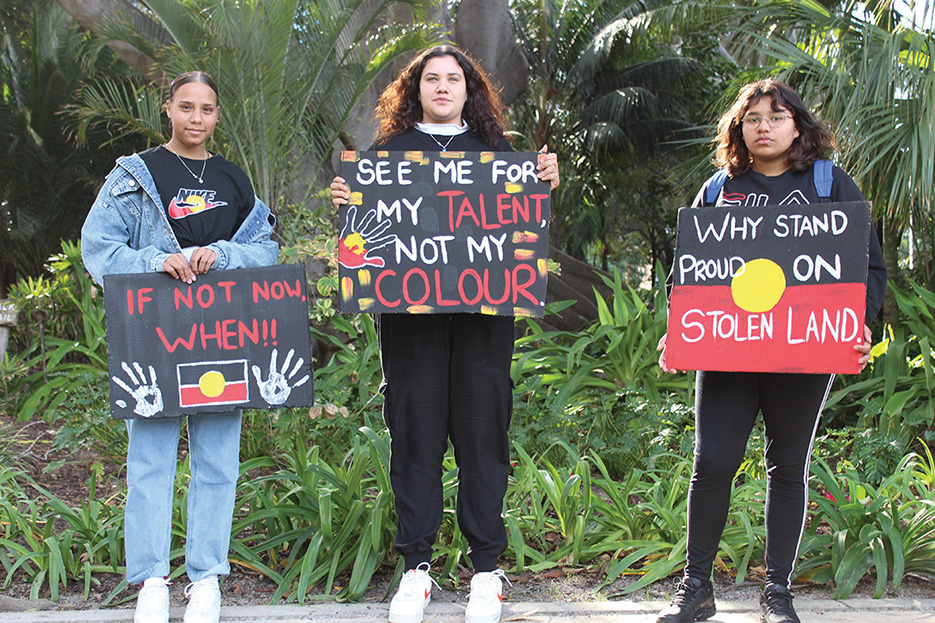
    Protestors drop to their knees in support of the Black Lives Matter movement. Photos by Kelly Warden.

    ABOUT 500 people gathered in Langley Park for a youth rally supporting the Black Lives Matters protests last Saturday. 

    With posters demanding governments address the appalling rate of Indigenous incarceration in Australia and work towards sovereignty for First Nations people, the grassroots group responsible for organising the protest, Boorloo Justice, guided the chanting protesters through the city.

    “The voices of youth are ultimately the catalyst for racial equality and national reform,” Boorloo’s team said in a statement on their Facebook page. 

    The wave of BLM protests rippling through cities across the world was sparked by the death of African American man George Floyd at the hands of Minneapolis police on May 25.

    Activists across Australia have since brought the movement’s message into an Australian context, by raising awareness of First Nations people who have died in police custody, and the fact their incarceration rates are higher than those of African Americans in the US. 

    According to a report released in March, the Australian Indigenous incarceration rate rose above the African American incarceration rate in 2017. 

    The report, authored by Federal Labor frontbencher Andrew Leigh, shows African American incarceration rates in 2017 were 2,304 per 100,000, while in Australia the Indigenous rate was 2,433 per 100,000 in the same year.

    Since then, Australia’s rate has continued to rise, while America’s is steadily decreasing. 

    “It’s happening worse in Australia,” said protest marshal Ariel Turner. 

    Incarceration rates

    She says the public needs to be more aware of Indigenous deaths in custody, increasing incarceration rates, and told the Voice she wants white Australians to be better allies to the movement.

    “Being white, I have so much more safety to speak out about it. This is something that’s been underground for too long,” she said. 

    Boorloo Justice leader Bree Yarran said she wanted Australians to look past the blunt statistics of how many Indigenous people have died in custody.

    “We have to look at what came before, that brought us here,” she said.

    During her address, Ms Yarran spoke about Australia’s history of making racist policies, specifically the ‘Aborigines Act 1905’ which opened the door to thousands of people, including her Grandmother, to be taken from their families and put into missions.

    “Though the Stolen Generation policies ended in the 1970s, it still has an ongoing effect on First Nations family members,” Ms Yarran said. 

    “There is a new Stolen Generation still happening today.” First Nations children in Australia today are 10.2 times more likely to be placed in out of home care than non-Indigenous children.

    “In WA alone, First Nations children make up 55 percent of children in foster care,” she said.

    Ms Yarran attributes this to “systematic failings by the government which echo our devastating and traumatic past”. 

    Elders told the crowd stories of other racist crimes they and their family members had experienced in years gone by.

    Keith Tapiwanashe Makuni wished the McGowan could tackle racism with the same zest as Covid-19. Photos by Kelly Warden.

    Journal

    One woman read from her grandfather’s journal about white people “taking our ears from our bodies and putting them up on the wall”. 

    Keith Tapiwanashe Makuni called on WA premier Mark McGowan to use the same energy fighting systemic racism as he did to mitigate the Covid crisis.

    “We want a new era. We want empowerment. We want equality. We want fair treatment,” he said during his speech. 

    The Voice spoke to a handful of protesters who felt the police presence was over the top, both at the protest and in Perth City generally.

    “Perth is a small city with a big police presence,” said sister activists, Sym and Shaan who moved here from London in September last year.

    The sisters told the Voice they felt there was “macho behaviour among police,” saying there’s “not much reason for it other than intimidation”. 

    After the rally, protester Hannah said she felt “there was an imbalance in the number of police officers per each protester. 

    In my opinion the police officers at this protest were noticeably more provocative than the previous protest”. 

    Hannah says police officers smirked when protesters ‘took a knee’ in solidarity, and she recalls “one male police officer even scoffed”. 

    “First Nations people are only 3 per cent” of the population, says Ms Yarran. “We need the other 97 percent to stand in solidarity to make a difference.” 

    by Kelly Warden