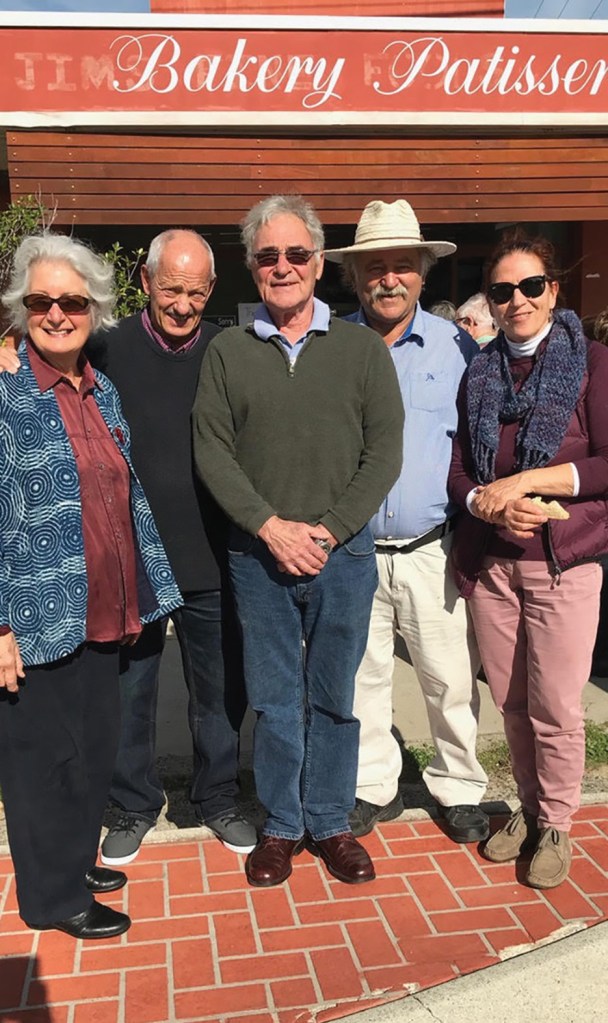
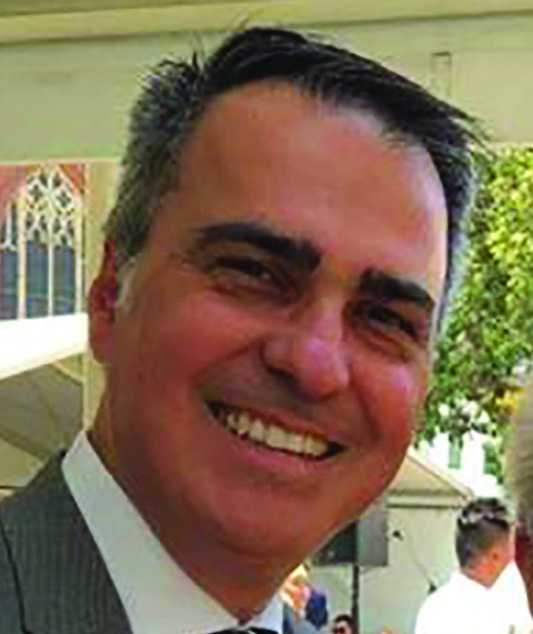
Supporters gather to farewell Nick Niederberger (second on the left) on Saturday July 4.
AFTER 21 years, revered Pearlof Highgate patisserie chef NickNiederberger is retiring.
Building owners Franz Seidl and Hanneke Rekelhof organised a get together for their beloved tenant on July 4 to farewell the master patissier with friends and supporters, including Vincent mayor Emma Cole (Mr Niederberger baked her wedding cake 17 years ago).
Originally from Switzerland and known for his giant European baking hat, Mr Niederberger opened his small Lincoln Street shop in 1999 and it quickly became a multicultural hub, people brought together by a love of frangipani tarts and football (his walls were decorated with soccer World Cup memorabilia).
When his retirement was announced the Pearl’s social media pages were flooded with hundreds of people imploring him to stick around and keep baking his rhubarb flan, pies and pastries, but Mr Niederberger says the time is right and he’s looking forward to having more time to sleep in and chase the grandkids around.
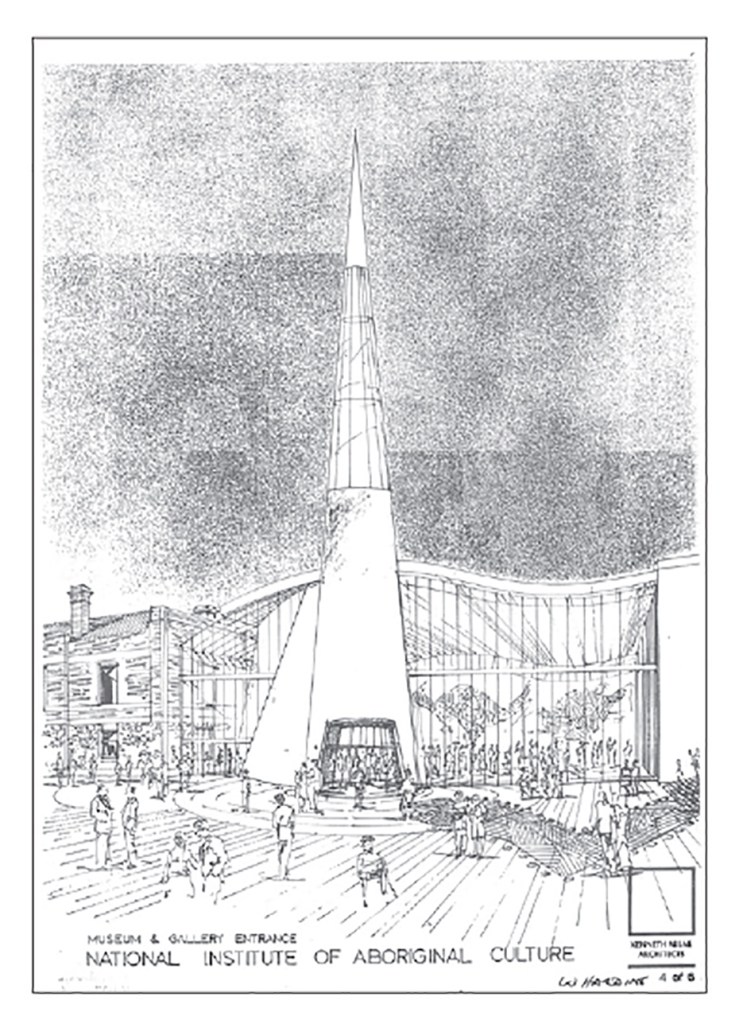
A constituent recently dropped by Patrick Gorman’s office to show him mid-90s plans for an Aboriginal cultural centre.
WITH successive state government plans for an Aboriginal cultural centre having come and gone without a brick being laid, federal Labor MP Patrick Gorman says it’s time for the Commonwealth to fund a national centre in WA.
First the Dowding government’s 1989 planfor a centre at the old Swan Brewery site, then the Court government’s 1994 plans for a “National Institute of Aboriginal Culture” at Beaufort Street’s Swan Barracks, the Barnett government’s plan for an Elizabeth Quay centre, then the McGowan government flagging something at the East Perth Power Station: All have come to nought. The lot at Elizabeth Quay is still just water evenas the hotel and apartment developments have sprung up.
Optimistic
Mr Gorman says afterthe lapsed plans: “I’m really optimistic we will get some movement by the end of the year. [It’s] been a good idea for a long time, but I believe the time has well and truly come”.
The federal advisory body Infrastructure Australia has listed a national Indigenous art and cultural centre as one of the near-term needs in its 2020 infrastructure priority list, but didn’t suggest a location.
“Infrastructure Australia, which are pretty serious bean counters in terms of what infrastructure will be good for the national economy, say this is a national priority to have a series of such centres across the country,” Mr Gorman says.
He says Perth should geta national centre featuring Indigenous culture from across Australia, including modern stories and contributions to art, film and music.
New South Wales, the Northern Territory and South Australia also want to host the national centre (SA almost got the title for its upcoming cultural centre, before quietly dropping the “National” bit after closed-door discussions with the federal government).
Mr Gorman says there’s“huge appeal” for international tourists. “There’s survey after survey that shows authentic and accessibl e Indigenous cultural experiences is one of the key priorities for tourists, and one of their disappointments that they don’t access such experiences in their time in Australia.”
Perth’s bicentenary is coming up in 2029, which Mr Gorman previously described as a difficult milestone given the date marks the beginning of appalling treatment of Aboriginal people. But he says a national Indigenous centre would be an opportunity to make it a date of recognition, plus the federal government is known for splashing out cash to states in the lead-up to bicentenaries ($470 million in today’s money was spent on Sydney’s 1988 bicentenary). He recently ran a survey asking how to celebrate 200 years, and an Indigenous centre was the most popular result.
Nonprofit city advocate group Committee for Perth are dead keen for a centre, having called for one for a decade now, and their June report said a world centre for Indigenous culture could be the “one big thing” to put Perth on the global map.
Perth city council chair commissioner Andrew Hammond endorsed their report and said an ideal location isin the heart of the city close to significant cultural sites.
“With a strong Whadjuk Nyoongar history and due to its location on the Derbarl Yerrigan (Swan River), Perth is a place of cultural significance in Western Australia,” his statement on the CfP report said.
“It would be a powerful message of reconciliation to have a cultural centre built in a place of such significance, with many suitable and iconic locations available throughout the City of Perth.”
Mr Gorman wouldn’t name a location, saying that’d have to be consulted on with traditional owners, but he has one stipulation: “Rather than a height limit, I’m putting a height requirement: It needs to be 67.5m tall so it’s bigger than the Opera House.”
CHARGES have been laid against former Perth city councillor Jim Adamos.
Police from the WA Financial Crimes Division laid the charges just three days after City of Perth inquiry commissioner Tony Power gave his summation before heading off to prepare his final report.
Two charges against Mr Adamos allege that in August 2017, “through a sham lease at a property in East Perth, the man enabled electors to be enrolled that were not eligible to vote in a City of Perth Council election”.
Mr Adamos is also facing three charges of making false claims for allowances between September 2015 and March 2017.
He’s due to face Perth magistrates court July 13.
The City of Perth inquiry referred 23 people including council members and senior administration members to state and federal authorities. Four former councillors and two staff were reportedly under investigation within a day of the inquiry closing.
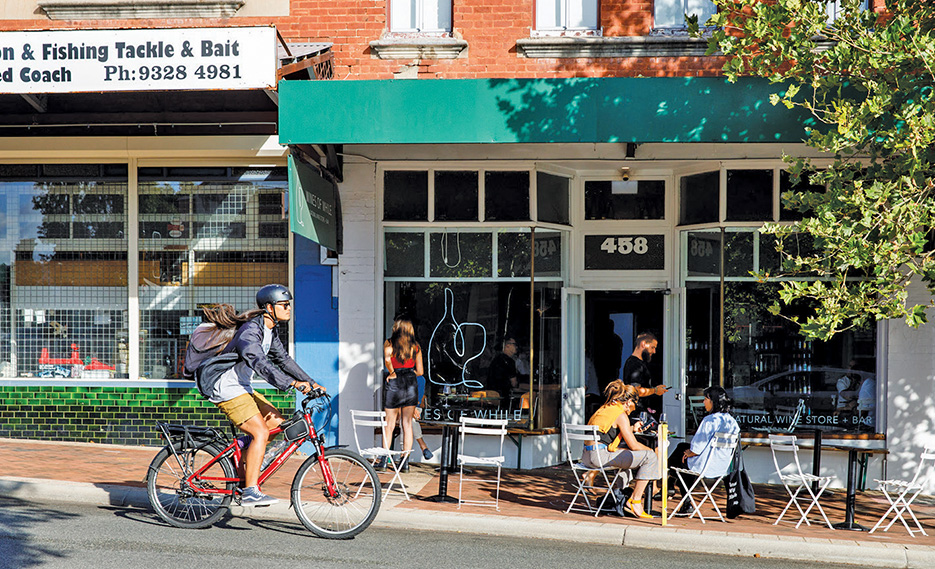
William Street is planned as a “primary route” in the new Long Term Cycle Network plan. Photo by Jessica Wyld.
CONSULTATION’S open for the future of Vincent’s bike lanes and the WA government says it’ll accept late answers.
Originally the Department of Transport wanted all councils to endorse its “Long Term Cycle Network” plan by June 30, saying only those routes outlined in the plan would be eligible for state funding for a year.
Vincent council said that didn’t leave them with enough time to consult the public, and refused to endorse the plan in June, with mayor Emma Cole calling the deadline “incredibly unusual”.
There was also uncertainty over how long the funding might be locked out for, now confirmed to be one year rather than three.
Extended
Transport minister Rita Saffioti has now given the okay for the deadline to be extended.
Ms Cole’s written to the minister saying “we were very pleased to learn that you would be happy to extend the deadline for the City of Vincent to submit our final comments on the LTCN and our funding applications for next year’s cycling grants program so we can finalise this community consultation”.
She said the DoT’s planned route through the middle of Hyde Park was not a goer and they’d work on an alternative: “Hyde Park is heritage listed and renowned for being a tranquil sanctuary. It is not suitable for high traffic/high speed cycling.”
The new plan with the Hyde Park route removed is up at imagine.vincent. wa.gov.au and comments are open until July 21, with council scheduled to endorse the final plan at the August meeting.
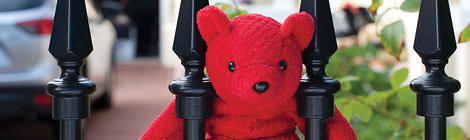
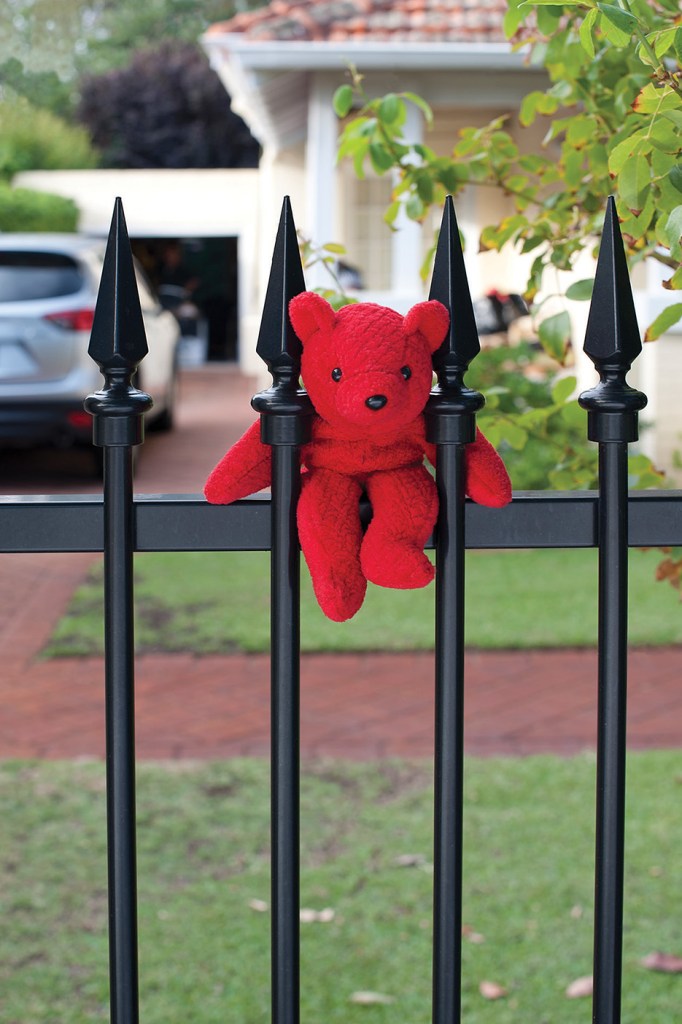
Red bear on First Avenue, Mount Lawley from Out of Hi-bear-nation exhibition by DeeDee Noon at Bowie Kitchen Cafe.
ARTIST and researcher DeeDee Noon has spent years examining peoples’ connection to toys.
When she recently returned from a trip down south to find bears in many Perth windows to comfort children during lockdown, she was compelled to photograph them and delve deeper into the origins and meanings.
“No one’s been able to pin down where it came from,” she says. Wichita, Philadelphia and Reykjavik were all early adopters of the bear hunt, but Bear Zero remains a mystery.
“At one level, it seems very hyper-local,” she says, but notes it’s also a global phenomenon that has spread widely.
“I do find interesting the parallel process of a real deal virus, Covid, and the viral spread of the bear hunt.”
Viral marketing
Ms Noon, a research candidate at ECU, wondersif the origin could beviral marketing, as many corporations have jumped on Covid to bolster their image with comforting ‘we’re all in this’ campaigns.
“There’s a loveliness to this, I’m not taking that away at all, but as adults [we] have a broader perspective, and I’ve seen this before.”
Apart from manufacturers pushing them into the public conscious to sell more bears, they’ve also been used to bolster other brands: Saatchi & Saatchi used Ted to rehabilitate the image of the UK’s Richmond Sausages after it turned out they were loaded with horse meat.
In recent years the publishers of the book We’re Going on a Bear Hunt have pulled off marketing stunts like a Guinness World Record “largest reading lesson” to keep the book popular (the author Michael Rosen recently spent 47 days on a ventilator and almost died from Covid-19, but that’s probably not a marketing stunt).
Apart from selling bears, books or horse meat sausages, there’s also just the passive benefits to the social media and traditional media getting eyes: “The internet is a hungry beast,” Ms Noon says, “and if everyone is at home and not out in the world, then the internet has to have content. And the bear hunt helped generate content.”
Whatever the origin, Ms Noon says the people putting them up in windows have good intentions: “The outward message is one of care – be brave, it is a confusing time – and comfort.”
Ms Noon says the teddy’s been a symbol of comfort for about 120 years since it was named for Theodore Roosevelt, whose hardy adventurer heart melted when confronted with a bear who’d been wounded on a hunt. A resulting political cartoon showing the usually-fearsome creature as cute and pitiable inspired toymaker Morris Michtom to createthe first teddy bear, sending one to Roosevelt and asking permission to use his name.
“In a very short time the bear’s gone from a scary predator to a protector,” Ms Noon says, with Ted’s snout getting shorter and more cute compared to the original half-tonne apex predator that’s near-immune to small calibre fire.
Windows
Ms Noon says it wasn’t just bears she saw in windows while documenting the trend: Lazy sloths hanging on fences evoked images of sedentary residents inside, and living room windows put a new lens over Tickle Me Elmo’s grin.
“Tickle me Elmo’s usually quite happy,” Ms Noon says, but during this pandemic “I’ve seen enough Tickle Me Elmos with their noses behind glass to change that cheery grin to look like a yelp for help.”
Her photography exhibition Out of Hi-Bear-Nation is at Bowie Kitchen Cafe on Coode Street, Mt Lawley, until July 13. Ms Noon gives artist talks on July 11 at 11am, 11.20am, and 11.40am (call 9371 9900 to book a spot).
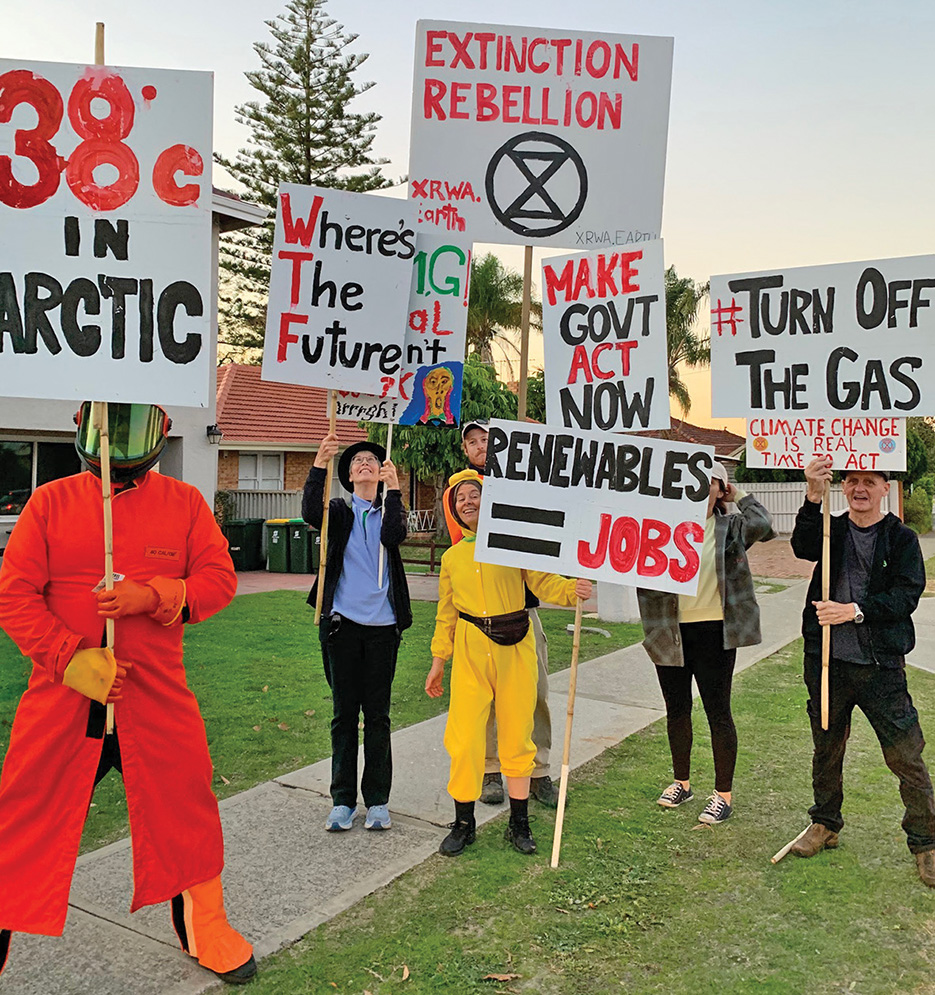
XR members Ray Brown, Liz Wright, Fiona Moran, James Rutherford, Isabel Murray and Ron Pyle, at Alexander Drive on July 3.
IN November a group of 11,000 scientists co-signed a letter stating that climate change was happening faster than previously thought, declaring a “climate emergency” requiring urgent change tohow we live. Here in Perth,the local North of the River group of the global Extinction Rebellion movement have recently emerged from lockdown and have written this week’s Speaker’s Corner on why they’re recommencing regular actions to ensure this threat isn’t forgotten amid coronavirus concerns.
WE’RE a bunch of local citizens out on the streets in our neighbourhoods becausewe want to make sure thatpeople are reminded weare in a climate crisis andthat there’s something that ordinary people can andmust do about it.
We are a local group ofthe international movement Extinction Rebellion (known as XR) which formed in the UK in 2018 with the goal of preventing the worst case scenario of runaway climate change and ecological and social collapse, a scenario we are unfortunately heading towards quicker than originally predicted by climate scientists.
As you’ll see in one of our signs; we are experiencing an unprecedented: “38 degrees in the arctic”.
Ray Brown is an industrial chemist and member of our North of River group of XR; he says there is a very narrow window of time to prevent the worst scenarios unfolding and that even with things as they are now with droughts, floods, bushfires, water being carted to 14 towns in the south west of WA, it’s crucial for people to take action.
The consensus science from the United Nations’ International Panel for Climate Change (IPCC) tells us we have an eight-year window of time to prevent the worst global warming scenarios unfolding.
Our Paris commitments are to reduce CO2 annual emissions by 28 per cent of 2005 levels.
Just to get down to 2005 levels means we need to cut emissions by 30 per cent.
Hellbent
Alarmingly, the McGowan government is extremely keen to massively increase gas production via the emissions-intensive Burrup Hub expansion that will increase emissions by 17 per cent;they are hellbent on hiding this information from us, and are completely reckless in supporting this project.
It is a numbers game, Mr Brown said, climate change has become politicised and there are powerful vested interests influencing governments and citizens to maintain business as usual.
We need 3.5 per cent of the population to get active in demanding that governments take swift action to take the steps that scientists tell us are necessary.
Rallies, letter writing and petitions are fine but they haven’t been enough to change things.
Getting enough people to join Extinction Rebellion and participate in non-violent direct action is the best chance we have of making our government pay attention and to do the right thing, thereby givingus a chance to live well for generations to come.
Our North of the River group meets regularly on Saturday afternoons.
We were hiring a venue but when the virus hit we started meeting in Woodville Reserve, when it was safe to meet in person again.
Isabel Murray, a barista from Mt Lawley, joined the group recently and said: “I was a little nervous about what to expect but everyone is so lovely and you can be involved at any level you’re comfortable with, though it’s hard to resist a little protest action!”
All are welcome at our weekly meetings, the details of which can be found on the Extinction Rebellion Western Australia’s facebook page or on http://www.xrwa.earth, or they can be contacted at xrwa_nor@protonmail. com.
AS we stare down a financial apocalypse, most of us will be looking for good value when eating out.
I spotted some great mid-week deals at The Oxford Hotel, so I decided to take the family up to Leederville for a Tuesday night feed.
The Oxford had an al carte menu with a decent range of pizzas, mains, burgers and salads.
There was nothing earth shattering on there, but it had all the old favourites like chicken parmi and fish and chips.
I decided to get the beef Madras curry from the winter warmers menu (all dishes $19.50) and my wife ordered the lamb shanks. The menu changes every week and includes desserts.
The main dining area was minimalist, almost utilitarian, with basic wooden chairs and tables with not much on them. It wouldn’t have looked out of place in a Bauhaus exhibition.
A few small design touches could make the area seem more inviting, matching the grandeur of the heritage-listed 1906 hotel.
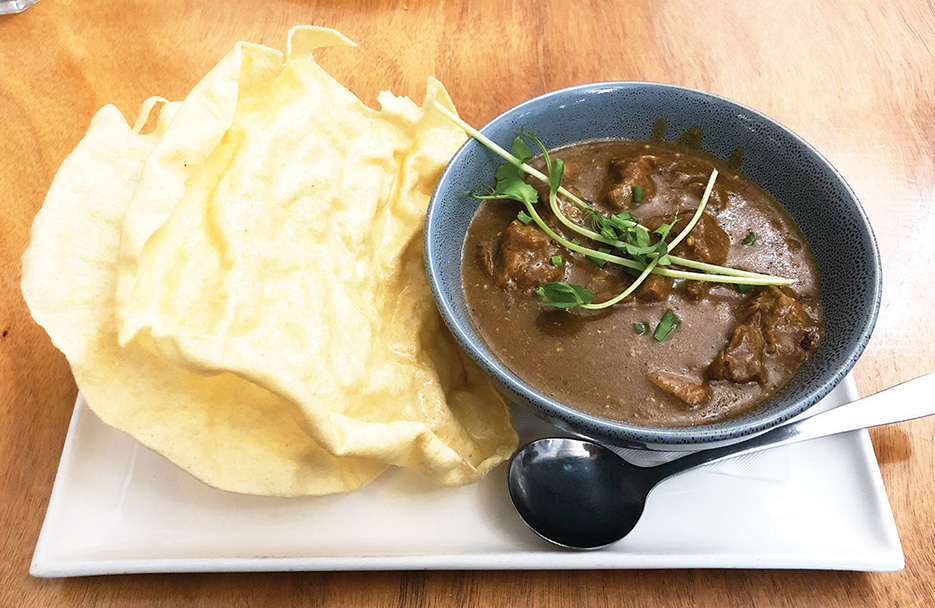
Thankfully the food more than compensated for the ascetic furniture. My beef madras was fantastic: there wasn’t a hint of fat on the gorgeously tender beer and the thick sauce had a lovely peppery kick.
The freshly-made poppadoms were diaphanous and crunchy, with a pleasant trace of oil on the crater-like surface (perfect for scooping up the boiled rice and dark viscous sauce). Delicious.
The dining area was soon filling up with an eclectic mix of seniors, families and young couples, so this was clearly a popular spot for locals during the week.
Unfortunately the acoustics from the wooden floors and high ceilings created a shrill din, and those seeking a more intimate meal should dine in the annex or the beer garden, which had lots of foliage and a massive roof to keep you dry.
Pizzas were only $9.50 on Monday and Tuesday nights, so the kids got a ham and cheese each.
They were quiet as Benedictine monks as they munched away. I tried a slice and can verify the base was lovely and light and tasted like it had been freshly made. They didn’t skip on the ham, and the thick coarse chunks reminded me of a gammon steak.
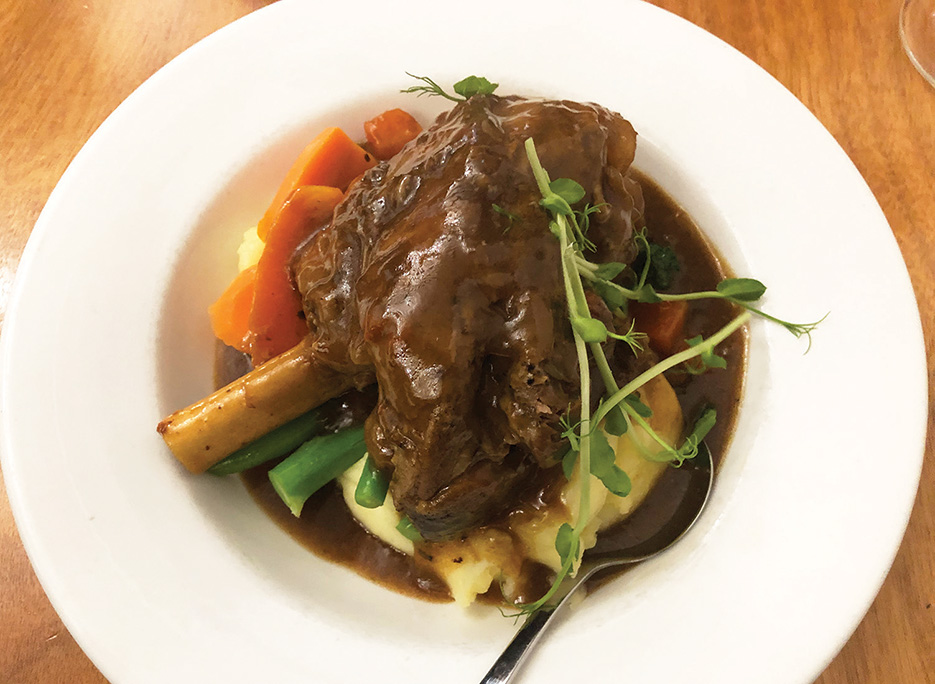
My wife’s lamb shank was humongous and looked so good I almost had a Proustian flashback to my gran’s house in the 1970s. The lovely tender meat was falling off the bone.
“The sauce is to die for and the seasonal vegetables and mash potatoes are all cooked to perfection.”
The service was fast and efficient throughout the night, and the busy waitress asked if me wanted our excess pizza bagged-up to take home. The Oxford’s winter warmers menu is great value and they also do $8 burgers and fish and chips on Thursday, and a pasta or parmi for $15 on Monday. In my book, an authentic pub meal should be tasty, filling and great value.
The Oxford Hotel met all those conditions and excelled on the taste and portions front – it was a delicious pub meal.
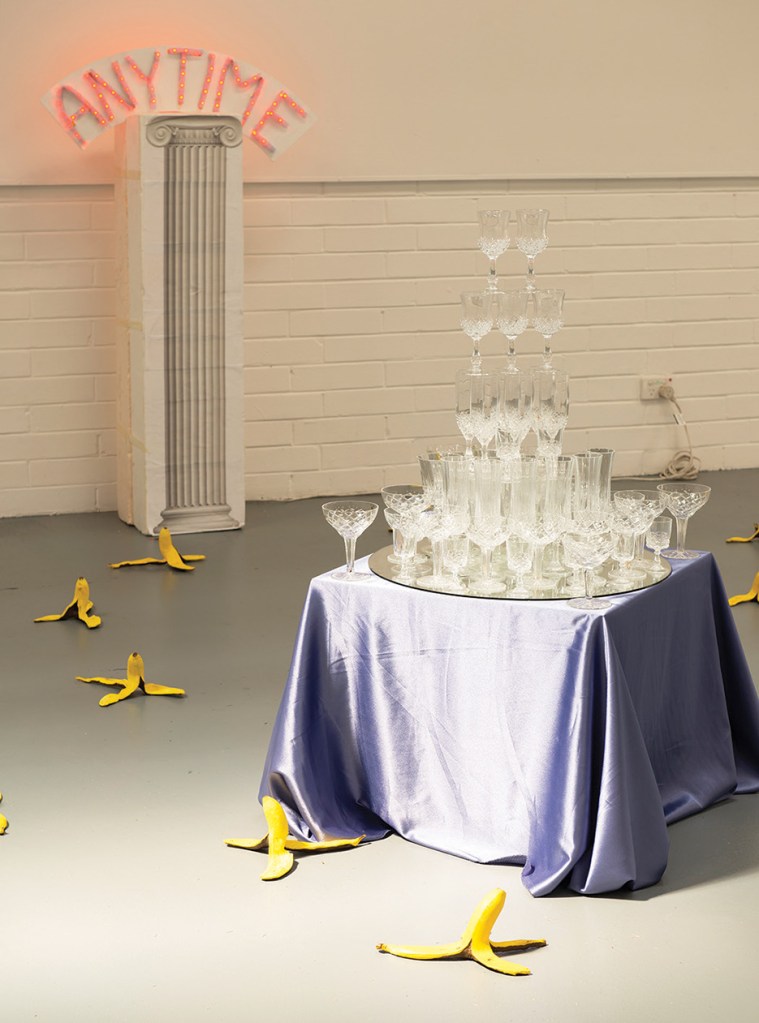
SIAHNE Rogers sifts through the detritus of her grandfather’s doomed burger empire, Fast Eddy’s, in the exhibition Hatched.
Fast Eddy’s was Perth’s first 24 hour fast food restaurant and opened to much fanfare in 1979 on the corner of Hay and Milligan Streets.
It soon became home to a diverse and colourful cast of characters including ravenous brothel, nightclub and shift workers.
Rogers’ grandfather, Ern Galloway, took over the restaurant in the 1990s and opened more franchises in WA and expanded into other states, but in 2002 the company went into receivership and most of the WA stores were sold.
In 2018 Mr Galloway died, and a year later the last Fast Eddy’s in the Perth CBD closed down after 41 years in business, prompting Rogers to reflect on the burger dynasty.
“A huge part of my childhood was growing up in and around Fast Eddy’s,” she says.
“My family worked very closelywithin the business, and there were many days as a child where me and my sisters would be hanging out in one of the restaurants, colouring in the latest activity sheets for kids, climbing on too many chairs in precarious ways…
“I knew my grandfather very well and continued to spend a lot of time around him, right through to my adult years and his passing in 2018.
“Because of this, there has been this space for reflection on how his life played out both as great grandfather to me and relatives, but also a serious business person and the lifestyle that comes with that during the days of success with Fast Eddy’s and after.”
Incorporating memorabilia from the restaurant and tongue-in-cheek references to the fall of the Roman empire, Rogers uses pathos and humour to poke fun at consumerism and capitalism.
“The point of departure for my work came from reflecting on my grandfather’s life (in particular, running Fast Eddy’s and growing up around that as a kid) and responding to the themes that came up for me during that process,” Rogers says.
“It lead me to think further about failure, success, status, and futility, how they are influenced by pre-existing ideology, and how that is navigated through lived experiences.
“My response to this was underpinned by my interest in how these themes are explored .through the archetypes of humour and slapstick, developing a visual language that helped me articulate my own personal reflection to both my grandfather’s story and the themes explored within that.”
The 28-year-old works in a variety of mediums and says she is inspired by artists like Shana Moulton, who is based in New York and develops her work around a narrative.
Rogers, a Curtin uni graduate, is one of 24 emerging visual artists featured in the exhibition Hatched, which showcases work by newly graduated artists from across Australia.
The exhibition in on at PICA gallery in Northbridge until October 18.
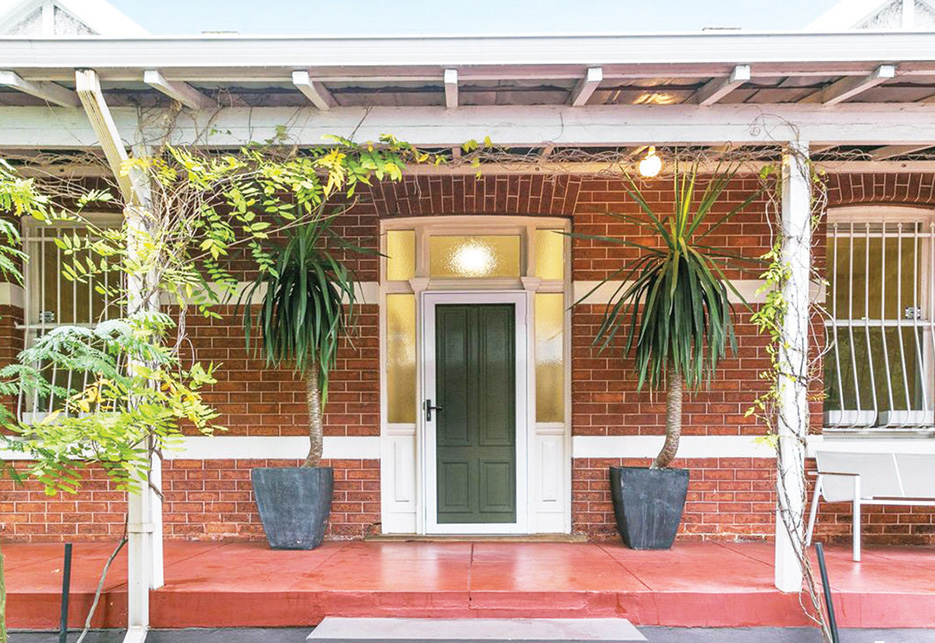
THERE’S a real sense of history to this federation home in North Perth.
There’s no ostentatious chandeliers or in-your-face architecture, but a number of under-stated period touches create lots of character and charm.
Combine that with all the mod cons and you have a superb 21st century home.
The facade of this three bedroom one bathroom abode has tuck-pointed brickwork and vines coiling around the beams of a white verandah.
It’s a charming entry statement and a sign of things to come inside.
On opening the front door you are greeted with a narrow hallway, with polished jarrah floorboards, and two archways that funnel your vision towards a sitting room.
It’s a perspective you’d expect to see in a great painting or a scene directed by Orson Welles, and this vista differentiates it from the open plan clones on the market.
The original fireplace in the lounge is a stunner, and the owners have used the contrasting light and dark colour schemeto great effect, emphasising the columns in the fireplace.
A high ceiling and dainty ceiling rose round things off nicely in this room.
The kitchen is a cute old school number; it’s the not biggest but it has bags of charm and the white subway tiles are a stylish touch.
Out the back is a decent-sized courtyard fringed with lots of small trees; creating a shady oasis in the harsh WA summer.
But don’t worry the gardens are reticulated, so it will be low maintenance.
At the end of the courtyard is a charming gazebo with an outdoor setting.
There’s some creepers and another tree here, and it’s a delightful spot to entertain family and friends.
The bathroom is crisp and modern with grey floor tiles and white gleaming surfaces.
All three bedrooms are a good size, and the main is semi-ensuite with plenty of cupboard space.
This property has reverse cycle ducted air-conditioning, a double carport and an alarm system.
Situated on a 369sqm block on Fitzgerald Street, this home is right beside all the cafes and restaurants on Angove Street, and a short bus ride from the city.
There’s also several sporting clubs and good schools nearby.
This home will appeal to a couple who appreciate elegance and style, and want to be close to the city.
$800,000s 493 Fitzgerald Street, North Perth Crush Realty 9328 2345 Agents: Nathan Miles 0404 107 638 Bruce Reynolds 0419 965 137
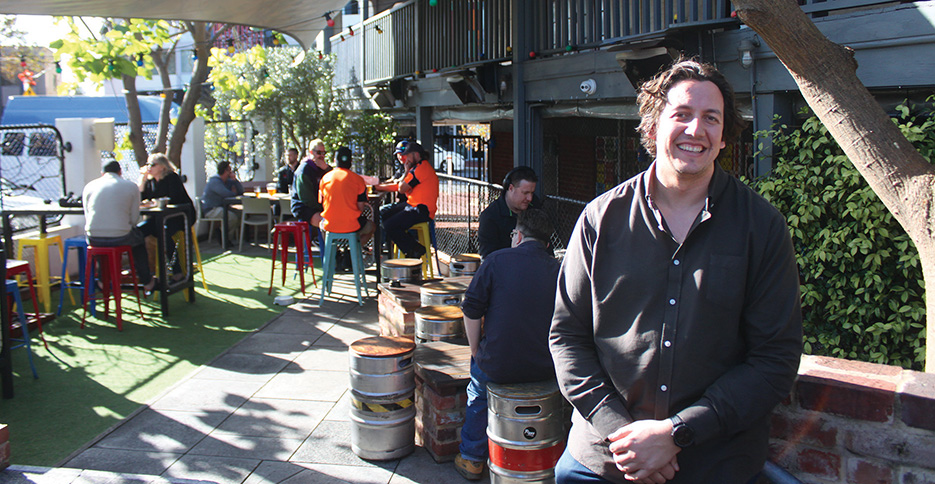
Rosemount Hotel venue manager Calvin Hook. Photo by David Bell.
LOCALS pining for apint have flooded backto pubs as restrictions arelifted.
The Rosemount Hotel’s manager Calvin Hook says it’s been heartening to see people pour back in post-lockdown.
When the hotel hada very partial reopening mid-May with a 20 person limit, he says “we were overwhelmed with the response from the local community.
“Every session for two weeks was booked out. We had about 300 emails in the first 24 hours from people asking if there was a table.
“We had to bring staff back just to manage the inbox and confirm bookings.”
The 20 person limit wasn’t profitable for a venue that can hold more than 800 across its different areas, but he says they still wanted to keep the doors open.
“It’s not a profitable exercise,” he says, but it was important to “reopen the business and connect with the community, to give people a space to come out and socialise in.
Loyal
“The pub’s had a good, loyal following for a long time and we’re just focused on being that cultural hub.
“It made us feel really good, how the pub connects to people.”
It was a nervous time from March 23 when all bars were closed through to May 18 when they could have small re-openings. Mr Hook says they had to adapt fast; beer was sitting in kegs and they didn’t know if the lockdown would be over before it spoiled, so they started selling from the keg straight into oversized bottles (growlers) through the hotel’s bottle ship. That’s been so popular among lovers of fresh draught beer that they’ll keep doing it.
The Rosey’s also seen a surge of people missing live music come rushing back, even when the shows had to be seated through most of June.
“People are really excited to get back to watch live music,” Mr Hook says.
“Everything we’ve done so far has sold out. There’s a huge demand.”
Now that restrictions are further lifted, some weekdays are busier than pre-Covid lunchtimes.
As of June 27, patrons no longer have to be seated, and the main limit is the one person per 2 square metre rule.
“It’s the start of a return to normal,” Mr Hook told the Voice.