
• Thanks, Uruguay
    • Claire Leong (in checks) and family greet her parents Jesz and Madge Fleming as they arrive home at Perth Airport.

    Family grateful for South Americans’ cruisy response

    THE family of a WA couple who spent two weeks in a Uruguayan hospital with Covid-19 have thanked the South American country for their safe return.

    Madge and Jesz Fleming contracted the disease aboard the cruise ship Greg Mortimer, which was turned away from several ports before being allowed to dock off Montevideo on March 21. They were among 112 Australian and New Zealand passengers evacuated on a charter flight from Uruguay.

    Vulnerable

    Their daughter, North Perth resident Claire Leong, says her parents were “alone and incredibly vulnerable”.

    “I had to have conversations with my dad that you wouldn’t normally have,” Ms Leong said.

    “It was an intense experience. I’m lucky my mum and dad survived it because they might not have,” she said. 

    Hours before the flight was due to depart, Mr Fleming was still receiving treatment for Covid-19 at the hospital Britannica in Montevideo. He was airlifted from the cruise ship five days earlier with low oxygen levels, and Ms Leong was unsure if he would be cleared to return on the flight to Australia. 

    Ms Leong praised the support from Uruguay’s government.

    “When you consider what our government has done in relation to cruise ships, [Uruguay] gave the hand of friendship, when most people are running away and scared,” she said.

    “My dad felt even though he was in isolation in the hospital and it was a very intense experience, where everyone was gloved and suited up to come and see him, he felt like he was part of a family in that hospital. That was the kindness that was given to him by the cleaners, staff, doctors and nurses,” she said.

    For the Flemings the Antarctic cruise was a once in a lifetime opportunity which took years of planning and cost nearly $60,000.  

    When the Greg Mortimer departed Ushuaia, Argentina on March 15, all crew and passengers were given temperature screenings prior to boarding. At the time none of the 217 people aboard were displaying Covid symptoms.

    Ms Leong described said the situation on the Greg Mortimer evolved rapidly as cases emerged. “No one really knew, things changed very quickly,” she said.

    “I think my parents would say that hindsight is an incredible thing…obviously in retrospect they should never have left, and no one should have gotten on the ship,” Ms Leong said. 

    Mercy

    “They were just at the mercy of a kind government and kind people who would actually look after them and see their plight.”

    Ms Leong says her family has been welcomed back to Uruguay and is looking forward to visiting the country when travel restrictions are lifted. 

    “For my dad and I, the message we want to get across is that in the horrors of all of these things basically, it was the humanity and connection that was ultimately the beautiful story…there will be more connections between Uruguay and Western Australia that’s for sure.” 

    Aurora Expeditions, which operates the Greg Mortimer, also thanked Uruguay in a statement: “We cannot praise more highly the wonderful care that passengers, staff and crew received in Uruguay, both on board and in hospital. We all want to acknowledge and thank the Uruguayans for their enormous humanity.”

    Uruguay has recorded 711 cases of Covid-19 and 19 people have died. 

    On Wednesday the crew of the Australian-owned boat were finally allowed to disembark in Uruguay after spending more than a month in isolation.

    by ESTELLA SMITH

  • Verge pick-ups back
    • Weekly rubbish collection’s endured as normal, and soon bulk pickups will be back. Photo by Monica Defendi Photography

    VERGE collection is back on in Vincent if WA’s coronavirus infection rate remains low.

    April’s collections were cancelled over the contractor’s concerns about picking up potentially contaminated junk and because its small team would struggle to absorb absences in the event of illness. 

    The pickups will now start July 20.

    The council has strongly advised people not to pick through others’ junk piles because of the risk of infection.

    “We want to thank community members for their patience and understanding when we put the junk verge collection on hold,” mayor Emma Cole said.

    “We believe it is now safe 

    to re-schedule bulk hard waste collections and give everyone the chance to get rid of any junk they have, particularly with so many clean ups happening as we spend much more time at home.”

    Leaflets will go out ahead of collections across five areas through July and August so don’t jump the gun and dump earlier than the weekend before the pickup. 

    By DAVID BELL

  • Staff cuts revealed

    VINCENT council has stood down 147 staff since March 23 due to Covid-19 related closures, denying them nearly $1 million in wages.

    Local governments aren’t eligible for JobKeeper payments but last month premier Mark McGowan urged councils not to stand down staff.

    “Redeploy staff, put them into other roles.. we need people employed, we need jobs, and we need people out there delivering incomes into the community and we need families supported,” Mr McGowan said.

    Many councils heeded the call. 

    Stirling redeployed some staff in-house and sent excess to help charities like Vinnies and Meals on Wheels cope with increased demand. 

    Bayswater redeployed almost every person put out of work when facilities like Bayswater Waves and The Rise closed. More than 60 were sent to areas like the community care team keeping in touch with older folks, fitness staff delivered library books, and others joined the parks team for mulching, revegetation, and maintenance projects.

    “Staff are embracing the opportunity to experience working in new areas and gaining additional skills and knowledge,” Bayswater CEO Andrew Brien said. 

    Perth council has redeployed parking inspectors to safety patrols, and other staff to its Community Careline call centre. 

    Vincent council’s redeployment effort has seen just 28 people offered alternative full or part-time jobs.

    Its latest budget numbers reveal it saved $988,864 because “casual employment has decreased significantly due to the closure of Beatty Park and library”. 

    In total 114 casual staff and 33 permanents have been stood down, while 21 sole traders operating at Beatty Park also lost work.

    Australian Services Union branch secretary Wayne Wood told the Voice “any stand downs by local governments during Covid-19 are disappointing. 

    Redeploying

    “We’ve seen many councils do the right thing by redeploying most of their staff to other essential services within the community, but some have failed.”

    He’d written to Vincent in early April asking what was happening with stand downs, and was told the  council was looking into redeployments; there was no mention of the large numbers of furloughed staff. 

    Mr Wood said with WA’s restrictions lifting as of Monday, he wanted all staff returned to work immediately.

    “There is now no excuse for local governments to continue to stand down workers. The state government has announced financial assistance for councils to access, and with facilities now reopening, local governments should be preparing to get staff back to work.

    “Budgetary concerns during a pandemic are understandable, but it is not right to use the current crisis to make staff savings, without proven substantial associated loss in revenue, and if there are alternative measures such as access to cash reserves and government assistance available.”

    Vincent’s permanent staff were allowed to use up leave, while casual employees were given two weeks’ “special leave’ and paid what they’d usually earn. 

    One charity recently asked Vincent if the furloughed staff could be deployed to help them out, but was turned down. 

    Disability services provider Cahoots had missed out on funding at the April 28 meeting when the council was giving out $1 million of coronavirus relief cash. Cahoots usually runs youth events and during the pandemic it had been delivering groceries to people with disabilities. 

    Cahoots CEO Jess Karlsson asked the May 5 committee if they could get support in other ways, such as redeploying stood-down staff as “service delivery volunteers”. The answer was no.

    The library’s scheduled to reopen May 18 and if the curve stays flat Beatty Park’s due to reopen towards the end of next week, abiding by state government requirements.

  • Sex workers call for help
    • The industry has had to appeal directly to the public to keep sex workers from ending up on the street.

    No financial support during Covid-19

    SEX workers have been left facing homelessness and hunger due to the impact of Covid-19, sparking calls for the government to provide more assistance.

    Australia’s peak body for sex workers, the Scarlet Alliance, says the precarious nature of the industry and the need for workers to protect their privacy and those of loved ones, is making it difficult for workers to access economic relief.  

    The alliance says it has made formal approaches to the Morrison government seeking support and consultation, but has been roundly rebuffed.

    “We are experiencing a complete failure of government to engage with sex worker organisations,” says Respect Inc coordinator Elena Jeffreys. 

    Dr Jeffreys has been a sex worker for the last two decades and advocates for  workers’ rights. 

    Discrimination

    She said visa holders and international students working in the sex industry were ineligible for support under the stimulus packages because they “cannot demonstrate their earnings for fear of discrimination or criminalisation”. 

    “Sex workers who in the first few weeks of the pandemic were using up any savings, are now without income,” says Dr Jeffreys.

    Sex industry regulation varies between states; in WA prostitution is legal, but heavily restricted under criminal law.

    WA sex worker support project manager Lena Van Hale says WA’s legislation excluded sex workers from broader industrial and civil laws designed to stamp out exploitation in the workforce.

    “We have to choose between being fined and criminalised or having our families and ourselves be homeless and hungry,” says NSW Sex Workers Outreach Project CEO Cameron Cox.  

    WA’s Department of Communities acknowledged there was little help available for sex workers, with a spokesperson saying there was “no visibility or any policies specific for sex workers”.

    This lack of visibility and exclusion from social support services is being felt by sex workers globally. 

    According to a UNAIDS press statement issued earlier last month: “Sex worker-led organisations from all regions are reporting a lack of access to national social protection schemes and exclusion from emergency social protection measures being put in place for other workers.”

    Along with the World Health Organisation, UNAIDs has previously backed decriminalising of the sex industry to manage the spread of HIV/AIDS, and says the same goes for Covid-19.

    “The criminalisation of various aspects of sex work in the majority of countries serves to magnify the already precarious situation of sex workers in the informal economy,” it said in the statement. 

    Australian Federation of AIDS Organisations CEO Darryl O’Donnell says; “sex workers take public health extremely seriously and have been at the forefront of efforts to slow and prevent the spread of conditions such as HIV, hepatitis C and other STIs.

    “It’s time for government to now support them through this very difficult period by providing robust income support in a time of crisis.”

    Listening

    One brothel madam revealed how she’d ordered her girls to offer only “doggy, on top or handjobs” to try and prevent Covid-19 infections, but shortly afterwards the industry was completely shut down by the McGowan government’s strict social distancing rules.

    Dr Jeffreys wants to know; “who is listening to sex workers? Why are we at the end of the list when it comes to our workplace health and safety, our welfare, our income, or respect and recognition for the work we do?”

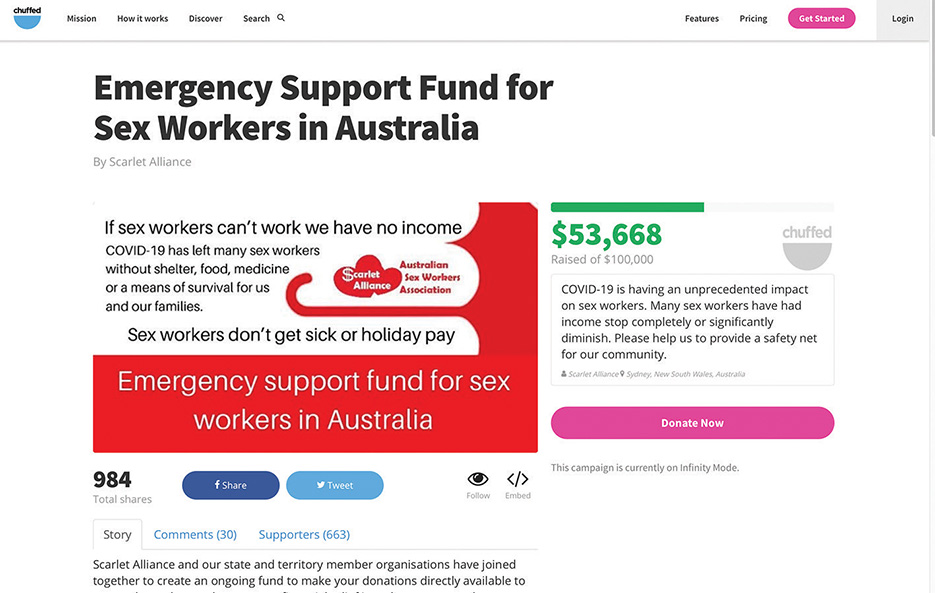
    The Scarlet Alliance and its state and territory member organisations have turned to the public for support.

    An emergency support fund has been set up with donations going directly to sex workers in need. 

    Secure donations to this fund can be made at: https://chuffed. org/project/emergency-support-sex-workers-australia 

    “This will not be enough to meet the demand but will assist in bridging the gap until essential government support is provided,” the Alliance said.

  • Spending millions out of character

    THE Morrison government’s increasing use of “character” tests to cancel visas is costing taxpayers millions of dollars.

    The cancellations have led to the Department of Home Affairs’ legal budget ballooning out by 20 per cent to $111 million in the 2018-19 financial year, with the bulk going to external legal practices.

    Home Affairs’ money is a big source of income for private legal firms and the increasing pattern of spending on immigration matters makes it a stable source of income.

    In 2017-2018 total Commonwealth legal expenditure only rose 3.8 per cent but external expenditure rose 13.2 per cent.  A comparison for the 2018-2019 financial year is not available as a spokeswoman for attorney general Christian Porter said the current COVID-19 crisis had delayed the latest report.

    Delayed

    Home affairs minister Peter Dutton can refuse or cancel a visa if a person fails the character test under s.501 of the Migration Act and he has done this with increasing regulatory since 2014.

    In limited circumstances the decisions can reviewed by the Administrative Appeals Tribunal and published tribunal decisions show they have a heavy immigration case load. 

    The test is wide-ranging and can be failed for criminal convictions carrying a 12-month prison term and includes suspended sentences.  Offences against women or children are also included.

    Refugees seeking asylum and migrants who have grown up in Australia and have a long work history and strong family ties have had visas cancelled.

    While Home Affairs’ pockets have been deep for lawyers, Perth-based The Humanitarian Group says those challenging decisions often have limited resources and are up against it in the courts.

    Vulnerable

    THG senior supervising solicitor Katy Welch said they provided free legal advice to eligible clients and worked with the Visa Character Cancellation Group to prepare a submissions to a recent inquiry into amendments to the character test rules.

    It found vulnerable people struggled to get legal assistance, were more likely to miss a deadline and lose a right, and their responses were likely to be of a lower quality.

    It said cancelled visas could lead to detention, family separation, forcible removal, losing refugee protection or being sent back to a dangerous situation, which could have a dramatic impact on people’s lives and mental health.

    The submission argued any changes resulting in more visa cancellations would cost the community through increased pressure on the courts and detention centres.

    Home Affairs declined to comment.

    by KYLIE WALLS

  • Concerts reviewed

    OUTDOOR concerts are being reviewed in Perth’s CBD to determine whether people are still happy with the number being held.

    Under state laws, outdoor venues such as parks can only have two loudish concerts per year unless the local council CEO is satisfied extra ones aren’t too disruptive to neighbours.

    Perth council’s survey is looking at the impact of events at Langley Park, Ozone Park, Russell Square, Supreme Court Gardens, and Wellington Square.

    There’s been scores of responses so far, with a couple of people saying public holiday events were a problem because there was no one at the council to complain to.

    Wellington Square’s been contentious so far, roughly split between those supporting extra events and residents fearing more sleepless nights and disruptions.

    One comment said daytime festivals at Wellington are fine; “but the noise levels at night make it impossible to put my young child to sleep. The two-day event over New Years Eve 2020 was a nightmare”.

    Another said “my baby was crying for three days in this New Year!”

    Stressful

    Others called the events “stressful” and said Langley Park was a better fit because it wasn’t surrounded by so many residents.

    The survey’s up at engage.perth.wa.gov. au until June 3.

    Outdoor events were flagged as the loudest when the state government was looking into laws protecting music venues against noise complaints. Those are still in the works, with months of consultation being compiled into a recommendation that’ll be put to the state environment minister Stephen Dawson.

    by DAVID BELL

  • Post back
    Happier now: Patrick Gorman pleased to see most services restored a little ways down the road. Photo supplied.

    NORTH PERTH’S postal service has been restored, but will operate out of a temporary pick up.

    Labor’s federal MP for Perth Patrick Gorman blasted Australia Post over the bad timing of the closure and a lack of communication with customers.

    A temporary counter down the road at 451 Fitzgerald Street was available for pickups, and after some prodding by the federal MP that’s now been expanded to cover most postie services like stamps, parcels and bill payments. 

    But it’ll be cashless and can’t handle passports. 

    Mr Gorman’s happy they’ve got the services back but wants long-term certainty. 

    “The decision to close the post office in the middle of a state of emergency was clearly a mistake,” he said.

    “Australia Post must now work to ensure there is a long term plan for postal services in North Perth.”

    by DAVID BELL

  • Robbery charges
    Police prepare to raid a unit in Maylands over two armed robberies of pharmacies.

    A MAYLANDS man has been arrested on suspicion of armed robberies of two local pharmacies. 

    The robbery at the Maylands Amcal happened December 30, 2019 when a masked man claiming to be armed threatened staff and demanded prescription drugs. The Inglewood 777 was targeted on May 7, when a robber entered the pharmacy and again demanded prescription drugs.

    Police flooded the streets after the incident, using sniffer dogs and interviewed neighbouring businesses asking for more CCTV.

    The alleged robber was arrested a few blocks away in a Harrow Street home. Police executed a warrant and charged him with two counts of armed robbery, one count of possessing drug paraphernalia with prohibited drugs in it, and one count of being disguised to commit an offence.

    The 35-year-old man fronts court on June 5.

  • Claims still unchecked

    NINE months after the “appalling misuse” of reimbursements at Perth city council was exposed in an inquiry, expense claims are still not being fully scrutinised. 

    A new internal audit of reimbursement “payment vouchers” has found some staff, and even a commissioner, aren’t providing adequate documentation to explain their purchases, though it didn’t suggest there had been rorting.

    A recurring theme of the WA government inquiry into the council was councillors getting away with questionable claims because staff didn’t stand up to them or thoroughly check their supporting documents. 

    Lavish dinners, a $400 sports outfit, family dry cleaning and $99.50 children’s shoes were among the claims by councillors.

    The council’s internal audit sampled 40 recent vouchers and found five with inadequate documentation.

    That included “two instances whereby no evidence of invitations to attend event/interstate meetings were sighted in relation to claims by a commissioner for reimbursement of taxi expenses”. 

    Another 20 anomalies were spotted, including missing signatures or a lack of management approval.

    The audit noted this could lead to an increasing risk of phoney payments.

    Following the audit, accounts staff were reminded to reject any claims without appropriate documentation, while the whole voucher system will be reviewed. 

    At the May 6 audit committee meeting, external member Robert Maurich said the findings were “concerning”.

    “There’s a large amount that is currently used for these payment vouchers – $1.8million [per year] – and there’s a certain degree of noncompliance there in terms of use of those vouchers,” he said.

    by DAVID BELL

  • Credit checks 

    AFTER decades of being in breach of state regulations, City of Perth executives will now have to show credit card statements to councillors.

    Most councils publish corporate credit card statements in publicly-available agendas, but at Perth they’ll only be available to councillors or members of the public who request to see them.

    Perth has 25 staff with credit cards for swift and convenient payment of job-related needs like pencils, notepads, and $1,000 conference tickets.

    An internal audit of the city’s credit card policy has now been made public. It didn’t find any evidence of suspicious spendings, but the lack of transparency made it a “medium” level risk. The audit said “regular detailed review of all payments can help identify unusual card use”.

    Not providing the statements to councillors is a clear breach of the Local Government Regulations in place since 1996. In 2018 an auditor general report into the issue said all payments, including corporate credit card payments should be seen by council on a monthly basis.

    But the risk of credit card misuse didn’t get a look-in at the City of Perth inquiry hearings, eclipsed by actual reimbursement misuse.