• Tower sell-out

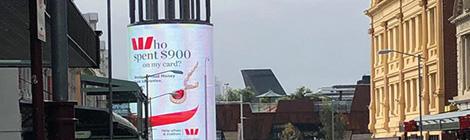
    CORPORATE advertisements are beaming from an artistic tower at Yagan Square which was supposed to be reserved for artworks and live-streamed community events.

    The tower’s design was inspired by the bullrushes which once grew in the area’s now-filled wetlands, and its 14 columns represent the local Noongar language groups. The square itself is billed as “a window into Noongar culture”.

    But now the artistic offerings are interspersed with 30 per cent ads.
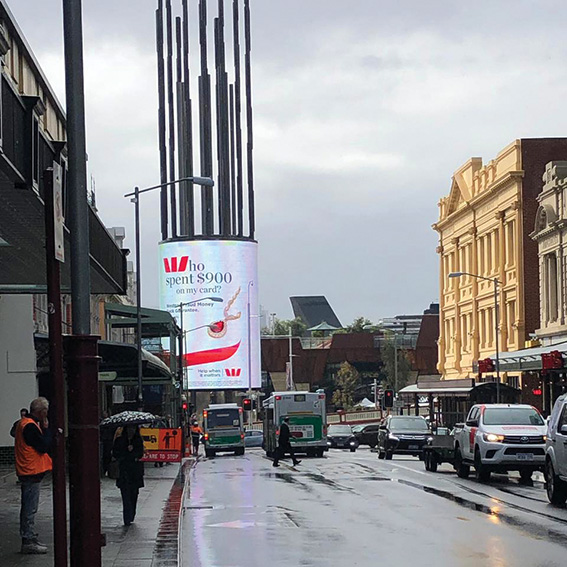
    • It was meant to have art on it. Photo by Reece Harley

    Elder Robert Eggington says the ads are “totally out of place”, but he wasn’t surprised to see them given how often Aboriginal culture is commercialised, appropriated, and disrespected.

    Mr Eggington said he was disappointed how little of the state’s Aboriginal history was being portrayed in Yagan Square.

    “I think Yagan Square has failed miserably the objective which Aboriginal people initially thought it would offer,” he said.

    “That is the real shame of it, because that is what happens to Aboriginal people all the time. You’re given an expectation, then there’s a treachery.”

    The square is controlled by the state government’s Metropolitan Redevelopment Authority. In all the documentation we’ve found dating back to the Barnett government’s announcement of the design in 2014, there’s no mention of it being used as ad space.
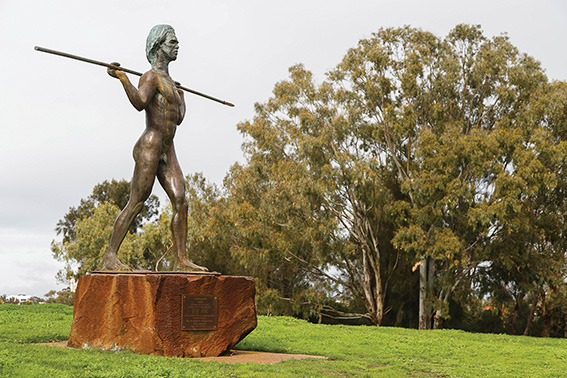
    • A statue of Noongar leader Yagan on Heirisson Island/Matagarup.

    “On the giant screen, you could find anything from abstract graphics, to visual artworks, live-streamed events and community pieces,” the MRA’s website states.

    Perth councillor Reece Harley first raised the issue after spotting a Westpac ad up there last week.

    “Yagan Square was promised to all of as an important civic space that would acknowledge and celebrate Aboriginal stories and culture.

    “Premier Barnett chose the name, and in doing so, he elevated community expectations. The digital sign was explained to the public as a community facility that would showcase art, events and promote the city and square, not as a commercial revenue opportunity open to the highest bidder,” Cr Harley said.

    by DAVID BELL
  • ‘So where’s Yagan?’

    THE name Yagan Square was chosen by former premier Colin Barnett, who said in 2014 the Noongar warrior “played an important role in attempting to bring together Aboriginal leaders and European settlers”.

    Mr Eggington says given that introduction it was strange not to see more of the story of Yagan portrayed in the square.

    In early May 1833, Yagan and his father Midgegooroo had a £20 bounty put on their heads after their group killed two white colonials, an act of retaliation for the unprovoked shooting death of one of his people.

    Two months later Yagan was shot by the young William Keats at the head of the Derbarl Yerrigan, or Swan River.

    His death was a “betrayal,” Mr Eggington says.

    Keats’ employer Henry Bull had forbidden his men from killing Yagan, but the boy wanted the bounty.

    He spotted Yagan and asked for help hunting, then when the Noongar was turned away, Keats shot him in the head.

    Yagan was decapitated and his head was smoked and put on display for three months.

    Mr Eggington says it was a grisly sign: “This is what can be expected for Noongar peoples if you resist our occupation of your land.”

    In September 1833, grim profiteer Robert Dale took Yagan’s head to England in the hope of selling it. A river and a mountain are named after Dale.

    The head was a morbid curiosity to Englanders and was shown at private parties before ending up in a museum, storage, and finally a mass grave.

    It was repatriated in 2010 and buried in the Swan Valley, but Mr Eggington says even now Yagan can’t escape being a curiosity for wadjellas.

    “Even his burial site is a tourist attraction,” Mr Eggington says.

    History

    “The history of this country is so atrocious.”

    Mr Eggington believes the only way for Yagan’s story to be told properly in the square named after him is by other Noongars.

    “It could be an incredible opportunity to meet with Aboriginal people, to talk around a campfire… it could be the beginning of some better understanding,” Mr Eggington said.

  • Unstoppable force

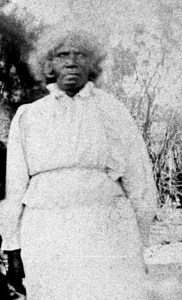
    THIS Naidoc Week we profile Whadjuk resistance figure Balbuk (1840 to 1907), whose traditional land covered much of what is now Perth’s CBD.

    Known by a newspaper of the era as “The Last of Perth’s First Citizens,” Fanny Balbuk Yooreel was born in the sacred birthing grounds of the Matagarup shallows, near what’s now called Heirisson Island.

    She was known to walk a track between her birth site and the wetlands where the Perth railway station now sits, gathering eggs, turtles and crayfish from the rich swamp.

    • Balbuk. Battye Library [25341P]
    Over the decades, Perth started to grow. In 1881 the train station was built over the wetlands, and houses sprung up along her path.

    Out of habit, and protest, she kept walking the same route, “through fences and over them”.

    A lot of Balbuk’s history was recorded by Daisy Bates, whose histories have been undermined by inaccuracies. Taken with a grain of Anglocentrism, Bates described Balbuk’s “powerful, sturdy frame and quick, strong, and somewhat domineering temper”.

    Bates wrote that Balbuk had a prodigious knowledge of plants and wildlife and Noongar lore, she loved beer, and wrote “to the end of her life she raged and stormed at the usurping of her beloved home ground”.

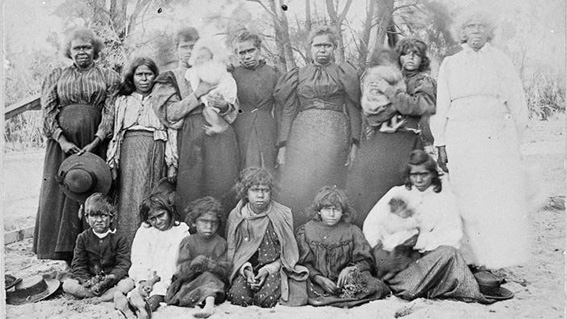
    • A group of Aboriginal people on a trip to the zoo. Battye Library [25341P]
    Her grandfather was Yellagonga, leader of the area north of the river when the colonials arrived. She had four powerful maternal ancestors who Bates describes as “grandmothers”, or demmangur.

    Bates wrote: “Balbuk often related a tradition concerning four women who “came from the east – Beverley way”, and who, her mother had told her, were the progenitors of all the Swan River natives”.

    One of her grandmothers, Moojorngul, was buried beneath Government House.

    Bates records that Balbuk would “stand at the gates of Government House, reviling all who dwelt within, in that the stone gates, guarded by a sentry, enclosed her grandmother’s burial ground”.

    While Bates’ histories were flawed and paternal, the information she recorded from Balbuk was used in the 2006 native title claim which recognised Noongar connection to the land.

    Balbuk died in 1907, and had no children. She was recorded in the newspaper of the day as “the last female representative of the Swan River natives”.

    by DAVID BELL

  • Cigar bar stubbed

    STIRLING council has stubbed out plans for a cigar lounge in Inglewood, with fears stogie smoke would drift over to the neighbours.

    The applicant planned to open a cafe, shop and a cigar lounge at the disused car yard at the corner of Beaufort Street and Nelson Street, saying it would have “a high standard of design that negates issues such as noise, smell and vibration”.

    Stirling council staff note the smoking area was located just 1.5m away from the boundary of the house next door and smoke and noise alike would waft over.

    They also weren’t thrilled by the design, especially the planned 1.8m timber wall facing Beaufort Street. The council’s Local Development Plan calls for new buildings to fit neatly into the area’s traditional streetscape and this design “addresses Beaufort Street with a blank wall, contrary to the character, amenity and heritage of the area”.

    The city received 14 letters of objection, and three of support, and councillors unanimously voted it down.

    In September last year a high-end cigar bar attempted to open up on Lord Street in Highgate, but that was rejected by Vincent council over health concerns.

    by DAVID BELL

  • Mild rate rise

    STIRLING ratepayers will receive a mild 0.9 per cent average rates increase this year.

    Mayor Mark Irwin said the council had “worked hard to develop a budget that has a minimal financial impact on our residents and ratepayers” while still delivering 200-odd services, and a few major projects this year.

    One of the biggies is the $24 million Stephenson Avenue extension, which is the first stage of a major overhaul of the Stirling city centre. Aimed to build a lively hub around Stirling Railway Station, it’s due to kick off next year if all the approvals line up.

    Cr Irwin puts a lot of the savings down to an organisational review which has helped drive efficiencies, while spending on legal fees was about half a million less than last year.

    The previous financial year the council spent $1.64m heading to various courts, tribunals and commissions.

    Stirling’s rate increases have been trending downward over the past decade, though it separates the rubbish collection charge which does zip up higher some years (this year rubbish charges are up 1.45 per cent, making it $350 for a year’s standard garbo service).

  • Wheely tacky

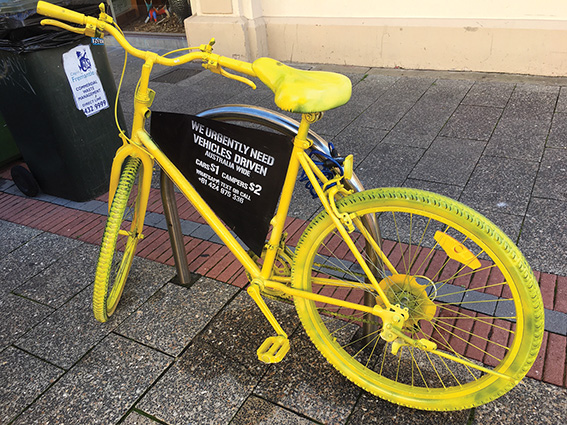
    A LOATHED advertising trend has come to Perth with garishly painted derelict bicycles being chained to bike racks.

    The bikes are in poor shape; their crossbars have been cut out to make room for the signs, and many of the tyres are flat. Calling the number reveals they’re advertisements for Wicked Campers, who are looking for people to relocate hire vehicles between cities.

    The bike tactic is seen as a cheap way to get a message out, bypassing council approval and avoiding the costs of more traditional signage such as bus shelters or park benches.

    It’s been seen in the eastern states and overseas for a decade.

    •They’re everywhere, and they’re in such bad shape they’re not even worth stealing.

    Right on schedule for most global trends, the bikes have now come to Perth, being spotted in the Perth CBD, at Matilda Bay, and all across Fremantle.

    Philip Taylor from Westcycle says he’s noticed them recently and “it’s an annoyance, absolutely … bike parking is few and far between at the best of times, so any illegitimate use of bike parking is a concern”.

    Perth and Fremantle councils have deemed them advertising. Fremantle council has hauled off four bikes so far, and Perth council’s impounded two.

    The Voice called the number on the ad and were directed to email questions to Wicked Campers (though an earlier email did not get a response, and Fremantle council hasn’t had any luck getting through either).

    by DAVID BELL

  • It’s as clear as mud

    A STIRLING councillor has had a crack at the city’s transparency after it emerged accessing information about political affiliations isn’t a walk in the park.

    In June, councillor Stephanie Proud moved to set up a voluntary online register for councillors to disclose political party memberships (“Party’s over for Proud idea,” Voice, June 13, 2019), but staff recommended against the proposal on the basis the information was already publicly available in the councillors’ annual returns and it was voted down.

    But good luck getting a look at those documents if you work a nine-to-five job: The only way to see them is to make an appointment to see paper copies in person at the council’s Cedric Street premises during office hours.

    “It is little wonder that over the past 12 years, there have been less than six requests by members of the public to inspect the register,” Cr Proud said.

    Her motion had been based on a similar system at Bayswater where one click brings up councillors’ party memberships.

  • Culture can’t be bought

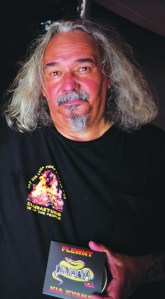
    ROBERT EGGINGTON is a Noongar man and executive officer of Dumbartung Aboriginal Corporation, an advocacy group that aims to keep the culture alive and “tell our story our way”. This Naidoc Week, when the flagship event has been branded with a corporate name as the “Chevron Ball”, and as significant cultural sites are emblazoned with advertising, he warns of increasing commercialisation of Aboriginal culture, and says cultural revolution — not Welcome to Countries — is needed now. 

    THERE is a dangerous absurdity happening in our country.

    Our culture is being promoted by government policies and industrialists.

    It is being slowly and cunningly prioritised; to exclusive white entertainment in auditoriums across the world; our traditional dance looks more like modernism ballet than customary cultural laws that gave great credence to the world of our ancestors.

    Our once great sacred objects echo out from alien and foreign environments.

    The government funds only what they want to take from our precious culture and spirituality and then creates an illusion of “Australiana” taking only what they consider less offensive and profitable; by these means they turn us less empowered and more assimilated!

    ROBERT EGGINGTON

    Birthright

    I have witnessed this with every passing year for the past 40 before this cultural immersion denigrated and cut from our spirit our birthright to the most ancient ceremonial grounds on the earth.

    During past NAIDOC weeks we did it without any influence from multinational companies and local shires, for as little as we had at least it was ours and we controlled it no matter how hard!

    Self determination is the foundation that we should be leaving as a legacy for our young people and generations to come.

    The political idealism of Welcome to Country should be immediately stopped and we as a people should sit down and wongee (speak) about what this really means and who commenced this propaganda, and why?

    There are a lot of Aboriginal people across Australia I would believe who would ask the most profound question: Why do we really do such a thing?

    Following the atrocities and continued genocide of our people, how can we possibly welcome the killing fields, the Stolen Generations, the citizenship rights and curfews and slavery and all that they have turned us into?

    Yes, we are a diverse race in these modern times and there are many of us who are materialistically privileged and affluent however spiritually and culturally bankrupt.

    I say it’s not what we have that makes us different, it’s what we have lost that makes us the same!

    We need to raise a cultural revolution in unity and solidarity with all the nations across our country and fight for the right to our customary cultural laws and practice on our sacred and significant lands.

    We need to take back our cultural rights from those who profit from its sales, and create awareness among ourselves of the danger of what happens when we capitalise on our own dispossession and colonisation and sell it for a blood stained dirty dollar.

    This will give our young people, staring at our culture through glass plated windows or in some market place, or upper auditorium and feeling so disconnected from it, a hope that our proper cultural dignity and integrity can fill their spirits with resilience and hope to never give up.

    Compassion

    We cannot afford to turn away from the great darkness that has transcended upon our people. We must make our weapons strong with love and compassion for each other before we lose all to the assimilate systems that teach our young from the historical lens that the victors’ deceitful truths are the vanquished lies.

    “May our Campfires Burn Forever.”

  • Get your jet boots on

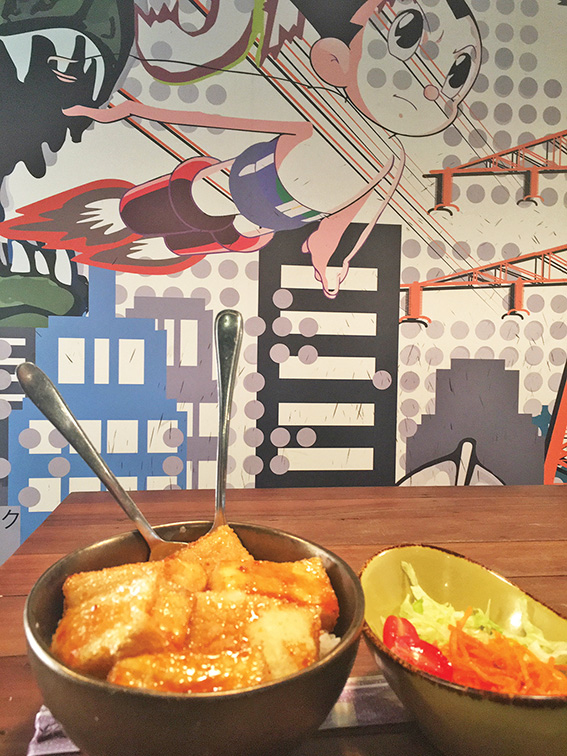
    GODZILLA’S  open mouth was perilously close to my head as I waited for my lunch at Mr Munchies in Mt Lawley.

    Unlike Astro Boy, depicted in the same mural, I didn’t have jet-power boots to escape, but I didn’t care because lunch was about to arrive at my table.

    I discovered the Japanese eatery, tucked down an arcade off Beaufort Street, a couple of years ago.

    On that occasion I had the sashimi which was easily some of the best I’ve tried, the thinly sliced tuna, salmon and mackerel soft in texture and fresh on the tongue.

    But despite that very enjoyable meal it fell off my radar until recently.

    Mr Munchies prides itself on its sushi and there’s a wall menu of options to customise your own, with chicken (teriyaki, katsu or kraage), salmon, tuna, pork or vegetarian.

    But on a cold miserable day I was looking for something warm and ordered a tofu bowl ($13.40), and veggie gyoza ($13.90).

    Encased in a paper-thin, golden skin, the piping hot silken tofu was amazing, with a beautiful balance of flavours from sweet and chilli, to salty.

    Their coating dripped down into the rice making the dish brilliant to the last grain.

    Condiments on the table included pickled ginger, which really sparked up the fresh, crisp salad in a side dish.

    The gyoza (Japanese dumplings) were an attractive green, and packed with a mix of flavours that rolled around the tongue in perfect unison, to be finally dominated by the sharpness of the enoki mushrooms.

    Next door is Bossman where Greek and Middle-Eastern sweets are the go, so I grabbed a couple to go with afternoon tea.

    The Greek biscuits ($3) were buttery, and not too sweet, and the baklava ($4.50) was amazing.

    Instead of the usual hazelnuts she uses walnuts which give it a pleasant, peppery contrast to the sweet-syrup of the pastries.

    by JENNY D’ANGER

    Mr Munchies
    12noon–3pm and from
    5.30pm daily
    Bossman
    7am–4pm daily
    669 Beaufort St, Mt Lawley

  • Otton displays feminine wilds

    MT LAWLEY playwright Charlotte Otton’s feminist cabaret Feminah is back to wreak more vulgar hilarity on Blue Room Theatre’s new Winter Nights festival.

    The show was a big hit at this year’s Fringeworld Perth where it picked up an award, and has also scored a gong for “tour ready” show from the Melbourne fringe – before she’s even played there.

    Feminah: The Second Coming explores feminism from every decade from the 1800s, retelling the music from that era and what the women’s revolution had achieved at the time in a way we have not heard before.

    Reflections

    The show is part cabaret and part comedy, drawing on universal themes through personal stories and reflections interwoven between the songs.

    Otton is interested in the way women have been brought up to sculpt their bodies, and the way they talk and present themselves through etiquette and excessive apologising.

    Her show emphasises how society’s in-built patriarchy still has a powerful grip over women in their lives and sense of self.

    Feminah: The Second Coming also taps into the notion of vulgarity and what Otton describes as “the pursuit to be free and vulgar in my body; of what I am as a woman”.

    She looks at what happens when the patriarchic rules are shed and women can express the more bestial elements of themselves.

    While Otton is enthusiastic about the positive changes brought about by the women’s movement over time, she taps into experiences women might still recognise to show how persistent patriarchy has been.

    She draws on her own childhood experiences for the show, saying she now looks back on that period and realises how much of her behaviour – and the expectations of others – had been formed by their patriarchal indoctrination.

    Otton hails from Sydney where she studied improv for three years before moving to Perth to study performance at the WA Academy of Performing Art.

    Since then she’s had somewhat of a glittering start to her career in Perth’s independent theatre scene, performing in a successful season of Rorschach Beast’s Hive Mind and selling out her 2018 solo show Let Me Finish.

    Feminah: The Second Coming is at the Blue Room theatre on August 1 and 2 from 7.30pm. Tickets are $20 plus booking fee from http://www.blueroom.org.au

    by ALEX MURFETT