• Dark ages in Stirling

    STIRLING residents are installing fewer solar panels than residents in any other Perth council area, prompting the city to develop a new Community Energy Plan.

    Stirling mayor Mark Irwin said he was shocked by the low solar take-up, which was revealed in the latest Australian Bureau of Statistics report.

    He says the city’s proposed energy plan will help residents switch to more efficient appliances and renewable energy.

    “There are a lot of ways we could support residents such as offering upfront discounts or rebates on agreed items to reduce the overall cost,” Cr Irwin said.

    “But, to find out how we can best cater for our residents so they can make changes for the better, we need everyone’s feedback and ideas.”

    Cr Irwin is encouraging residents to complete a survey on the city’s Your Say website by June 17.

    A series of workshops this month will also provide opportunities for residents to share their thoughts:

    • Tuesday June 4 at Stirling Leisure Centre, Herb Graham Mirrabooka from 10am-noon

    • Tuesday June 11 at Leisurepark Balga from 6-8pm

    • Saturday June 15 at Stirling Community Centres, Tuart Hill from 10am-noon

    To fill in the survey or register for a workshop go to http://www.yoursay.stirling.wa.gov.au/energyplan

  • Call for festival return

    THERE have been growing calls to bring back the Beaufort Street Festival to revive the street, but festival co-founder John Carey says it’s not the answer.

    “A one-off event, in my view, doesn’t answer or address the key challenge of rents and a mix [of shop types],” Mr Carey said.

    “A booze and food fest is not the answer.”

    • The festival used to bring a lot of people to the street, for a day.

    The popular festival was largely run by tireless volunteers from the Beaufort Street Network, with some funding from Vincent and Stirling councils.

    Mr Carey said he used to put in 20 to 30 hours a week for six months to get the festival ready.

    “I had no commercial interest, and we worked our guts out to make that festival happen, and it’s a lot of time, energy and resources.

    “Many of the alcohol businesses did not sponsor it or invest in it.”

    He says “some bars would have their biggest day in sales, yet give little to no financial help at all.

    “The irony was noted: volunteers with no commercial interest working their guts out to deliver profits to businesses who would not invest in the festival”.

    The festival ran from 2010-2015, and it was a big day for traders.

    But one day’s business wasn’t enough to counter the long term downturn: Bodkins Bootery reported a record trade during the 2011 festival but they still closed that branch shortly afterwards.

    In 2016 the Beaufort Street Network decided to focus on smaller events throughout the year, rather than one big annual event. So far they’ve held speakers corners, the Dogtober dog show, the Christmas Festival, and the “Art on Beaufort” street gallery show, where the utilitarian Water Corp banners for the mains replacement project have been festooned with artwork to help turn the disruption into an attraction.

    by DAVID BELL

  • Breakthrough in abscess treatment

    PERTH startup Inova Medical is set to do a pilot trial of its innovative “Abcease” device with Royal Perth Hospital.

    Most patients referred to hospital with an abscess need a general anaesthetic and have to go under the knife.

    They often end up taking up a valuable hospital bed for two or three days as the procedure is non-urgent and they are “bumped” from theatre lists.

    The single-use Abcease device can be used to treat patients under a local anaesthetic, and is a one-stop solution for penetration, drainage, and collection.

    Patients are out of hospital quicker and there’s less strain on the health system.

    The device is also an alternative treatment for elderly patients and others who can’t have a general anaesthetic.

    Abcease was the brainchild of three talented Perth locals – research scientist Melanie White, consultant general surgeon Dr Ming Khoon Yew and bioengineer Dr Alex Hayes.

    “We recognised that skin abscess treatment hadn’t changed for a very long time; it often involves a multi-day stay in hospital, general anaesthetic and an operation,” says Ms White.

    “Not only is this costly and creates congestion in an already-burdened health system, it is inconvenient for patients who are away from home, work and their families for several days.”

    A recent study of start-ups across Australia painted a grim picture, but since forming in 2017, Inova Medical has gone from strength to strength with its Abcease prototype performing well in pre-clinical trials over the last three years.

    Recently it took part in the CSIRO’s ON program, which helps start-ups transition to commercialisation, and Inova is hoping to release Abcease within the next five years.

    Remote

    Ms White says the device could potentially help patients in remote rural areas.

    “Initially, Abcease will be used in hospitals as an alternative to surgery,” she says.

    “However, one of the benefits of Abcease is that is has the potential to be used in a range of settings.

    This includes metropolitan hospitals and GP surgeries, as well as country health services in rural and remote areas where it can be a very long trip to hospital.

    “We are also exploring the possibility of its use by nurse practitioners.”

    Ms White says the Abcease pilot trial will also involve Curtin University.

    ——————————

    Festering problem

    There has been a 48 per cent increase in hospitalisation due to cutaneous abscesses in Australia between 1999-2008, but the treatment of skin abscesses has remained relatively unchanged for the last 50 years.

    Whilst considered relatively benign, abscesses are a significant precursor to major medical conditions like sepsis, infective endocarditis, osteomyelitis, necrotising fasciitis and septic arthritis.

    Data from Royal Perth Hospital shows that 60 per cent of patients presenting to emergency for treatment of deep subcutaneous abscesses were admitted under the surgical team for in-patient, in-theatre incision and drainage.

    Australia-wide, the annual hospitalisation rate for abscesses is about 62 per 100,000 population and rising.

  • LETTERS 1.6.19

    What now for Bill?
    HOW do Labor Bill Shorten’s feelings now compare with those that Hillary Clinton endured more than two years ago?
    On approaching the  final straight of the Australian federal election race Shorten seemed assured of elevation to prime minister only to have Liberal Scott Morrison burst past him – propelled to some extent by Clive “Trump” Palmer’s scary millions.
    Likewise, Hillary felt certain to become the first woman president of the United States when the illiterate billionaire Donald Trump snatched the White House, courtesy of  the weird and archaic Electoral College with which Americans persist.
    Bill Shorten – or rather, Chloe Shorten’s husband – is still a young man, however, and his political ambitions are unlikely to have been completely doused.
    Ten years’ hence, who knows what might be in store for him?
    There’s unlikely to be a repeat performance of May 18, 2019. Ahead of him could still be an opportunity to become Australia’s saviour; given that today’s predicaments will persist, even intensify.
    Bill’s mission might even be to save us from  ending “on the beach” with Neville Shute – sorry: even a junior octogenarian can meander.
    We return to Hillary who is, of course, in years, two decades ahead of Bill Shorten. Even so, I have for her a scenario that space here prevents my setting out.
    Winsley Hurst
    St Georges Terrace, Perth

    Underpaying foreign workers is discrimination
    I RECENTLY came across an article in your newspaper titled “Working the system”, about temporary migrants and working holiday visa holders being underpaid in several 7-11 outlets.
    This issue has prompted me to consider how Australians treat people from other nationalities.
    I feel that Australians are beginning to treat foreigners worse and worse over time, with the emergence of extremist religious terrorist groups only stoking the fire.
    It is true that what these people are doing is terrible, but it does not warrant discrimination against people without the same radical ideology but the same religion.
    Since many people are not militant, they are not treated by white people the same, since they can be punished for it (though some people still do, shown in the recent Christchurch shooting).
    I believe that doing things such as underpaying foreign workers is a form of discrimination supposedly within the bounds of the law.
    Nowadays, there are resurgent ideas of a ‘White Australia’.
    I believe that the White Australia Policy was removed for a reason, and now, many people seek to deny foreigners their jobs in Australia and give them to white Australians.
    Rather than forcing foreigners out of a job, it would perhaps be better to focus on creating more jobs, so that foreigners could keep their jobs and Australians could get jobs as well.
    There is another problem with underpaying foreign workers.
    It is taking advantage of migrants who are still settling into the country and denying them income, right when they need it the most.
    It is a product of greed and again, should not be unpunished.
    It shows the selfish motives of their employers, making money at the expense of others.
    It is not an acceptable practice.
    I say again, I believe that underhanded low-key discrimination should not go unpunished, whether or not the problem could have been prevented by the victim, and taking advantage of people who are new to the country by underpaying them to further the employer’s profits.
    Name and address supplied

    Claws out!
    CAN the Rock Lobster Council provide us, the owners of the resource as well as consumers, with a logical and succinct reason why the proposed arrangement relating to the increased catch and share for the home market – West Australian consumers – was rejected by the industry?
    Their rejection of the proposed arrangement means that all catch is marked for export.
    Rejecting and ignoring the WA consumer having access to this food at a reasonable price and the potential employment of thousands of West Aussies in tourism, hospitality and the proposal shows selfish arrogance.
    N Agocs
    Grand Prom, Bedford

  • Chu through this

    IT was only 11.30am but lunch-goers were already starting to file into the Chu Bakery in Highgate.

    Clutching one of their tuna baguettes ($7.50) I made the most of a gloriously sunny autumn day and headed across the road to Hyde Park.

    The in-house bread was wonderfully crunchy and the tuna and mayonnaise had a pleasant zing, perfectly balanced by thinly sliced cucumber and plenty of rocket.

    Arriving back at Voice HQ with boxes of decadent sweet delights, there was no shortage of volunteers to put them to the test.

    Even the reclusive accounts team emerged from their bolt-hole to sample the gooey treats.

    A huge lamington ($5.80), lemon cheesecake, praline and chocolate eclairs, strawberry and cream tart, ($5.50 each) and a coconut croissant ($5.20), all disappeared in next to no time.

    Fluffy

    “The croissant is a perfect balance of sweetness and savoury; it’s light and fluffy without sacrificing flavour,” office manager Bryan said.

    “It’s nice and buttery as well, and really yum,” accounts young gun Lindsay said.

    “My favourite was the croissant,” sales director Natalie chimed in.

    The creamy cakes and tarts went down a treat, and the light choix pastry eclair filled with hazelnut praline was a big hit with accounts newby Maisy.

    “It’s chewy and a bit like a churro,” the millennial said.

    Grazing on a lamington she opined: “It’s light and fluffy and has a really good amount of coconut, not like the ones in the supermarket.”

    Sales rep Ange was a fan of the lemon cheesecake.

    “It’s nice and tasty, not overly sweet and not heavy,” she said.

    Hailing from Germany, staff member Heike is known for her tough stance on anything substandard, especially food.

    But she reckoned the strawberry tart had a good balance of flavours.

    “It’s German-endorsed now,” she declared, licking cream off her fingers.

    “There’s something homemade about it, it tastes of grandma’s cooking.

    “In a world of packet food this gives me faith.”

    by JENNY D’ANGER

    Chu Bakery
    498 William Street, Highgate
    open Tuesday to Sun 7am-4pm

  • Blinded by the dark

    IF you like black humour, A World of Dark Comedy will be right up your sardonic alley.

    Now in its second year, the Perth festival screens comedy shorts from around the world that were deemed a bit too confronting for the more-established Over the Fence Comedy Film Festival.

    • In Sausage, a graduate actor confronts the less glamorous side of the film industry.

    Founder Greg Coffey says they have 13 delightfully black comedies lined up for this year.

    “Filmmakers let their weird and crazed interpretations run wild in a festival that was made to show their imaginations, from the edgy, grisly, outrageous, cheeky and twisted side of comedy,” he says.

    Buttons

    “They are bad, they are wrong, they push all the wrong buttons – but they are awesome.”

    Writer’s Workshop, by US filmmaker Ryan Francis Johnson, is about the fall-out from a brutal critique of an author’s work.

    “It goes too far, way too far,” Mr Coffey says. “It’s awesome and there’s payback.”

    • Setting them Straight is a darkly hilarious story of a young man coming out as straight.

    Mt Hawthorn director Kaleb McKenna’s highly-regarded Setting Them Straight has already screened in US, Russian, Indonesia and St Kilda film festivals.

    It’s the darkly hilarious story of a young man who has to “come out” as straight to his parents.

    UK director Danny Pattison’s Refugees Welcome Here was so confronting one of the selectors didn’t want it shown.

    “Because it reminded him too much of his family,” Mr Coffey says.

    The protagonist, Helen Matthews, is a proud Londoner who is cultured, generous and inclusive, the film’s blurb says.

    • In Norwegian film The Funeral, a young woman attends her father’s funeral, only to have some uncomfortable secrets emerge about her disfunctional family.

    “She believes in the EU, farmers markets and the healing power of a good brew, but above all else she believes refugees are welcome here…in theory anyway.”

    A World of Dark Comedy 2 is on at The Backlot, Simpson Street, West Perth, June 13-June 15, 7pm.

    Tickets $20 ($16 concession) at trybooking.com

  • Picture perfect – you can bank on that

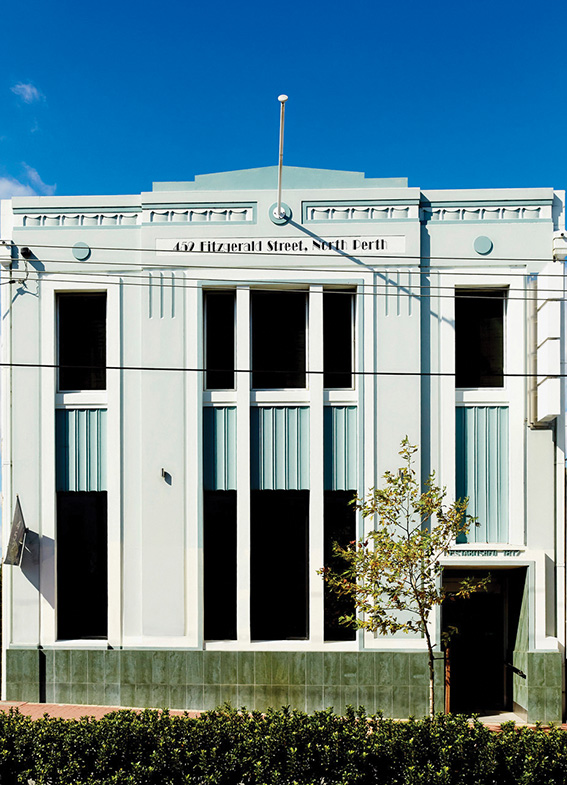
    RESTORING an old bank in North Perth was a labour of love for its owner, award-winning photographer Denise Teo.

    The Fitzgerald Street branch of the The Bank of New South Wales was opened in 1938, but when Teo bought it in the 1990s it was being leased by ANZ.

    Ceilings had been lowered, unattractive fluoro lighting installed and the floors were covered in carpet squares.

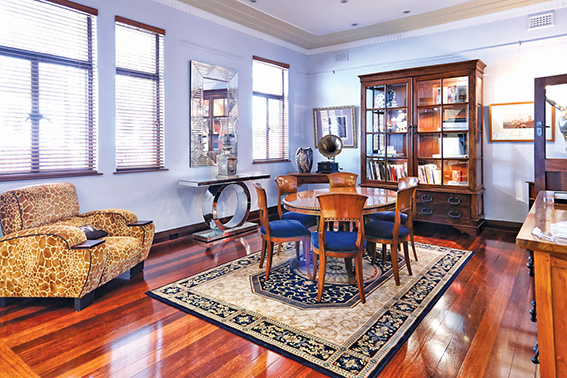
    She took her time restoring the art deco building, designed by renowned architect firm Hobbs Forbes, including reinstating the soaring 4.5 metre high ceilings and uncovering and polishing the jarrah floor boards.

    Darkroom

    It’s been Teo’s photo studio and gallery for more than 20 years, and the only room not restored to its former glory is the darkroom.

    “I left it to show what the building was like.”

    Downstairs is a sweeping gallery space with massive windows and a recessed ceiling.

    Six Belgian up-lights in the floorboards cast a 30-degree beam of light, creating a theatrical atmosphere.

    Beautifully restored jarrah stairs with acorn finials lead to the second level, which was the bank manager’s family home until 1976.

    “His son, now in his 60s, came in and said he’d lived here,” Teo says.

    The huge studio/portrait room, across the front of the second level, was the family’s lounge and dining room, and the rear kitchenette was once a kids’ bedroom.

    New owners could use this fantastic art deco property as commercial premises, but it would also make an amazing home/office.

    Although there are toilets on both floors, there’s no proper kitchen or bathroom, but there’s plenty of space to put some in.

    The building is heritage-listed but some works are permitted without planning approval, such as interior fit-outs.

    This stunning property in the heart of the Fitzgerald Street strip with cafes, hotels and shops in every direction.

    452 Fitzgerald St, North Perth
    from $1.59m-$1.795m
    Wayne Heldt
    0433 118 353
    Bellcourt Property Group
    Mt Lawley
    6141 7848

  • Putting the bight on miner
    • Protesters, including Greens senator Jordon Steele-John, gathered outside Equinor’s Perth office. Photo supplied.

    A DOZEN protestors gathered outside the Perth office of Norwegian energy company Equinor last week as the company ramps up its bid to drill for oil in the Great Australian Bight.

    Equinor recently released its response to public submissions on its environmental plan, ignoring all but 1039 of the 31,772 submissions, most being rejected as too political.

    Recently graduated environmental scientist Damien Cole, who ran as an independent in the seat of Corangamite, criticised Equinor for ignoring submissions, saying there was widespread opposition to mining in the Bight and the consultation period was a good opportunity for people to speak up about the issue rather than just its proposal.

    Future

    “Communities are worried about more than that, they’re not just worried about Equinor, they’re worried about the future of their communities,” Mr Cole said.

    “Surely out of the 31,000 submissions there was more than a dozen odd where they went ‘oh yeah, that’s relevant’.

    “Overall they’ve made this submission process way too specific and they’ve used very confusing language, obviously in order to eliminate a lot of the objections or a lot of the submissions,” Mr Cole said.

    He joked that if the drilling went ahead, he might try paddling out into the Bight to lock himself onto the oil rig.

    Last month a paddle-out protest was held at Cottesloe Beach opposing Equinor’s plans.

    Coastal Cleanup Crew founder Daisy Kermode attended the event, which was part of a national protest: “I really don’t think that new oil drilling in the Bight is positive for the globe or the Southern Ocean environment, that’s why I went to the protest,” Ms Kermode said.

    Last week’s protest was timed to coincide with Equinor’s annual general meeting and a delegation of opposition groups from Australia flew over to protest.

    Contemptuous

    Wilderness Society South Australia director Peter Owen flew to Norway to tell shareholders the company was contemptuous of Aussies, as it had released its environmental plan on the last possible day to avoid a government-regulated feedback process.

    “Instead it ran its own sham feedback process and has dismissed almost all of the Australian public concerns represented by 30,000 unique submissions in just five weeks.”

    In its response, Equinor said it had rejected the majority of submissions because they dealt with the “political” debate over mining in the Bight rather than addressing specific issues with its environmental plan.

    It said of the 1039 submissions considered, only 13 resulted in changes to its plan.

    They include expanding the list of potential species affected by mining to include beaked whales, and revising underwater sound modelling so that the noise of transponders is considered.

    by RACHEL SIMMONDS and STEVE GRANT

  • Cyber attack spooks Baysy
    • Cybersecurity expert Scott Helme. Photo via his Twitter.

    A CYBERATTACK on Bayswater council has prompted it to consider hiring a cybersecurity officer and spending up to $165,000 on safety upgrades.

    City staff advised councillors that the cost of “not undertaking essential cybersecurity protection is immeasurable and has not been contemplated”.

    Last year the city’s website was caught up in a clever hack that affected more than 4200 websites worldwide.

    The hack inserted a script that used people’s computers to generate the cryptocurrency Monero, with the cash being sent to the hacker’s account.

    Last year the city commissioned Deloitte to audit its cybersecurity and it awarded a rating of 1.5 out of 5.

    The proposed cybersecurity upgrades in the 2019/20 budget would increase this rating to 3.

    Upgrades include:

    • $60,000 to identify and remove credit card numbers stored in old documents and emails

    • A $5000 “IT vulnerability scan” to probe the existing system for weaknesses

    • $80,000 to replace backup servers which are often targeted in data hostage hacks

    Government bodies have increasingly been the target of hackers in recent years.

    The perpetrators have ranged from extortionists wanting payment in cybercurrency, to suspicions that a “state actor” could be behind some cyberattacks.

    In October last year the WA government revealed that departmental websites had been subject to millions of intrusion attempts in the last couple of years, with 11 successful to some degree.

    Some of those were as simple as hackers sending phishing emails to get people to provide their personal details, but one involved hackers tapping into North Metro TAFE systems and stealing staff account details, encrypted password files and students’ details.

    In the US, local governments including the City of Atlanta and the City of Baltimore have been paralysed by ransomware hackers holding their data hostage. These attacks infest the IT systems with viruses that lock users out, and can delete all data if the victim doesn’t pay a ransom.

    UK-based information security expert Scott Helme–who uncovered the global hack that affected Bayswater council last year–said at the time “there were ways the government sites could have protected themselves from this.

    “It may have been difficult for a small website, but I would have thought on a government website we should have expected these defence mechanisms to be in place”.

  • Bittersweet victory
    •Patrick Gorman and wife Jess cast their votes, while Leo (not of voting age) offers moral support.

    WHILE the national election result shocked the pollsters, there were no surprises locally with Labor’s Patrick Gorman winning Perth and Liberal candidate Vince Connelly taking out Stirling. There’s a number of votes still to be counted as we go to print so the final results may vary slightly, but the overall outcome won’t change.

    PERTH

    With 35 per cent of the primary vote, preferences carried Mr Gorman over the line. He wound up with just over 55 per cent of the two-party preferred vote.

    A smattering of smaller parties including United Australia Party, One Nation and the Western Australia Party likely nibbled away the conservative primary vote, which was down five per cent this year, with Liberal Jim Grayden picking up 37 per cent.

    Caroline Perks got the best primary vote the Greens have ever had in Perth, up two per cent to 19. It was the highest Greens vote in the whole state, with even the barefoot division of Fremantle coming a distant second with 15.8 per cent.

    Despite not much local campaigning from One Nation, 2.4 per cent of Perth voters lodged their number 1 vote with their candidate Mel Lownds.

    In his post-election announcement Mr Gorman gave a “shout out to my Labor colleagues, especially the WA crew—I look forward to working on the rebuild with you. The job has already started”.

    He acknowledged his opponents, “especially Jim Grayden and Caroline Perks. Both ran strong, values focussed campaigns”.

    STIRLING

    Mr Connelly won the seat for the Liberals with 47 per cent of the primary (56 per cent 2PP). Labor’s Melita Markey ran a high profile campaign, but only managed to slightly increase the Red’s primary vote to 32.7 per cent.

    Greens were steady at 11 per cent, One Nation celeb candidate Angus Young got 3.33 per cent, and Stirling councillor Liz Re standing for the Western Australia Party got 1.77 per cent, slightly ahead of the other microparties–Australian Christians (1.73) and United Australia Party (1.69).

    The day after the election, outgoing Liberal Stirling MP Michael Keenan said “It is a huge relief to know the seat I held for the past 15 years will be remaining in a safe and strong set of Liberal hands.”

    by DAVID BELL