• Great outdoors struggles with Pokemon craze

    THE scuffing feet of thousands of Pokemon Go players is causing havoc at Kings Park.

    While the ridiculously popular app has been a boon to businesses and helped dragged gen-yers off the couch and into daylight, newly planted garden beds and grass where Pokemon characters “gather” are being trampled to death.

    Thousands are flocking to Kings Park day and night, causing authorities to rope of large sections of grass and issue a plea for players to take their rubbish with them.

    While virtual monsters don’t care about litter, the park’s home to 100 native animal species in the park from birds to spiders that don’t appreciate cans of energy drink and Cheetos packets being tossed into their home.

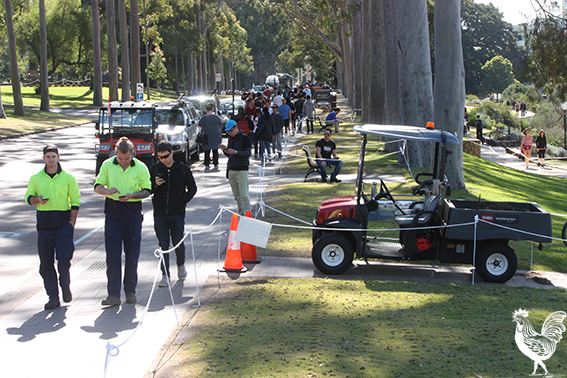
    • It’s Tuesday morning on a school and work day, yet Kings Park was packed with players hunting for rare Pokemon characters. Photos by Steve Grant
    • It’s Tuesday morning on a school and work day, yet Kings Park was packed with players hunting for rare Pokemon characters. Photos by Steve Grant

    The park authority’s also banned cars stopping along Fraser Avenue because of the jams caused by players desperate to snag an adorable Dratini. The Chook’s photographer said there was also a fug of cigarette smoke in popular Poke stops to counter any benefits of being outdoors.

    Describing the players’ behaviour as “unusual”, the authority says mass displays of pink everlastings, which have only recently germinated and are a big drawcard for the wildflower season, have been affected.

    About 1000sqm of turf has been damaged and roped off, with the worst affected areas needing to be replaced and the rest given a top-dressing of sand.

    The grass is expected to recover by October, however the garden beds may take up to a year.

    Crossing roads

    The KPBA has asked Pokemon players to stick to footpaths, keep out of the garden beds, watch out while crossing roads and not to disturb others trying to pay their respects at the park’s memorials.

    Even the federal government’s issued a safety edict: The Stay Smart Online initiative has sent out a “moderate” priority alert noting that Pokemon Go players have been involved in near misses between pedestrians and cars, people are playing while driving, while crowds of players in Sydney were waterbombed by angsty residents tired of the noise.
    02. 943NEWS 2

    Players have responded to the anti-grognards by circulating memes pointing out that for years people have been telling nerds to go outside, and now they finally have gone outside everyone’s telling them “yes, but not like that!”

    It sounds like some of the Kings Park staff have had their fill: Lisa Sheppard left a one star review on the Kings Park Facebook page stating: “The grumpy old man from the information centre needs to check his temper. We understand the sudden influx of people at the moment probably brings with it a certain amount of trouble makers, but to bellow angrily at a couple of six year olds for stepping in the wrong spot is unacceptable. Take your anger out on someone your own size or at least someone who’s doing something wrong intentionally. We left the park with the kindest, soft-hearted little boy in tears. You sir, are a horrible person!”

    Park authorities are looking into the brisk ticking off.

    by DAVID BELL

    CHEZPIERREDELIGHTSOFFRANCE10X3V3 copy.pdf

  • Hammond straight to shadow cabinet

    NEWLY minted Perth Labor MP Tim Hammond has walked straight into federal Labor’s shadow cabinet.

    Mr Hammond has been given three assistant shadow ministries by Opposition leader Bill Shorten.

    Mr Hammond will answer directly to Mr Shorten in the digital economy and startups portfolio, and joins fellow Sandgroper Kim Carr with innovation. He’s also picked up shadow assistant minister for resources and Western Australia under Jason Clare.

    “We have a lot of work ahead of us, but I know we are up for the challenge and have never felt more ready to roll up my sleeves and give it all I have got,” Mr Hammond says.

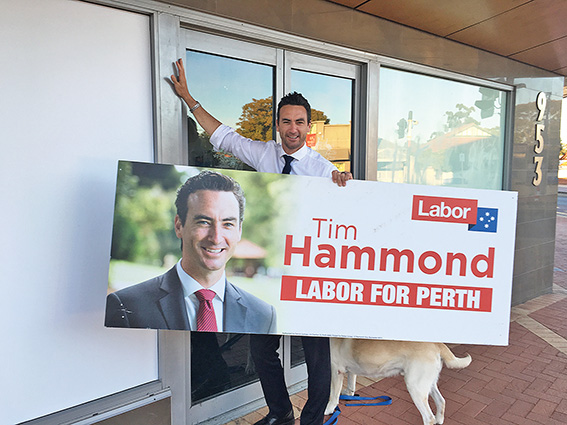
    • Tim Hammond moves into his new office, which just happens to be the one vacated by former Perth MP Alannah MacTiernan. Photo supplied
    • Tim Hammond moves into his new office, which just happens to be the one vacated by former Perth MP Alannah MacTiernan. Photo supplied

    In a press release Mr Hammond says the focus on digital and tech fields is a pointer Labor’s preparing for the next stage of the economy: “Our magnificent resource companies will mine data in much the same way as they mine resources to drive the next wave of job creation.

    “In my role, I hope to assist this exciting sector in moving towards new methods and new technologies to drive our economy into the 21st century.”

    One of his first acts since being elected — apart from heading along to a Baigup Wetlands cleanup over the weekend — has been to get stuck into the state Liberal government over closing the RPH after-hours GP clinic, saying as a father of two younguns it’s important to be able to get to a nearby doctor day or night.

    Mr Hammond’s moved into Alannah MacTiernan’s old office on Beaufort Street’s Inglewood stretch.

    by DAVID BELL

    935 Estia 10x3

  • Tough green rules for developments

    VINCENT council has introduced tough new rules requiring 25 per cent of big developments be set aside for greenery.

    Previously developers only needed to leave 10 per cent for gardens, lawn or trees in mixed use developments or blocks of flats, but the council is concerned about the city’s rapidly diminishing tree canopy. It’s busily trying to plant up its verges and parks, but is unable to keep pace with the chainsaws in suburban blocks.

    Planning director Gabby Poezyn says the new rule is “in all probability” Perth’s toughest.

    Mayor John Carey says less greenery equals higher local temperatures for people living in the developments, and it can also lead to health and psychological effects.

    Council staff warned against the 25 per cent green space requirement, arguing 20 per cent was more reasonable.

    Prohibitive

    The larger requirement could make “commercial development… prohibitive in some instances, although it is recognised that some of this landscaping can be provided on the roof top or on upper levels”, they argued in a report to councillors.

    In presenting the motion to council Mr Carey showed what wouldn’t count as soft landscaping; a dead green wall from a local block of flats.

    They’re meant to look like lush walls of plants but in Perth often fail because of the tough climate or poor management.

    Even Perth city council couldn’t keep one alive at Northbridge Piazza, despite constantly dumping cash into its care.

    Mr Carey says the policy is a stop-gap measure while Vincent completely overhauls its planning rules.

    There’s a lot of discretion built into them, and in the hands of development assessment panels the results are often taller, bulkier, and with less setbacks than neighbours would like.

    “This has been a massive project and I think there’s been a bit of frustration by councillors and myself,” Mr Carey says. “We want these reforms in place. What we’re doing is ensuring a stronger framework so if the DAP continues, at least we know the minimum benchmarks are better in the interests of Vincent amenity [re] height, bulk, setbacks, soft green landscaping, all those sorts of issues.”

    by DAVID BELL

    943 Safarii 10x3

  • More walkies in Stirling?

    DOG exercise parks in Stirling have been so successful the council is thinking of creating another five.

    Stirling opened its first doggie run-around in Inglewood in 2013 and when it proved a hit opened a second at Charles Riley Memorial Reserve in November last year.

    Now it wants pooch owners to be no more than a 10-minute drive from the nearest exercise area and has put out a strategy for public consultation that proposes new ones at the Lake Gwelup, Dianella and Carine regional open spaces, Celebration Park in Balga and Robinson Reserve in Tuart Hill.

    Fenced-in parks are supposed to provide a space where dogs are secure and amongst people comfortable with dogs. Owners don’t have to be on high-alert so they’ve got more time to socialise, fostering community spirit.

    “Feedback we have received from dog owners already using the two fenced dog exercise areas in the city indicates that owners find the enclosures more than just an area for their four legged friends to run free,” said Ian Hunter, Stirling’s manager of parks and reserves.

    Community consultation is open until August 15.

    NBC Voice Specials Ad PRINT

  • Locals pack talk on future of Bayswater

    A “VISIONING” event run by community and business group Future Bayswater has been a smash, with more than 150 interested locals packing out the local bowling club.

    Paul Shanahan from FB says they weren’t sure what to expect after setting up a series of talks involving planning experts, who’ll give locals ideas about how they could shape the town centre.

    “The Bayswater bowling club was packed and the event became standing room only very quickly. It’s obvious Baysie residents are keen to have a conversation about what the future could look like at the town centre,” Mr Shanahan says.

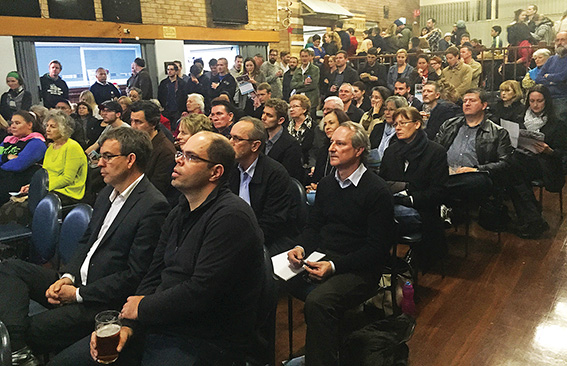
    • More than 150 people turned out for the launch of a talk series that brings in experts to give locals ideas about shaping the future of Bayswater town centre.
    • More than 150 people turned out for the launch of a talk series that brings in experts to give locals ideas about shaping the future of Bayswater town centre.

    Structure plan

    The series comes as Bayswater council brews a town centre structure plan, with urban renewal a major theme.

    More mixed use development, more population to keep business humming, affordable housing, greener town centres and better pedestrian access are among FB’s aims.

    • Julian Bolleter, John Del Dosso and Stuart Doran were the guest speakers to launch Future Bayswater’s free speakers series. 
    • Julian Bolleter, John Del Dosso and Stuart Doran were the guest speakers to launch Future Bayswater’s free speakers series.

    The next free event is on August 4 at the Bayswater hotel.

    Urban design specialist Malcolm Mackay will talk about issues the city might face in the future how they can be planned for now, while former South Perth mayor James Best will argue Bayswater needs to “evolve with the times”.

    Check http://www.futurebayswater.com to register because spots will be gobbled up fast if it’s anything like the launch.

    by DAVID BELL

    DHM Plumbing 5x3

  • Child abuse charges

    A FORMER psychiatrist from the Hillview Terrace Hospital (also known as the Hillview Child and Adolescent Clinic) has been charged with sexually abusing three patients.

    Police from WA’s child abuse taskforce charged 68-year-old Ian Stuart McAlpine of West Leederville with 26 counts of indecent assault, eight counts of sexual assault, five counts of indecent treatment of a child under 14 and one count of defilement of a girl under 13.

    The offences were alleged to have occurred between 1985 and 1992.

    Hillview opened East Vic Park in 1985, but was closed after 10 years following a damning report by Perth lawyer Neil Douglas which found inappropriate physical contact between patients and staff, a dominant nursing culture and rorting.


  • Sicari’s closing ‘up’ for retirement

    SICARI STATIONERY on William Street closes its doors at the end of this month after 35 years in the heart of Northbridge.

    Owner Frank Sicari insists the store is closing up, not down, giving it the positive spin of someone heading happily into retirement. He’s even celebrated the occasion with big fluoro letters in the shop window screaming “retirement sale” in all-caps.

    Mr Sicari has seen many faces come in and out of the stationery shop over the years, and has watched Northbridge gradually change outside his window.

    He’ll miss the customers most of all.

    “The whole world goes past this shop,” Mr Sicari says.

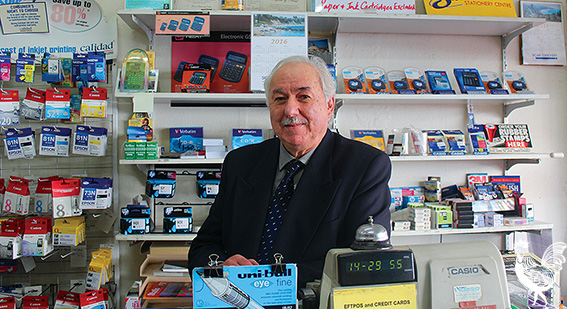
    • Frank Sicari is in two minds about retiring. Photo by Trilokesh Chanmugam
    • Frank Sicari is in two minds about retiring. Photo by Trilokesh Chanmugam

    “They’ve been very very nice and I’ve loved the support. I’ve met some lovely people. It’s what made the days go by.”

    Author Tim Winton, a multiple Miles Franklin award winner, would come into Sicari’s to buy typewriter ribbon in the 80s and 90s because it was one of the few places still selling it.

    Selling stationery was never Mr Sicari’s plan as a kid, but he found it grew on him over the years, and the decision to retire was a tough one.

    In the end, the thought of spending more time with his friends and family won him over.

    On his first day of retirement, Mr Sicari is going to have a good sleep in, then go out for a leisurely cup of coffee with his wife.

    by TRILOKESH CHANMUGAM

  • The halal revolution

    IT’S the dish Pauline Hanson refuses to eat.

    The halal snack pack; a multicultural fusion of doner meat, chips, cheese and sauces to terrify any purist (foodie or racial).

    The online Halal Snack Pack Appreciation Society now boasts 162,665 members on Facebook and is growing by thousands every week, its popularity soaring since Labor senator Sam Dastyari, a non-practising Muslim, started raving about them earlier this year.

    When he invited Ms Hanson out for a HSP in Western Sydney following her election, she baulked.

    Invented in Sydney about 30 years back (or 50, depending on various claims), many Perth kebaberies seem a bit shy about its name, sticking to the less political “meat box”.

    But walk into Habib’s Kebabs in Freo and mention HSP, and the brothers know instantly what you’re after.

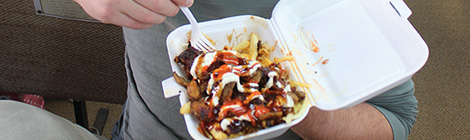
    • This Chook’s first halal experience.
    • This Chook’s first halal experience.

    Holy trinity

    “We do anything you want, we do cheese, we do the holy trinity,” the chef proudly claims, referring to the purists’ choice of sauces; chilli, barbeque and garlic.

    The HSP appreciation society deems anyone ordering tomato sauce or salad in their pack a “haram dingo”, haram being Arabic for forbidden.

    Habib’s chef says the dish had boomed locally, while over east it’s reportedly surpassing kebab sales in some restaurants.

    Food’s long been tied to politics, race and class.

    Lobsters were once the preserve of poor servants or prisoners and were seen as a gross ocean bug.

    The name even comes from the old English “loppestre,” a corruption of locust.

    “Lobster shells about a house are looked upon as signs of poverty and degradation,” John J. Rowan wrote in 1876.

    In the Pacific Standard article How lobster got fancy, Daniel Luzer says it was embarrassing for kids to go to school with sandwiches full of lobster meat during the Depression.

    Rationed

    It was one of the few meats not rationed in World War II, and people got a taste for it. Demand grew, numbers shrank, and the cost skyrocketed.

    The HSP fits neatly into this timeline of food as politics. Among the members of the HSPAS, eating the dish is a declaration of solidarity with Middle Easterners and Muslims, and a statement against the anti-halal scare campaign trumpeted by right-wingers.

    It’s also incredibly tasty, making it a very palatable way to fly your anti-bigotry.

    Habib’s HSP has meat piled high on top of chips and cheese for $14.50; a generous stack of tender cuts of lamb, beef and chicken.

    Along with Habib’s Kebabs, places around Perth universally regarded as worthy among the HSPASers include Perth Kebab Station in Subi (though it’s so well regarded the lines can be long), Alladin’s in Morley or Five Star Kebabs on Horrie Miller Drive.

    by DAVID BELL

  • LETTERS 30.7.16

    943LETTERS

    No way to treat CEBA
    AS a former councillor at the City of Bayswater, I was dismayed by your “Festival in doubt” article on the July 23.
    I personally am a long-term member of the Central Eastern Business Association and I chair the Bayswater Child Care Association which is also a member.
    I can attest to the tremendous benefits which CEBA brings to both the business and the wider community of the eastern suburbs.
    Only the other week CEBA had the federal minister for communications, Mitch Fifield, attend a local function in order to hear the needs of locals, and about local businesses having access to the national broadband network.
    CEBA has been working for the community for the last 40 years and it should be noted that local business provides approximately 20 per cent of Bayswater’s rates and so it is unacceptable for the city to take their work for granted and not even bother to ensure a quorum can remain in the room to make decisions on behalf of this hardworking community body.
    Michael Anderton
    Chambers Way, Noranda

    It’s political ping pong
    THE recriminations between the City of Vincent and the Liberal MLA for Perth, Eleni Evangel continue unabated.
    The “international incident” concerns allegations made by Ms Evangel of political bias by Vincent against her.
    Being the mayor of Vincent has been a good starting point for aspiring Labor state politicians – first John Hyde and now John Carey.
    Some ex-Labor politicians have, after they left state parliament, become the mayors of Vincent; Nick Catania and Alannah MacTiernan.
    John Carey must be happy indeed that all the Vincent councillors have now swung in behind him; “Hail to our glorious leader.”
    What we now have is a mutual admiration society. Is it an ALP sub-branch?
    As far as Vincent is concerned I think the Shakespearean saying, “The lady protests too much”, rings true.
    The gloves are off, “let the biffo begin!”
    Paul Mannion
    Clive Road, Mount Lawley

    Hey, big spenders
    THE City of Vincent has been spending big.
    To sustain this type of spending Vincent has been selling off assets and increasing rates.
    Last year the residential minimum rate was raised significantly, by $200.
    That’s equal to a 28 per cent increase.
    This year, Vincent has proposed further increasing the minimum rate by another $100 (a further 11 per cent).
    These increases are far greater than CPI, in effect a 42 per cent total increase over two years.
    Average incomes and pensions are not going up at these rates, so these huge hikes are unfair as they will hit the poorest and lowest income families the hardest.
    Keeping in line with Vincent’s recent letter mail-out to all pensioners about the capping of the rates rebate, I trust that Vincent will be consistent and send out letters to all residents affected by this rate rise, explaining that complaints should be sent to the mayor of Vincent, John Carey.
    Mark Rossi
    Buxton St, Mount Hawthorn

    941 Auspoint 10x3

  • Time to give DAPs a good shake-up

    BRAD PETTITT is mayor of Fremantle. Last week his council considered a motion to review the much-maligned development assessment panels, but in this week’s SPEAKER’S CORNER, he says simply scrapping them is not the way to go.

    DEVELOPMENT assessment panels are a contentious issue in Perth right now.

    You might have read about a growing campaign against them led by predominantly inner-ring and western suburbs councils. While they are getting lots of press and “Scrap the DAPs” is a punchy slogan, I am not convinced that the current anti-DAPs movement offers the best way forward if we are interested in creating a more liveable Perth.

    Former WA planning minister John Day recently dismissed the DAP opposition as ‘cause célèbre‘ and I’m not sure this dismissal is quite right either. There are some real and concerning issues with the current DAP system that need to be reviewed and rethought. DAPs have been shown to be slower, more expensive and less representative than the previous approvals process – and that’s when they’re not approving developments that push the bounds of local planning schemes and good design.

    In fact, a WALGA report in collaboration with the Local Government Planners Association conducted an analysis of DAP agendas and minutes between July 1, 2011 and June 30, 2014. Analysis of the 520 development applications dealt with during this period revealed that:

    • there has been an increase in applicant fees by 19 per cent;

    • it takes longer than 100 days to process applications (on average);

    • the process results in a high number of SAT appeals at great expense to the Department of Planning; and

    • DAPs expended vast resources in determining a significant number of relatively straightforward and clear cut applications that could have easily been processed under delegated authority by local government officers.

    While DAPs might not be performing as well as promised it is important to remember that they were brought in, in part, because Perth was failing to realise its urban infill targets and address suburban sprawl in a coherent and strategic manner, in part due to an overly localised, NIMBY attitude to new development and density in some areas.

    While in a post-DAP world we are now seeing higher rates of urban infill and higher density development slowly emerge (we have gone from 27 per cent to 31 per cent infill in recent years) I am not convinced that this approach is working as well as hoped. For a start Perth’s urban infill rate of 31 per cent is still way off the 47 per cent target signed up to.

    I am even more concerned the urban density we are getting is not the high quality, strategic kind of smart density Perth really needs. By that I mean density located in and around train stations and good transit, in activity centres and close to jobs and schools and shops.

    Instead we seem to be getting haphazard density away from good transit and centres and often approved by DAPs. This dumb-density is angering local communities who can clearly see what this density is costing them in terms of their suburb’s amenity and character but cannot clearly see what benefits smart density could achieve in terms of a less congested, more diverse, sustainable and liveable city.

    In other words DAPs have failed to adequately solve the problem they were largely created to address and are instead in danger of fuelling a new density hangover that will once again set back community support for density for decades.

    I am increasingly of the view that we need to rethink DAPs and more fundamentally how we best achieve greater density in Perth. To do this we should consider turning the DAP idea on its head by returning power to local communities how and where they put density. But to avoid the NIMBYism that has plagued development in Perth so far local councils should be required to sign up to agreed density targets.

    If these are met they should be rewarded with greater infrastructure spend by the state government.

    This localises power and responsibility and with the right incentives to communities it should result in better-informed and strategic decision making. This is covered in part of the DAP item that came to Fremantle council last week which (along with other possible improvements) called for:

    “Consideration of incentive based replacement for DAPs which rewards local government for setting appropriate density targets for their area (through community led design) and making strong progress towards meeting these targets. This should include a particular focus on development and density located in areas adjacent to transport and near designated activity centres. Local governments who are delivering on agreed density targets will be rewarded with infrastructure and other funding that will not be available to local government not meeting their targets.”

    The DAP debate has a fair way to go but I’m pleased Freo council’s approach has been about more than a catchy slogan that says “no”. The Labor and Liberal parties support DAPs so this approach isn’t likely to generate change. That’s why we’re after a more sophisticated approach that is willing to work through the complex issues so we can then advocate improved and workable solutions to the challenges of development and density.

    Microsoft Word - 160721 The Voice - Open Day