RESIDENTS who live near Russell Square are finding January’s Fringe World Pleasure Gardens didn’t live up to its name, with many complaining of rowdiness.
Artrage merrily hoofed it to Perth city council this week asking to use the space again for 2016, but hit a stumbling block, with council staffers pointing out they’d “received a number of complaints post-event (2015) from residents in the area”. Artrage met up with residents and promises to reduce noise and other impacts, and provide tickets so residents can keep using the park.
THE big Food Truck Rumble will go ahead again next year but Perth city councillors are worried the event’s competing with hard-up ratepaying businesses.
Despite the misgivings, most voted to hand over $10,000 in sponsorship so it can run at the Perth cultural centre
Cr James Limnios pointed out restaurateurs were worried the event would draw away their customers.
New councillor Jemma Green agreed, also voting against the item: “I wouldn’t support it being there because it is going to have a negative impact on traders.”
Lord mayor Lisa Scaffidi supported the sponsorship but agreed bricks and mortar foodies have “lots of costs, rents, fit outs, rates” that food trucks don’t.
She said the foodie events had been introduced to Perth when it was quieter and keen to draw in a crowd: “We did it to bring people into the city at a time when we didn’t have as many venues.”
Cr Reece Harley maintains the event brings people into the city and they still go on to spend at nearby eateries and businesses.
The Rumble is planned for April 3, 2016, 11am to 8pm.
LOWER permit prices and better street access for food vans have been suggested at Bayswater council following complaints from vendors.
Deputy mayor Stephanie Coates hopes lower permits — they’re currently $1500 a year — will form part of a permanent mobile food vehicle policy.
She also wants to give vendors more space on streets, rather than restricting them to parks and residential areas as per the 12-month trial, which ended September.
Councillor John Rifici told councillors that traders needed to be consulted to ensure their trade wasn’t impacted, but Cr Sally Palmer says that’s a “waste of time” and “over the top”.
“Of course they’re going to say no they don’t want it,” she says.
She and Crs Coates, Catherine Ehrhardt, Dan Bull and Chris Cornish voted to ditch consultation but lost.
Thirteen businesses took part in the council’s food truck trial, including Annie’s Wood Fired Pizza in Bardon Park, Cool Breeze Cafe in Riverside Gardens and the “StEats” cluster of seven traders at Bert Wright Park.
A council report states complaints from traders include pricy permits, signage restrictions and access to power.
Pizza-maker Ian Gibson says his generator costs $50 a week, an “unviable” amount and would like access to metered power.
He’s asked the council for the same deal as Cool Breeze Cafe: a marked parking spot just for him, permanent signage and power connection.
A council document says residents have issues with noisy generators, and officers suggest limiting how many could be used within the city.
During the trial period, permits to operate in one location were $500, $800 and $1500 for three, six and 12 months respectively.
A similar 12-month permit in Fremantle costs $290 for any location.
Vincent and Perth’s equivalent is $1100 for any location, while Stirling’s is $1800.
The policy aims to “activate under-utilised spaces”.
THOUSANDS of dollars may have been wasted by Bayswater council because of a failed attempt to find a better place for sports field lighting in Maylands, mayor Barry McKenna concedes.
Cr McKenna acknowledged at last week’s meeting the council should have replaced floodlights at De Lacy Reserve instead of spending time and money investigating options to move them to Gibbney Reserve.
“I don’t understand why we didn’t put them back up at De Lacy,” he told councillors, lightly throwing a pen on his desk.
Despite this, he voted alongside most of the council to continue with plans for lighting at Gibbney.
This leaves tentative plans to replace lights at De Lacy Reserve on hold until the council gets “geo-technical survey” and lighting quote from Western Power for Gibbney reserve at consultants’ fee of $15,000.
It is also despite the council this month receiving a 65-signature petition from a Bayswater resident against the lights going in at Gibbney.
Concerns include noise at night, street parking and impacts on the reserve’s amenity.
More than 140 previously objected to lighting at De Lacy for the same reasons. New lighting is expected to cost $133,000 and last 20 years.
The council spent $20,000 on a review of sports field lighting on all active reserves, including these two in Maylands, in 2013/14.
LOCAL music ensemble Decibel has little hope it will finally go on a US tour to promote its new app after another “disappointing” blow to federal arts funding.
The group, composed of talent from Edith Cowan University, missed out on a US tour because of Australia Council funding cuts of $105 million over four years, announced in May.
And there’s still little to get excited about, band member Cat Hope says, even though new arts minister Mitch Fifield last week decided to return $32.4m back to the council over four years and pool $12m in a new program called Catalyst.
“There’s less money available so it’s now more competitive,” Ms Hope, who’s also an ECU associate professor.
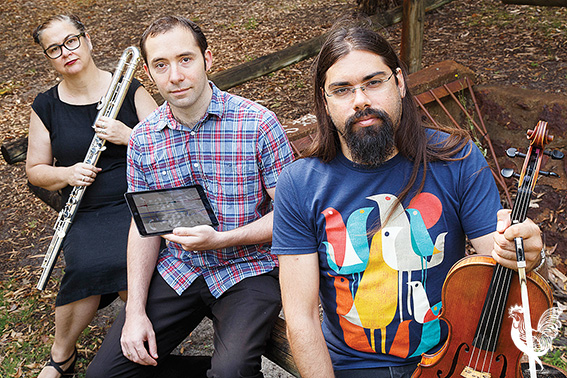
• Decibel new music ensemble has missed out on a US tour as a result of Australia Council funding cuts. And they’re not the only ones to have missed out, WA Chamber of Arts and Culture chief executive Henry Boston says. Pictured are Cat Hope, Stuart James and Aaron Wyatt. Photo by Matthew Dwyer
Having received a totol of about $100,000 in council funds on four other occasions for past projects, they liked their chances of getting their $50,000 US trip partially funded by the peer-reviewed body in mid-year funding round.
But that round was dumped by former arts minister George Brandis.
The group was due to tour the US late this year to promote its “ScorePlayer” app—developed together with prolific US composer John Cage—which uses new animated notation technology for reading music. (This technology is the next step up from graphic notion, so say goodbye to reading music on paper).
“We’ve invested about two years into this project,” Ms Hope says.
“Now, if we don’t go soon to hold workshops and demonstrations, to show people how it works, we’ll miss the moment.”
“If the government really wants to encourage innovation and international recognition, it’s going the wrong way about it.”
Senator Fifield says Catalyst will do “some very different things to the Australia Council”.
“We’re proposing that Catalyst can help support new ways of partnerships and collaboration,” Mr Fifield says.
“So…someone might want to set up a new fellowships program, or they might want to come up with an innovative way of funding an infrastructure project. So on the partnership and collaboration side, that’s something really that the Australia Council doesn’t do.”
But Greens arts spokesperson Scott Ludlam took to Twitter this week with the #freethearts hashtag, saying it’s still just a “slush fund”.
“Brandis’ pointless $20m arts slush fund is now Fifield’s pointless $12m slush fund,” Mr Ludlam tweeted.
He told the senate on Monday that Senator Brandis had “broken something that didn’t need fixing” when he pulled funding from the Australia Council to create his own National Program for Excellence in the Arts.
“I have never seen this degree of unanimity of representation,” he told senators.
“They have clawed back a little over a third of the funding and put it back into the Australian Council’s peer-reviewed process, where it belongs. That still leaves $12 million in this new Catalyst entity that nobody can figure out what it is for.”
WA Chamber of Arts and Culture executive director Henry Boston has “significant concerns” that no money returned to the council will address funding cuts for small-to-medium arts organisations.
“A broader group of applicants will be competing with the small-to-medium and major organisations for a smaller pot of money,” Mr Boston says.
“It’s very disappointing that not more funds were returned to Australia Council.”
He says there’ll be a heavier workload on arts organisation, making it harder for to complete core business: making art.
Community Network WA managing director Pilar Kasat, based on Murray Street in the CBD, says it’s had to put three projects on hold to revisit business plans over the past few months.
It’s vying for $200,000 per year—about 10 per cent of its kitty—from the council.
The Voice has previously reported the community network, Perth-based Tura New Music and the Perth Institute of Contemporary Arts stood to lose a combined total of more than $700,000 because of the cuts.
A NINE-YEAR-OLD boy with Aspergers went from being unwilling to participate in class, to being more attentive and displaying a positive attitude—in five weeks.
The catalyst: a creative writing program.
Lover of literature Gae Oaten says the program, run by volunteers at her not-for-profit organisation A Maze of Story, has helped children and pre-teens from various cultural backgrounds become more creative and social.
Astounded by the talent of children, once given the opportunity to let their imaginations run wild, she gave the Voice a taste of one of the students’ stories.
It starts by introducing Bob and Mary, who are in love. Bob is brown.
“Then his next line is, “oh and by the way, Bob is a mouse’,” Ms Oaten, of Northbridge, says.
“It was so well put.”
• Gae Oaten, founder of the not-for-profit organisation A Maze of Story, with Embleton primary students, aged from 7-12, who were part of a five-week creative writing program. Photo by Matthew Dwyer
Children start the program brainstorming with coloured pens on large paper.
Creative juices flow as volunteers play games to exercise the imagination: one involves putting an inanimate animal on their heads, and children have to explain what it is without being direct.
Then, only after a few weeks, volunteers and “story weavers” (experienced writers) start aiding the children with editing.
It’s important to let children to have the freedom with their own stories, Ms Oaten says.
The former psychotherapist says some of the children—most are disadvantaged—have written about subjects such as domestic violence and suicide: “A volunteer helps two children develop their stories so it’s almost one-on-one, and children are in a nurturing environment,” she says.
At Embleton primary school, Marylin Makubaru, 11, wrote about a mother surrendering her two daughters for adoption.
“I love reading dramatic books,” Marylin says.
The Voice asks: “So do you want to be a writer one day?”—”Yeah, sure, why not?” she replies.
Her story, and those of 11 of her classmates, have just been published with the help of A Maze of Story.
The organisation was modelled on the success of 826 Valencia, based in San Francisco. It needs more volunteers. For more information, visit amazeofstory.org.au.
A VAST bounty of historic photographs has been released through Vincent city council’s local history centre website.
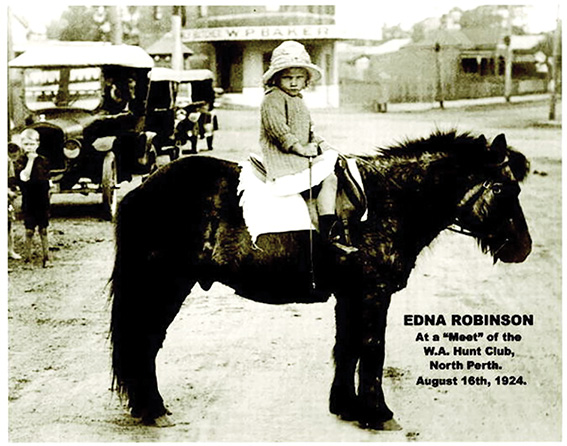
The database lets people search by topic, decade and suburb. We plugged in the topic “animals” and “the 1920s” and found this 1924 photo of Edna Robinson, the youngest member of the WA Hunt Club having joined at age four. Taken on Angove Street, her pony Toby in the picture was her regular means of transport and took her to school each day. The centre’s records say, “on this occasion she was made to carry a whip and was most unhappy about it. Hence the somewhat surly expression on her face.”
Photo supplied | City of Vincent library and local history centre
The site’s free for everyone to find hundreds of photos like this at http://www.vincent.wa.gov.au/library, then click on “local history image library”.
WA’s chief rabbi Dovid Freilich has spoken against Islamic fundamentalism, saying Islam should soften and its leaders formally accept other faiths in the wake of Perth’s first prayer shared by both Catholics and Jews at a synagogue last week.
The Menora-based rabbi says it will make a “world of difference” if Islamic leaders take on a similar tact to the Catholics in cracking down on religious hate and adopt a version of the “Nostra Aetate”.
The Nostra Aetate is a Catholic document formally acknowledging non-Catholic faiths which was adopted 50 years ago last month. It was the focus of a 600-strong service at Perth Hebrew Congregation on Wednesday last week, with the mostly Catholic and Jewish participants showing it’s being successful in slowly mended the 2000-year-old conflict between those faiths.
“It would be wonderful…if they [Islamic leaders] came out with such a statement like Nostra Aetate that actually said, ‘we have our religion, and we have respect and love for all other religions and beliefs, and they’re allowed to practice their religion without any persecution from us because we believe every religion is equally accepted in the eyes of God’,” rabbi Freilich told the Voice.
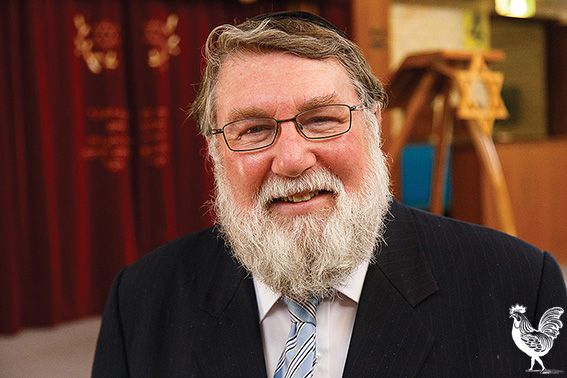
• Rabbi Freilich. Photo by Matthew Dwyer
“If they were to do that, you’d have a situation here where you wouldn’t have a venue big enough—you couldn’t hold another celebration here at the synagogue because you wouldn’t be able to fit the people in,” he laughs.
“I’m telling you straight out: I pray to God,” he says as his mood changes and tears start welling, “I don’t want to see any violence.
“The truth is I would welcome and pray to God that they would do that because I hate to see [non-fundamentalist Muslims] vilified as I hate to see anyone vilified.”
Asked by the Voice why he thinks it hasn’t happened yet, he replies: “Because sadly you do have fundamentalists, and I can’t speak on behalf of my muslim brethren…[But] maybe they fear themselves to come out with such a statement because they don’t know what terrorism could prevail upon them.”
Last week’s service came just days after terror attacks in Paris and Beirut, among others.
Coolbinia man Sharon Pelach says the timing made it more emotional.
“It was a very powerful, emotional service and you could see there was a genuine friendship and bond between the leaders,” Mr Pelach says, commenting on Perth archbishop Timothy Costelloe’s presence.
“To cap it all off, for me personally, to have people of different denominations sitting together with a common direction, especially with what’s happened with recent terrorist attacks, was very moving.”
“I thought, ‘wow this is the direction we should all be on’.”
Emotions were particularly high when the Shema—one of the central Jewish prayers—was sung by everyone, and led by Catholics.
The English translation from Hebrew reads: “Hear, oh Israel, the lord, our God, the lord is one.”
Islamic Council of WA president Rateb Jneid did not directly address the idea of an Islamic version of the Nostra Aetate.
But says: “I am happy to work with anyone seeking peace and social and religious cohesion in our beautiful state [in WA].”
“Muslims believe in the same God that Jews and Christians’ honour, although we differ about particular theological points that define him.
“Muslims regularly interact with people of other faiths positively and have always concerned ourselves with the preservation of the right of others to maintain their churches and synagogues.”
He would not say whether he would campaign for Islamic leaders, across Australia as well as the globe, to formerly stamp out extremism.
Christian writer Maureen Fiedller, from the National Catholic Reporter, wrote last month the Catholic/Jewish relationship was an example that religions can change.
State Liberal MP for Mt Lawley Michael Sutherland—a presbyterian—attended the Menora event and says it’s clear “shackles of the past—the haunted past—relationships have now largely been broken”.
“Suspicion and lack of trust have been replaced by understanding and common purpose.”
WHEN Connections opened 40 years ago people were terrified of being spotted going into the place.
If there was even a hint of a line, many would walk around the block to wait for it to disperse, or just go home.
“Even when I started in ‘91 there was a no-camera policy in the nightclub,” current co-owner Tim Brown says, with patrons too fearful of being outed, worrying how it could affect their job, social life or family.
They were hard days, Brown recalls.
“Connections was not doing well, that was the glory days of DC, Dual Control, it was a legendary club in this town.
“The times were also quite dramatic in that it was at the height of the AIDS crisis and the manager here had passed away, as had a number of staff and several drag queens, and the guts had been ripped out of the business.
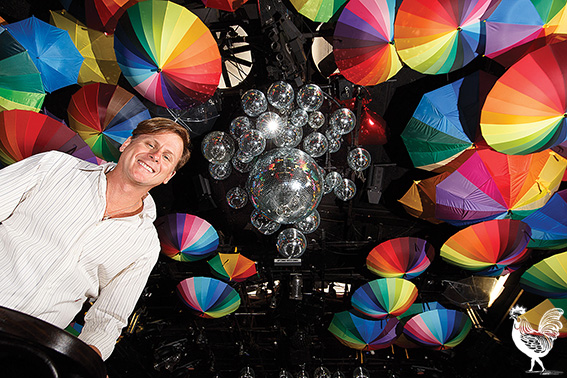
• Connections co-owner Tim Brown gearing up for the 40th year anniversary of the club. Photo by Matthew Dwyer
“There is a whole generation lost there. In a way it feels like how they talk about the world wars, a whole generation removed from the community.
“At that point Connections was really on the ropes, there was no customers, morale was low, and we had to get it back.
“Everyone thinks it’s just always been there and it’s always going well, but there’s been times where it’s been really tough.”
Changing demographics and expectations, and a new acceptance for straight patronage, has resulted in ongoing changes.
“It was very much a closed shop,” he remembers of the early days. Now the club’s strength is its diversity, he says. Connections has youngsters, old timers, gay, straight, trans and men who just like wearing women’s clothing.
“We have not just a huge age range, but a huge socio-economic range… that helps the safe feel of it. You realise when a place is full of a bunch of guys who are the same age [that] older people have a moderating effect on the behaviour of younger people.”
While some gay club goers prefer to keep the space exclusive, Brown says he’d never discourage straight patrons.
“If we’re going to be visible and go everywhere, we have to return that favour,” he says. “The last thing I want to see is reverse discrimination. You don’t have to be gay, but you have to be tolerant.”
And while there’s a temptation to wallow in nostalgia (especially with so many musical faves coming from yesteryear) Connections has made sure to keep the space up to date: When the small bar trend rolled around it rode that wave, installing a more chilled out relaxed space for a quiet cosmo and a chat. And Brown’s a music man first, and not just a behind-the-scenes owner filling out paperwork: “The music needs to be good,” he says. “I’m a DJ as well, I play in both rooms.”
For its 40th anniversary it’s drawing on that history: It’s dug out about 1500 photos from across the club’s history, even some from the early era despite the camera ban. And across the years it’s had theme nights with music from each of its decades, with a musical journey across them planned for the big 40th.
A path of good intentions
I CYCLE most days. I recently tried the new bikeway along Scarborough Beach Road. Some observations:
• the bike path physically separates cyclists, cars and pedestrians: very good;
• the bike path is (mostly) wide enough to allow cyclists to overtake each other in both directions: very, very good.
Nonetheless, I’m unlikely to use the bikeway again. I think it is unsafe and inefficient:
• unsafe. The bikeway is interrupted by driveways and intersections. At one end there is a bottleneck which unceremoniously feeds cyclists back into moving traffic where cars can move at speed. Along this stretch cars negotiate other cars which are parking, reversing and turning, which may or may not notice that they suddenly need to share the road with a cyclist who a few metres back was out of sight and mind. Such short, interrupted bikeways lure unwary cyclists and drivers into a false sense that cyclists have a designated space. This can lead to sad events.
• inefficient. The bikeway does not go anywhere I want to go. I’m not being facetious — I invite you to look at what useful car infrastructure does; it takes as many people as possible to and from their workplaces efficiently. This bikeway doesn’t even try to do that. At best it takes a handful of people from a Nandos to a coffee shop a few hundred metres away.
No doubt this bikeway is part of a larger planned network which I can’t yet see. Even so, if the finished product resembles this initial segment I suspect other cyclists, like myself, will continue to seek back-street alternative routes, probably longer but probably quicker and definitely safer, with less traffic and fewer traffic lights.
No doubt many cyclists will applaud the bikeway because anything is better than nothing. I know I sound petulant by criticising the imperfect result of a progressive intention. But I see community goodwill and taxpayer money wasted by such ineffectual gestures. Justin Alfredson York St, North Perth
Invisible isn’t good enough
I AM offended by Sasha Verma’s letter, “Give less, it’s a kindness not a cruelty,” Voice Mail, November 21, 2015). The letter is classic NIMBYism. The writer concedes the “problem” (groups of poor/Aboriginal people) existed in Weld Square before they’d moved in to the area.
But now the writer has moved in, the “problem” is in their “back yard”, and doesn’t want to have to look at it.
It’s not that the writer would like community groups and government to assist these fellow members of the community, the writer just doesn’t want to have to see the “problem” from where they now live.
Secondly, it is clear from the rest of the letter that the reason the writer has no interest in sensitive and more effective measures to address the “problem” is that they see the “problem” as simply a lifestyle choice of the people in Weld Square that the letter writer just wants to again be able to not see.
The writer seems to want a magician to wave a wand to change these choices of lifestyle or make the “problem” invisible to the writer again.
I feel qualified to find this letter offensive because over the past 20 years my wife and I have lived in a similar inner Perth area (near Robinson Park) and raised a family. Similar groups of poor/Aboriginal people were here moving from park to park when we arrived, and this in my family’s “back yard” has not prevented our children from becoming well-balanced community members who have empathy for those doing less well than they are. Robert Bowe Brisbane St, Perth
I applaud
I AGREE with John Carey’s statement that bike lanes are “not just about today, but for the next 50 to 100 years”.
I love the fact that Vincent is taking measures to try to discourage the over-reliance on cars by West Australians.
By restricting private vehicles to one lane, as on Scarborough Beach Road, traffic will move more slowly. This may frustrate some drivers but hopefully encourage them to use public transport, cycle or walk instead.
The majority of people in suburbs close to Perth do not need to drive their cars to the city. Exceptions would likely be shift workers and those who require the use of their car during their work times. Also people who have bulky/heavy equipment to carry.
A person I know lives within walking distance of a bus stop on Charles Street in North Perth and does not require his vehicle during office hours. His city workplace provides free parking so he chooses to drive! For the sake of his own health and that of our environment he should be encouraged to commute by a more sustainable mode of transport.
I would like to see bike lanes along all major transport corridors, including Loftus Street. Where separate bike lanes may not be possible I would suggest a shared bike/bus/taxi lane and that all other vehicles are confined to one lane.
I also applaud the planting of so many new trees along the new bike lanes. They are visually appealing and are helping to enhance the air quality and reduce the heat.
Thanks so much, City of Vincent. Anne Bate Loftus St, Leederville PS: Thumbs down to the pink lycra mob I saw last Saturday at about 8am. They headed down Scarborough Beach Road in a westerly direction and not one used the bike lane. Oh well, that’s their choice if they want to emulate a Tour de France peloton.





















 Perth Voice Interactive