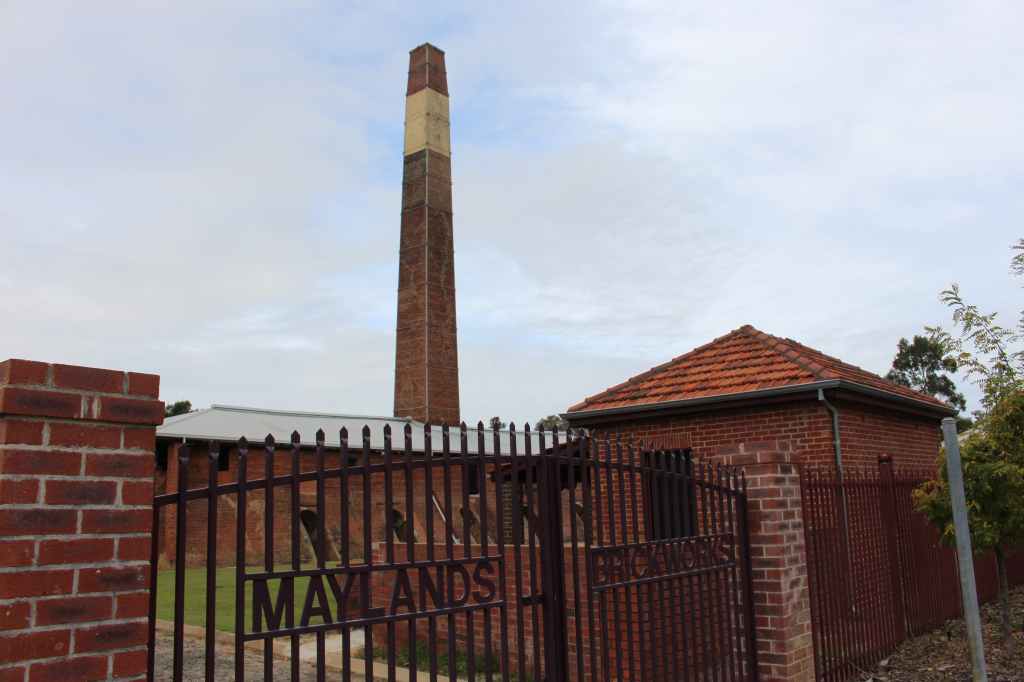
The old Maylands Brickworks, home of the venerable Hoffman kiln. Photo by City of Bayswater
STORIES, photos and names of workers and people associated with the old Maylands Brickworks are being sought for an open day on December 13.
For 23 years Maylands Brickworks has been fenced off with minimal public access, but the Friends of Maylands Brickworks have organised it to be opened up through Bayswater council.
FOMB, a group dedicated to protecting the state heritage-listed site, want to connect with workers, relatives or others who had ties to the Brickworks.
When the kilns were in full production the brickworks had more than 130 employees. Most lived close nearby, so they’re hoping they or their families will hear the call and come forward with tales and memorabilia for a display.
If you have a lead get in touch with FOMB via their Facebook page, email friendsofmaylandsbrickworks@ gmail.com or on 0439 491 585.
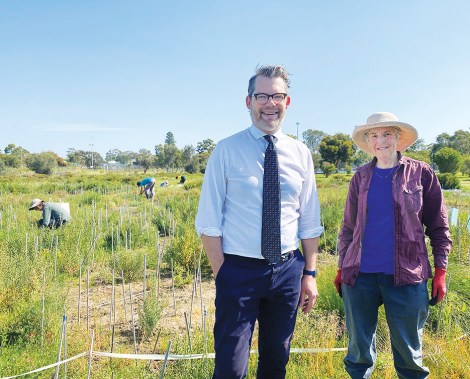
Bayswater mayor Dan Bull and Friends of Maylands Samphires’ Jo Bower.
A 10-year plan to rid the Maylands Samphire Flats of exotic weeds aims to protect its long-term future.
The salt marsh is federally listed as a threatened ecological community.
The Friends of Maylands Samphires have already been beavering away since 2012 pulling out invasive species and revegetating the riverfront with natives like samphires and saltbushes that protect the ecosystem.
Climate change
FoMS member Jo Boyer says they were pleased Bayswater council funded the 10-year management plan to further guide their work.
The plan’s part of Bayswater’s overall push to restore its 11km stretch of foreshore and prepare for any effects of climate change.
Like Berringa Park Wetlands which got its 10-year plan in August, restoring the flats is a complicated task. The 25-odd invasive species need a variety of specialised methods to remove them. Wild gladiolus has to be cautiously sprayed with herbicide because pulling it out physically spreads the cormels around and only leads to more of the stuff. Giant reed needs to be removed from upstream first, since it propagates downstream, and there’s many other peculiarities about how to tackle couch grass infestations and sour fig forests.
Along with weed removal and native propagation, a crushed limestone path will need to go in as a buffer to keep virulent lawn from encroaching on the samphires.
Ms Bower says: “Maylands Samphire Flats is a very special site with four main samphire species, and the FoMS is very pleased to have the management plan to guide future conservation work.
“The samphire plants provide food and shelter for insects and small animals which then feed a great variety of bird life. The plants are also good filters of pollutants and nutrients like phosphates and nitrates, preventing them from entering the Swan River.”
The clearing and planting will be done in six zones, with the last added a patch of grass which is usually too boggy for the city’s mowers to deal with and could provide a buffer if the river levels rise because of climate change.
Correction: Last week we said the Maylands Samphires also work at Wright Reserve, but they actually stick to the flats around Clarkson Reserve.
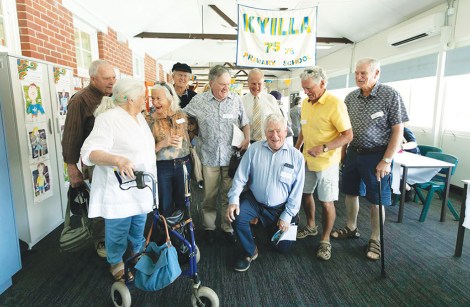
Old mates catch up at Kyilla primary’s 75th anniversary.
KYILLA Primary School has unveiled a new Whadjuk Noongar motto at its 75th anniversary open day: “Kata Djinung”.
It’s a translation of the school’s motto “To See and To Understand” which was adopted in 1988. The Whadjuk Noongar words join the boomerang that’s been a feature of the logo since 1988.
Principal Jo Hine tells us the new motto came about through the efforts of Julianne Bull, a parent of three former Kyilla students (including Bayswater mayor Dan Bull).
Back in the ‘80s Ms Bull worked with Noongar leader Ken Colbung, also known by his Aboriginal name Nundjan Djiridjarkan, to come up with the motto.
Ms Hine says back then a lot of Kyilla families were keen to use the Noongar words, but the P&C went with the English “To See and To Understand”.
Ms Bull recently spoke to the school board, which was fascinated to hear the story and the idea was revived in time for the 75th anniversary on October 24. Ms Hine says the school is continually looking to acknowledge the contribution of the Indigenous community and the motto was a good way to go about it, while also being a good teaching point for students.
THE past repeating and hidden histories of our suburbs loom large in this year’s Vincent local history awards, with tales of past pandemics and happiness found in the streets.
Along with 189 photos it was a bumper year for written entries with 22 stories and memoirs submitted for the Geoffrey Bolton award, with first place going to Ron Lindsay’s tale of his post-war youth “Feral in an Inner Suburb”.
The writing was so top notch two equal second prizes were awarded. One was for Melinda Tognini’s “Rumours”, the story of Mount Hawthorn resident, Bulwer Street baker and Gallipoli veteran Herman Kuring who went missing on Rottnest Island in 1941, sparking rumours he was a Nazi spy.
Equal-second was Noongar elder Lindsay Calyun’s
“Moorditch Footprints,” a story of growing up in East Perth in the 1960s after escaping the Roelands Mission.
Vincent mayor Emma Cole says they’re keen to learn more history from Mr Calyun. “We are very fortunate that [Mr Calyun] entered his memoir ‘Moorditch Footprints’ into the awards, giving us a different perspective of boyhood.
“Lindsay’s reflections on the close-knit Aboriginal community in East Perth are significant and his memoir shows just how close to home the experiences of the stolen generation are for many Noongar elders in Perth.”
Pandemics modern and historic also feature: doctor Jenny Fay writes about fears, anxieties and supply shortages as the medical profession wrestled with the emerging Covid-19, while Beryl Long writes of her own experience in lockdown in 1943 after coming down with diphtheria.
“Our extended family and friends stayed well away from us,” she writes.
“The word diphtheria scared them, as it scared the wider community. It was an infectious disease that we didn’t know a lot about. For weeks after my diagnosis my family at 7 Peach Street were ‘socially distanced’ whether they chose to or not and it was a difficult time for us all to endure, not just me.”
The entries are on display at the 99 Loftus Street hub or through the library’s website.
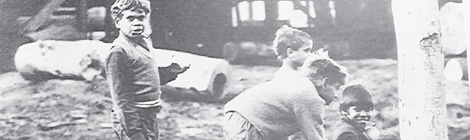
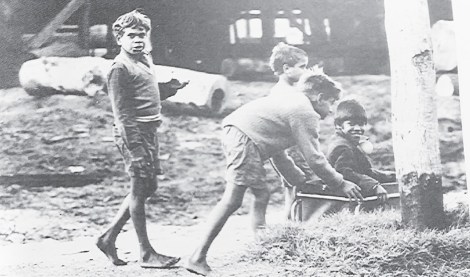
A photo of Lindsay Calyun (left) in the 1960s was used in C.F. Makin’s PhD thesis “A socio-economic anthropological survey of people of Aboriginal descent in the metropolitan region of Perth.”
Mooditch footprints
In “Mooditch Footprints,” Goomalling-born Noongar elder Lindsay Calyun writes of being taken from his parents and brought to Mount Lawley Receiving Home, before being sent to Roelands Mission. He escaped in 1968 and returned to his family in East Perth.”
It was good days when we were young growing up in East Perth. Some old people were there, no house, they slept everywhere down by the river, alongside the railway line. Even in the parks around West Perth, but they would come to East Perth to meet other old people.
“They were from the stolen generation.
“Moore River gang and Carrolup mob. My father was taken away from his mother, he was in Moore River. My mother was taken too, she was in Carrolup and Moore River but they didn’t talk about that.”
“The police drove everywhere in the East Perth and West Perth area looking for Noongars. Black fella’s young and old, they didn’t care.
“Black fella’s they chased them around like kangaroos and rabbits and at night time they would drive around spotlighting for Noongar people and drive pass the street where you live and shine the spotlight onto your house. Every night in East Perth, on the park, like we were kangaroos, or animals.”
Surviving the pandemic
In “Surviving General Practice in 2020,” doctor Jenny Fay from Fitzgerald Medical Practice writes about the early days of the coronavirus pandemic as personal protective equipment runs low, most visits are replaced by phone calls, and her email inbox is flooded with advice and updates from a numerous organisations and departments.
My friends know it is hard for us in general practice. I had two friends that offered to make me cloth masks. I would never normally think these adequate, but since we were very short of personal protective equipment, I accepted gratefully.
In March, we don’t have more than a dozen gowns and are short on alcohol gel. We order a dispenser (even by August, it hasn’t arrived).”
“On one day, I’m so pleased to find a patient of mine having a blood test. I’ve known her for years. I know she has cancer. We sit and talk, and she too is pleased to see someone face to face. Two weeks later and we have a phone consultation as she is now terminal. I try and convince her it is ok to let her family in to visit, but she won‚Äôt have it.
“Her family feel they are a risk to her. I try to say that this time is important, and short. Another two weeks later and I’m completing her certificates, those that mark her passing. Her funeral takes place with only 8 family members plus celebrant and funeral attendant, as those are the rules now. This, for a long life well lived, and for a person so greatly loved. We hear many tales of sorrow like this. It’s gruelling and very sad.”
Rumours
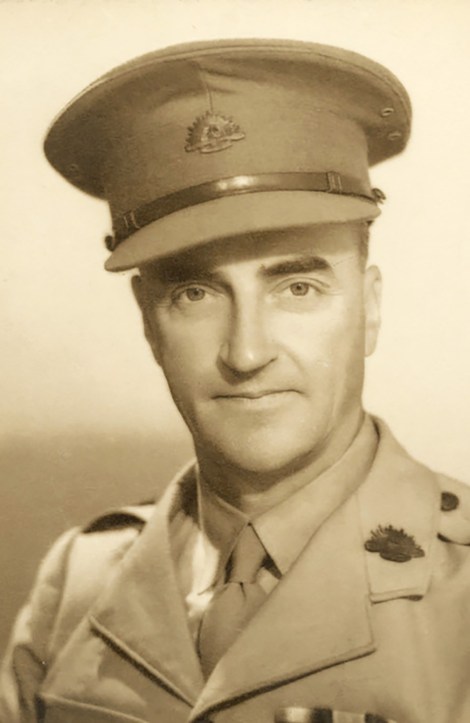
Herman Kuring, who disappeared while on Rottnest. Only his hat was found.
From Melinda Tognini’s “Rumours,” the story of Great War veteran Herman Kuring, who disappeared at Rottnest and was then subject of false rumours about him being a Nazi spy picked up by a German vessel, maybe even the Kormoran:
The Western Australian public may have been unaware that Herman had been one of the first to sign up, just a fortnight after war was declared.
“He survived the Gallipoli landing on 25 April 1915 but
‘stopped one in the shoulder’ two days later. After spending several days on a hospital ship, he returned to the front, where he was wounded again.
“Again he recovered, just in time to take part in the Battle of Lone Pine.
“Following the Australian evacuation of Gallipoli, Herman found himself on the Western Front.
“Despite being wounded a third time, he was still fighting when the Australians helped reclaim Villers Bretonneux in April 1918.
“He returned from the First World War, aged twenty-three, as the youngest major in the AIF… none of that seemed to matter among Perth gossip mongers.”
“On Wednesday 3 September 1941 – exactly two years after Prime Minster John Curtin had declared that Australia was again at war – tragedy struck.
Herman was last seen at Wilson’s Bay …the only clue to Herman’s whereabouts was his hat, which was discovered floating in the water at the foot of the cliff.”
I’VE been meaning to try Goreng Goreng in Mt Lawley for a while, but every time I pass by the tiny eatery is packed to the gunnels.
On Tuesday night I went there with the family a bit earlier and managed to secure a table for four by the window.
The eatery is situated on Walcott Street, opposite the Astor Theatre and near the old offices of former MP Michael Sutherland, who presided over Mt Lawley like a modern day Nero.
Goreng Goreng is a casual, no-frills place with utilitarian furniture and a menu printed on the wall.
But there was a large funky mural adding a splash of colour, and it felt bright and modern.
The menu a nice range of noodle and rice dishes including lemongrass prawn, udon laksa, honey pepper beef and of course mee goreng.
There was also a small number of entree dishes, and you could order bespoke noodle and rice combos.
The prices were very reasonable and for our family of four the total including drinks was $62.
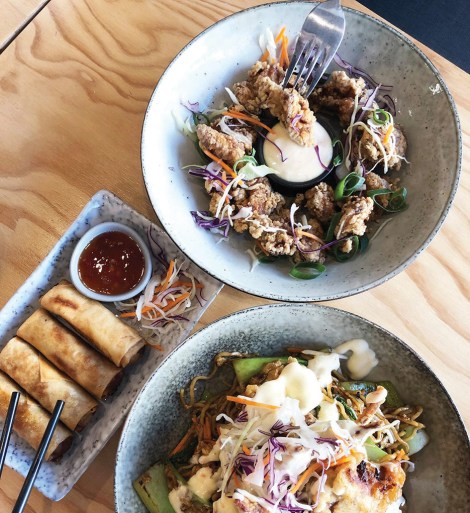
On a cold stormy night, my red curry chicken ($13.90) was just the ticket.
It had that delicious depth of flavour synonymous with slow-cooked food, and the soft carrots, green beans and succulent chicken melted in the mouth.
The star of the dish was the rich moreish sauce, which had a slightly sweet reprise.
Perhaps the curry could have been a bit spicier, but that was my only quibble.
Across the table my wife was enjoying her Asian BBQ beef
($14.90), with the sticky glaze glistening under the restaurant lights.
“The beef is lovely and tender and the veggies aren’t overdone,” she said.
“The glaze is delicious and the slices of beef and veggies are just the right size to negotiate with chopsticks. Maybe the sauce could have more of a kick, but it’s very tasty.”
Although Goreng Goreng was tiny, the huge floor-to-ceiling windows created the illusion of space, and I enjoyed the art deco lampposts silhouetted against the Astor Theatre across the road.
For a brief moment I pictured Mr Sutherland striding about in his pomp, barking lunch orders down the phone to quivering interns.
There was a steady stream of people coming in to Goreng Goreng for takeaway, while couples and families enjoyed a sit-in meal with some BYO.
The chefs were busy beavering away in the open kitchen and the place had a lively, inner-city vibe.
The service was good throughout with the pleasant lady at the till asking the chef to do a no-sauce chicken and vegetable noodle ($13.90) for the kids, which went down a storm.
The vegetables including bok choy, cauliflower and carrot were all super fresh and it was a fragrant and healthy dish.
We shared some spring rolls (four for $5.50) which were piping hot and had a satisfying crunch, but the vegetable filling didn’t reach the height of the mains.
Goreng Goreng surpassed my expectations and sells delicious, super fresh food at amazing prices.
Just get there early if you want a seat.
by STEPHEN POLLOCK
Goreng Goreng 75 Walcott Street, Mount Lawley 9328 2811
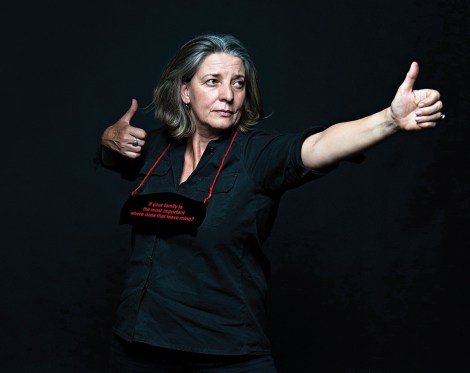
PERTH artist Olga Cironis gives a voice to the “other” Australians in her poignant new sound installation Forest of Voices.
For the exhibition, Cironis recorded intimate stories of love and loss from people in diverse communities across Australia, amassing 64 hours of recordings.
She merged them into an immersive and slightly lyrical collage, in which you are not sure where one moving story ends and another begins.
“Forest of Voices included people from diverse backgrounds with their different personal stories,”Cironis says.
“These narratives were anonymous and thus, because love or the desire to belong is familiar to us all, the social and cultural spaces between us became the familiar link that bound us together.
“My art practise centres around exploring the impact that history and memory have on personal and shared identity.
“This installation is a timely reflection on shared vulnerability and the possibilities contained in social acts. Reflecting our environmental emergency and covid-19 that has changed how we are in the world.”
Forest of Voices is situated on the first floor gallery of the Perth Institute of Contemporary Arts, where tiny speakers dangling from the roof softly bombard visitors with “whisperings of desires, love, pain, loss and fear…a delicate chorus of voices, a sound that from a distance is similar to the wind through branches.”
Cironis says editing the recordings was technically challenging, but she’s happy with the end result, describing the installation space as a “quiet place of contemplation”.
“I experimented with different editing processes and very carefully extracted fragments of the recorded stories to create a slow meandering human sound moving through the space overlapping the sound of the elements and breathing. At one point it was a cacophony of voices, but we pared it right down to a quiet place of contemplation with the soft sounds of natural landscape.”
Forest of Voices is at PICA until January 10, and will be on show alongside Refracted Reality in the ground floor gallery and SMASH IT in the screen space.
Featuring the work of ten artists and collectives, Refracted Reality includes painting, photography, video and sculpture.
Touching on a wide rangeof topical issues from personal sovereignty to environmental upheaval, curator Anna Louise Richardson says the exhibition is a medium through which ideas pass and bend, and are eventually cast into dramatic relief.
SMASH IT by Brook Andrew, an Wiradjuri interdisciplinary artist, gets its title from his push to subvert colonial archives and question the established narratives of the past.
Andrew’s intense and powerful short film includes footage and archival materials from his private collection, and the Smithsonian Institute in Washington DC.
For more info about all the exhibitions go to pica.org.au
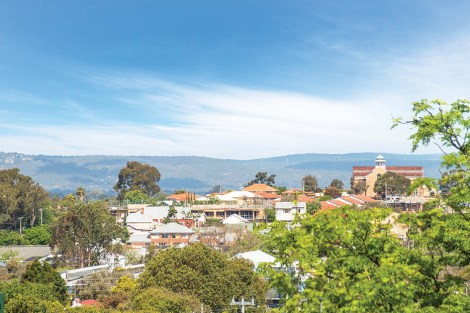
SITUATED on an elevated block in a corner position, the pièce de résistance of this Maylands house is the glorious views of the Perth Hills and beyond.
Sit on the balcony at night with a glass of vino and enjoy looking over the trees and rooftops at this glorious vista, which includes a church with a charming belfry in the distance.
You can enjoy the panorama from countless different rooms and it really is a great selling point.
But there’s more than a great view to this four bedroom two bathroom house; it’s a great family abode with lots of scope for entertaining.
The open plan dining and kitchen area is bright and airy with a tiled floor and neutral colour scheme.
I like the kitchen which has got some dramatic flair thanks to a bright red splash black that contrasts with the sleek white cupboards and drawers.
It’s a great entertaining area with loads of bench space to prep food, and has lots of room to mingle with friends and family.
After dinner head outside to the enormous spa, which has nice wood panelling and room for just about half the street.
It’s another flamboyant touch that seperate this house from others in its price bracket.
There’s also an undercover alfresco out here, a small lawn and some lovely shrubs and plants, including lemon and lime trees.
All four bedrooms are well appointed with the main, located upstairs, including a walk-in robe, a balcony and a bathroom with a freestanding bath.
The home includes a double garage, and has a contemporary facade with a small driveway for visiting guests.
Situated on Crawford Road on the Maylands/Inglewood border, this home is close to all the delights of Beaufort Street including The Inglewood Night Markets, and is near to Inglewood Primary School and the local Coles.
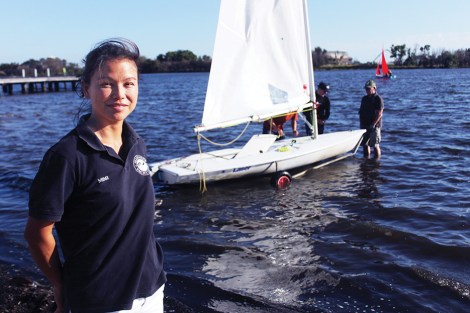
Maylands Yacht Club president Mimi Secco. Photo by David Bell.
A NEW plan to let waterskiers and jet skis into more of the Swan River has led to a flow of concerns for sensitive shorelines being eroded and hoons encroaching onto quiet yachting waters.
The WA Department of Transport is currently testing the waters on redrawn boundaries that’d extend the Belmont water ski area 100m upstream and 145m downstream,with the latter eating into the area currently used by Maylands Yacht Club.
Club president Mimi Secco says “we gave up quite a lot of space to the water skiers about a decade ago” to keep the peace and they’re reluctant to cede more water. The new water ski zone engulfs one of their racing markers, and because they come in pairs that’d mean two have to move.
“It’d shorten our course and there’s no compensation at the other end.” The other end is marked by Windan Bridge and they can’t hold races under that.
The club’s already facing an uncertain future because of multiple large apartment blocks going up on Belmont Park opposite them, with 4,500 new apartments across several towers. A new public jetty on that side of the shore is also proposed.
“That development could create an existential crisis for the club,” Ms Secco says. “That’s going to have a massive impact on the wind, we’re going to have to adapt and do whatever it takes.”
The club’s been hostto state titles but it could be trickier to attract them with the shortened course and unpredictable changes to the wind from the apartments.
“Having less water to work with makes it even harder for the club to survive,” Ms Secco says.
From the other direction, the changes would also allow jet skis into the yachting part of the river. Jet skis are currently forbidden from going upstream of Windan Bridge.
Sometimes a rogue jet skier ignores that rule and hoons through anyway, disrupting a quiet day’s sailing with froth and wake. The jet skiers will still have to stick to the regular river speed limit (5 knots, or 8 knots in the yachting zone) but even as it stands policing is rare.
Letting jet skis access more of the river has also prompted environmental concerns from the wake’s potential to erode the shore.
Friends of Maylands Samphires takes care of the riverfront around Clarkson Reserve, removing invasive species to let the native samphires and saltbushes regrow (the salt-tolerant plants filter out pollutants and are habitat for birds).
FoMS member JoBower says letting jet skis upstream “would have significant impact on the fragile riverside ecology and disturb the quiet recreation pleasures of thousands of residents and visitors to riverside parks.
“The proposal would undermine the significant riverside conservation work along the river by councils and local Friends groups over many years.
“In Maylands… there is an area of saltmarsh which is classified as a ‘threatened ecological community’ and is an important bird breeding site.”
The proposal would run for a two-year trial and the DoT runs these river-use reviews every four or five years. The DoT says the expanded boundary aims “to improve safety of water ski activities”.
Consultation is via mysaytransport.wa.gov.au (Swan River upper reaches aquatic review) and has been extended to November 13.
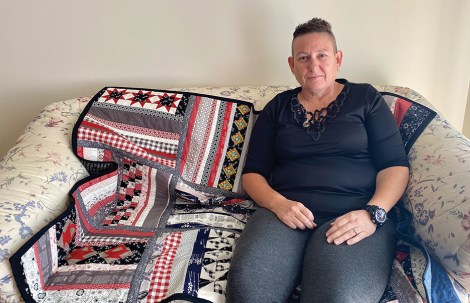
• Priscilla Harris finds comfort in her new quilt in her new home.
A CHANCE encounter between a quiltmaker and her next-door neighbour has led to a simple gesture bringing comfort to formerly homeless women.
Quiltmaker Bev recently bumped into her neighbour Mel Ashton, who chairs homeless services organisation St Bart’s. Bev’s been quiltmaking for 20 years and donates them to anyone she knows who needs cheering up, and offered three of her one-of-a-kind handmade quilts to St Bart’s.
“I had a few spare quilts at home and really wanted to do something to help the women at St Bart’s feel comfortable as they move on to living independently,” Bev said.
Her quiltmaking group got on board and another six handmade quilts went to women staying at St Bart’s Women’s Service in East Perth, a transitional housing facility accommodating up to 20 women.
One of the giftees was Priscilla Harris who was at SBWS to recover after rehab. She’s recently moved into her own home.
“I just love the quilt, it matches perfectly in my new home,” she said.
PERTH’S new councilwill undergo transgender awareness training following lord mayor Basil Zempilas’s major on-air gaffe.
Mr Zempilas has made several apologies over insensitive comments he made on his October 28 radio show which prompted thousandsof petitioners to call for all Pride events to be moved to neighbouring Vincent.
Mr Zempilas opened the November 3 council meeting with another apology: “I am sorry for what I said. I realise the pain those comments have caused”.
He said he’d met with several members of the LGBTIQ+ community including PrideWA to personally apologise, and had said sorry to city staff and councillors.
Gender identity quickly entered the practical realm at the meeting as the councillors discussed funding for a homeless womens’ shelter.
David Goncalves, East Perth local and past president of Rainbow Labor, attended public question time and asked if councillors “support the use of this shelter by trans women, who face higher rates of discrimination and are statistically at a higher rate of needing to access life-saving refuge and crisis shelters”.
Mr Zempilas replied: “The city recognises that members of the LGBTIQ+ community continue to experience discrimination and may not receive equitable access to the support services they require. It is our job to improve that situation.”
He referred the query
to the council’s community development general manager Anne Banks-McCallister who said “any individual who does identify as a woman absolutely is entitled to access the safe space for women”.
Mr Zempilas said the work on the new code of conduct starts this month and he had another meeting planned with LGBTIQ+ leaders this weekend.
He said his family had “had to go through a difficult time… because of what I did and what I said”.