THE Perth International Jazz Festival will go ahead in November, though it’ll be slightly less international than most years.
Festival director Mace Francis said planning had been a wild ride, but “it’s with great pleasure and, honestly, sheer delight that we’re able to present the 2020 PIJF.
“There has been a lot of changes that have had to happen, but at our core we want to give you a weekend of the very best jazz that we can.
“Come and take a risk with us to see as much music as you can, experience new delights, reacquaint yourself with old favourites and just have the best time. This festival is for you and we look forward to seeing you there, from a safe distance.”
Along with solid local acts there’s a few internationals including expats Linda May Han Oh and Tai Cohen, who’ve returned to Perth to escape the US’s small Covid problem.
A free night launches the festival at the State Theatre courtyard on Friday November 6. Other events are spread across the weekend including a jazz picnic in the park, a jazz dinner, a 1920s style Cotton Club Dance Party, and dozens of jazzy acts. Tickets are available for the shows across that weekend via moshtix.
PARKING permits will soon go digital in Vincent, but some residents are unhappy about a lack of consultation.
Three readers have contacted the Voice with various concerns about the new system, which sees residents create an account where they can lodge their rego number as well as those of guests.
Rangers will use number plate scanners to automatically figure out who’s allowed ‚Äì and who cops a fine.
Council staff reckon it solves the problem of permits being lost, stolen, falling off the dash or disappearing with a visitor, and there’s no waiting period while a paper one gets printed and posted.
But Highgate’s Gordon Lee told the Voice people without computers or the internet would be unable to join the online system.
North Perth’s John Matthews said he couldn’t see it fixing the current system’s problems of low-priority streets rarely being patrolled, or the leniency shown to bad parkers.
This week another reader said that without permits on dashboards, residents couldn’t tell if their streets were clogged with illegal parkers. She hada dozen other questions about how it would operate and says the council should have consulted.
The change wasn’t run past councillors, with Vincent’s admin viewing it as a simple technology switch they had the delegated authority to implement.
Vincent mayor Emma Cole believes elected members should have been alerted to the pros and cons, and given the chance to decide if it had to go out for community consultation; almost all changes that go in front of council get advertised unless they’re extremely minor or technical.
Communication
Instead, some councillors only learned of the new system when letters went out to existing permit holders and some started arcing up.
Ms Cole says the new system will be better, but; “I really think we could have done a much better job on communication with that, and that’s something I’ve raised with the CEO”.
As a result of the complaints, paper permits will remainfor people who can’t access the e-permit system through disability or lack of internet access.
Ms Cole says a new letter will be going out in the next couple of weeks properly explaining the e-permit system and she says it does have a lot of benefits.
Rangers will be able to hit more streets since they can sweep an area just by driving through rather than scrutinising permits on foot, and visitor passes can be instantly added from a computer or phone so you can give a tradie a visitor pass if they stop by while you’re not home.
“When you look at thebenefits, I think they do outweigh the existing permit system,” Ms Cole says.
There’s been a coupleof instances where Vincent council’s not been kept in the loop by Vincent staff recently, like the state government’s long term cycle plan which councillors became aware of two years after staff first heard of it.
Ms Cole says councillorshave again requested the administration complete a
“Community Engagement Framework,” a year-overdue policy that’d make it clear what has to go out for community consultation.
“A community engagement framework’s something that council has been seeking for some time,” Ms Cole says, adding “we wouldn’t have these situations” if it was in place.
PLANS are afoot to extend the waterski area on the Swan River along more of the delicate Maylands Peninsula foreshore.
The Department of Transport is currently accepting public comment on plans to extend the allowable waterski area 100 metres upstream and 145 metres downstream.
It’s called the “Belmont water ski area” but encompasses a significant chunk of the Maylands peninsula, and the changes increase their area by about a third and encroach on the special 8-knot restricted area used by Maylands Yacht Club.
They’re also testing the waters of public opinion on a plan to let jetskis go upstream of Windan Bridge for a two-year trial, but sticking to the existing 5-knot speed limit.
Submissions can be made via mysaytransport.wa.gov.au and have to be in by October 30.
A CYCLIST died after beinghit by a bus on Beaufort Street this week, just months after motorcycles were bannedfrom the bus lane due to safety concerns.
On October 6 at 4.10pm, a route 60 bus travelling north on Beaufort Street turned left onto Newcastle Street, hitting a cyclist who was going north on Beaufort. The tight turn was introduced to route 60 this year; previously the bus made the left further up at Brisbane Street where there’s more clearance.
The cyclist, a 54-year-old man, died at the scene with an onlooker holding his hand.
The intersection doesn’t havea green-shaded head start box for cyclists, just a “keep clear” zone to give buses extra space to navigate the tight corner.
Bike rider and pedestrian advocate Andrew Main has long held concerns about bikes sharing busy streets with vehicles. He says while it’s not yet clear what happened, in many cases a bike head-start zone, such as those being rolled out by Fremantle council, could prevent this kind of collision.
“I think they should be compulsory on any route that’s identified as a bike route, that’s definitely something that needs to be common practice.
“We also need to look at the bus routes. If they’ve got a route where they have to swing out and turn in, that’s a design failure, and maybe they need to look at route selection.”
Until recently both bicycles and motorbikes were allowed in bus lanes on Beaufort, Fitzgerald Street and a few others. In June the Public Transport Authority announced motorcyclists would no longer be permitted in the bus lanes.
The PTA’s report said visibility was a concern: “Motorcyclists present a relatively small visibility profile compared to buses.”
The report said bikes in bus lanes “is a much debated topic between transport planners and engineers” and it acknowledged “cyclists have an even smaller profile than motorcyclists,” but didn’t propose prohibiting cyclists from bus lanes.
Mr Main says in general having cyclists in bus lanes is “not reallya solution” to unsafe streets and a lack of bike infrastructure. He avoids them and says they’re generally only used by a small number of the more confident cyclists.
Former City of Perth councillor Reece Harley has been growing increasingly concerned about the safety around bus lanes over the past few years.
A candidate for the October 17 election, he says “the new council of the City of Perth needs to undertake an urgent review of the adequacy of city cycling infrastructure.
“We should also be liaising closely with the PTA on the safety of bus routes throughout the City, and looking especially at the interaction of buses, pedestrians, cyclists and other traffic at intersections.”
“The number 60 bus route used to head east on Brisbane Street and was recently re-directed to Newcastle Street, turning left at a much busier intersection and heading through a much busier part of the city which gets gridlocked most mornings and afternoons.”
PERTH Bike Hub have surveyed the City of Perth election candidates to find out who knows what bike riders need, and PHB’s Heinrich Benz says they’re pretty encouraged by the responses.
“This survey is about much more than bikes: Our survey questions were firmly focused on public space and offered candidates a way to share their vision for our city,” Mr Benz says.
Most of the 31 candidates and all seven mayoral candidates responded to the survey by PHB, a volunteer run-group promoting safer streets.
“We’re encouraged by the responses we’ve received to our survey. Most candidates recognised that the status quo for walking, cycling and e-scooters in central Perth isn’t good enough, and are supportive of improvements to make our streets safer for active transport.
“We were also pleased that most candidates seemed to understand that funnelling more car traffic onto our streets isn’t good for the long term economic success, sustainability and liveability of our city.”
PHB is not formally endorsing any candidates, but candidate responses and PHB’s very frank and forthright reviews of their stances is at bicycleperth.blogspot.com
THREE Bayswater councillors have lodged protest votes against an ancient policy exempting churches and charities from paying rates, with one saying “everyone should pay their fair share”.
The council’s policy is based on a state law which declares land isn’t rateable if it’s used exclusively for charity or worship-related activities.
Recently the Chin Emmanuel Church in Embleton and Maylands-based charity Communicare both applied for a rates exemption under that policy.
At the September 22 council meeting councillor Michelle Sutherland requested the items be brought up for discussion so she could vote against them. Cr Catherine Ehrhardt and Steven Ostaszewskyj likewise lodged no votes, with Cr Ostaszewskyj explaining simply: “I just think everyone should pay their fair share.”
Cr Sally Palmer said it was clear the organisations qualified under the policy, and the majority of councillors agreed. The church saves $4,488, Communicare saves $1,830.
Communicare is a men’s domestic violence counselling and accommodation service. Residents do pay to stay at the facility, making up about 30 per cent of its yearly revenue. But it doesn’t cover the full cost of services and the council report says it is classed as a charity under the four-century old “Charitable Uses Act of 1601” passed by the Tudor-era British parliament.
A third group, Potters House Christian Centre based in Morley, also sought exemption on its $18,874 rates bill.
The council said no, “because the property is not used as a place of public worship.
“The actual use of this land is predominantly for weekly theatre, live music and live testimonials,” which wasn’t considered a benefit to the broader community.
FEDERAL Perth Labor MP Patrick Gorman has reviewed treasurer Josh Frydenberg’s budget and dubbed it “mean”
“It leaves too many people out,” Mr Gorman said.
“If you’re over 35, you’re going to find it really hard to find a job under this budget,” he told us via phone from Canberra. “If you’re on Jobseeker, you’ll find that paying the bills next year is going to be really difficult.”
Businesses are getting $4 billion of subsidies to hire unemployed people under 35, while Jobseeker’s going back to the $40 a day rate; Mr Gorman says that’ll be a blow to businesses relying on the extra spending the bumped up payment had sparked.
Schools and sports clubs will lose out as the Local School Community Fund and the Community Sport Infrastructure Grants (aka the Sports Rorts) are also gone.
“While debt is the biggest it’s ever been, there’s been these cuts and abolitions to programs like the schools fund that used to help pay for playgrounds, air-conditioning… I thought that was quite a mean cut.”
Last year grants helped Bayswater Primary School get an enclosed assembly area to shelter students, Sir David Brand School in Coolbinia a sensory playground, and Maylands Peninsula Primary School to expand its overly-busy playground.
COMO The Treasury’s suite shows why guests have voted it tops – four times.
FOR the fourth time Perth’s COMO The Treasury has been voted best hotel in the Australian Pacific region by readers of travel publication Condé Nast Traveler.
Designed by Kerry Hill, it’s the centrepiece of the 2015 project to restore iconic state buildings in the Cathedral Avenue hub.
The hotel narrowly narrowly beat out New Zealand’s QT Wellington for the top spot, and was the only WA hotel to make the top 10 list.
COMO group PR director Chris Orlikowski says: “Though this has been a turbulent year for the industry, readers’ votes carry even greater weight than usual, because they show what matters most at a time when people aren’t able to travel the way they’d like to.
“The global COMO teams look forward to welcoming travellers back to our destinations.”
SEXIST corporations won’t get Vincent council’s business under a proposed policy.
The council’s draft purchasing policy is based on the Commonwealth’s practice of eschewing goods or services from large companies that don’t comply with the Workplace Gender Equality Act.
The Act requires companies with more than 100 employees to submit a report to the WGE Agency showing employee gender breakdown, wages, and what policies they have to improve equality.
Non-compliant companies aren’t necessarily sausage factories; refusing to report, lying on the report, or not having policies to address sexual harassment/paying genders equally can earn a spot on the government’s naughty list.
Dome Cafes Australia and the trustee that owns Pan Pacific Perth are on the 120-strong list.
On the flip side, the council will aim to buy more from Aboriginal-owned and disability enterprises – if practical and value for money.
“Buy local” and buying from environmentally-friendly companies is also encouraged.
Mayor Emma Cole says “with all of our policies, we’re trying to embed the community priorities from our strategic community plan,so we’re looking at things like life cycle costs, sustainability ratings, workplace gender equality, and at the same time it has to be balanced against value for money.
“We have our Reconciliation Action Plan where we talk about supporting Aboriginal businesses, and we really need to put that into place with our purchasing policy, we need to follow through and demonstrate that we’re doing that.”
The policy’s up for comment via imagine.vincent. wa.gov.au until October 26 at 9am.
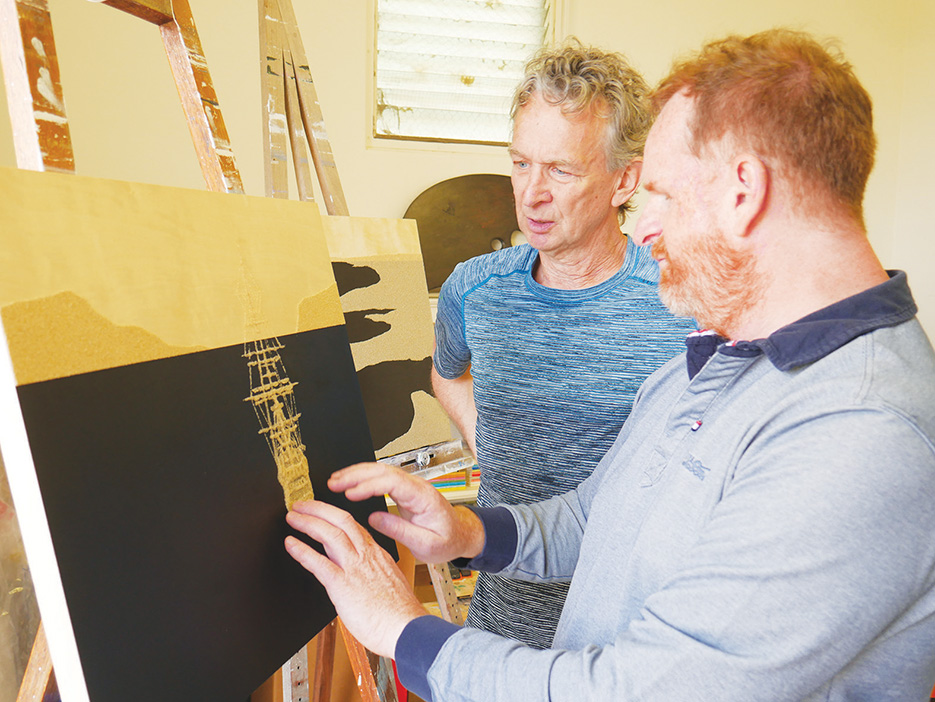
Artist Nigel Laxton and Ryan Honschooten, who’s experience a painting by touch for the first time.
WHILE most galleries sternly warn patrons “Pease do not touch the art”, newly opened Kamilė Gallery is tossing that aside this weekend with a tactile session for blind and low-vision people.
Optic nerve cancer robbed Ryan Honschooten of his sight as a toddler, and while he’s previously explored sculptures through touch, he says Mt Hawthorn artist Nigel Laxton’s textured paintings took his art experience to a new level.
“I really want to spend forever just looking at it,” Mr Honschooten tells us.
Sand
Laxton was planning his exhibition Aggregate as a series of ambiguous works exploring the materiality of sand, and says the idea morphed when gallery owner Kamilė Burinskaitė expressed an interest in making the gallery fully accessible.
“An inclusive gallery is not just about having wheelchair access. I want to display artwork and exhibits which you can run your hands over and get a better understanding of textures,” Ms Burinskaitė said.
“I saw Nigel’s paintings and knew that they would appeal to a wider audience.”
Laxton’s existing pieces layered sand and other material with paint, so the colour detail would’ve been missed by blind people. He created three new works conveying that detail through touch, by varying the texture and density of the layered sand.
They were based on one of his exhibition pieces depicting Captain Cook’s arrival in Australia, with its dark shading marking the ambiguity of the event as a historic moment but a black day for Aboriginal people.
For most of his life, Laxtonwas a materials scientist, inventor and engineer, and the material he used held significance and also embodied the works’ ambiguity.
He’s had his studio at Point Heathcote (Goolagatup) for five years and says it’s both a significant Aboriginal site “and it’s also where Captain Stirling came down the Swan River when he was looking for where to settle Perth”.
He went down to the Heathcote beach and sought fine sand, a mixture of quartz, calcarenite, and wind-blown shell fragments dating back to the ice age.
“To some people it is sand, but to me it is a little bit more,” he says.
An artist’s talk and tactile tour on October 10 has been organised for blind and low-vision people through disability services provider VisAbility, where Mr Honschooten works as a youth officer. It’s been lined up on the weekend ahead of October 15’s White Cane Day, a symbol of independence.
Mr Honschooten has a background in sailing, including a three-month voyage on a square-rigged ship and says he especially enjoyed how Laxton recreated the rigging in his painting.
“He’s used really fine [sand] for the rigging, and there’s thicker sand where the rails are, and even thicker for the hull… it’s not just a flat piece of work, it’s got all these levels to it.”
Mr Honschooten says it’s a significant moment because he’s able to properly appreciate a painting first-hand: “If there’s a painting on the wall, I can’t get it, I can’t see it… if I go to an art gallery with you or anybody else and you have to describe to me what you’re seeing in the painting, I’m not getting what I’m seeing, I’m getting how you interpret it. That’s what art’s all about, how people interpret things.”
Canvas
He says blind people areas varied as everyone else: He pictures in his head what he’s feeling on the canvas, but others might conceptualise it differently at the upcoming tactile tour.
“I can’t wait to see what peoples’ reaction is,” he says.
While the artist’s talk and tactile tour is a one-off, the full lineup of works for Aggregate runs until October 30 at Kamilė Gallery at 3 Pier Street, and Ms Burinskaitė plans to hold more accessibility-focussed shows in the future.