
• Having a ball

    Pinchos is Perth’s happy place. 

    A few Sundays back we were lured to the Spanish tapas bar by its jovial clientele, who were sharing delectable dishes in the alfresco.

    We quickly waved down a waiter so we could join in the fun.

    The staff are just as cheery and attentive as the diners. 

    Despite the place being packed, we were shown to a table outside and served quickly.

    We were off to a great start, made even better by the quick service – Our seven plates were whisked to our table in less than five minutes.

    It may sound like a lot for two people, but everything here is designed to share so you can enjoy an ample selection of Spanish favourites without overdoing it.

    Every time I visit Pinchos I order the pork belly ($14.95). It’s to die for. 

    The belly is fried to crispy perfection then cubed and plated with a generous coating of dukka to add extra crunch and texture. 

    A splash of lemon juice added an acidic dimension and cut through the delicious fat.

    There are three types of croquettes ($9.90) available on the menu including potato and salt cod, and chicken and ham. My favourite is the mushroom, leek and manchego – a Spanish cheese made from sheep’s milk. 

    The filling was creamy, earthy and punchy thanks to the tasty mushrooms and luscious cheese filling. The leek added bite and the garlic aioli brought it all together.

    A small bite of chorizo with honey and goats cheese ($2) was a sweet accompaniment to our rocket, pine nut, pear, goats cheese and orange salad ($11.50).

    More substantial dishes can be found on the Bigger Plates menu and we didn’t regret ordering the beef cheeks ($27).

    The meat is slow cooked and fell apart with the slightest touch of my fork. The cheeks were served on a bed of very creamy caulifl ower puree and swim-ming in a rich port sauce. 

    This is a simple dish, but it packed some serious flavour. Kudos to the kitchen. 

    There’s always going to be a weakest link when you order so much food, and in our case it was the saffron labne served with flatbread ($9.90). 

    Saffron can be an acquired taste when other flavours aren’t used to mask it. In this case it added a bitter and metallic flavour to the labne. 

    Despite the disappointment, the toasted flatbread went well with the grapes, beetroot, pickles and dukka, also served as part of the dish. 

    Located on the traffic-heavy Oxford Street, Pinchos isn’t always the most peaceful place to dine, but the chaotic surroundings add to the bustling atmosphere of this incredible foodie hotspot.

    Pinchos is the perfect spot to soak up some sun, laugh with friends and enjoy some of the best food Perth has to offer.

    Pinchos
    112-124 Oxford Street, Leederville

    http://www.pinchos.me 9228 3008

  • Historic dub
    • Bruce Lee in Fist of Fury.

    The Bruce Lee classic Fist of Fury is to be the first ever film dubbed into Noongar and will premier at next year’s Perth Festival.

    The makers of Fist of Fury Noongar Daa have already begun recruiting local voice actors to dub the Cantonese-Mandarin from the 1972 original, which made Lee an international star and was released a few years after Indigenous people were recognised as citizens of their own country.

    Sadly Lee died aged 32 a year after Fist of Fury, but his explosive career changed the way Asians were represented in American films, and he became a hero for Asian-Americans, Afro-Americans, and the Noongar and wider indigenous community. 

    “Bruce Lee perfected kung fu and mastered life,” says Fist of Fury Noongar Daa adaptor Kylie Bracknell.

    “He was a moorditj (solid) philosopher who led by example. 

    “Why not link the most prominent non-white film star – much more than an actor – of the 1970s with Noongar language?

    “He’s a legend, a credit to the human race, and our people respect his journey, his art and his legacy.”

    Throughout his short life, Lee stood up against injustice and racism off and on the screen.

    Unlike other kung fu films of the time, Fist of Fury touched on historical and social issues like Japanese colonialism and imperialism.

    Fist of Fury has so many parallels to our Noongar way of life,” Bracknell says.

    “The struggle aspect of colonisation was an obvious contributing factor but it wasn’t the sole reason for this Lee film selection.

    Fist of Fury honours the language of the body and the film isn’t dialogue heavy, it allows one to ‘read between the lines’ so to speak.

    “Other relatable aspects include the significant burial ceremony at the beginning, the varied perspectives of grief and ‘pay-back’, Chen’s (the Lee character) dignified self-sacrifice quest in search for justice, paying homage to a loved and revered teacher, the modest love between Lee and his on screen fiancé, and the grounding Chen’s people have in philosophy and the land they exist on.”

    Bracknell and Perth Festival film programmer Tom Vincent came up with the idea for Fist of Fury Noongar Daa after being inspired by Navajo Star Wars, a 2013 Navajo-dubbed release of Star Wars Episode IV: A New Hope. “We thought ‘what if we tried something similar with Noongar’,” Bracknell says.

    “This is an opportunity to further contribute to the survival and strength of Noongar as a living language.” 

    The production of Fist of Fury Noongar Daa will employ about 40 locals, mostly from the Noongar community, but Bracknell was keeping tight-lipped on who would be the voice of Bruce Lee: “We can’t announce any casting news yet as we’re still in negotiation.”

    Bracknell, who directed Perth Festival’s 2020 landmark play Hecate, the Noongar version of Macbeth, says Fist of Fury Noongar Daa will be challenging.

    “The dubbing task for us will be far more difficult in some respects considering only two percent of the entire Noongar population speak their mother tongue,” she says.

    “This is very much a language reclamation journey nestled inside an Australian first dub.”

    Fist of Fury Noongar Daa, with English subtitles, will screen at Lotterywest Films at the iconic UWA Somerville outdoor cinema in February. 

    For more details go to perthfestival.com.au

    by STEPHEN POLLOCK

  • Airy abode  

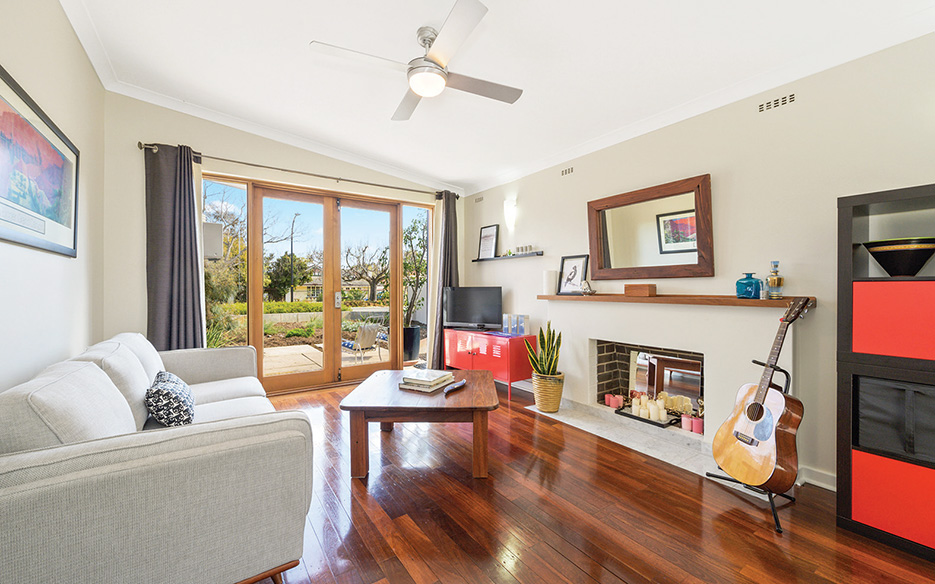
    As you walk through this Menora home you can’t help but notice the gorgeous natural light.

    It’s all down to a clever renovation that maximises the northerly orientation with floor-to-ceiling windows and sliding glass doors.

    It really does open things up and makes this three bedroom two bathroom abode feel extremely bright and airy.

    The open plan living/dining/kitchen area is massive and has a neutral colour scheme and contemporary ceiling fans.

    The renovated kitchen is sleek and modern with matching white cupboards and ceiling benches, making it a great spot to whip up dinner for family and friends.

    There’s also a wide island bench, which is used as a breakfast bar.

    At the front of the house is a study, but it would make a perfect home office for those still affected by covid-19.

    It has lovely views of the front garden and you can peek out the window during a Zoom call to your boss. Alternatively the study could be utilised as a fourth bedroom.

    After the working day is over, slide back the glass doors and head out to the large backyard, which has a sheltered alfresco and loads of attractive greenery including grape vines and orange, lemon, olive and quandong trees.

    There’s plenty of room to put in a lounge setting and pizza oven, and the bamboo screening and verdure creates a nice tranquil vibe.

    One of my favourite features in the garden is the fire pit in the corner, which is shaded by a lovely peppermint tree and enclosed by a little wall, where you can sit and toast some marshmallows.

    The bore reticulated garden just keeps on going and around the side is an established veggie plot – perfect for your own paddock-to-plate service.

    The house includes a 2.2kw solar panel system, ticking another green box and keeping your energy bills down.

    All three bedrooms are well appointed with the main featuring a split system air con and lush carpet. The house has a double garage, and a massive driveway if you have a boat, caravan or older kids with cars.

    Situated on Bradford Street, this home is within walking distance of Coolbinia Primary School, Mount Lawley High School and ECU.

    Come the weekend you can go to the nearby Yokine Reserve, where there is acres of green open space to exercise and play with the kids.

    This is a bright, inviting house with a fantastic outdoor area and lots of contemporary charm. 

    Home open 2pm – 2.30pm today (Saturday October 10)
    Negotiate in the range of $899,000 to $949,000
    54 Bradford Street, Menora
    Bellcourt Property Group Agent

    Natalie Hoye 0405 812 273
    natalie@bellcourtproperty.com.au

  • Family fears for Gibbs legacy

    KIDS visiting a state library display celebrating the works of May Gibbs only got to read books “inspired” by the famed author’s iconic bush babies, and not one word or illustration of her own.

    It was the last straw for Gibb’s grand-niece Julie Gibbs, who has waged a long battle against the imitations, saying they are swamping the market and destroying the originals’ integrity.

    “So I called the museum on Monday and pointed out that they weren’t actually books by May Gibbs, and they were mortified and took them out of the exhibition,” Ms Gibbs said.

    She says a follow-up email from the library was a good illustration of her point; it didn’t have any authentic Gibbs in its own collection to replace them, and she had to point staff towards private collectors with copies for sale when they couldn’t track any down in local bookstores.

    “May Gibbs’ books are inspired by growing up in WA – the creatures, the trees and the plants,” Ms Gibbs said.

    The author lived near Harvey in WA’s South West from the age of eight, riding her pony Brownie through the bush while painting and writing about what she saw. This period became important in the development of her famous bush stories, although before they shot her to stardom she had forged a reputation as a pioneering female political cartoonist.

    Gibbs spent time back in England before settling in Sydney in 1913, the same year the Gumnut babies made their first public appearance. When she died in 1969, she bequeathed the copyright to two charities, which in latter years have renamed as the Cerebral Palsy Alliance and Northcott Disability Services.

    They outsource control of the copyright to brand licensing and merchandising agency Merchantwise, which has licensed HarperCollins to publish the “classic” Gibbs stories, and Scholastic to handle the “contemporary” stories inspired by her characters.

    But Ms Gibbs said it’s the latter which are getting into kids’ hands, and while they carry the famous author’s name on the cover, it’s only inside where it’s revealed she didn’t write or illustrate them.

    “It’s got worse; it was insidious and it’s now so blatant,” she said.

    “At the least they should put that they are ‘inspired’ by May Gibbs’ characters on the front cover.”

    Ms Gibbs stays in touch with some cousins in Tasmania, another in WA’s South West as well as her two sisters, and say they “have these conversations over and over again” about trying to protect the integrity of their relative’s work.

    She says the latter stories “sanitised” Gibbs’ storylines, saying they lacked her greataunt’s “wicked humour” which led to generations of children being scared witless by the malevolent Banksia Man.

    Merchantwise’s senior manager of licensing Rosalie May acknowledges there is a disparity, saying it was down to Scholastic being able to produce short, budget contemporary stories and market them through its extensive networks such as schools and libraries, while HarperCollins produced “beautiful” copies of the classics which pushed them into a higher price bracket and were pitched more at bookstores.

    But that’s all about to change; HarperCollins’ license expired last year and a new one has been offered to Scholastic, which has plans to break the original five stories from the first Snugglepot and Cuddlepie book into smaller, more affordable editions, while other Gibbs stories which haven’t been published for years will also go back into print.

    Ms May said that’s also why the state library exhibition, which was originally created by the Museum of NSW, didn’t have any classics, as HarperCollins removed the last of its stock after the license expired.

    “We would have really loved to have had the classics in there, but it was a matter of unfortunate timing,” Ms May said.

    She said the first of the new editions are expected to be out as soon as November.

    “Hopefully the family and fans will be really happy about seeing some of the May Gibbs stories published for the first time in years.”

    She said the newer versions did have an important place, as they introduced people to the characters who might not have gelled with Gibbs’ originals – a point her grand-niece also acknowledges.

    “We have people who now know who May Gibbs is and Snugglepot and Cuddlepie because they read those books,” Ms May said.

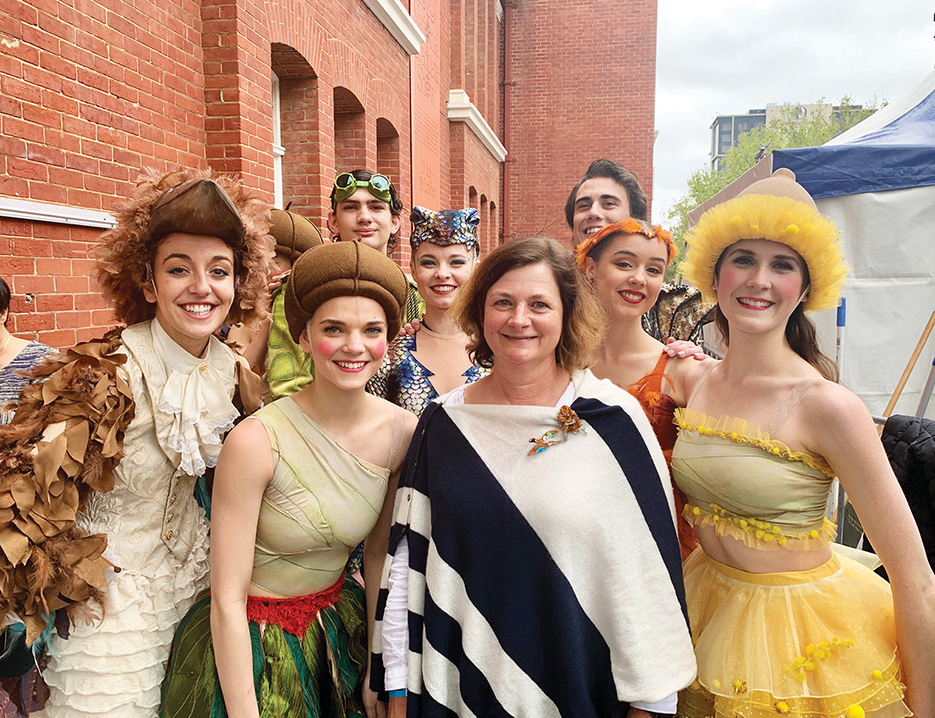
    The State Library of WA exhibition is part of the Awesome Arts festival for kids, which also features a ballet based on The Adventures of Snugglepot and Cuddlepie being performed by WA Ballet at the Perth Cultural Centre (if you’ve got an early copy of the paper it’s at 11am until Friday October 2 and includes an after-show workshop).

    That got rave reviews from Ms Gibbs: “The ballet was delightful. Authentic stories, lively music and dynamic dancers, and the costumes were fantastic,” she said.

    by STEVE GRANT

  • Council slammed for lunch with developer

    STIRLING mayor Mark Irwin is under fire from residents after he and the city’s two most senior public servants shared a luncheon with the developers behind the controversial Karrinyup West project.

    Mr Irwin, CEO Stuart Jardine and planning director Stevan Rodic were invited to share a front-row table at a Property Council of WA lunch on August 28 with representatives from AMP Capital – with WA premier Mark McGowan the keynote speaker. 

    AMP has a development application before Stirling for three high-density towers on the site of the Karrinyup shopping centre, which has been met with furious opposition from locals who have already collected more than 700 signatures on a petition calling for it to be scaled down.

    Former Stirling councillor and long-term property council member Paul Collins called out the city’s hierarchy at the council’s September 8 meeting, saying it was inappropriate to have accepted the invitation. 

    “Why anyone from local government would want to be on a developer’s table at a property council function is beyond belief,” he later told the Voice.

    “It’s even worse when that developer has lodged probably the largest, most expensive development application in Stirling this year.

    “It’s a perceived conflict of interest that could lead to actual conflicts; it brings into question impartiality and the ease of access which developers have in getting to the three most senior people at the City of Stirling.”

    But Mr Irwin defended the luncheon gathering, telling the chamber “maintaining relationships with developers is one of the important ways the city ensures … the economic benefit of development”.

    He said the participants had paid for their own tickets and denied it would compromise the city’s decision-making.

    But WA Party founder and local government expert Julie Matheson said under Stirling’s code of conduct, the trio should have knocked back the invitation from AMP. 

    “It’s very important that all councillors, elected members of a local government and planners do not attend events with developers, because there is a perception of favouritism and bias,” Ms Matheson told the Voice.

    “It just appears like it’s a club – an impenetrable club that residents and ratepayers can’t penetrate.”

    Ms Matheson described the mayor’s response at the council meeting as “dismissive” and said there was no evidence that maintaining relationships with developers was advantageous to electors. 

    “The mayor and the councillors are making a decision on a development application which affects the electors of their district. Under section 2.10 of the [local government] act the role of the councillors and the mayor is to represent the electors – not the state government or AMP Capital’s financial interests,” she said. 

    Conflict

    Former political journalist Peter Kennedy, now an adjunct professor at Notre Dame university, warned that councillors needed to be careful when dealing with developers to ensure there was no suggestions of a conflict of interest. 

    “The perception is important – everything must be done by the book. That’s why ratepayers are concerned. The perception of meetings and social gatherings does raise doubts in ratepayers’ minds and that’s understandable. 

    “It’s obviously a very sensitive issue – things like that do understandably cause concern. The whole process must be transparent. Everyone must know what’s going on,” Prof Kennedy said.

    The Voice sent Mr Irwin a comprehensive list of questions, but he refused to put his name to the answers; instead the council’s senior coordinator of communications Caitlin Tiller sent the paper a response directing us to attribute the comments to a “spokesperson”.

    “Attendance at the lunch did not compromise the city’s impartiality,” the response said, noting the lunch was pre-approved under the city’s events policy. 

    “The city has a reputation for maintaining the highest level of integrity… there is no evidence that the city’s impartiality has been compromised and it is inappropriate to suggest otherwise.”

    During the September council meeting, Mr Irwin pointed out that when staff or councillors met developers at the city’s headquarters, a probity officer attended, but when the Voice asked why a chatty meeting over drinks and canapes should be treated differently, the council responded: “A probity officer is required when meeting to discuss a specific application.”

    Mr Irwin also revealed that being at the front table earned him a chance to catch the premier’s ear, which resulted in a meeting the following day.

    The Voice asked the premier whether it was appropriate for developers to be acting as intermediaries in order for mayors to speak with him and how the opponents of the Karrinyup West development would feel hearing him describe their ilk as “naysayers and critics” while the mayor was sharing a drink with the developer directly in front of him.

    But his senior media advisor Lannie Le-Patterson batted off our questions: “These questions are better placed for the City of Stirling and the mayor,” Ms Le-Patterson said. 

    by ASTRID DAINTON

  • Harley: CBD exodus killing small business
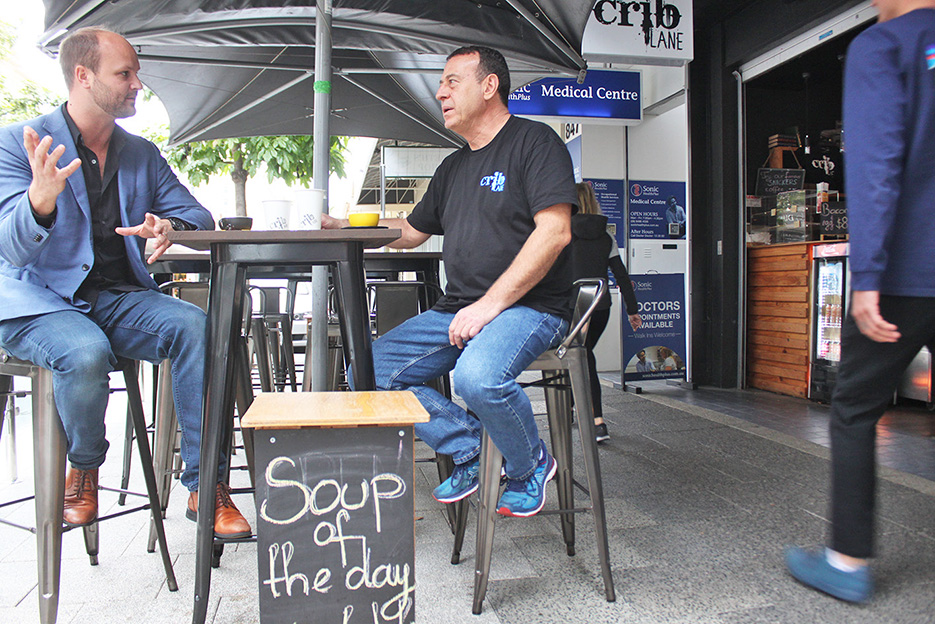
    • Reece Harley and Crib Lane cafe owner Michael Ivanoff back in June.

    A FORMER City of Perth councillor has implored the McGowan government to stop pulling public servants out of the CBD.

    Reece Harley was a councillor from 2012 to 2020, and now back on the campaign trail says a common call from city traders is the need for office workers to help them stay afloat. 

    Covid-19 hit them hard, but even before that the city’s retailers and hospitality businesses were feeling empty nest syndrome. 

    Crib Lane cafe owner Michael Ivanoff says “they’re killing us at the moment with these exoduses.

    “The more departments that leave, it keeps on affecting us.”

    From state government moves to work-from-home policies to the mining bust’s effect on corporate numbers, he says “every time something happens, the city gets hit the hardest”.

    This month in parliament Greens upper house MP Alison Xamon quizzed the McGowan government on the number of office workers who’d been shipped out of the CBD in recent years.

    Labor’s Sue Ellery responded that the number of full time-equivalent public servants in the CBD has dropped from about 17,000 in 2013 to about 15,000 as of March this year, largely as a result of the previous Barnett government’s decentralisation agenda. But those numbers don’t account for the latest relocations with hundreds more moving to Fremantle’s Kings Square in recent months. 

    Workers spend about $11,000 a year on city businesses, so it’s a big dent in a struggling economy.

    “City traders have been really hurting in recent years with thousands of public servants moving out of the city due to the previous state government’s public sector policy,” Mr Harley said.

    “Given the impact of Covid-19 it’s essential that the McGowan government halts any plans that bureaucrats might have to move their departments out of the city.

    “Our city is going through an office vacancy and retail crisis right now. The state government can play a fundamental role in supporting the city’s office accommodation market, and protect the livelihoods of the thousands of small business owners that rely on office-worker trade.”

    In August Mr Harley wrote to finance minister Ben Wyatt calling on a halt to any further movements, noting talk amongst city traders was that another department was contemplating a move mid-next year. 

    He urged them to pause any more moves until they could assess the full impact of Covid-19 on office vacancies.

    He got a response via the finance department. It doesn’t veto further moves, but it says they’re aware of the economic challenges and “there is currently no locational imperative to decentralise government agencies from the City of Perth with no major decentralisations in progress”. 

    Mr Harley says “the department’s response doesn’t fill me with confidence. City traders need a direct and unequivocal commitment from the state government to support the city and halt the exodus of public servants to the suburbs”. 

    by DAVID BELL

  • Shadow over light trail
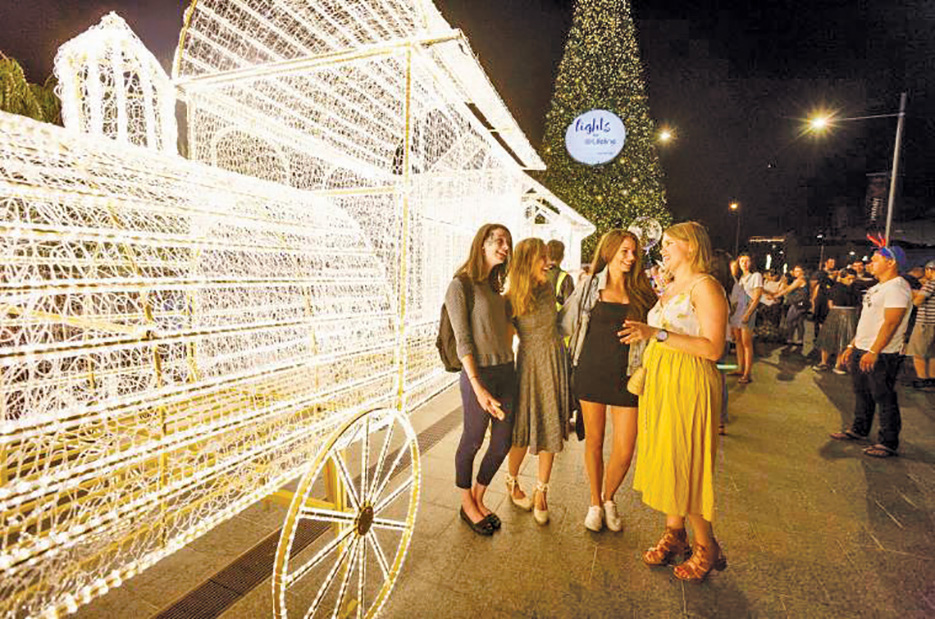
    The 2019 trail. Photo by Jessica Wyld for the City of Perth

    PERTH council’s Christmas Lights Trail may go a little more commercial this year with a plan afoot to let city retailers make a funding “contribution” to ensure the trail winds past their shop. 

    Perth commissioners held off endorsing the council staff’s plan to rejig the path this week, concerned that who’s paying to get a taste of the trail was being kept a secret. 

    A council report says staff have negotiated about $247,500 of Christmas cash contributions from “various stakeholders including major retail centres”.

    Cash

    The cash was “in exchange for a lighting installation near or within” the funder’s spot. It added on to $1 million council funding already committed and was intended to extend the trail rather than nick bits from elsewhere.

    When the plan to vary the path came up for the first round of discussion at last week’s council briefing, commissioners weren’t told who was paying in.

    Cmmr Len Kosova wasn’t comfortable.

    “It’s just a little bit too ambiguous for my liking … I’d like to know how much from whom, because there may even be conflicts of interest that need to be addressed there,” he said.

    At this week’s council meeting they were due to vote on the trail variation, and were provided a partial list that was kept confidential from the public. 

    Council staffer Tabitha McMullan explained the reason behind the list being kept secret: “We felt that, for these organisations, they usually like to have a say in the marketing and release of when their participation in the Christmas Lights Trail is announced. We felt to put that up in a council agenda… would rob them of that opportunity.”

    Confidential

    Commissioners felt that wasn’t a valid reason for it to be confidential. There was some uncertainty over whether the donors were offered confidentiality during the negotiations, so commissioners deferred the item until that could be cleared up and a list of donors could be made public.

    Chair commissioner Andrew Hammond said: “If an entity donates or enters into an agreement with council, then the community and the council has a right to know who that entity is, because in terms of ethical considerations there may well be some companies and entities that the city should not enter into partnerships with or receive money from… if there is an organisation that is unwilling to have the name of their entity disclosed, then I’d ask the question, why?”

    It was the commissioners’ last ordinary council meeting, so it’ll be up to the new council elected in October to vote on the path variation.

    by DAVID BELL

  • Residents question Karrinyup consultation

    RESIDENTS opposed to the Karrinyup West development say it was inappropriate for Stirling council to do the “bare minimum” consultation for a project with such a huge impact.

    AMP Capital has proposed three “high-end” residential towers as part of the shopping centre’s $800 million redevelopment, with 270 new apartments and a number of commercial tenancies.

    Karrinyup Community Group member Samara Kemp, who’s helped organise a 700-strong petition against the development, said the council only dropped letters to residents living up to 200 metres from the development.

    She says it’s only her group’s efforts that have alerted other residents to what’s planned; and she reckons they’re not happy and starting to get feisty.

    “You could tell they were hoping they wouldn’t get much of a response negatively so they could put in the report ‘people of Karrinyup haven’t replied so they don’t care’… but we do care; we’ve cared enough to make everyone aware of it.”

    AMP’s three towers would be 9, 15 and 24 storeys, which Ms Kemp says will have major impacts on surrounding streets.

    “It they are going to go above the eight-storey limit it’s going to impact so negatively, not just on me personally.

    “My main issue will be parking – all the tradespeople abandon their cars on my street and walk to the shops. They’re not cars, they’re utes and vans, and they just park them willy-nilly on the bend of the road. They double-park along there – you can hardly get the car up.”

    Ms Kemp says she and other residents aren’t against some development at the shopping centre, saying they’ll benefit from the additional facilities, but says AMP was given a generous eight-storey approval by the JDAP in 2013 and she can’t see how that’s suddenly jumped to 24.

    by STEVE GRANT and ASTRID DAINTON

  • City of Perth elections: The halfway mark

    WITH the yard-long ballot papers out and two weeks to go til polls close, we asked the lord mayoral candidates to reflect on the campaign so far, tell us what the voters are saying, or let us know about an issue that hasn’t had the limelight it deserves:

    Tim Schwass: As a first time campaigner I have been pleasantly surprised at how polite and supportive people are when I knock on their door.
    The online trolls I was warned about and was expecting.
    What I was not expecting was the over 1000 abusive and obscene posts on my Facebook as a result of Patrick Gorman responding on his facebook to a headline in the West Australian “Lock up Perth’s homeless” and an accompanying sinister looking photo of me. The article by Josh Zimmerman on 17/09/20 was accurate and fair. The headline was not.
    What my website says, the article says and I have said a number of times publicly is that I would be advocating for local laws against camping on the streets of Perth. The article uses the words “rough sleepers” which are not my words but I do not take issue with that. Before the law could be enforced people must be offered acceptable accommodation. The few, if any, that unreasonably refuse assistance would be taken by the police to court where the magistrates would apply restorative justice as they do in the drug court and the mental health court. There has to a way of enforcing any local law. No suggestion of people going to jail for being homeless. The local laws would help those that cannot help themselves but who fall short of the provisions of the Mental Health Act.
    The silver lining in this rather dark cloud was the misinformed abuse confirms the ground swell of support for the homeless. Happy to take a bullet for the homeless and my resolve to end homelessness in Perth has only increased.

    Mark Gibson: The election of Perth’s lord mayor is unique – a small city council with a few thousand voters, attracting big interest from across the metro area.
    For all the grand plans and bold ideas, sometimes the biggest issues are actually the smallest. Like restoring trust and integrity to the council.
    The toxic division of the previous council is one of the reasons I decided to run. As a long-term city resident with no links to business or politics and no campaign donors, I believe that I’m well placed to lead a properly functioning council, full of independent voices and free of conflict.
    I also believe that my plans for Perth will help bring the city I love back to life.
    As well as supporting businesses with faster approvals and encouraging shoppers with free short-term parking, I’m proposing blocking some streets to cars on weekend evenings.
    Imagine pedestrians and families taking back the streets, providing free entertainment, improving lighting and therefore safety.
    Only a resident truly knows what a city council needs. I will improve amenities and recreational facilities and make life easier for pedestrians, cyclists and scooter users with better footpaths and cycle ways.
    After four months on the campaign trail, the consensus is that Perth needs to be cleaner, greener, safer and more vibrant.
    It’s hard to argue with that but, if elected, I will ensure that the council’s main focus is always the residents and ratepayers. After all, they pay the rates which fund almost everything we do. 

    Bruce Reynolds:
    So why did I stand up to be counted – as I watched the election campaign unfold, some seemingly funded by deep pockets, I felt it was shaping up to be a power struggle, with the only options open to voters the “powers that be” to the left or those to the right (metaphoric options, not political leanings).
    I believe in balance to an ecology – and in a marine metaphor you do need sharks all the way through to plankton in the water, but too much of either creates problems in balance. I felt that the ordinary people, like you and I, could be the ones left out in the delivery.
    So, being a typical West Aussie boy, I felt compelled to step in, to be a voice for the people from all walks of life, who live, work, visit and run businesses in the City of Perth. To be a voice, a proxy for the entire community that makes up our great city.
    I see the role of Mayor as an opportunity to keep serving the city and the community that I love. If elected Mayor, while I will commit $50,000 of my annual allowances to set up a youth board, with a pay-it-forward culture and programs that connect the future leaders of our city to the community and the community to us. More than that I have lots of other great wonderful ideas and strategies but first we need to get to work and support those incredible hard-working staff and admin in the council and get all that backlog done with commonsense, energy and efficiency.
    I’m not here for a title or the limelight. If I’m not elected Mayor, I have nominated to serve as a councillor. To use the 24 years of multiple business experience and 20 years of community not-for-profit experience to use.
    Now, more than ever, we need a steady hand at the wheel for the many challenging times ahead. We need real compassion, teamwork, strategy and above all, we need to show people through action that we care.

    Basil Zempilas: How can it be that a modern city with an increasing family population does not have a primary school? We need a primary school in our city and the people of East Perth in particular have told me that’s what they want. Let’s cater for our children’s education needs in our wonderful city environment. I will champion their cause.
    The closest primary schools for the growing East Perth (or City of Perth) population is either Highgate Primary School, or Victoria Park Primary School, across the Causeway.
    Both of these Primary Schools are not only several kilometres away from East Perth residents, but are not readily and safely accessible for children who might want to walk or cycle to school.
    East Perth has a steadily increasing population over the past 20 years and one where many young families are moving to enjoy a vibrant inner-city lifestyle.
    If we want to encourage families to move into the inner city and embrace all the amenities that great cities offer, the we need to provide parents with essential services, and there is no more essential service than a primary school.
    Historically, East Perth used to have a primary school but that was closed when the nature of the suburb changed and there was a substantial growth in industry in the area (it used to be on Wittenoom Street).
    The urban revitalisation of East Perth this century has seen in an influx of families and if we want to keep encouraging families to make the City of Perth their home, then we need a primary school. That’s what families are telling me.

    Sandy Anghie:
    Most candidates are aligned on issues of homelessness, safety and vibrancy. What hasn’t been addressed is their experience.
    Electors need to look behind personalities and political catchphrases to the character and substance of candidates – to ensure they choose the right person for Perth’s lord mayor.
    Conflicts and favours – disclosed or undisclosed – can’t be tolerated. Financial interests in key decisions can’t be a distraction for the new council. You can’t want this job just for the title.
    The City of Perth is a large organisation dealing with complex issues, managing a significant budget, and dealing with multiple stakeholders. Strong leadership and solid governance is critical to regain the Perth community’s trust and respect.
    The lord mayor needs a proven track record in governance and finance, and proven ability to work with the community and stakeholders.
    I’m truly independent – my husband and I have no property dealings in the city; I have self-funded my campaign and not taken donations; my campaign is based on hands-on experience working in the city, not political advice; and I’m not part of a ticket.
    I have proven experience for the role – being a qualified lawyer, accountant and architect, having worked in large organisations and run my own business over 25 years. I’ve dedicated the past four years to revitalising Perth’s east end through the Historic Heart project, and have served on not-for-profit boards for a decade.
    I am the one with the right skills, experience and demonstrated leadership to be Perth’s next Lord Mayor.

  • Commissioner farewells

    CITY of Perth commissioners wrapped up their final council meeting this week.

    Chair commissioner Andrew Hammond said back in March 2018 “the organisation was in a meltdown. It was under siege, and it’s fair to say it required huge interventions in a range of areas… we had the inquiry hanging over the heads of staff, and of course that took a whole lot longer than we thought. 

    “We were first appointed for a period of 12 months, and we find now it’s been close to two and a half years.

    “Over that time though we were able to, I think, introduce the changes that were necessary to bring the city back to a level of proper governance and proper standards.”

    “We aren’t there 100 per cent yet, we still have a way to go, but all organisations can improve, they should improve forever.”

    Mr Hammond thanked commissioner Len Kosova for his insight, humour and attention to detail, and said commissioner Gaye McMath was able to help them “re-engage with a lot of important stakeholders. 

    “Some relationships have been terribly fractured over time for whatever reason, but we did make a commitment that we weren’t going to ask questions about why things had happened, other people can ask those questions, we’re about restoring things and fixing things up for the future.”

    In the last days of their reign commissioners had negotiated the outcome of the Perth City Deal with state and federal governments, and Mr Hammond said they were “pretty forthright in certain things we didn’t want in the city deal, and certain things we did want.

    “To have ECU come into Yagan Square is something that is beyond our wildest dreams. That is going to be the catalyst to start that journey to 90,000 people,” the target number commissioners set for the city residential population by 2050, and he implored the the staff and future council to keep that goal in mind.

    by DAVID BELL