• Stylish touches

    ARRIBA, arriba!

    If you like Latin America then you’ll just love the ceramic hand-painted basins imported from Mexico in this Coolbinia home.

    They’re just one of the colourful splashes of individuality that make this four bedroom two bathroom home stand out from the crowd.

    The lounge/dining room is a cracker with beautiful oak parquetry flooring, high ceilings and a relaxing neutral colour scheme.

    The corner wrap-around windows are another unique touch, providing great views of the back garden and bathing the room in natural light.

    Whipping up meals in this house will be a breeze in the sleek, stylish kitchen with Miele appliances, stainless steel benchtops and boiling water on tap.

    There’s even a butler’s pantry and loads of storage space in the modern-looking cupboards and drawers.

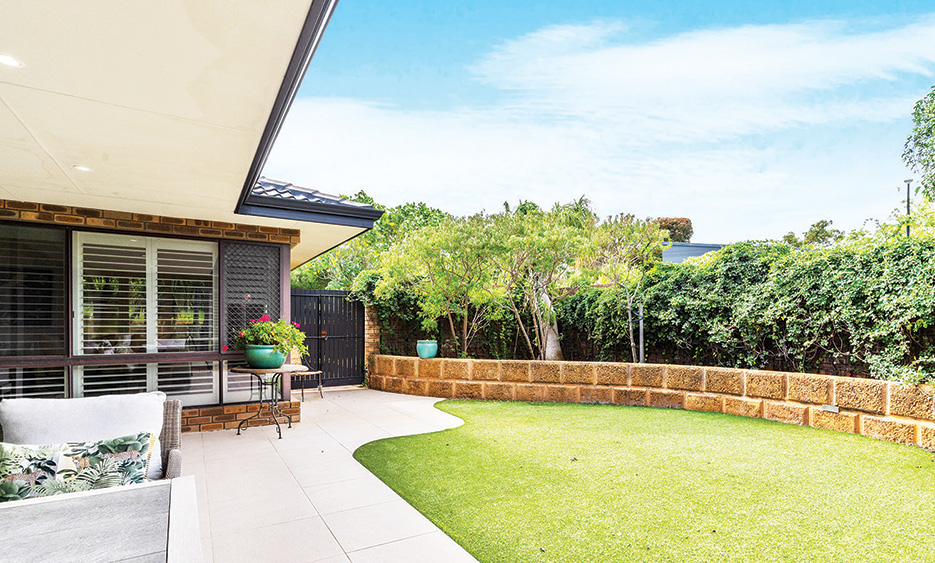
    After dinner head out to the sheltered alfresco, which overlooks a decent patch of grass for kids to play on and pets to roam. 

    The garden is a lovely relaxing spot with leafy shrubs and small trees in raised garden beds, creating a shady oasis. It’s also low maintenance with bore-reticulation.

    If you’ve got young kids then you’ll be glad to know there’s also an elevated cubby house and sandpit out here, so they’ll never get bored.

    There’s also a built-in desk in the family room, making it an ideal spot for older kids to do homework.

    It’s the littles touches of individuality that elevate this house, like the gold-leaf feature walls and the beautiful timber doors and architraves (even the pet door has a nice timber surround).

    All the bedrooms are spacious and well-fitted out with nice finishes, while the modern bathrooms have those Mexican basins, which are sure to be a talking point with guests.

    With a 954sqm block to play with, there’s plenty of scope for modifications and extensions, including putting a pool in the north-facing section.

    The home includes zoned reverse-cycle air con, a security alarm and a spacious double garage, with plenty of room for additional cars in the long, wide driveway.

    Situated on Warralong Crescent, this home is close to the local Coles, several parks and reserves, and it’s a short drive to all the cafes and restaurants on Walcott Street. This is a great family home with lots of unique, stylish touches.

    From $1.695m 
    Home open today (Saturday March 27) 10.30am-11.15am and tomorrow 1pm-1.30pm
    29 Warralong Crescent, Coolbinia
    Bellcourt Property Group 6141 7848
    Jody Missell 0401 770 782

  • Access rights
    Would you still be able to enjoy catch-ups with your grandkids if one of your children got divorced or seperated?

    WHEN a couple seperate or get divorced, there’s often a messy tussle over who gets the kids, but where does that leave grandparents? In this month’s Seniors feature, Catherine Leach from Perth’s Leach Legal explains what access rights grandparents have to their grandkids after a break-up.

    CHILDREN have a right to spend time on a regular basis with, and communicate on a regular basis with, both their parents and other people significant to their care, welfare and development (such as grandparents and relatives). 

    However, grandparents do not have an automatic right to see their grandchild if the parents decide that it isn’t in the child’s best interest. 

    Therefore, grandparents have to apply to the court to spend time with their grandchild. 

    Then, a decision is made based on what the court considers is in the child’s best interests.  

    Grandparents can start these Family Law proceedings at any time; it doesn’t have to be after a legal separation or divorce. 

    However, including grandparents in the organisation of parenting arrangements during divorce proceedings may be useful. 

    In doing so, everyone is aware of their rights to see the child once the divorce is finalised, and no further interaction with the court is needed.

    Definition

    The grandparents of a child may be either biological or non-biological.

    Custody If the children’s parents are unable to provide adequate care, it may be necessary for grandparents to apply for the children to live with them. 

    The court may order that the children live with the grandparents full time or they have shared care with the parents, depending on the child’s needs. 

    The court will make all parenting decisions based on the best interests of the child. 

    Grandparent parental responsibility 

    If the grandparent receives parental responsibility, it means that the grandparents can make long term decisions for their grandchild without consulting the parents. 

    This may include decisions regarding elective medical care, changing the child’s name or moving countries. 

    Grandparent parental responsibility may be given if the children live with the grandparents full time and the parents are not involved with the children.  

    Parenting agreement 

    The parents and grandparents can formalise parenting agreements by apply to the court to have it formalised. 

    This is an especially beneficial step if the child has been living with the grandparents for an extended period. 

    The court will formalise the agreement by making parenting orders by consent. 

    Raising their grandchildren 

    Australia has some excellent programs that assist grandparents who are the primary caregivers for their grandchildren. 

    Grandparents can apply to Centrelink for financial aid, including the Grandparent Child Care Benefit, the Family Tax Benefit or Child Support. 

    If you are a grandparent raising your grandchildren and need some support, please see the Services Australia website to learn about your area’s community support services.  

  • Healing Your Mind

    Learn how to heal through art, music, stories and language

    by Jane Grljusich
    Herald Promotions

    Group therapy. 

    Sound daunting? 

    It’s not really, and its worth any worry.  

    My experience at Wisdom In Your Life’s Healing Your Mind day courses was astonishing. 

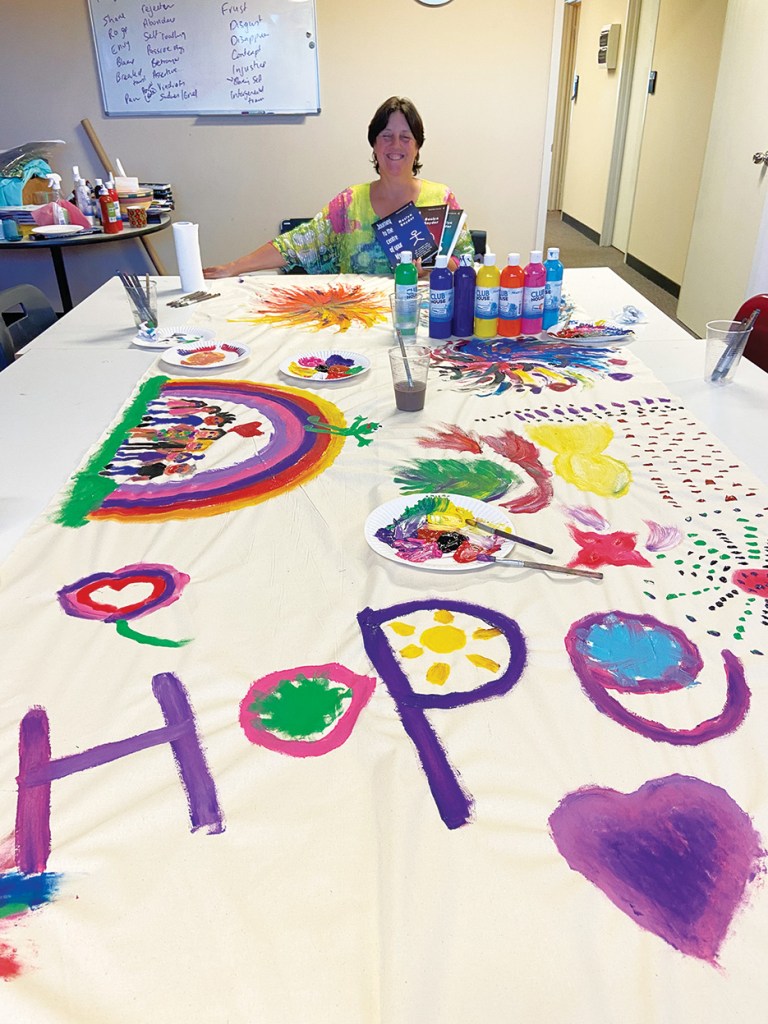
    Coming together with others, including Aboriginal people, to express (only if you choose to) challenges and feelings can be confronting, but Psychologist, Roslyn Snyder, and Aboriginal leader, Shaun Nannup, use their wisdom and strength to ensure it’s a safe and positive experience for everyone, no matter how different we may be or feel, and most of it is expressed through art, music, stories and language.

    It’s absolutely incredible what appears before you on pages as they gently guide you to toward healing and a healthy mind. 

    A lot of “stuff” falls out, kind of like how pennies drop when we hear a song, see a film, or read a book that resonates with us. 

    There are those “oh yeah” moments, and the “oh shit” ones. 

    Sometimes stuff we didn’t even realise was wrong with us oozes out, and if you choose to leave it behind with Roslyn and Shaun, they’ll burn it in a ceremonial fire and release the energy into the ether and away from you. 

    That’s how it works, and it’s the definition of cathartic. 

    WISDOM in Your Life provides simple, visual, inclusive and integrated
    teachings to heal the mind, enhance culture, or smooth the interface
    between two or more cultures; workplace, family, community or specialised

    Courses Available (full dates available at wisdominyourlife.com.au)
    UNIFYING HUMANITY
    Aboriginal storytelling 18 April, or 16 May (two-and-a-half hours from 5.30pm to 8pm)
    Place, Nature, Purpose – 26 May, 9 and 23 June, or 18 August, 1 and 15 September
    HEALING YOUR MIND
    Stage 1 – The Map – 20 & 21 April, 18 & 19 May, 15 & 16 June
    Sated 2 – The Compass – 6 & 7 April, 4 & 5 May, 1 & 2 June
    Stage 3 – Energy Patterns – 14 & 14 April, 11 & 12 May, 8 & 9 June
    EARTH SCHOOL
    Online – anytime

    CASE STUDY

    GOOD AND BAD – About two thirds of the young people in detention expressed this ‘split’ between good and bad that they cannot control.
    Psychologically, this occurs in people who have experienced life threatening trauma while the mind is still developing (i.e. before 25). According to Nijeus et al. the mind dissociates ‘splits’ to cope with what is happening. Different parts of the mind are affected depending on the stage of development. This requires specialised treatment. Given the level of DV and abuse in this group, this is not unexpected. No amount of anger/stress management, mindfulness or CBT will fix this. 

    My life. All good, me with my family, then my mother died, my brother was murdered and my best friend killed and died in my arms. Then everything was bad.
    Notice the trees are small, and the young
    person has blood on their hands.

    Stage 1. Good and bad, I feel like I am two people.
    Stage 2. I had to ask him to paint his spirit child I tried to make it lighterbut it kept going black!

    As this young person was struggling to paint their spirit child, I suggested imagining what it was like as they couldn’t see it. No words.
    Stage 2 later in the afternoon This is who I really am
    I explained that often when we have a split between good and bad, we need to join these two parts together. This young person did many more paintings trying to join the good and bad together and couldn’t do it, these all went in the bin.

    The two sides of me joined.

    WISDOM IN YOUR LIFE
    Goolugatup Heathcote, Applecross (Heathcote Cultural Precinct)
    Phone 9499 4053
    Email info@wisdominyourlife.com.au
    wisdominyourlife.com.au

  • Call for massacre memorial

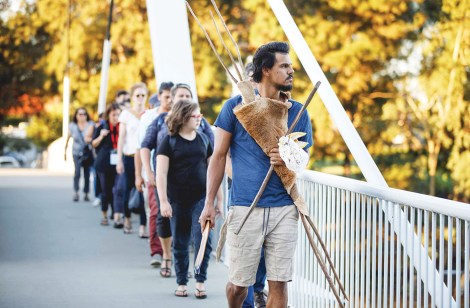
    • Writer and performer Ian Wilkes leads his audience around Lake Monger, site of the first major conflict between traditional owners and colonialists. Photo by Dan Grant

    FOLLOWING a sell-out Perth Festival oral history performance exploring a massacre of Whadjuk Noongars at Galup (Lake Monger), elders are calling for a memorial at the site and the story to be told in schools.

    Galup, the Noongar name for the area and the title of the performance, explored the story of a disputed massacre as it was passed down through generations of local indigenous people.

    “I’d heard there was a massacre there that got swept under the rug,” writer and performer Ian Wilkes said last year as Galup was being prepared. “When we were driving past on the freeway there, dad would point out at the lake and say ‘remember there was a massacre at that lake, boys’.”

    Mr Wilkes teamed up with writer, director and producer Poppy van Oorde-Grainger, and they searched archives and sought out the stories of ‘Birdiya’, the elders.

    They were pointed to Doolann Leisha Eatts, who’d been waiting most of her life to tell the story.

    “It’s a dream of mine, [for] 71 years… I wanted my story told, wanted it put out,” she said.

    “My grandmother told me when I was a little girl, many years ago, about Lake Monger, about Gallup.”

    Ms Eatts said after a confrontation nearby, the local people took refuge in Galup. 

    “They were shooting them and shooting them, and a lot of young people ran into the lake”.

    Her grandmother told her “a lot of them died in the lake. 

    “And she thinks some of them got away… she was hoping maybe, that they moved from Lake Monger.”

    Seven deaths

    A London journal published seven months after the event, quoting “Indian newspapers”, puts the date as May 1830, and the perpetrators led by Major Frederick Irwin. Irwin, later made acting governor of WA, claimed there was no one killed, but the journal numbers seven deaths. 

    Mr Wilkes ended every performance during the Perth Festival telling the audience “just because something bad happened here doesn’t make it a bad place”.

    Galup was a significant site for ages before the colonists came. It was a meeting site, and a resting place for the Wagyl. Even after the arrival, there were happy times there: It was the site of an early spearthrowing contest between Whadjuk man Yagan and an Aboriginal man from Albany, Gyallipert, brought up on a colonial ship. The two couldn’t speak each others’ languages, but were fast friends and competitors (Yagan won the contest, hitting the target of a narrow walking stick at about 25 paces). The lakeside was also the first place a Yonga, a kangaroo dance, was done while accompanied by piano.

    With the festival over, the four Noongar Birdiya consultants – Ms Eatts, Liz Hayden, Darryl Kickett and Ted Wilkes – want to see a lasting impact, and want the public to understand how the violence of settler colonisation still affects Australia.

    Galup’s team are now seeking to embed the history in the curriculum in local schools, they’re advocating for a memorial at the lake, and later this year the performance will be adapted for virtual reality.

    Ted Wilkes, father of Ian, said last year in the planning stages: “If this is the way of the future, and getting information out to people, I want to be a part of it.”

    Ms Eatts is glad the story will live on. “We’ve got a lot of lovely young people who are strong, coming out, and I’m so proud to see them. 

    “They’re getting strong in our culture, they want to know our language and our culture. 

    “That’s a good thing, because we’ve got to keep it going,” Ms Eatts said.

    by DAVID BELL

  • Next cab off the rank

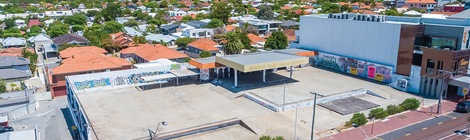
    The long-empty site. Photo supplied by Burgess Rawson

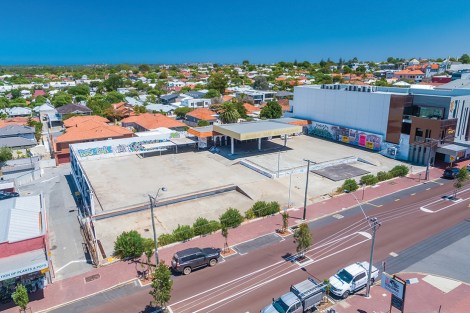
    DERELICT for years, the old Midway Taxi rank site at 387 Oxford Street has sold for $9.1 million.

    It was off the market for 35 years, owned by the Midway Taxi Management since 1985, and vacant for most of the past decade. 

    The site is currently only used by an occasional group of skaters for moody urban photoshoots, and is likely to be developed in the near future, being marketed as “an outstanding development site” in one of Vincent council’s district centre zonings.

    Development

    We don’t know yet who the new owner is, aside from them being an international investor with a history in the Perth property market. 

    Sold by Burgess Rawson, the company said it had received 50 enquiries which led to multiple offers for the property.

    Burgess manager Luke Randazzo says: “This is one of the last significant underdeveloped sites on the strip of this size and represents an important piece of the history of Oxford Street.”

    Burgess Rawson director Chris Tonich commented: “The future development of the site will greatly assist with the activation of the Scarborough Beach Road/Oxford Street Entertainment Precinct which has become one of the busiest and most vibrant high streets in Perth.”

  • Last pick-up

    ONE final bulk rubbish verge collection is scheduled in Vincent during July.

    Both treasured and reviled, the yearly tradition of a month-long scavenger hunt is being phased out after too many complaints about people dumping garbage weeks before pickup time, poorly behaved trash-pickers, and out-of-towners swinging by to add their non-Vincent garbage to local piles.

    Another problem was people dumping at the wrong time of year; around West Perth, the recent green waste collection tricked some into assuming the branches on the verge meant it was time to throw out a fridge or other broken furniture.

    After July’s final trash hurrah, the council will go to the on-demand “Verge Valet” system for an 18-month trial.

    From January 2022, residents can order an on-call garbage collection: No skip, just a pile on the verge for no more than three days before collection.

    The move is counter to the community consultation results which asked residents which system they liked: 52 per cent preferred a scheduled yearly pickup, 42 per cent wanted on-request, and 8 per cent were undecided.

    Despite the results, Vincent staff recommended the on-demand system to address the illegal dumping and public amenity complaints. 

    Councillors are due to endorse the new regime it at the next meeting. 

    It’s free for residents but slightly pricier for the council, expected to cost $245,000 per year compared to bulk collection’s $230,000. 

    At this week’s Vincent council briefing, mayor Emma Cole asked staff to ensure the 18-month trial didn’t lead to de facto adoption without a decision going back to council.

    “We don’t want to be caught out, like the Beaufort Street and Walcott Street intersection, where we forgot there was a trial,” Ms Cole said.

    by DAVID BELL

  • Brinksmanship

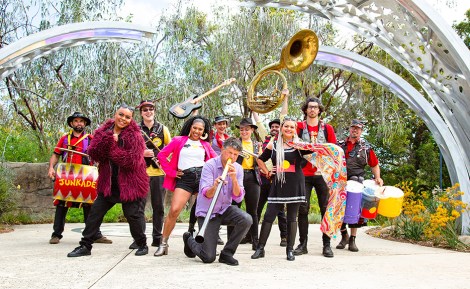
    Richard Walley’s Six Seasons & The Junkadelic Collective.

    Artists do it without ‘dirty’ money

    A NEW arts festival Brink has emerged promising to treat artists fairly and to challenge Fringe World’s acceptance of fossil fuel cash.

    In recent years some artists have been growing increasingly uncomfortable with Fringe’s major sponsor being Woodside, a fossil fuel company that’s also been criticised for its handling of Aboriginal rock art in northern WA. 

    Protests by artists at the 2020 Fringe led organisers to insert a clause in artists’ contracts for 2021 stating they must endeavour “to not do any act or omit to do any act that would prejudice any of Fringe World’s sponsorship arrangements… If you have an objection to a Fringe World sponsor, we ask that you consider whether participation in the festival is the right platform for your presentation.”

    Brink’s Vivienne Glance says tells us concerns had been building that polluters frame themselves as good corporations through sponsorship, giving them social licence to continue polluting.

    And “by giving fossil fuel corporations a licence to operate, [artists] could be seen as endorsing carbon pollution,” Glance says. “It puts artists in a very difficult position.”

    “So Brink came about because we wanted to give artists a Fringe-type arrangement without taking fossil fuel money.

    “It’s part festival, part protest, part activism, and part hope for the future. We would like people to start questioning these relationships.

    “Brink for us is a celebration of artists taking back control, and it’s a celebration of us saying we don’t want to be silenced, we want to work within our values.”

    They’ve been supported by Freo council and the festival is centred around Fremantle, hoping to lure Fringers south of the river for the shows from March 25 to 29.

    The organisers are volunteers and Brink artists handle their own sales, and Brink puts Aboriginal artists front and centre. 

    “We don’t see a lot of First Nations work in Fringe festival really, unless it’s a big company that’s doing it,” Ms Glance says. 

    The flagship show, Richard Walley’s Six Seasons & The Junkadelic Collective, is a presentation of songs for each of the six Noongar seasons. Four Aboriginal lead singers, Tani Walker, Joel Davis, Natasha Eldridge and MC Flewnt, will back the veteran Noongar performer.

    The events are up at brink.org.au

  • Heritage farcade

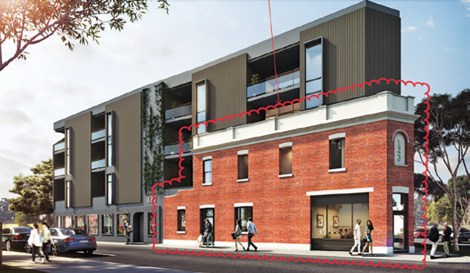
    The second plans submitted to Vincent council. As a penultimate indignity, the doomed facade was designated with red squiggles.

    FOR years before its demolition the old arts union building at 123 Claisebrook Road sat on a draft heritage inventory, passing hands from Perth council to Vincent and neither going through with granting it any permanent heritage protection.

    Built in 1890, for 50 years it was the base of president of the Authorised Newsagents Association of WA, Archibald Russel Somerville.

    He lived upstairs and had a shopfront on the ground floor, and was a gutsy purveyor of news. In 1936 he was one of just four newsagents in the area to stock the “Worker’s Star”, a communist newspaper. The intersecting street, Somerville, is named after him. 

    Assessment

    In the 90s the building was bought by Performing Arts WA and became an arts hub. 

    Perth council realised the building might be special in 1999, adding it to a “draft” heritage inventory. 

    But a full heritage assessment was not carried out by Perth council, nor Vincent who inherited it during a boundary change in 2007. 

    Twenty years later, new owners Sanpoint Pty Ltd said the bricks had turned to powder and nothing could be saved. 

    It’s unknown how much of that deterioration occurred in the 20 years of inaction.

    Performing Arts WA sold the building for $1.16 million in 2016. The area was ripe for development, with news the Barnett government had decided the two nearby concrete batching plants had to go, and the area would soon be more habitable.

    In December 2017, the state government’s development assessment panel, with Vincent council’s backing, approved demolition of most of the building. Twelce apartments would go to the rear, and the facade would be preserved.

    In mid-2019, the owner applied to knock down the lot, furnishing Vincent council with a report from Stewart Urban Planning that said structural investigations had now found that: “Due to the fragile condition of the building and the constrained nature of the site, it will be difficult to protect the retained building during construction, which could be inadvertently damaged or destroyed as a result of vibration from works or an incident with heavy machinery being utilised on-site.”

    Vincent council approved the full demolition unanimously. 

    As concerned locals mourned the demolition on social media in 2020, Vincent mayor Emma Cole assured them the council required the rebuild “to be an exact replica … same materials and exact form is to be built”.

  • Firey fanned a flame

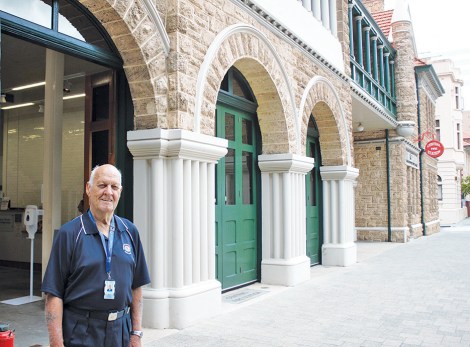
    Ron Harley outside the fire station he saved from demolition.

    VETERAN firefighter Ron Harley has marked 60 years’ of service, first on the front line defending lives and property and then behind the scenes fighting to save the Old Perth Fire Station museum from demolition.

    Mr Harley, 86, left Highgate secondary school at 14 and worked as a milkman, carpenter and whale flenser before joining the brigade in 1961.

    “I decided to make a career of the brigade,” he says, “to become an officer one day.”

    Mr Harley made station officer in 1966. He was a reformer, improving station designs, fixing training standards and compiling the first brigade training manual for firefighters to study. By 1984 he was superintendent of planning and training. 

    From early in his career Mr Harley had an eye for history, and he’s a key reason the DFES Education and Heritage Centre in the Old Perth Fire Station building is still around today.

    As old copper and brass gear was being phased out for modern equipment, he began preserving items.

    “I said ‘we’ve got to save the old stuff for future generations’,” he recalls. His collection grew with brass helmets, heavy coats, and even a rare La France Turn Table Ladder firefighting vehicle he found on a property out in Jarrahdale in 1978. 

    The gear didn’t yet have a permanent home, but in 1983 he got wind of a plan to demolish the recently-shuttered Old Perth Fire Station at 26 Murray Street, built in 1901 and decommissioned in 1979. 

    Unbeknownst to his chiefs, Mr Harley set up a temporary display of his collection in the dormant building. 

    When newly minted premier Brian Burke opened the new station nearby, Mr Harley led him away from official proceedings to give him a tour of the old station and let him know about the top brass’s plans to demolish it.

    “I approached [Mr Burke] and told him of my concerns, and that the station was historic and should become a museum of fire artifacts,” Mr Harley.

    After “15 minutes”, Mr Harley says, the premier was convinced and promised to preserve the gear and building, by turning it into a museum. The Burke government funded a restoration and opened the “Fire Education Centre” in 1985.

    Mr Harley says without Mr Burke, “this wouldn’t be here now, no doubt about it”.

    The restoration was extensive: When the station opened in 1901 it was made to fit three horse-drawn appliances. Bits and pieces were knocked out over the decades to fit ever-larger trucks. Columns, mouldings and original doors were re-fitted, and a limestone arch which had disappeared was reconstructed. 

    Mr Harley says the top brass never forgave him for going over their heads to the premier, and while he suspects it stymied his career he says it was worth it to preserve the building. 

    He retired in 1994, but soon after returned to the Fire Education Centre. Tens of thousands of visitors go through every year, including many school trips, and it was state heritage-listed in 2008.

    Mr Harley’s still there every Thursday, and the history bug runs in the blood: Grandson Reece Harley runs the Museum of Perth in the historic Atlas Building on The Esplanade

  • The Beadle hub

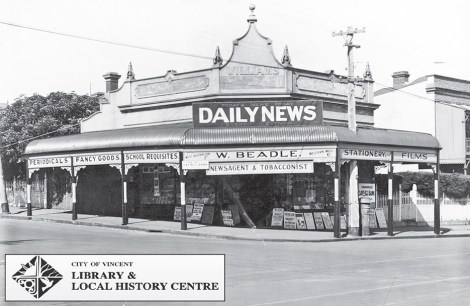
    Beadle’s Newsagency, 450 Newcastle Street, West Perth, c1930 (COV LHC PHO6091)

    FROM Vincent Library’s local history centre archives comes this photograph and information from Julia Robinson-White, great-granddaughter of prominent trader Bill Beadle. It was submitted to the 2020 Local History Awards, with supplemental research by Friends of Local History volunteer Liz Millward.

    NEXT time you’re at the corner of Charles and Newcastle Streets, take a moment to reflect on what was once there.

    From 1909 to 1919, Mrs ST Williams ran a newsagency at 450 Newcastle Street. 

    In 1920 the business was bought by returned serviceman William‚ ‘Bill’ Beadle and his sister Elsie McLeod. 

    In 1922, Bill married Victoria Bowden and the couple subsequently purchased Elsie McLeod’s share in the business which became known as W Beadle Newsagents.

    The Beadle family, which included daughters Dorothy and Jean, lived next door to the newsagency at 448 Newcastle Street. 

    The Beadle’s newsagency didn’t just sell papers – it was a post-office, library, tobacconist, bank, telegraph office and political hub.

    Bill and his mother Jean Beadle were staunch Labor Party supporters who were politically active. 

    Justice of the Peace

    Jean Beadle, who lived around the corner in Carr Street, West Perth, was one of the first Justices of the Peace in Western Australia and founder of Labor Women’s Organisations in Fremantle and the Eastern Goldfields.

    Bill Beadle was a Perth City councillor who ran (unsuccessfully) as a Labor candidate for the seat of West Perth and later Mount Hawthorn. 

    In 1947, Bill and Victoria sold the family business and Bill Beadle died shortly after. 

    In the 1950s, it continued to operate as a newsagency run by the Docwra family. 

    In the 1960s, the shop was demolished and the site became a car yard. 

    In the 1970s, construction of the Mitchell Freeway prompted the widening of Charles Street and the site of the former newsagency became part of Charles Street. 

    From 2000, a garden centre operated on the corner of Newcastle and Charles Streets.

    Vacant since 2014, the site of so much commerce and activity is currently being redeveloped as apartments.

    The day’s routine

    Bill and Victoria’s daughter, Jean, recalled the commitment to business and tremendous work ethic

    “Mum got up at 6am had breakfast which Sue had cooked, opened the shop in time to catch the early morning workers going to catch the train to work, then the local factory workers who started at 7am.

    Each morning, early, the front step and surrounds of the shop had to be washed down and the footpath swept, and the dozen or so boards advertising different publications put out. 

    These boards were like magnets and attracted every dog in the area to lift its leg on one or more.

    There were several tricks used to try and overcome this nuisance – one was pepper sprinkled around the board which made the dog sneeze when sniffed and hopefully the dog then forgot its original urge.

    Another was a ‘throw down’ aimed at the culprit.

    Dad got up about 4am rolled and delivered 400 papers, came home to breakfast about 6.30am, rested for about an hour then returned to the shop to allow mum to come home and see us before we went to school. 

    It was a long day as lunch and tea were taken in shifts, each coming home for a meal then returning to work as the shop closed at 8pm Monday to Friday.

    Saturdays it closed from 1pm-4pm then opened until 9pm. Sundays was almost a holiday with the shop opening later and closing about 11am. There were only two days in the year with no papers – Christmas Day and Good Friday.”